Chapter 3: Ibadan, Osogbo & the Sacred Grove


Through Ibadan: The Ancient City of Brown Roofs
We left Lagos State the following morning and entered Osun State via Oyo, passing through Ibadan — or, more precisely, through the traffic that Ibadan inflicts upon anyone attempting to traverse it. The city is the third largest in Nigeria by population, with over 3.6 million people, and its approach roads carry the full weight of that figure.
Founded in 1829 as a war camp for warriors from Oyo, Ife, and Ijebu, Ibadan evolved from its defensive hilltop origins into what was, by the mid-nineteenth century, the largest city in sub-Saharan Africa. The British arrived in 1893, found a population of 120,000, and proceeded to develop the colony for commercial purposes. The poet J.P. Clark, a Urhobo man from the Niger Delta, rendered Ibadan with characteristic compression: the city as a splash of rust and gold flung among seven hills like broken china in the sun. Seen from the highway in the haze of mid-morning, the brown zinc rooftops extending in every direction gave the image its accuracy.
Ibadan is also home to the University of Ibadan, the first university in Nigeria, founded in 1948 as a college of the University of London. Its academic tradition gave the city an intellectual weight that extended well beyond its size. We did not stop — the traffic alone argued against it — but one noted the city's presence as one notes an old argument: something unresolved, demanding attention it won't be given today.
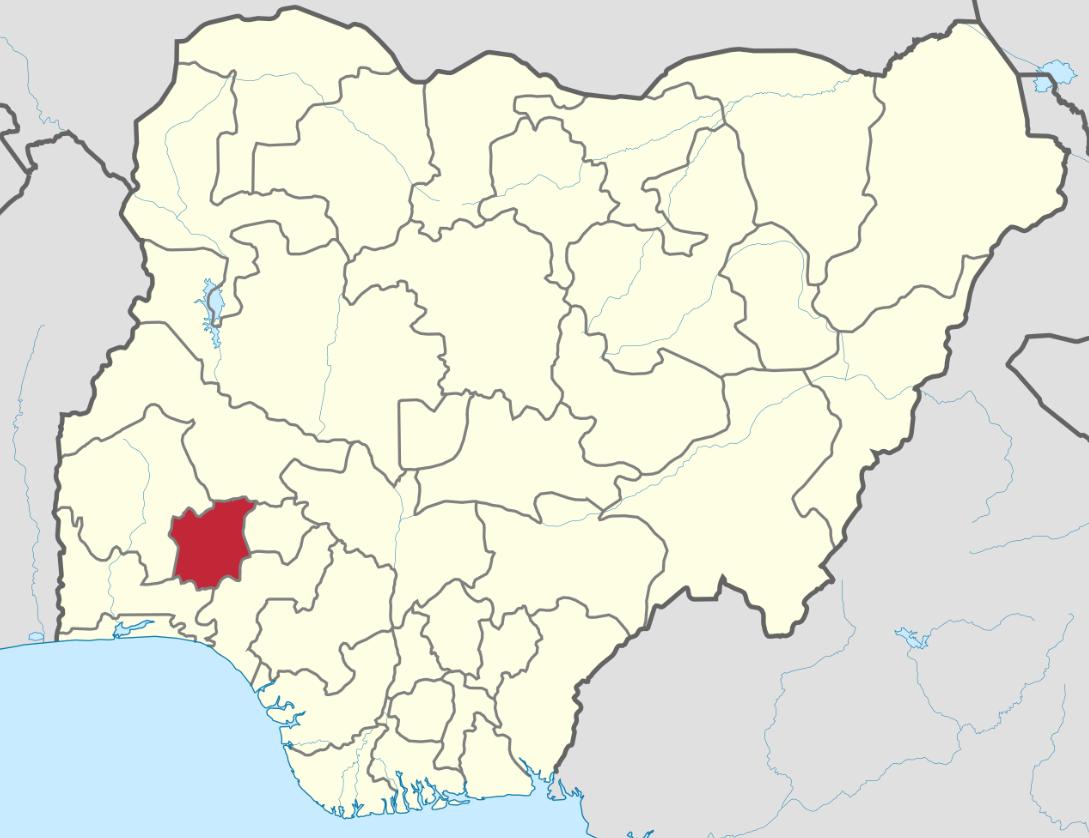
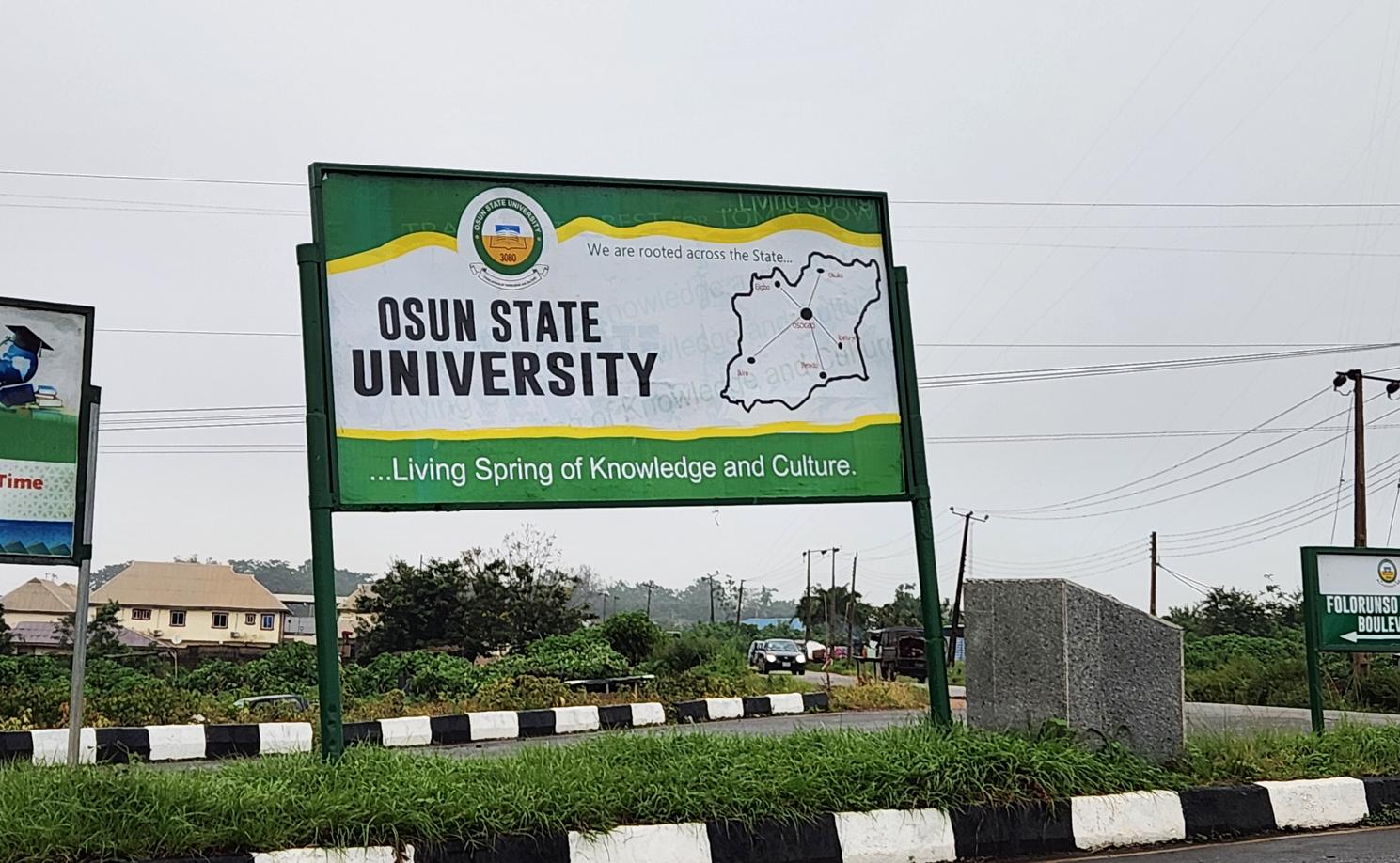
Nigeria's federalism is one of the more baroque constitutional arrangements in the world. At independence in 1960, the country comprised three regions; today there are 36 states, each with its own government, constitution, and flag — and, most revealingly, its own motto. Lagos is the Centre of Excellence. Osun State, whose border we were now crossing, calls itself the Land of the Living Spring. Jigawa, in the far north, is the New World. Zamfara proclaims: Farming is Our Pride. The mottos have the quality of aspirational self-description — what each state wishes it were known for, rather than what it necessarily is. Osun's, at least, has the merit of geographical accuracy.

Osogbo: The State of the Living Spring
Osogbo, capital of Osun State, is a trading city of some 500,000 people that sits at the junction of rail lines running north from Lagos toward Kano. It is known for its weaving, for the Oja Oba market, and for being the venue of the annual Osun-Osogbo Festival, which draws tens of thousands of pilgrims to the sacred grove on the banks of the Osun River. It is also, unexpectedly, a city of art — one whose most significant cultural monuments were created in large part by an Austrian woman who arrived in the 1950s and never left.
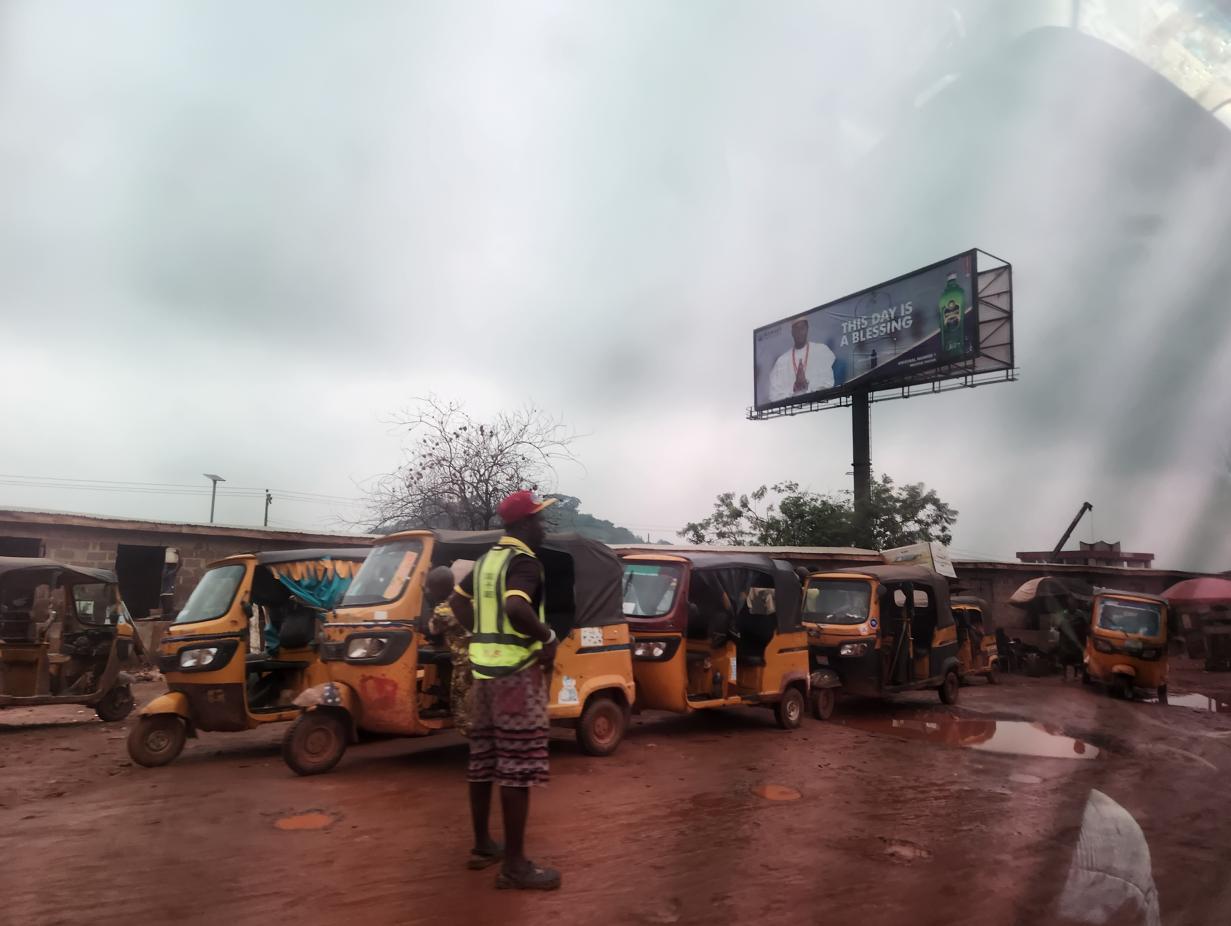
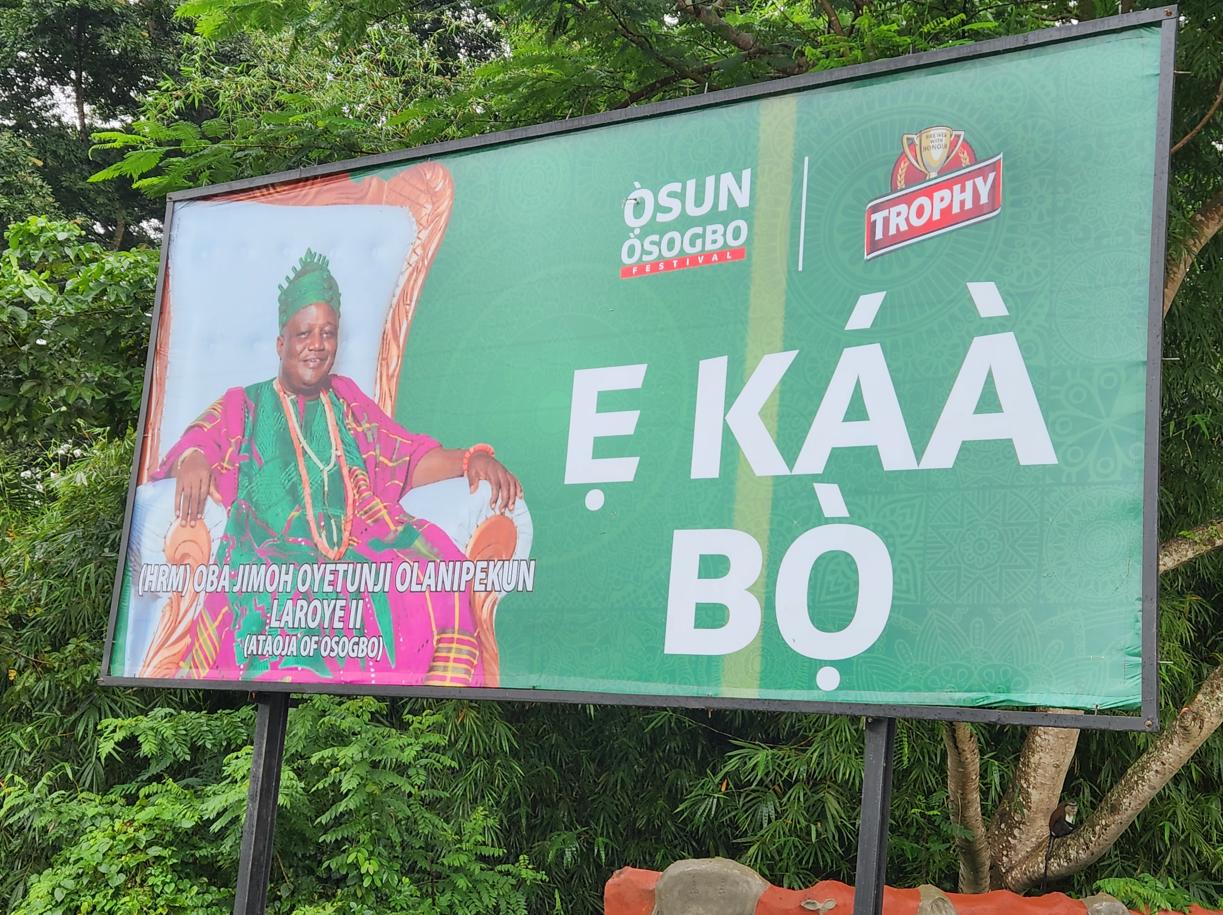
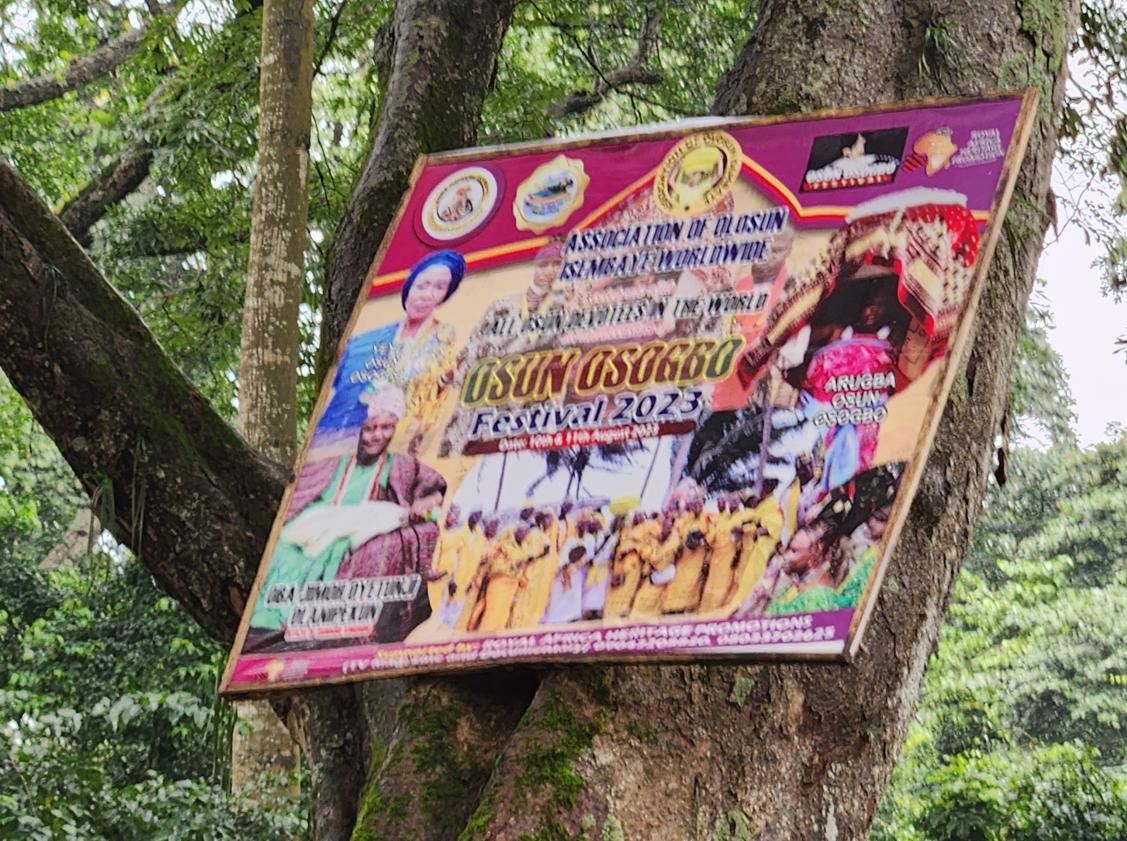
Entering the town, we passed a large roadside billboard. On a green background, a traditional ruler sat in elaborate pink and green regalia: HRM Oba Jimoh Oyetunji Olanipekun Laroye II, the Ataoja of Osogbo. The Ataoja — the title means, literally, the one who stretches out his hand and takes the fish — is the traditional paramount ruler of the Osogbo people. The billboard wished visitors welcome in Yoruba — E Káà Bọot — and was co-sponsored by Trophy lager beer. The sacred and the commercial in unforced adjacency: a distinctly Nigerian arrangement.
The Yoruba are one of the largest ethnic groups in Africa, numbering more than 52 million across Nigeria, Benin, and Togo. They have been an urban people for centuries — long before European contact, Yoruba society organised itself around powerful city-states centred on the residence of the Oba, the king. Archaeological evidence suggests that Òyó-Ilé, the capital of the Oyo Empire, had a population of over 100,000 at its height. Lagos itself, historically a Yoruba city, is today the largest urban agglomeration on the African continent.
Central to Yoruba religious and cultural life is the concept of the Orisha: a vast pantheon of deities and spirits who serve as intermediaries between human beings and the supreme creative force. Ogun is the god of iron, war, and victory — invoked equally by soldiers, blacksmiths, and, in more recent times, taxi drivers. Shango is the god of thunder and lightning, manifesting as a king who wields a double-headed axe. Esu Elegbara is the trickster-messenger, guardian of the crossroads, who speaks all human languages and conveys the wishes of men to the gods. And Ọṣun — Osun — is the river goddess: a deity of love, fertility, and the sweet waters of the river that bears her name. It is to Osun that Osogbo belongs.
The Osun-Osogbo Festival has a recorded history of more than 700 years, though its origins lie in a founding myth that stretches further back. According to that account, a group of migrants led by a hunter called Olutimehin settled on the banks of the Osun River to escape famine. The river goddess appeared from the water and proposed a covenant: she would protect the settlers and ensure their prosperity, if they in return would make an annual sacrifice in her honour. They agreed. The festival that commemorates that agreement — a two-week programme in August that culminates in a procession to the sacred grove, led by the Ataoja and the Arugba, a young woman of royal lineage who carries the sacrifice to the deity in a calabash held above her head — is one of the most significant religious events in Yoruba cultural life. In 2005, UNESCO inscribed the sacred grove on the World Heritage List.
The City Before the Grove
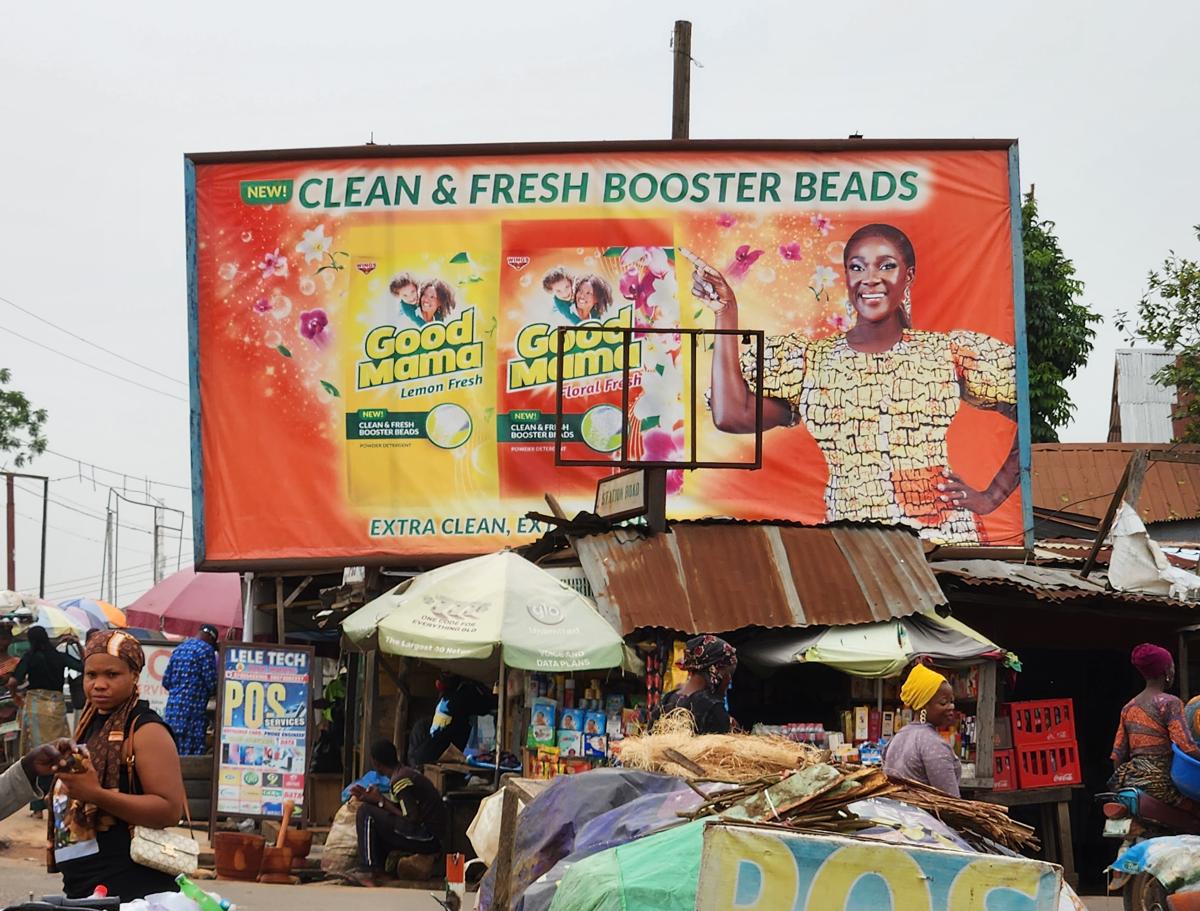
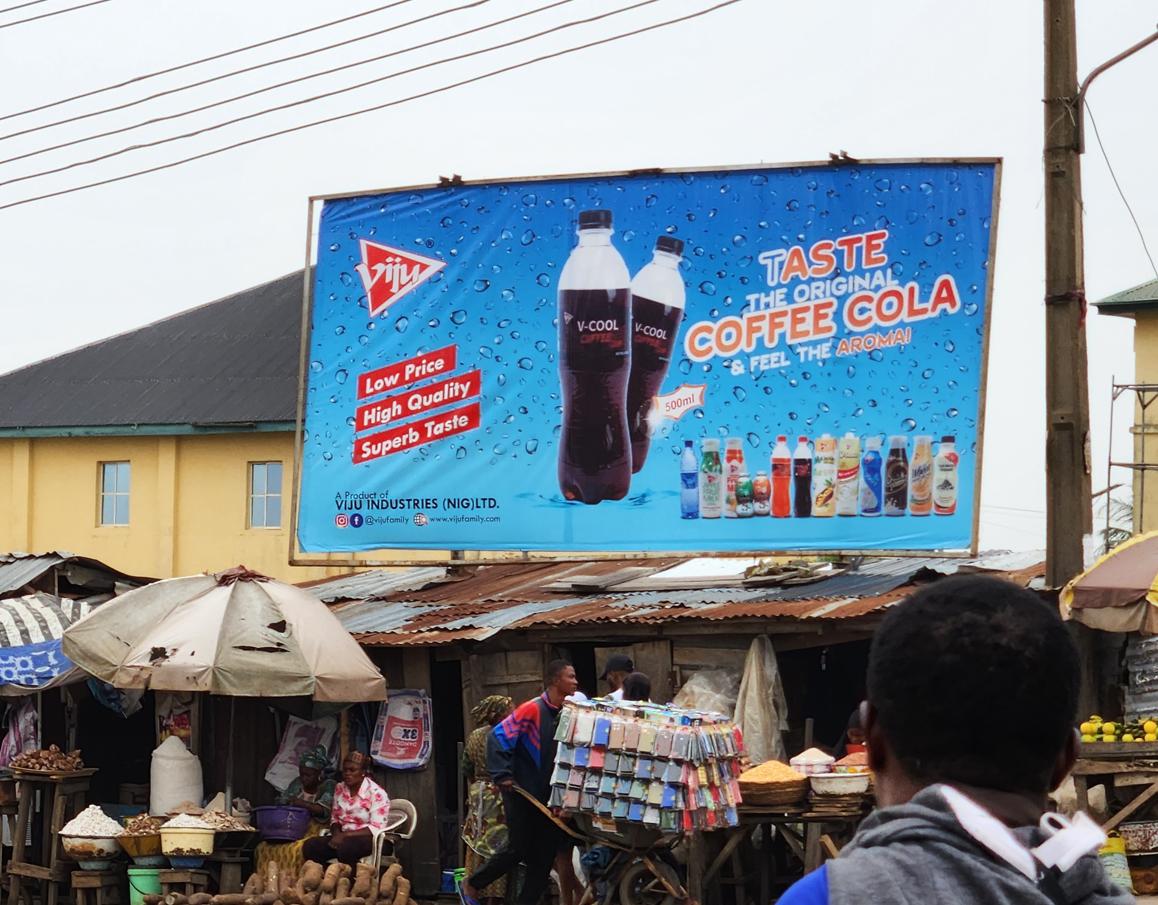
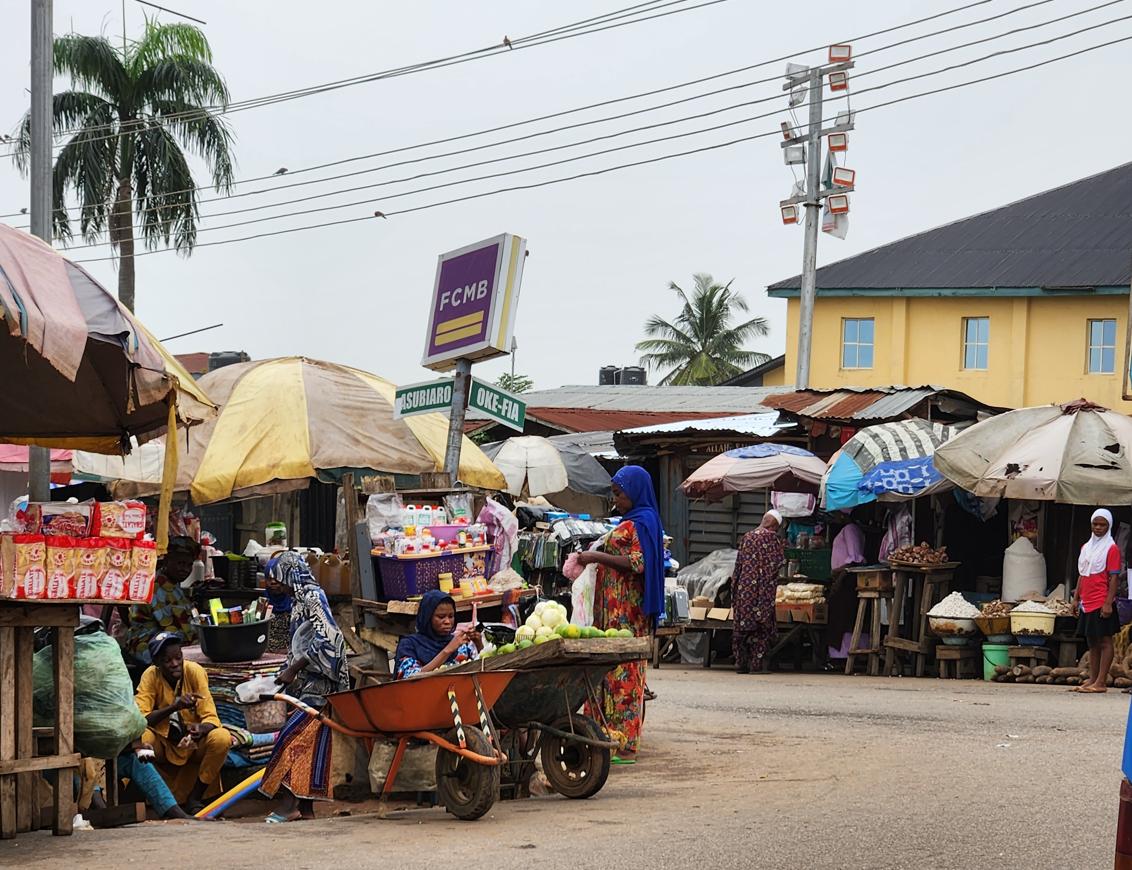
Before the grove, there is the city. Osogbo's streets in the wet season have the texture of all Nigerian provincial cities: the layered signage, the produce laid out on tarpaulins at intersections, the minibuses threading between pedestrians and wheelbarrows. The Osogbo Central Mosque stands on the main street, a substantial grey building with blue domes and green-shuttered arched windows, its entrance sign in both English and Arabic. Market stalls press right up to its forecourt — vegetables, packaged goods, a woman with a wheelbarrow of cabbages passing beneath a billboard advertising Good Mama laundry powder in vivid orange. At the junction of Asubiaro and Oke-Fia, the FCMB bank sign floats above the stalls. Most of the vendors are women in hijabs; Osun State is mixed Muslim and Christian, its urban markets reflecting both.
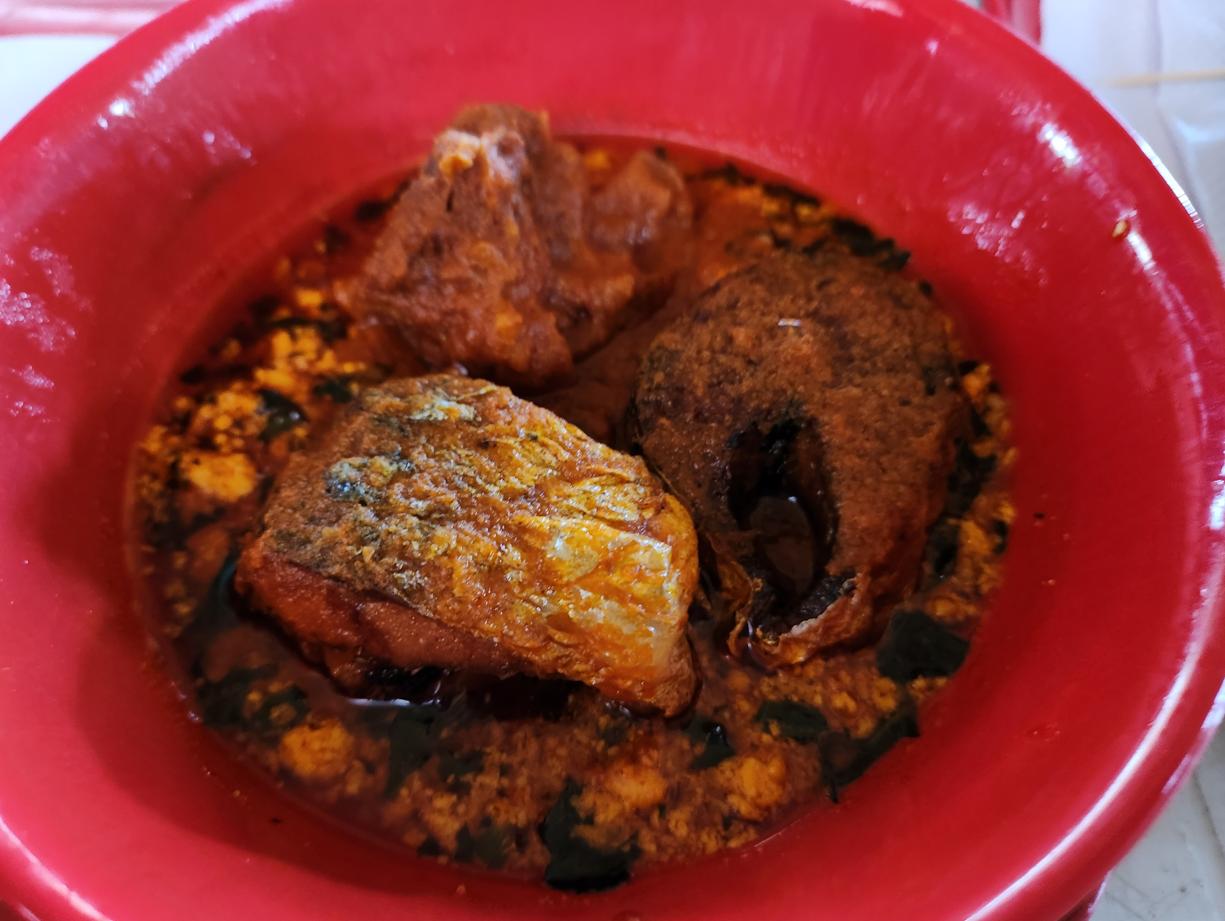
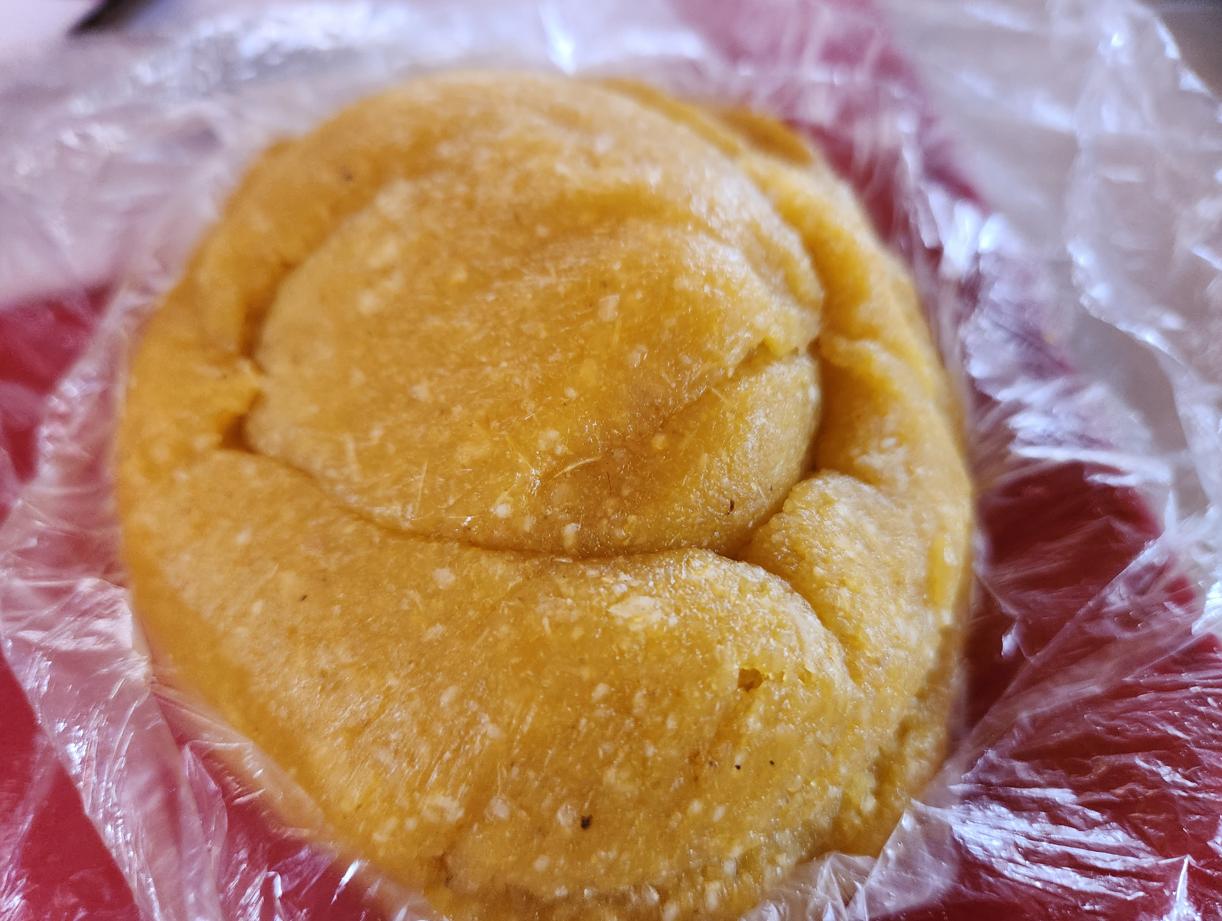
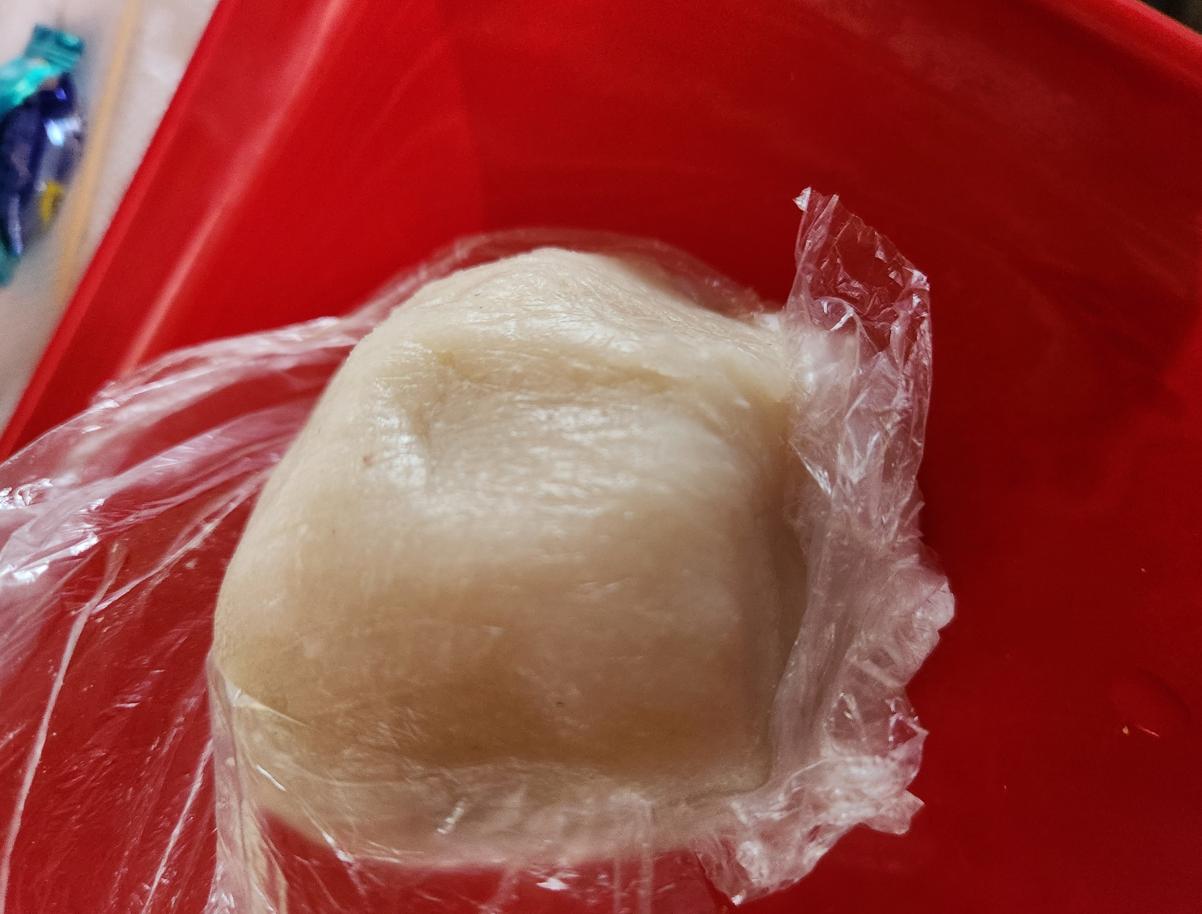
We ate at a local bukateria: food served in red plastic bowls, without ceremony or menu. A deep, viscous soup arrived, its surface sheened with palm oil, three substantial pieces of fish and meat half-submerged in the broth alongside dark, wilted greens — bitterleaf or waterleaf, I could not tell which. With it came a mound of golden-yellow amala, its colour the result of being worked with palm oil until it had taken on that saturated ochre hue. It was served on a square of plastic wrapper inside the bowl, the standard presentation: functional, exact, requiring no translation. The heat of the pepper in the soup was the kind that builds slowly, announcing itself fully only after the meal is finished. By the end of the week, I had learned to order with caution.
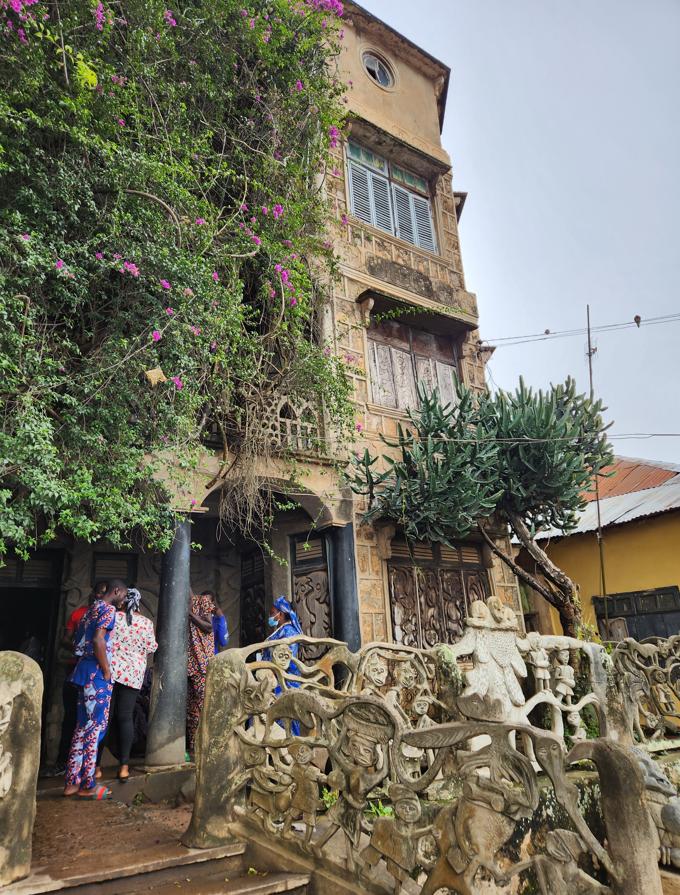
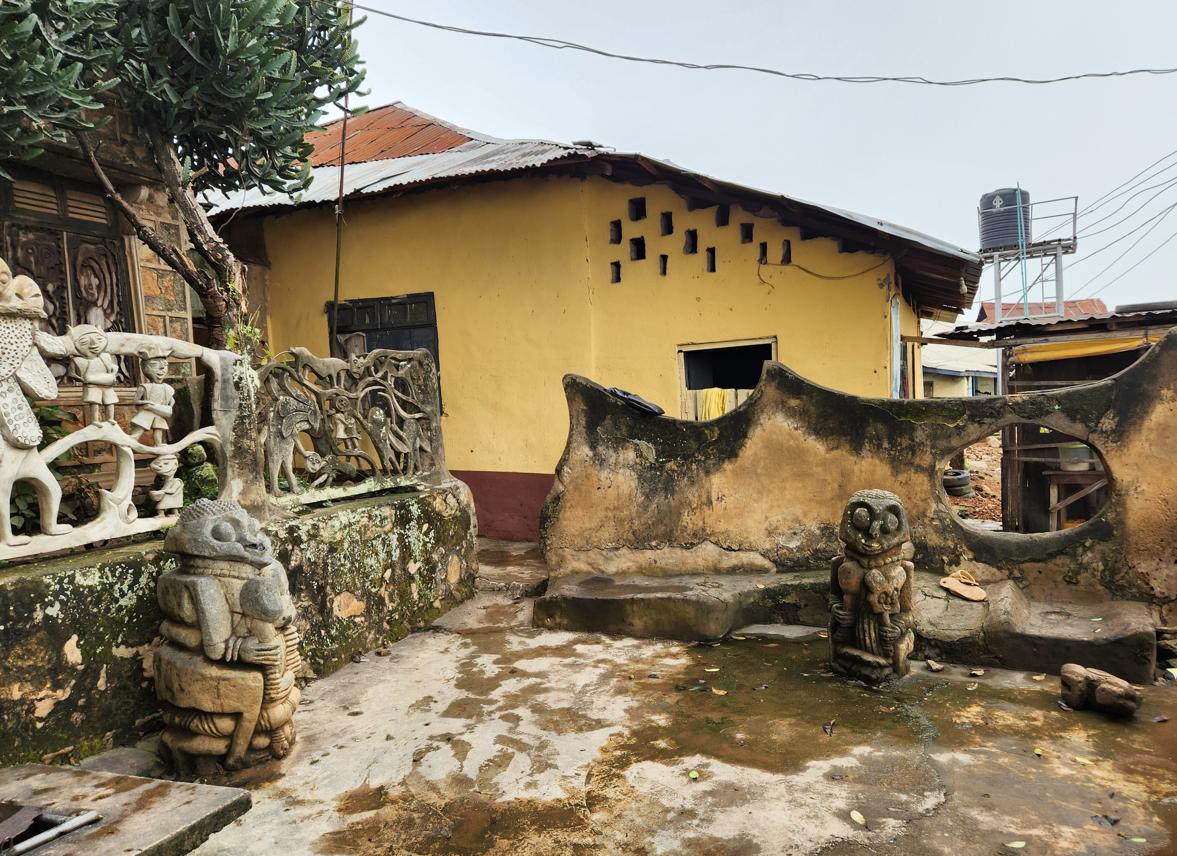
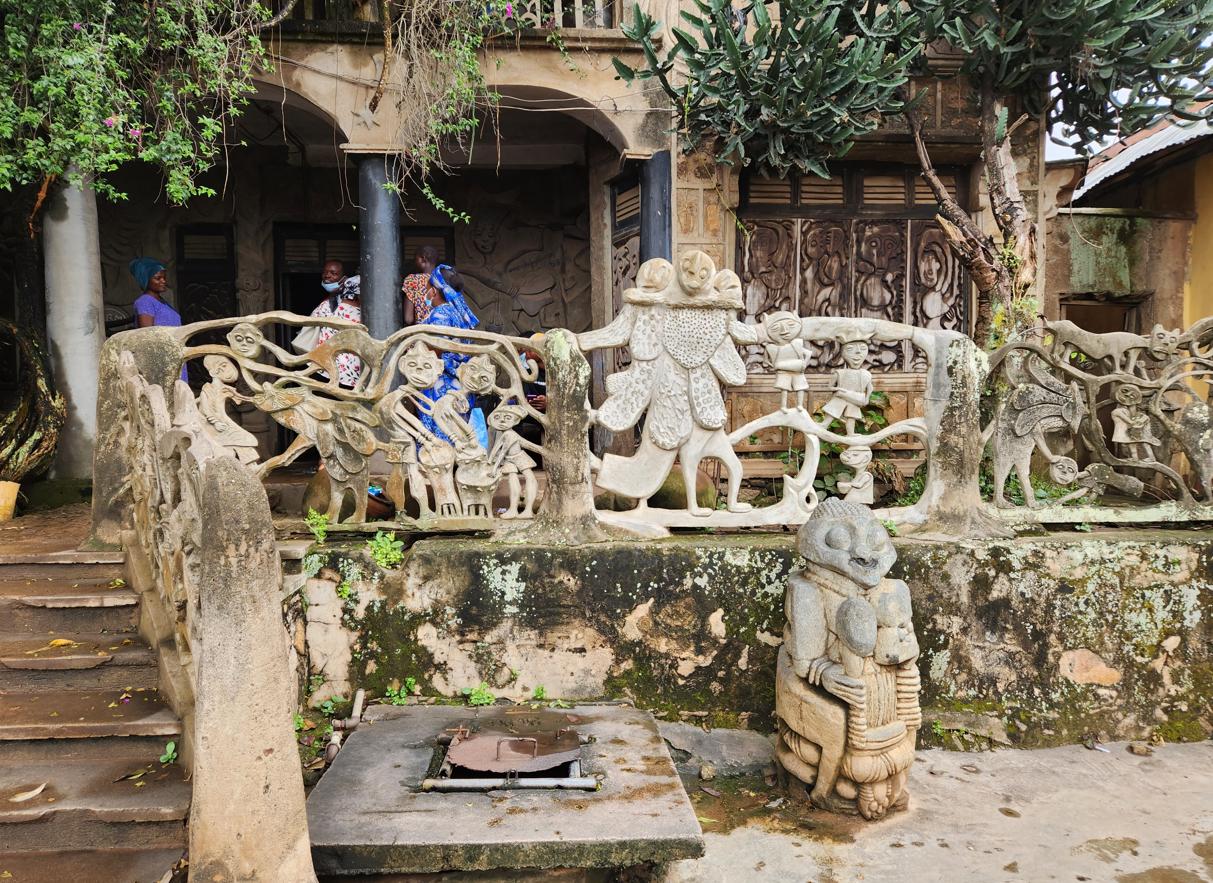
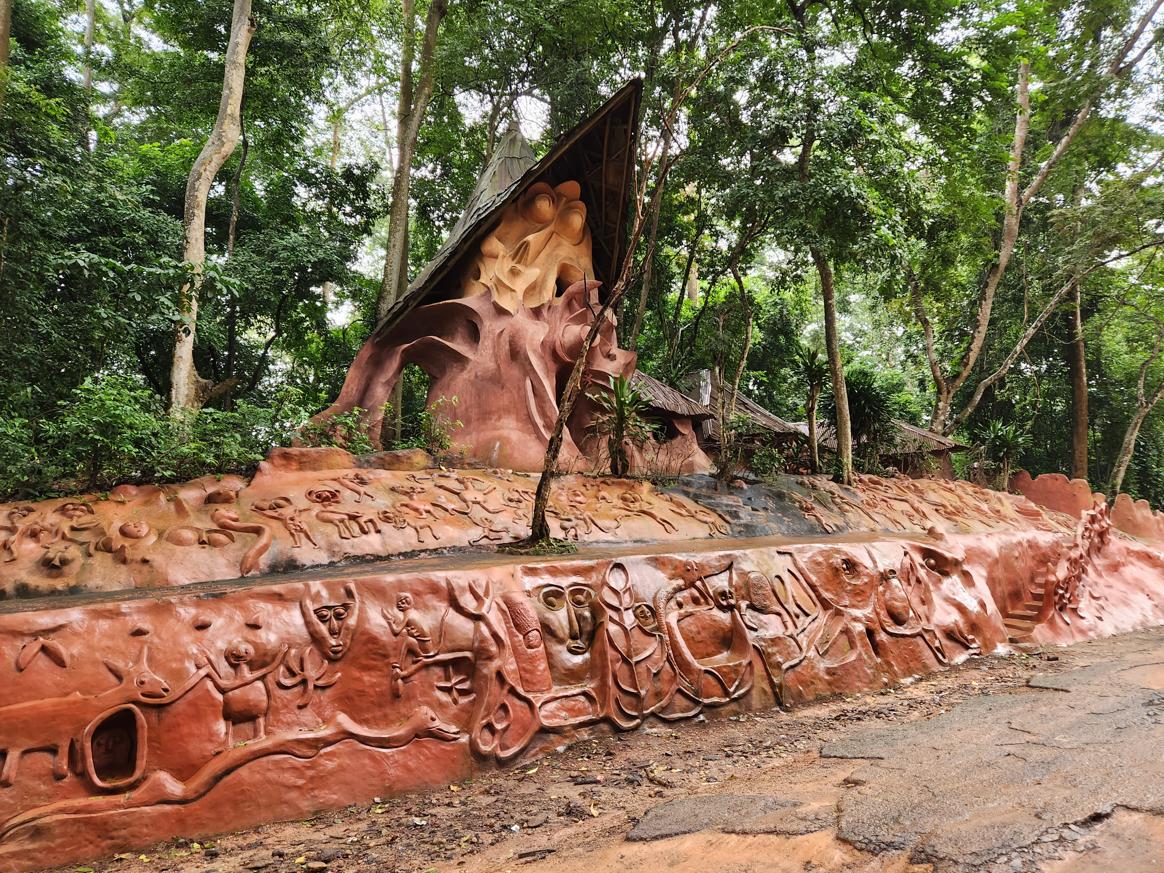
We visited the compound of Susanne Wenger — or rather, of her estate, since she died in 2009 at the age of 93. Her daughter introduced the place. The exterior walls were a continuous sculpture: terracotta-red concrete moulded into figures, faces, animals, and abstract forms that ran along the boundary without interruption, as if the wall itself were a single organism in the process of becoming. A sculptural balustrade at the entrance carried relief figures — a large sunflower-like medallion at its centre — and behind it rose a colonial-era house with carved wooden doors and an arched verandah, the building itself decorated with further reliefs, every surface treated as an opportunity.
Susanne Wenger was born in Graz, Austria in 1915. She studied applied arts, arrived in Nigeria in 1949 with her husband, the linguist and anthropologist Ulli Beier, and within a year had passed through a bout of tuberculosis that, by her own account, redirected her entirely toward the spiritual world of the Yoruba. She and Beier eventually divorced; she married a local drummer, converted to the Orisha religion, was initiated into the cults of Obatala, Soponna, and Ogboni, and was given the chieftaincy title Adunni Olorisha — the devotee of the Orisha. She finally settled in Osogbo in 1961 and remained there for the rest of her life.
What she found in the grove, when she first arrived, was a sacred space in the process of dissolution. The post-war period had brought urbanisation and the weakening of traditional obligations; shrines were abandoned, fishing and hunting in the grove continued in defiance of ancient prohibitions, and the forest was encroached upon by land speculators. Wenger, with the support of the Ataoja of the time and a group of local Yoruba artists whom she organised into a cooperative, began a decades-long process of restoration and transformation. She rebuilt shrines, commissioned new sculptures, introduced a generation of Nigerian artists — among them Twins Seven Seven, who went on to international renown — to the possibilities of sacred art. The grove became, in the process, something it had not quite been before: a living artistic monument as well as a religious site.
Whether this constitutes an authentic restoration or a form of creative reinvention has been a subject of debate among Nigerian scholars and religious practitioners. Wenger's relationship to Yoruba culture was profound and, in her own telling, spiritually complete. But it was also the relationship of a European woman who arrived from outside, found something she recognised as valuable, and proceeded to shape it according to her own vision — however deeply informed that vision was. The tension is not easily resolved. What is not in dispute is that without her intervention, the grove would probably not exist in its current form, and would almost certainly not be a UNESCO World Heritage Site.
The Grove: Where the Goddess Lives
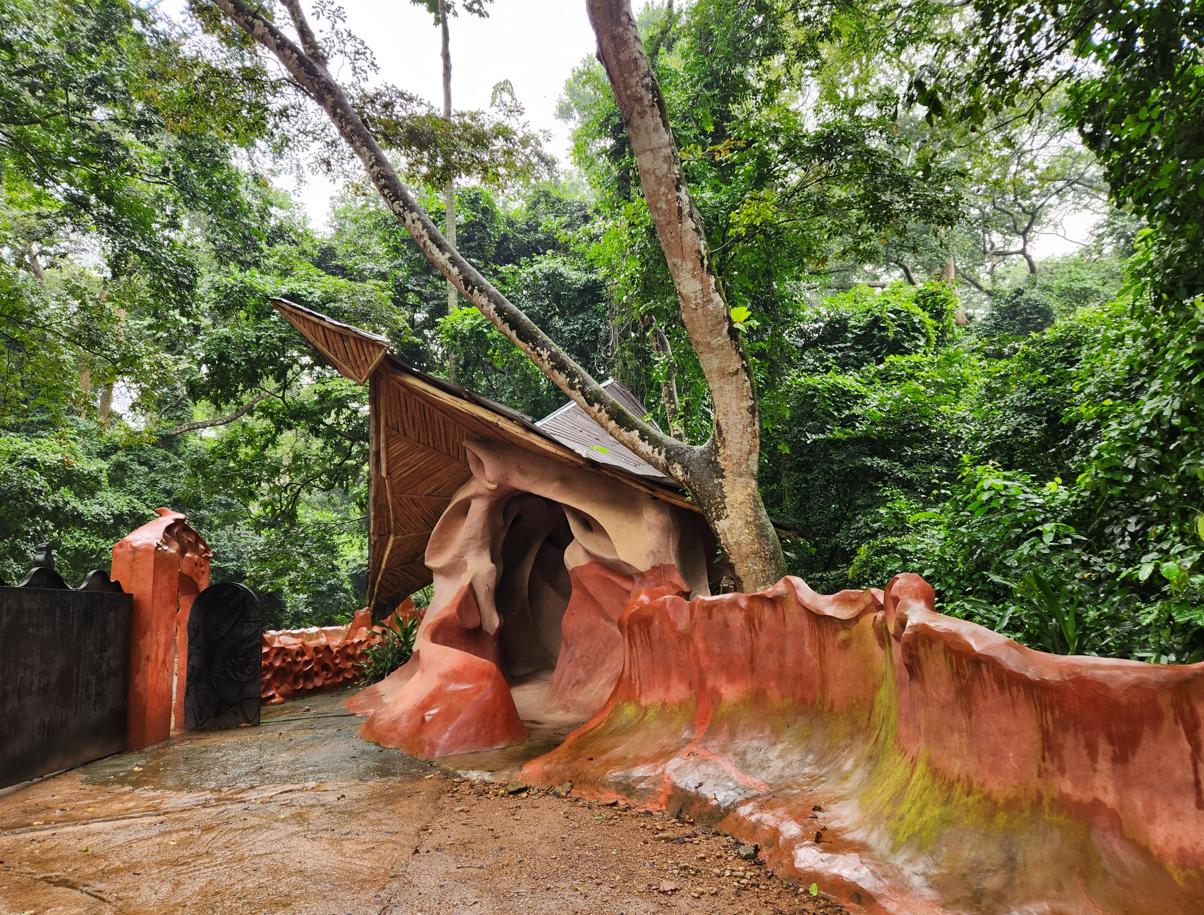
The Osun-Osogbo Sacred Grove begins a short distance outside the city, at the point where the forest reasserts itself against the encroachment of Osogbo's streets. It is several centuries old and among the last of the sacred forests that once adjoined most Yoruba cities before urbanisation consumed them. Entering it, one passes first through a gate.
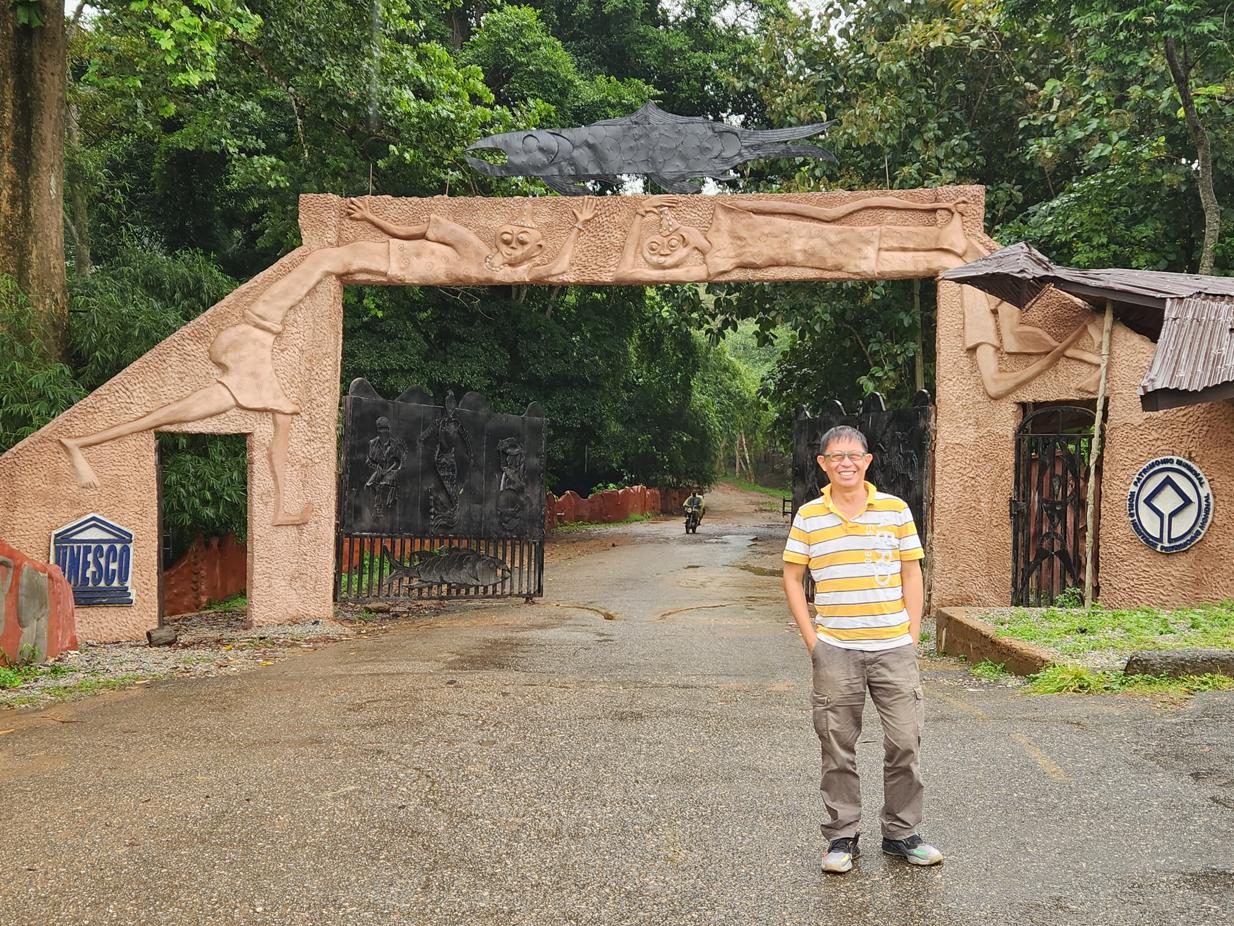
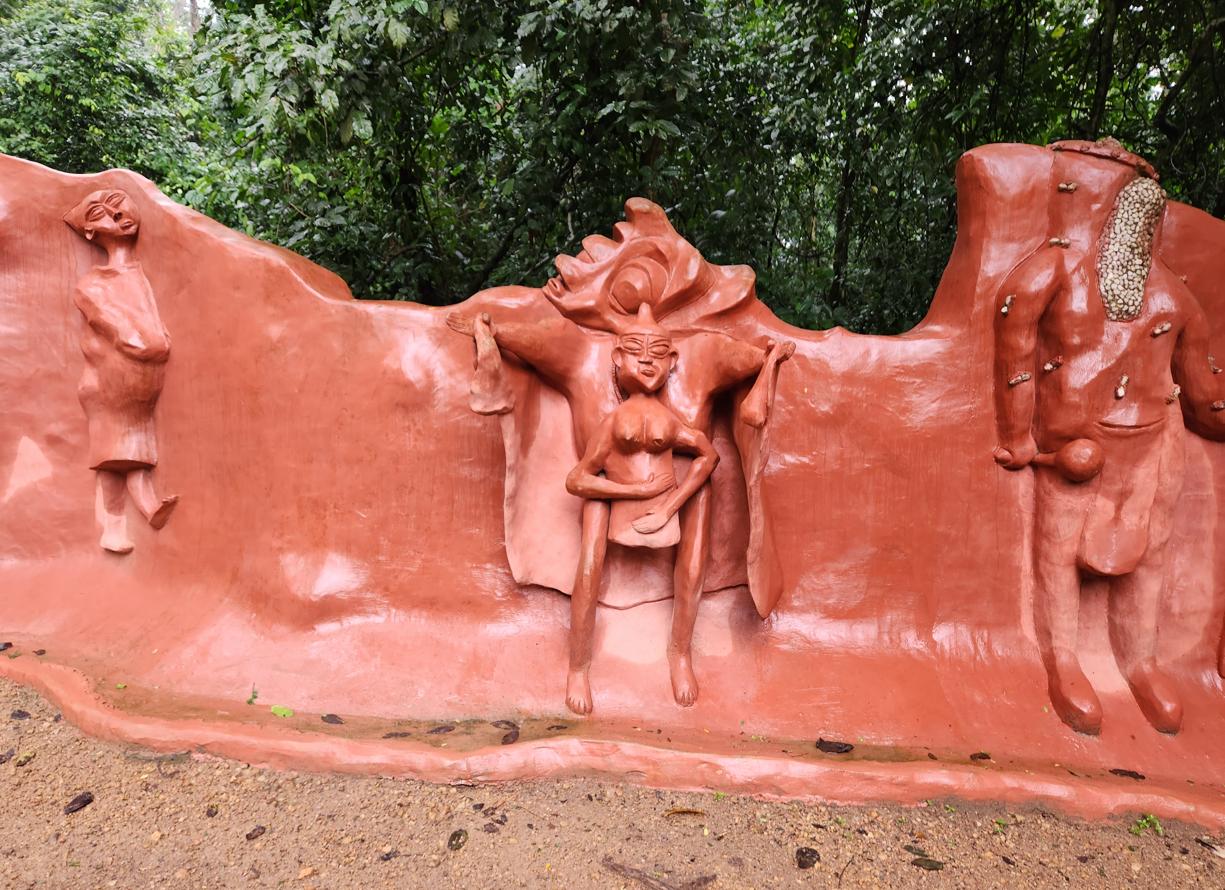
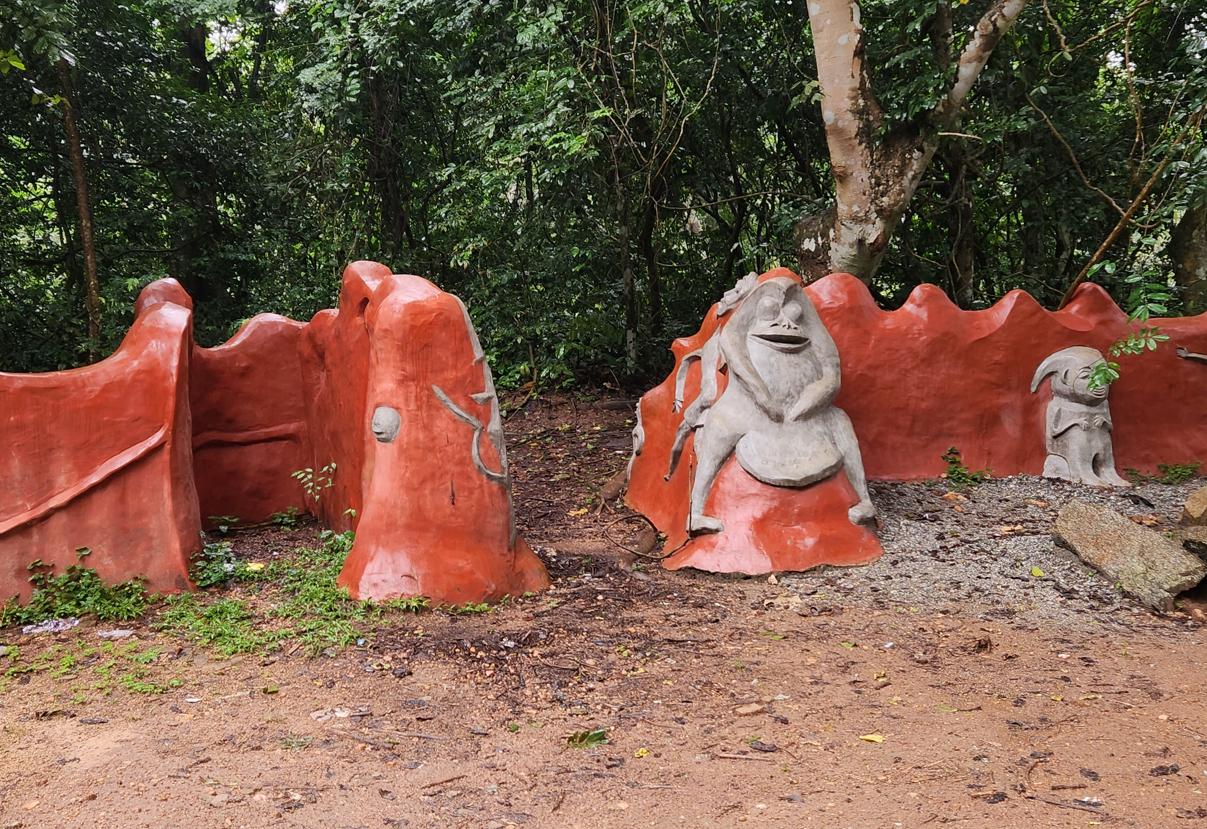
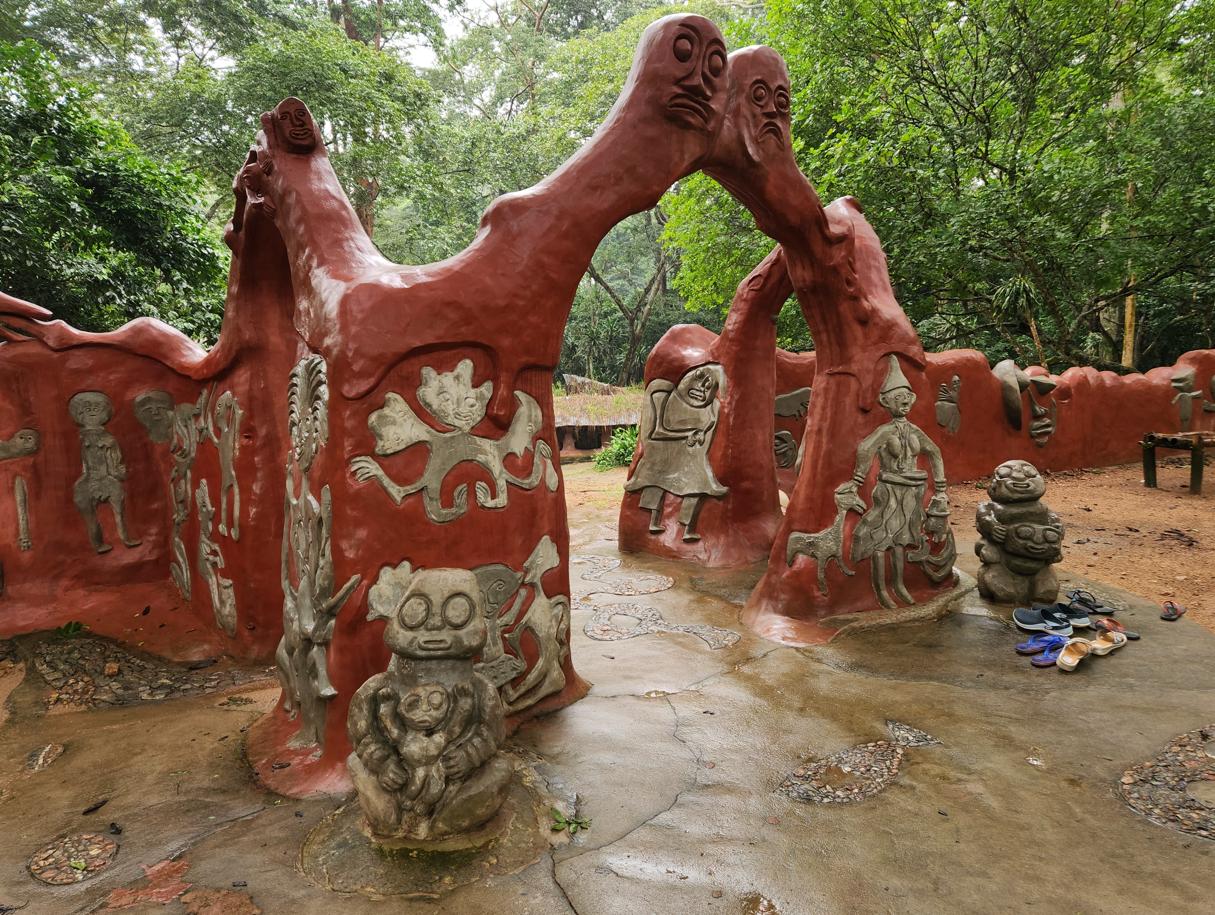
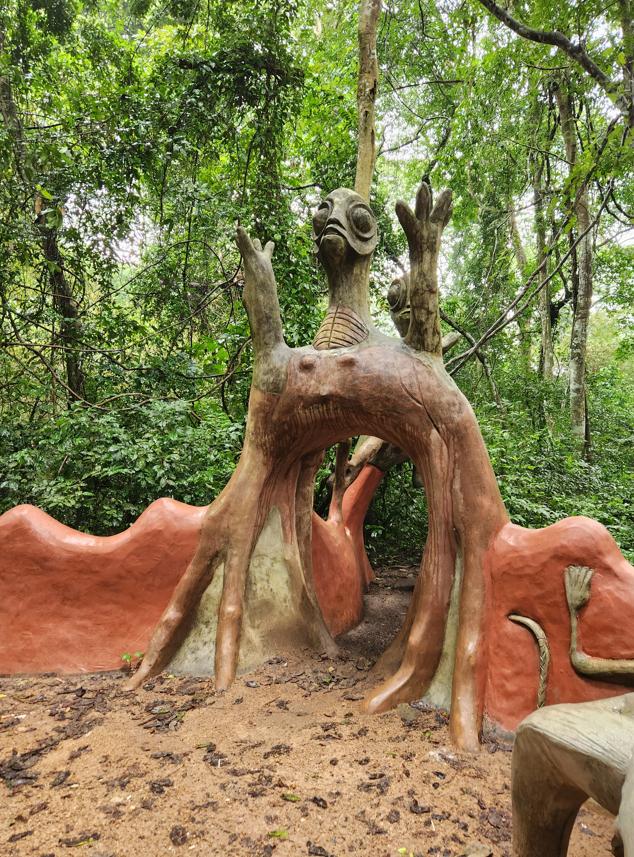
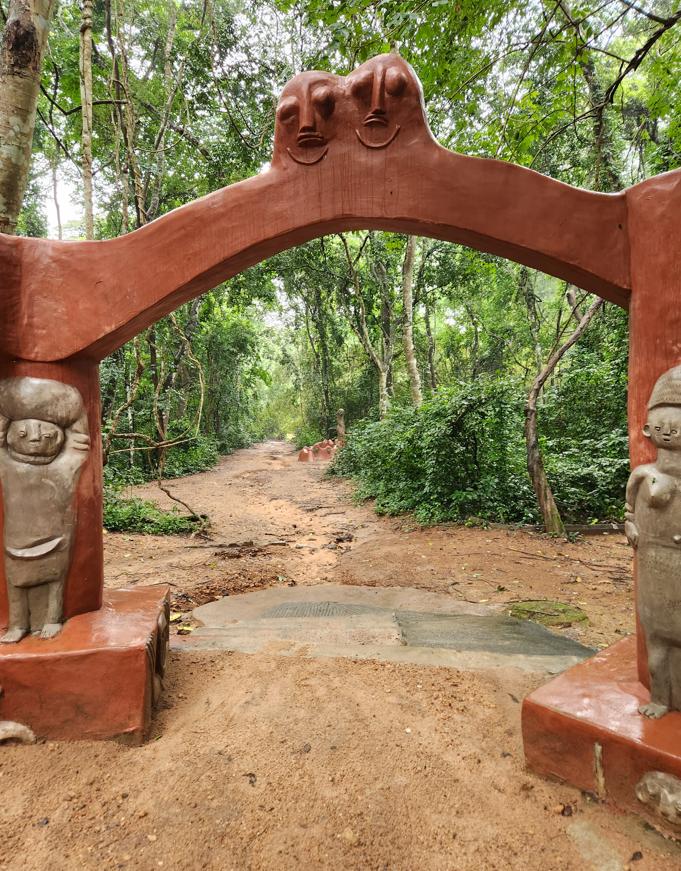
The gate is itself a sculpture: two massive terracotta-red figures rising from either side of the path, their arms arching overhead to meet at a point where the hands clasp — or perhaps press against each other in some attitude of tension or greeting. Their faces are wide-eyed, solemn, slightly alarming in the way that protective spirits are meant to be alarming. The walls on either side of the gate are studded with relief figures: elongated beings, trickster shapes, a squat seated deity with a knowing expression, fantastical animals. Shoes were left at the threshold — a scatter of sandals and flip-flops beside the entrance confirmed that we were to remove ours as well. You do not enter this place shod.
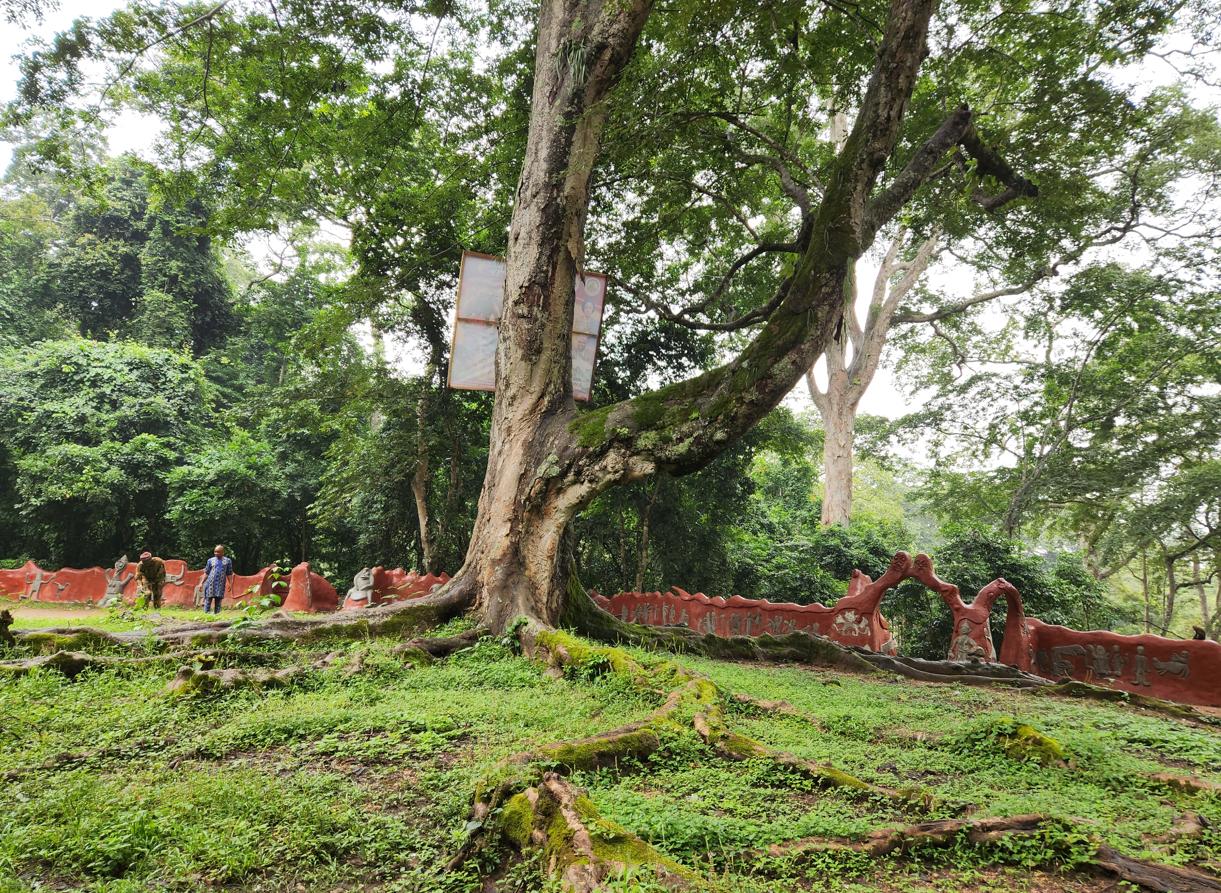
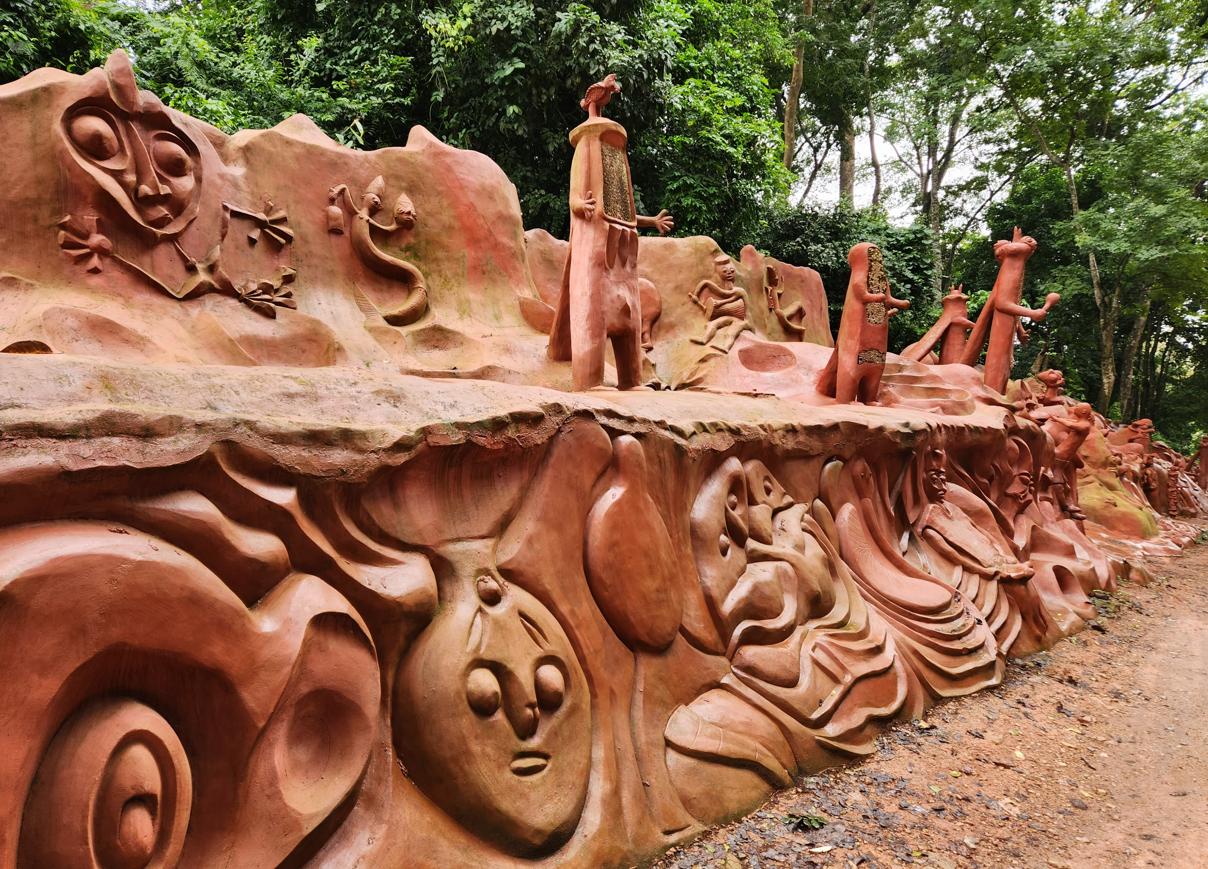
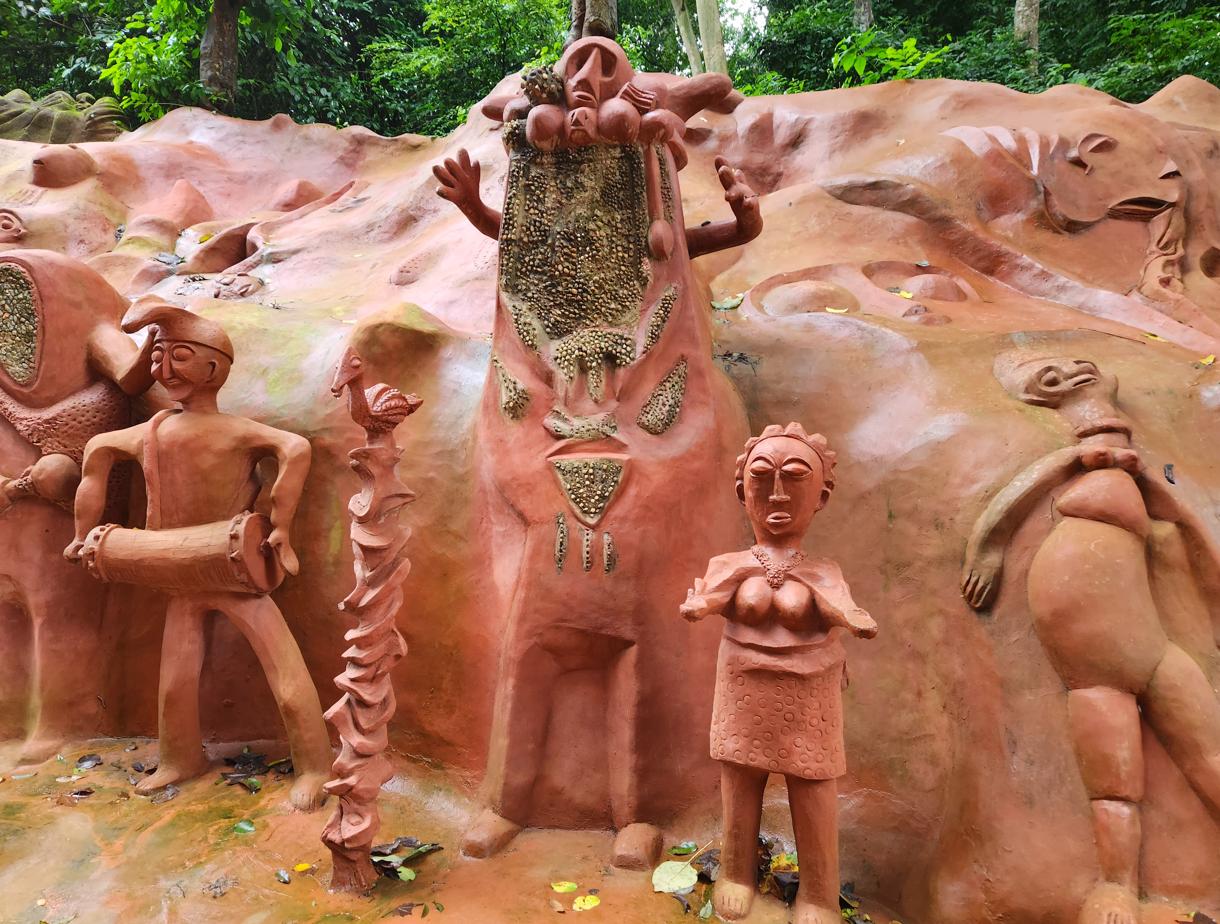
The path through the grove is lined with a continuous terracotta relief wall that extends for some distance, its lower register filled with swirling organic forms from which faces emerge, and its upper register populated with standing figures — elongated, arms raised, some gesturing outward as if in mid-speech or mid-command. The wall recedes into the forest as the path curves, sculpture becoming landscape becoming sculpture again. The figures are not decorative. They are theological statements made in clay, representing the Orisha and the mythological narratives of the Yoruba cosmological system.
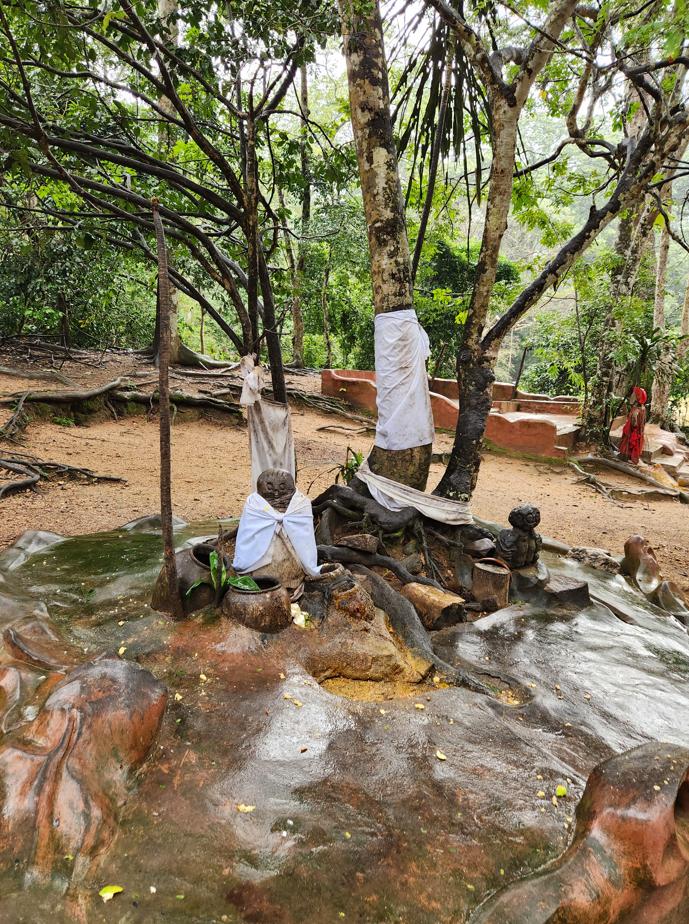
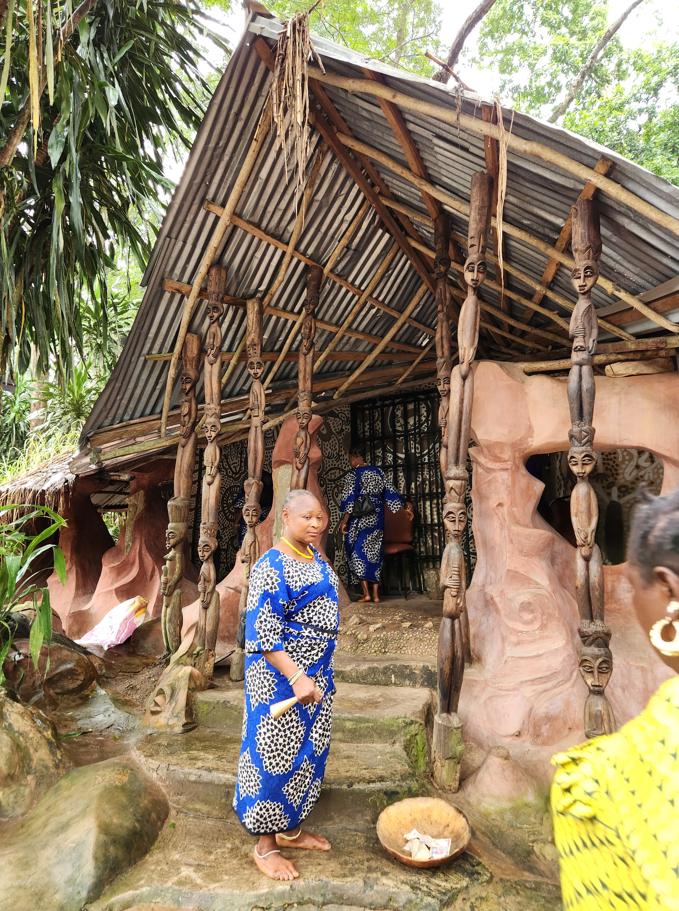
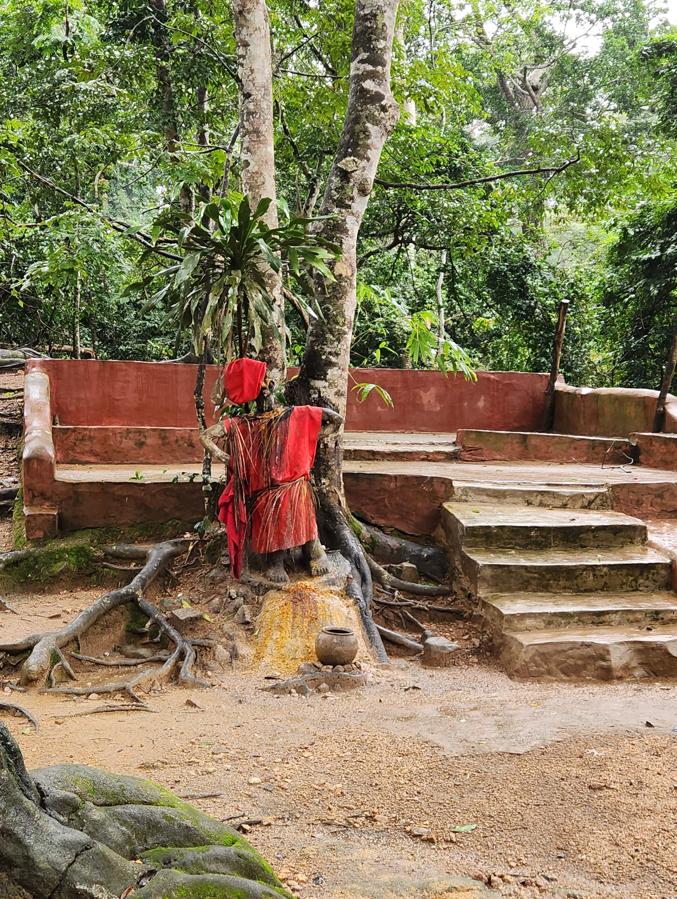
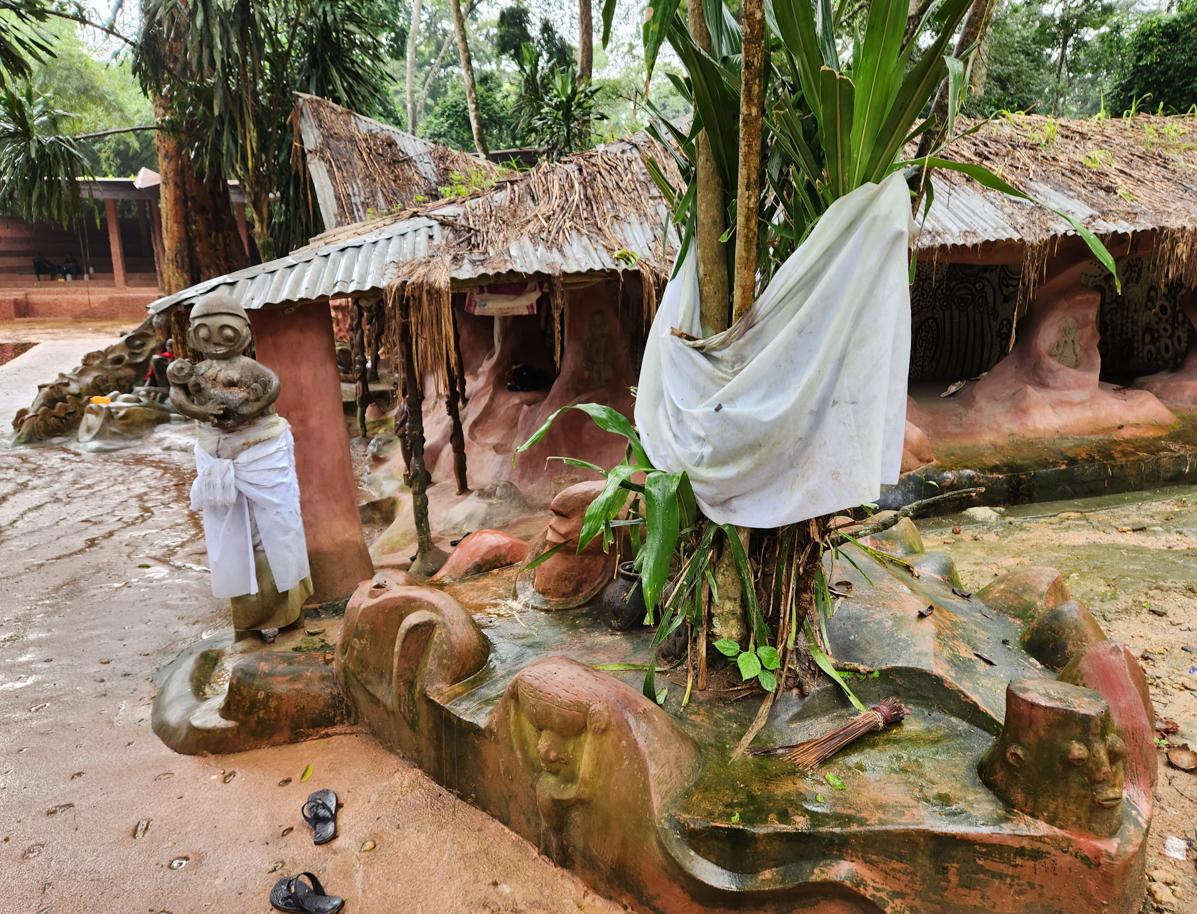
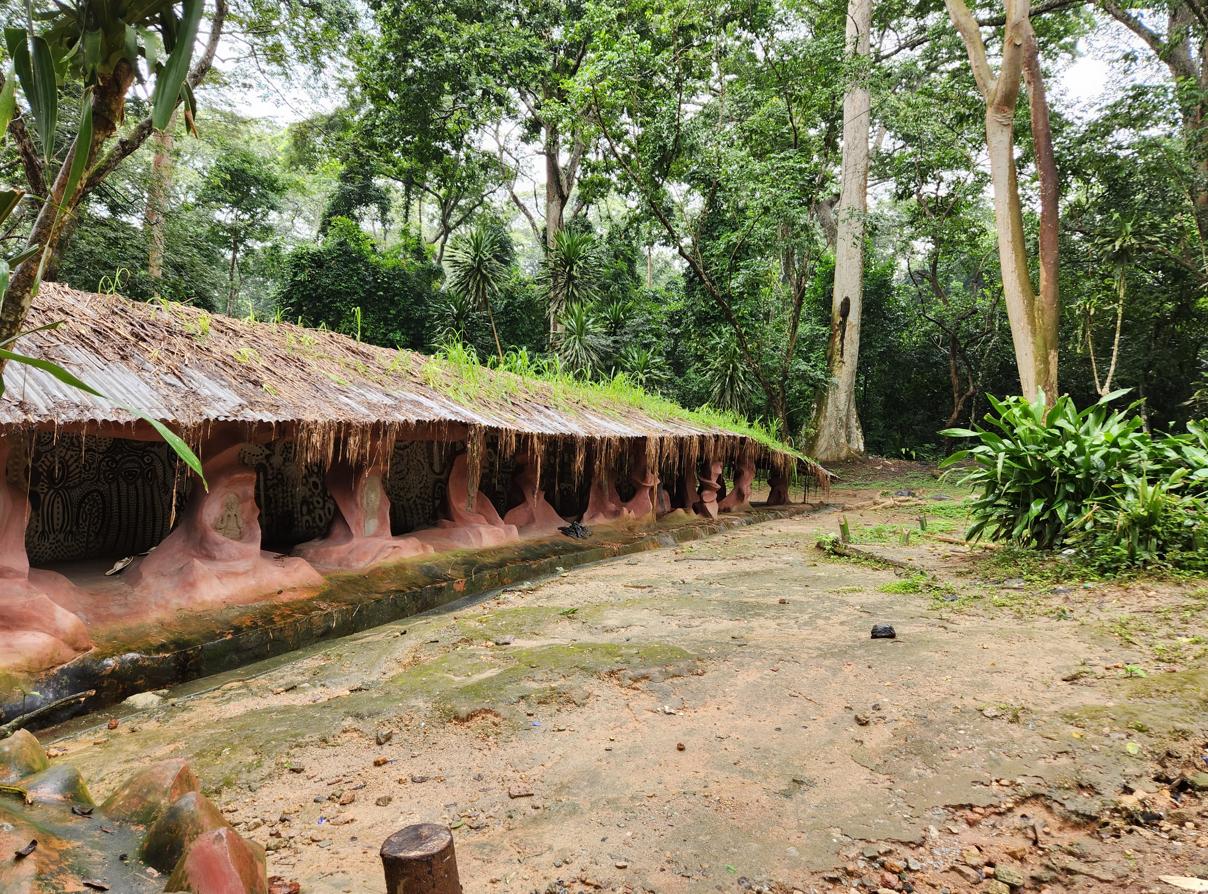
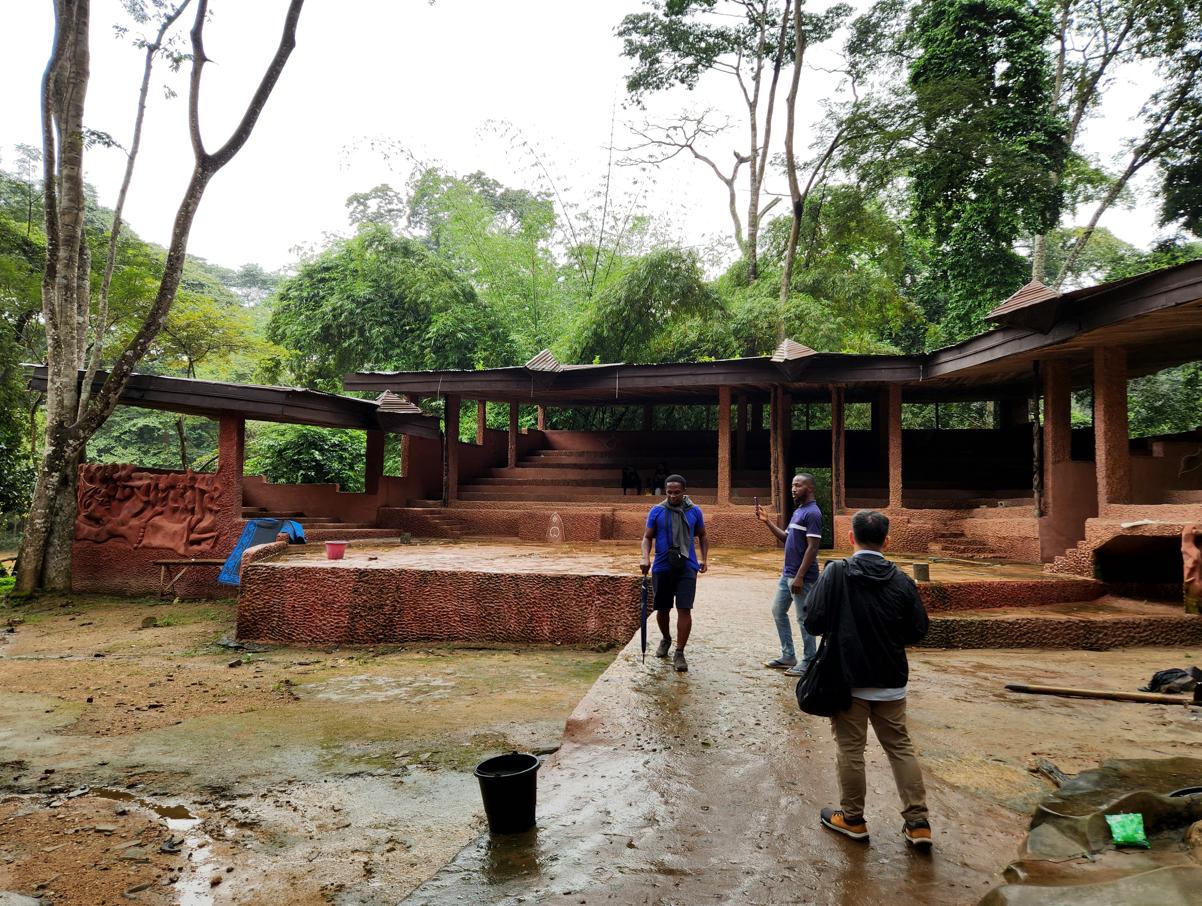
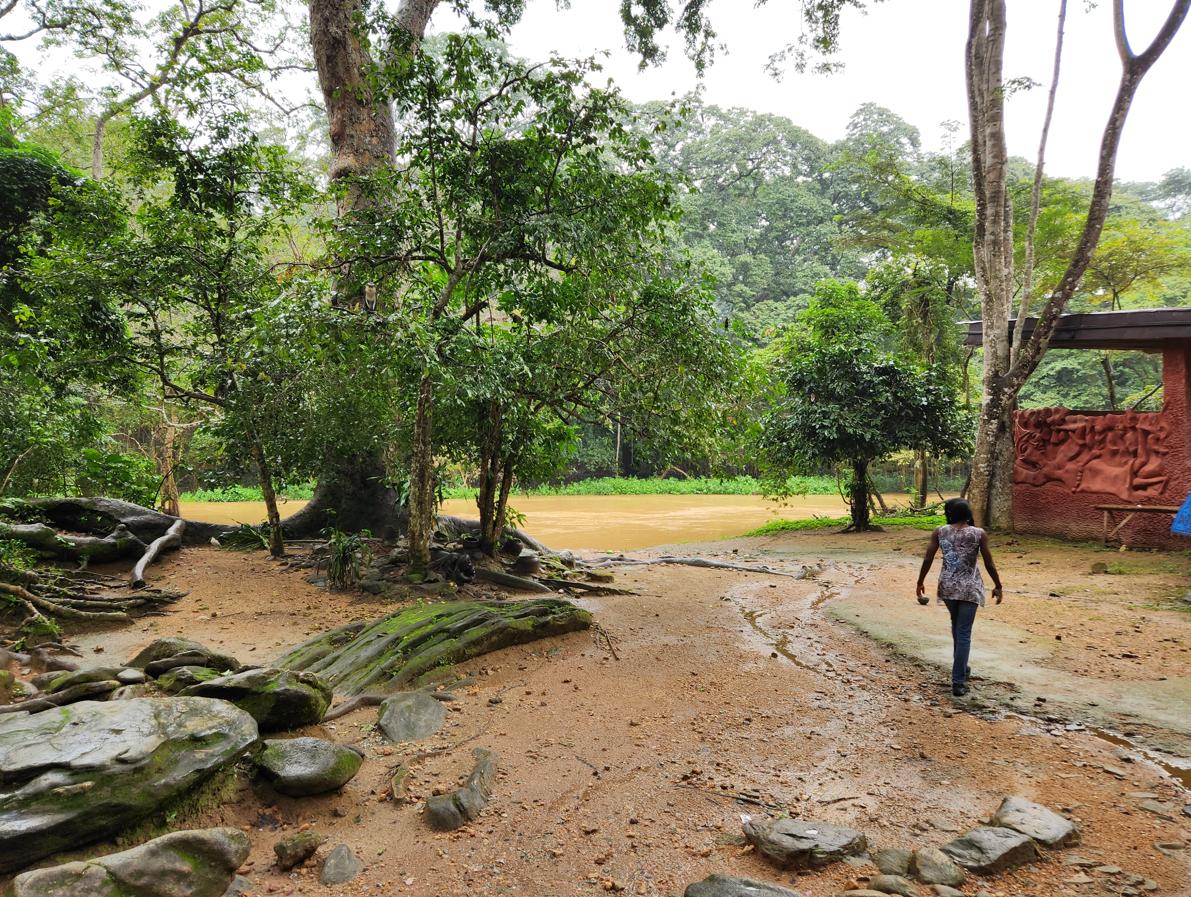
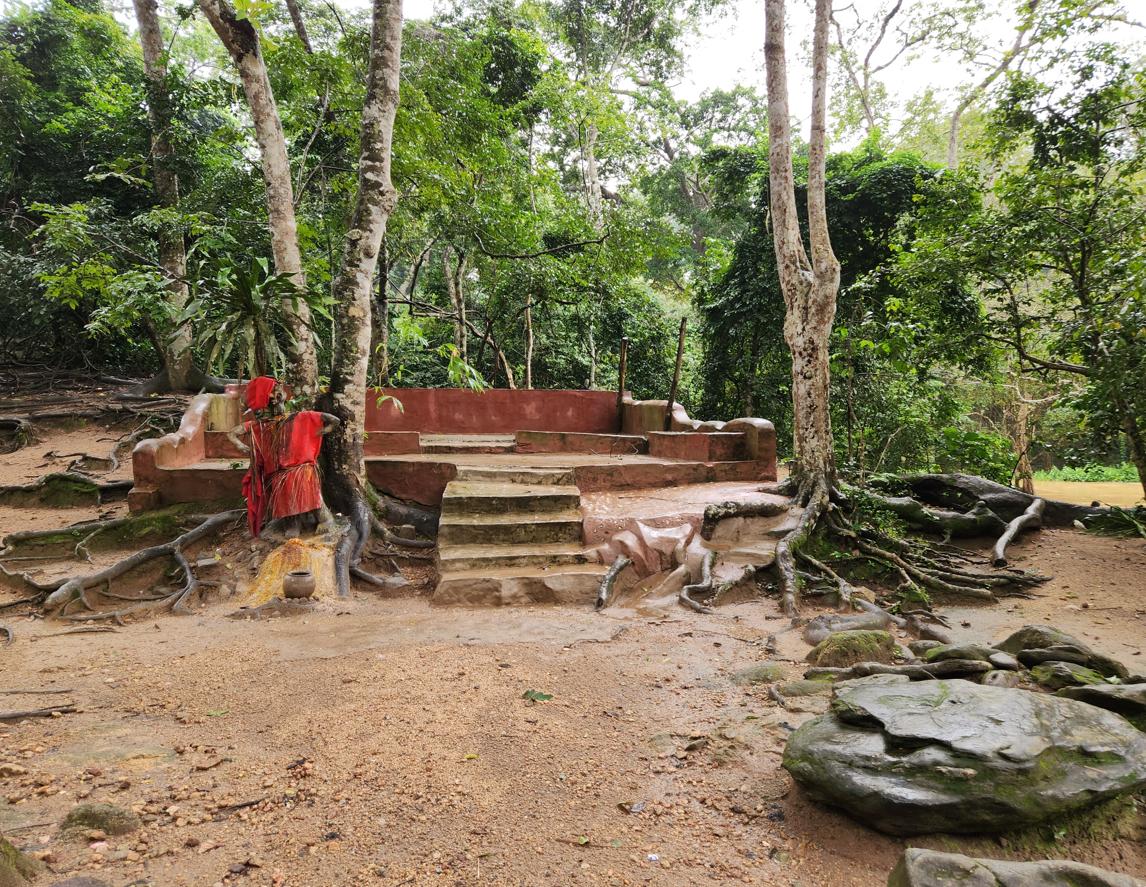
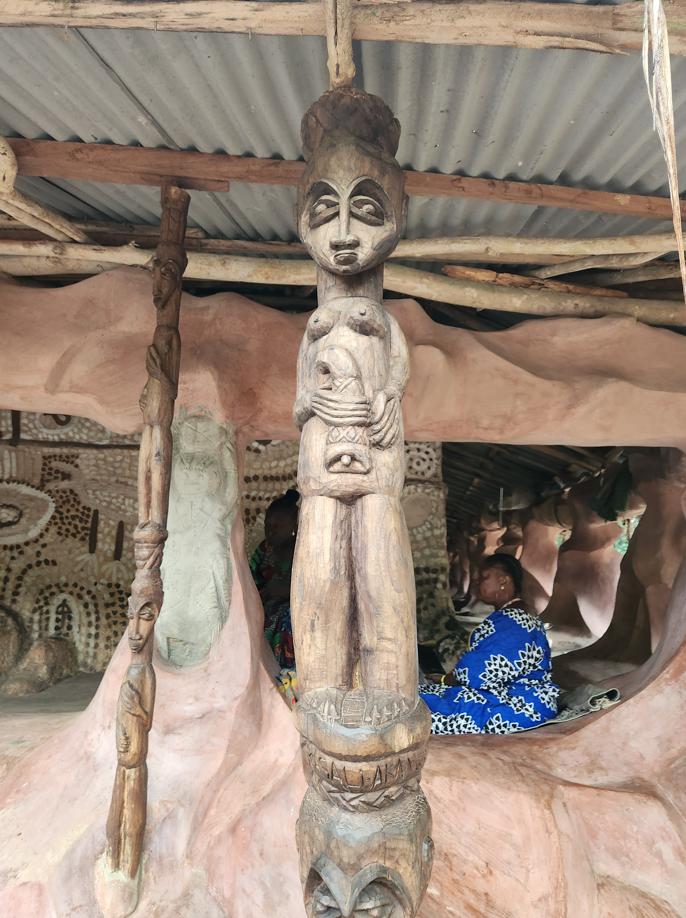
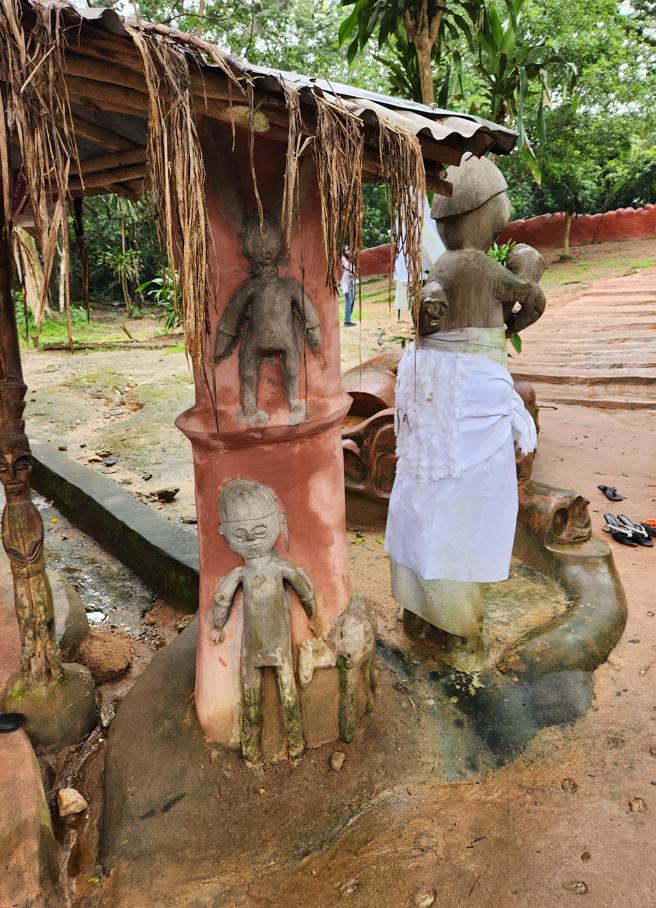
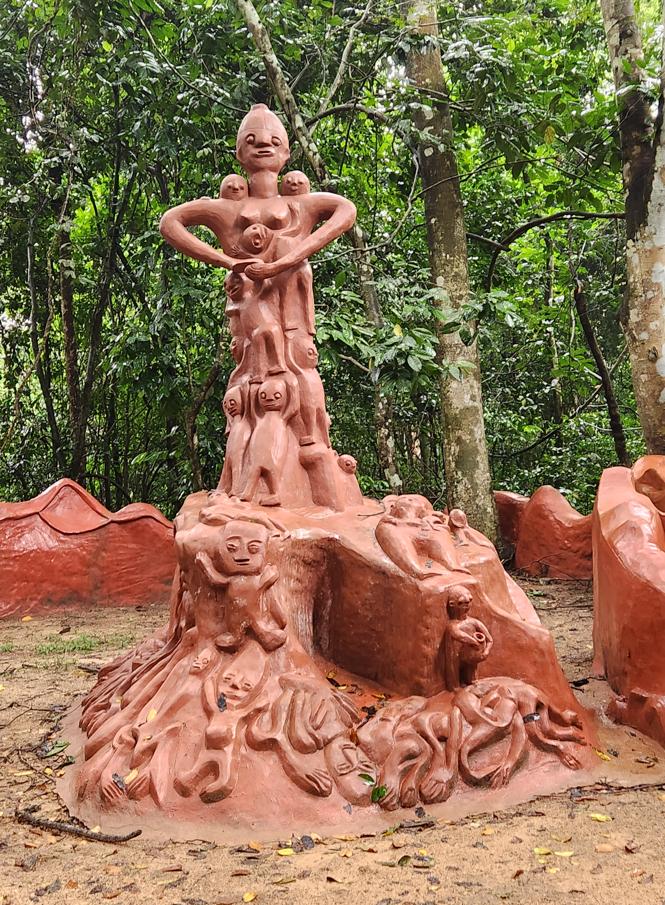
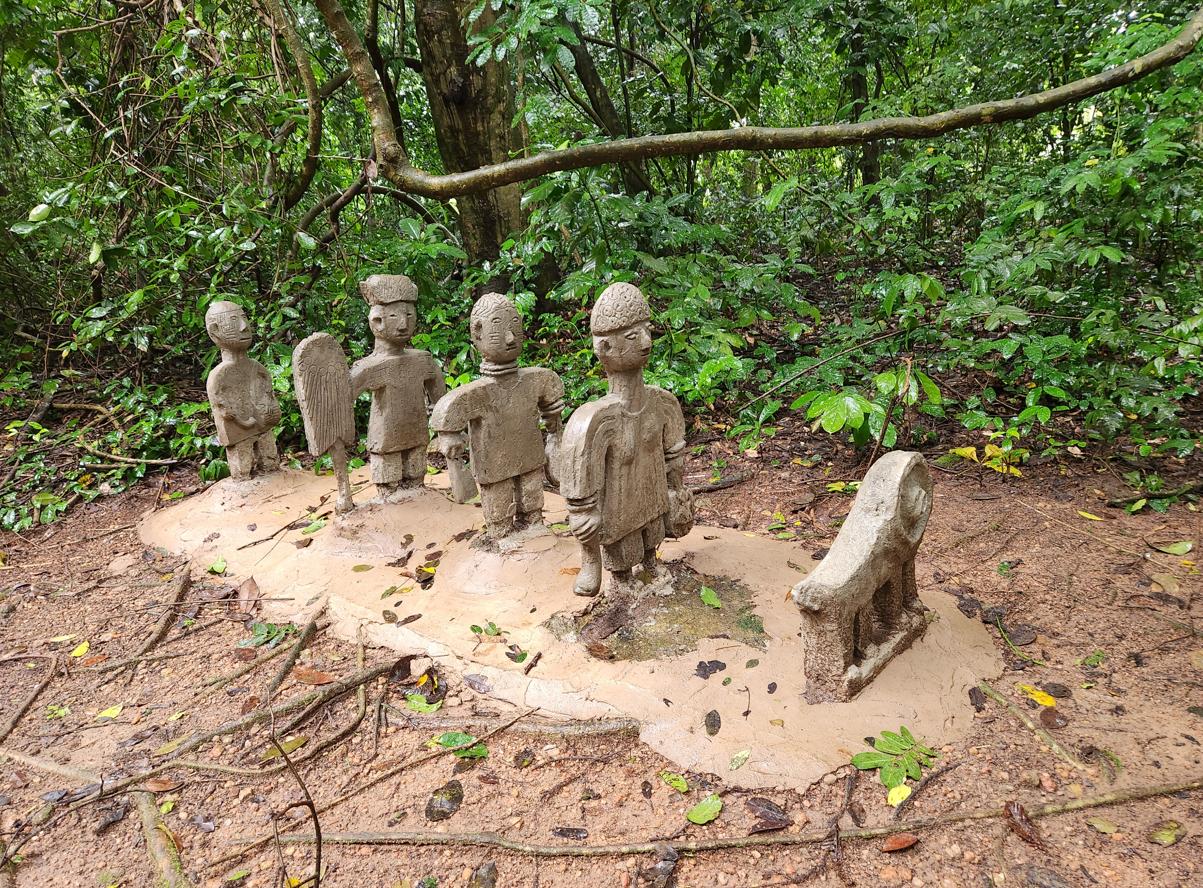
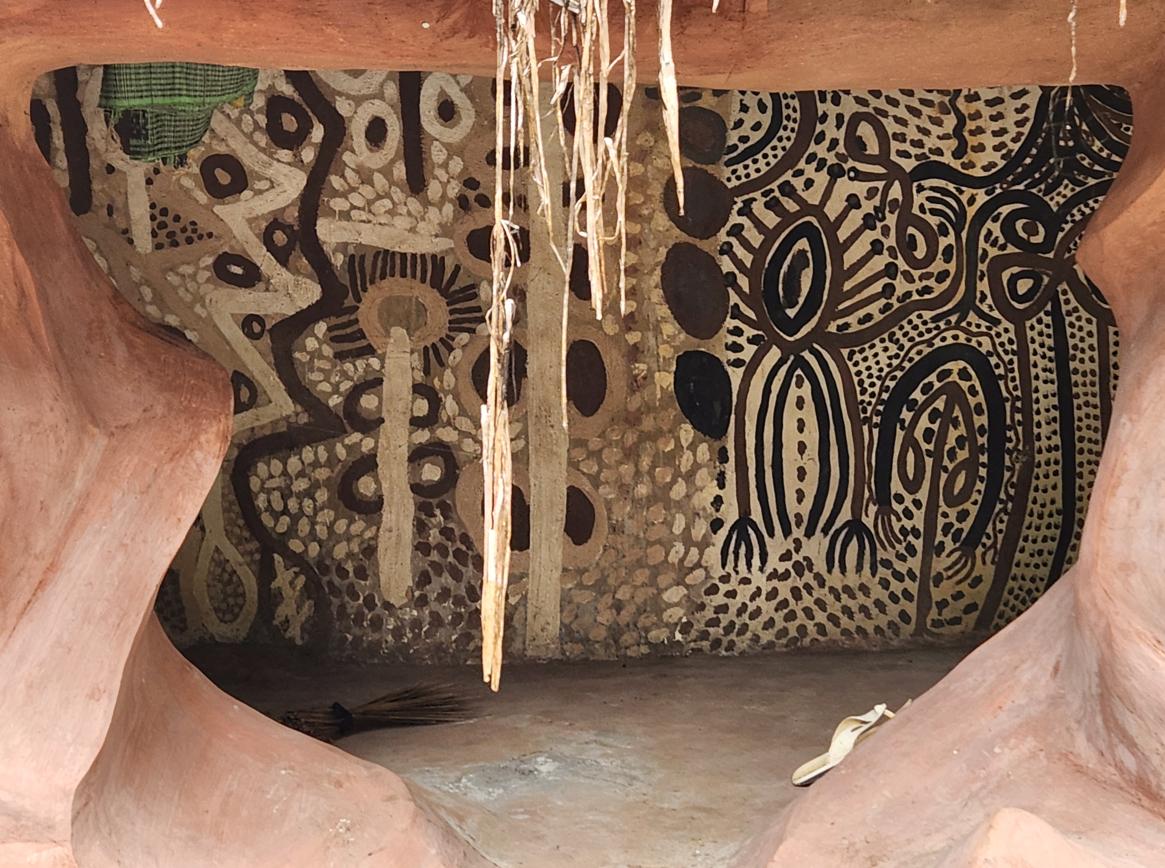
Further into the grove, separate shrine compounds stand among the trees. Each is dedicated to a specific deity or set of spiritual forces, and each has its own architectural character. In one, two figures emerge from thick column-like bases under a thatched overhang, the wall behind them painted in a dense, almost hypnotic pattern of black circles and ovals on the terracotta ground — a cellular or cosmological design that seems to shift as you look at it. A figure in a white cloth wrapping stands nearby, the white signifying ritual purity or dedication to a specific Orisha; Obatala, the deity of creation and purity, requires white.
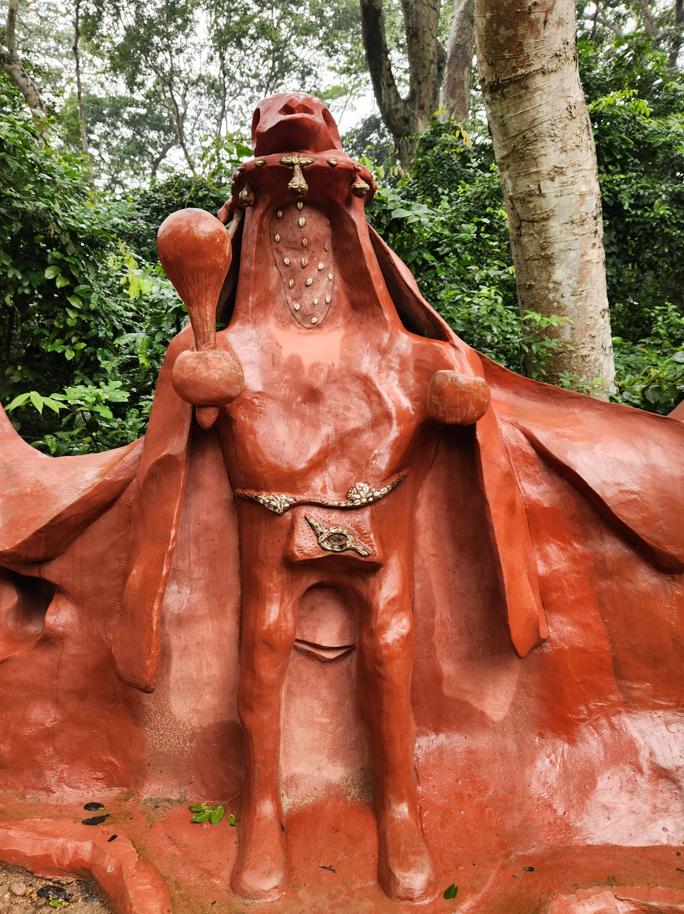
One compound contains the most commanding single sculpture in the grove: a large cloaked deity figure, terracotta-red, frontal and imposing, holding what appears to be a staff or ritual rattle in one hand, the other arm extended. The figure wears real gold beads around the neck and a decorated belt set with a raised eye motif. The combination of modelled clay, real jewellery, and the dense forest behind gives the statue a presence that photographs capture inadequately. It occupies its clearing with absolute authority.
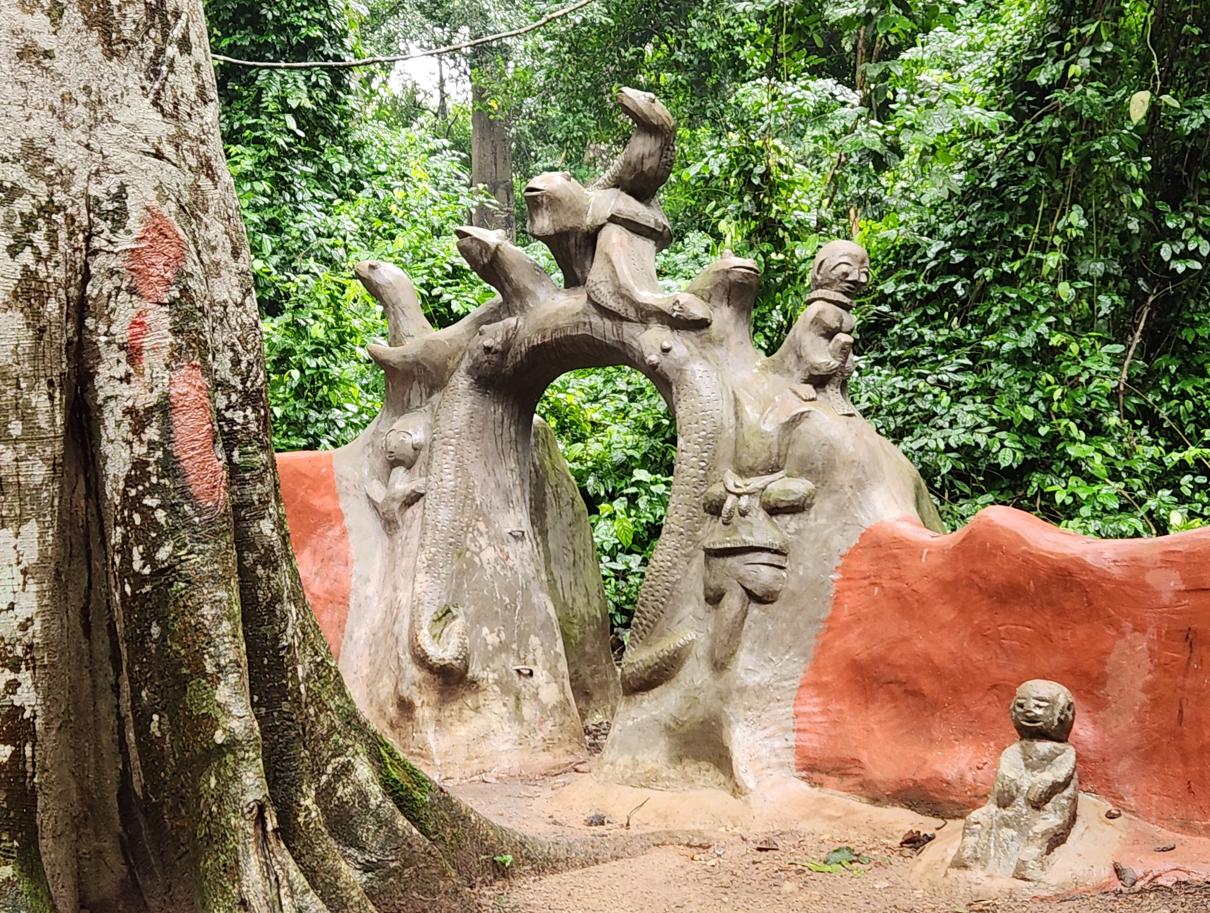
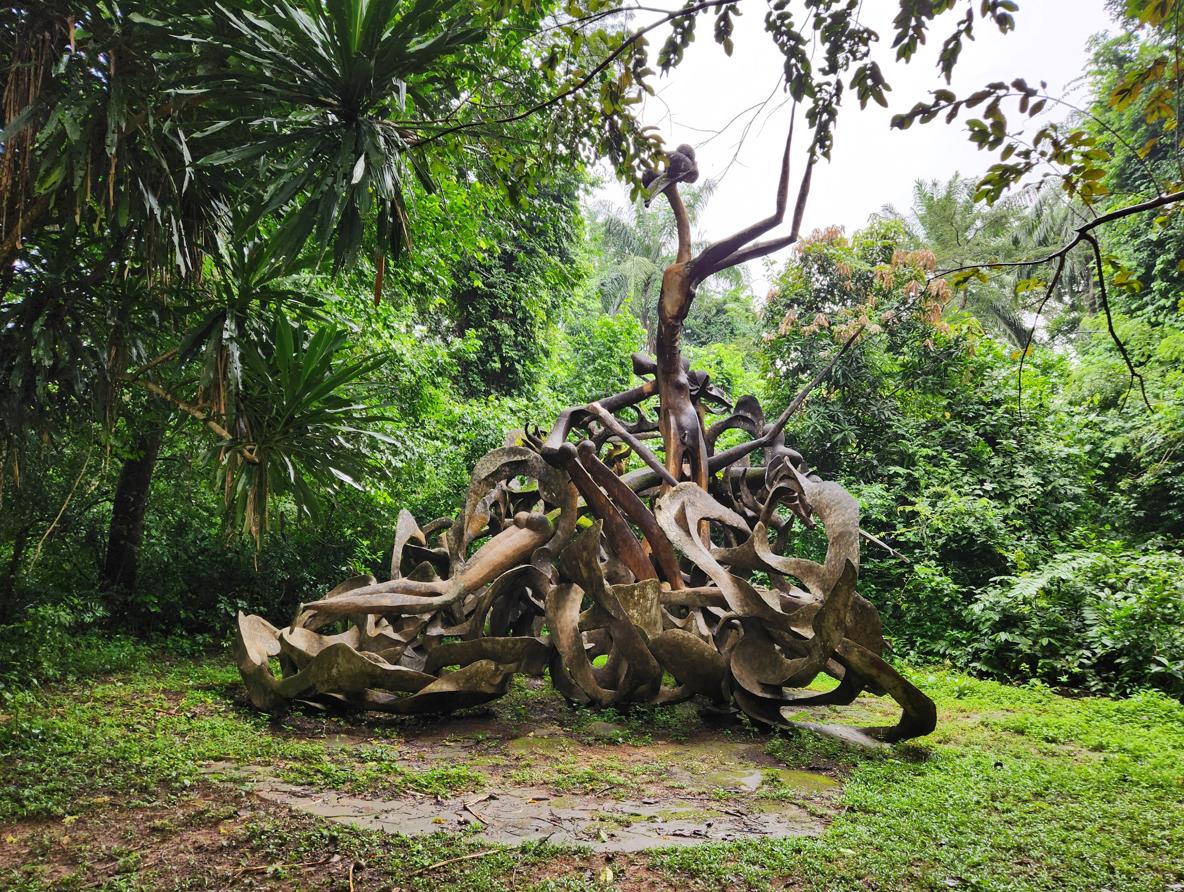
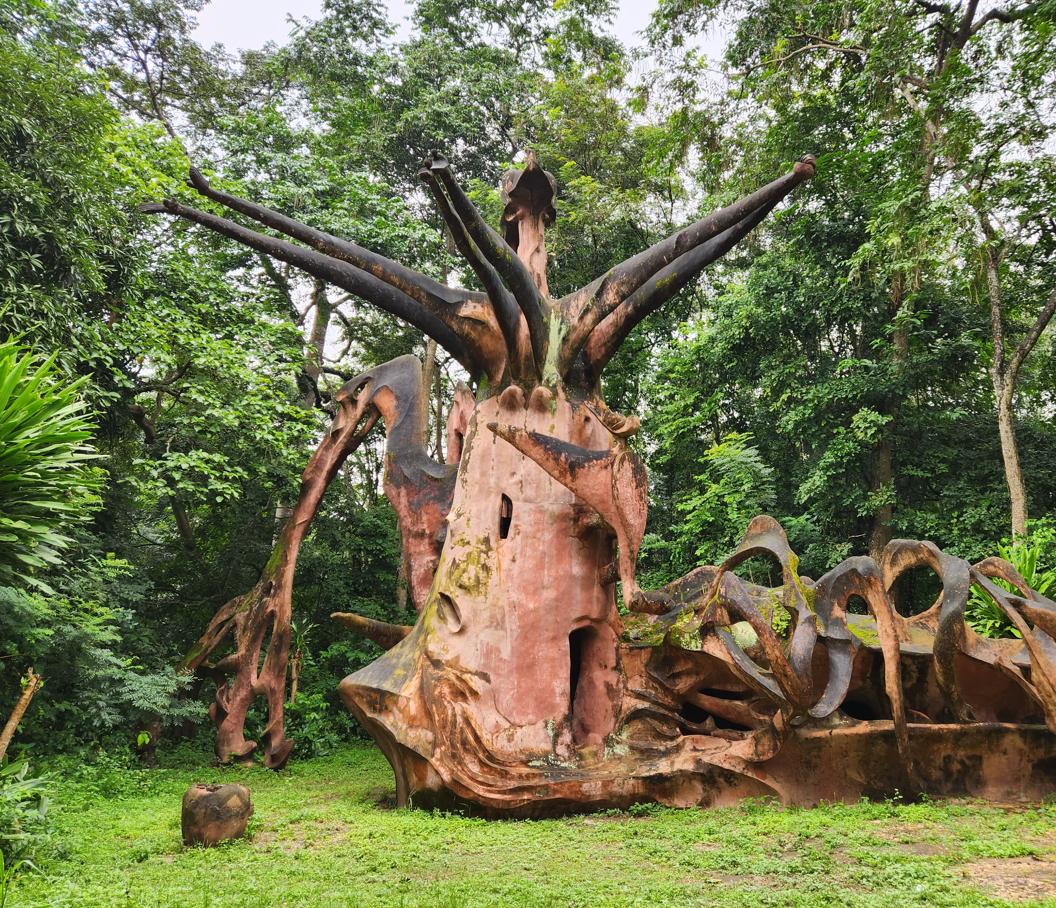
Elsewhere, a monumental abstract structure — a central column with branching iron armatures spreading outward and upward like the limbs of a dead tree, flanked by a long serpentine form coiling along the ground — stands in a clearing where the grass has grown long around its base. Moss has colonised sections of the concrete surface. The forest is in the process of reclaiming it. The effect is not one of abandonment, exactly, but of a work that has entered into a longer conversation with its environment — the kind of conversation that neither party will resolve in human lifetimes.
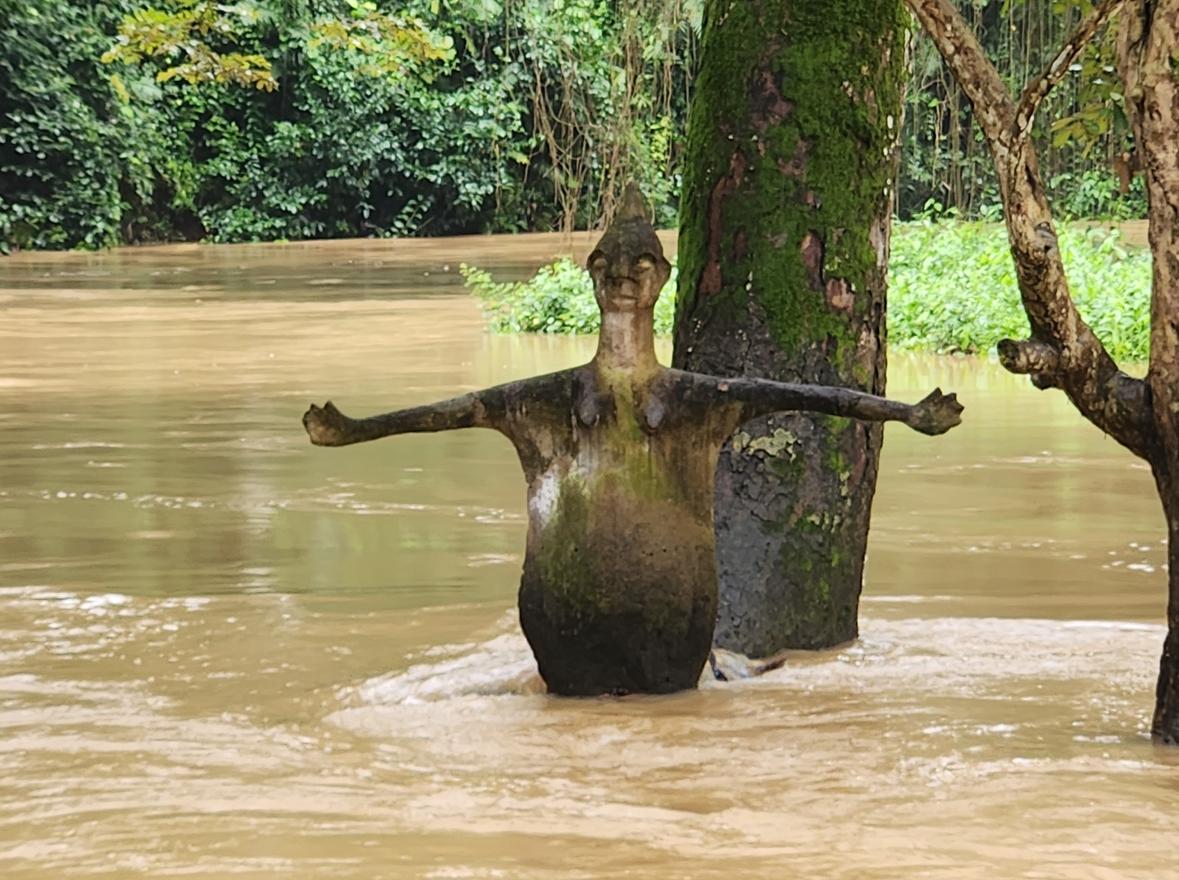
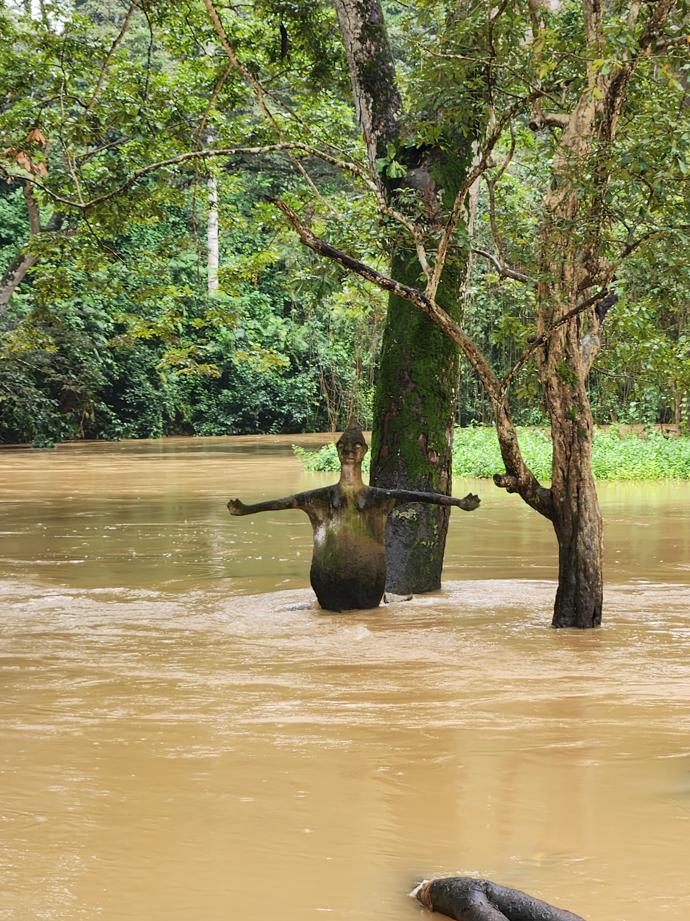
The most powerful image in the grove, however, was not a sculpture but an accident of hydrology. The Osun River, swollen from days of rain, had risen well above its usual banks and flooded a section of the grove's lower reach. Standing chest-deep in the brown, turbid water, its surface broken by the current, was a dark bronze or iron figure — arms extended wide, face upturned toward the canopy. Trees stood half-submerged around it. The figure had not been placed in the river; the river had risen to meet it. For a moment, the distinction between religious representation and religious event collapsed entirely. The goddess was in her element, and the element had come to her.
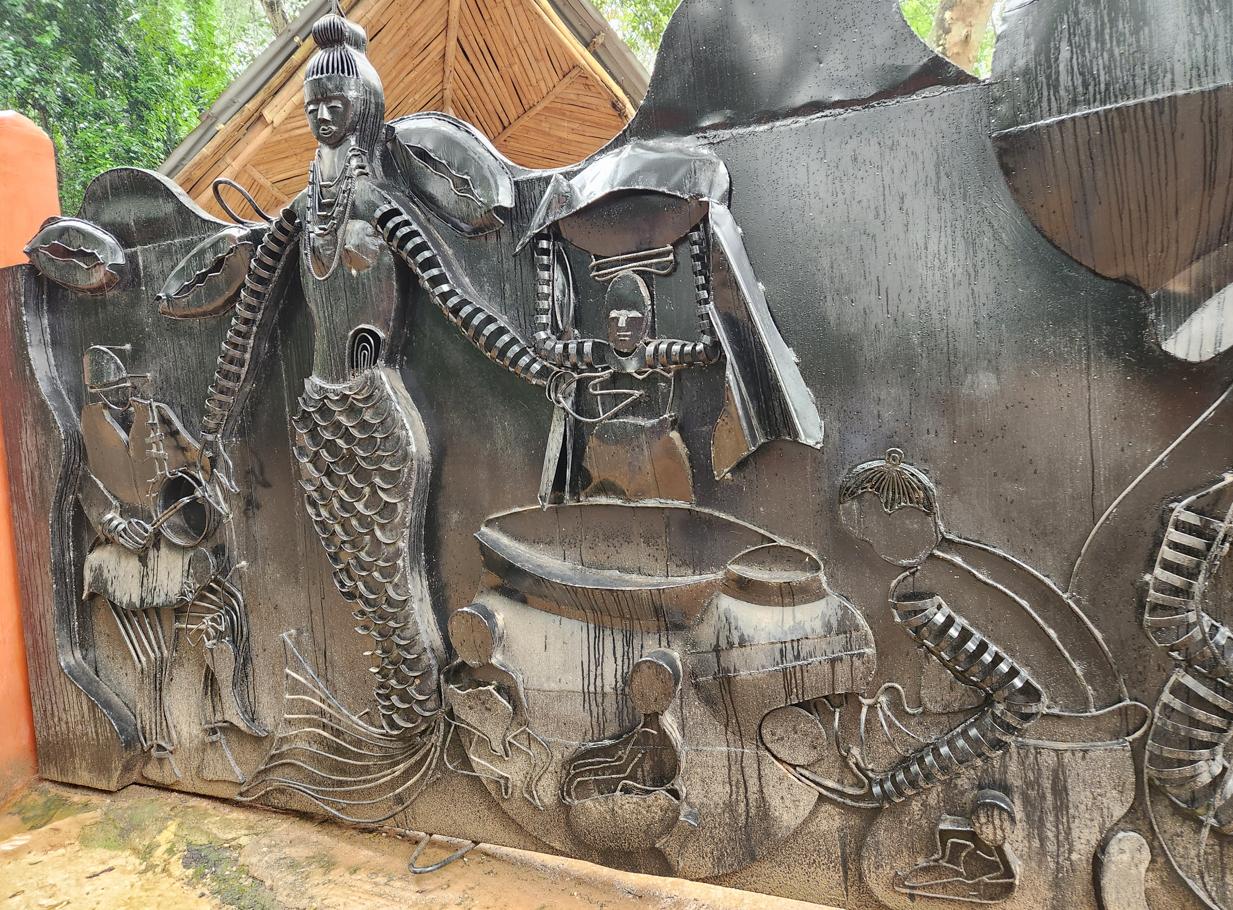
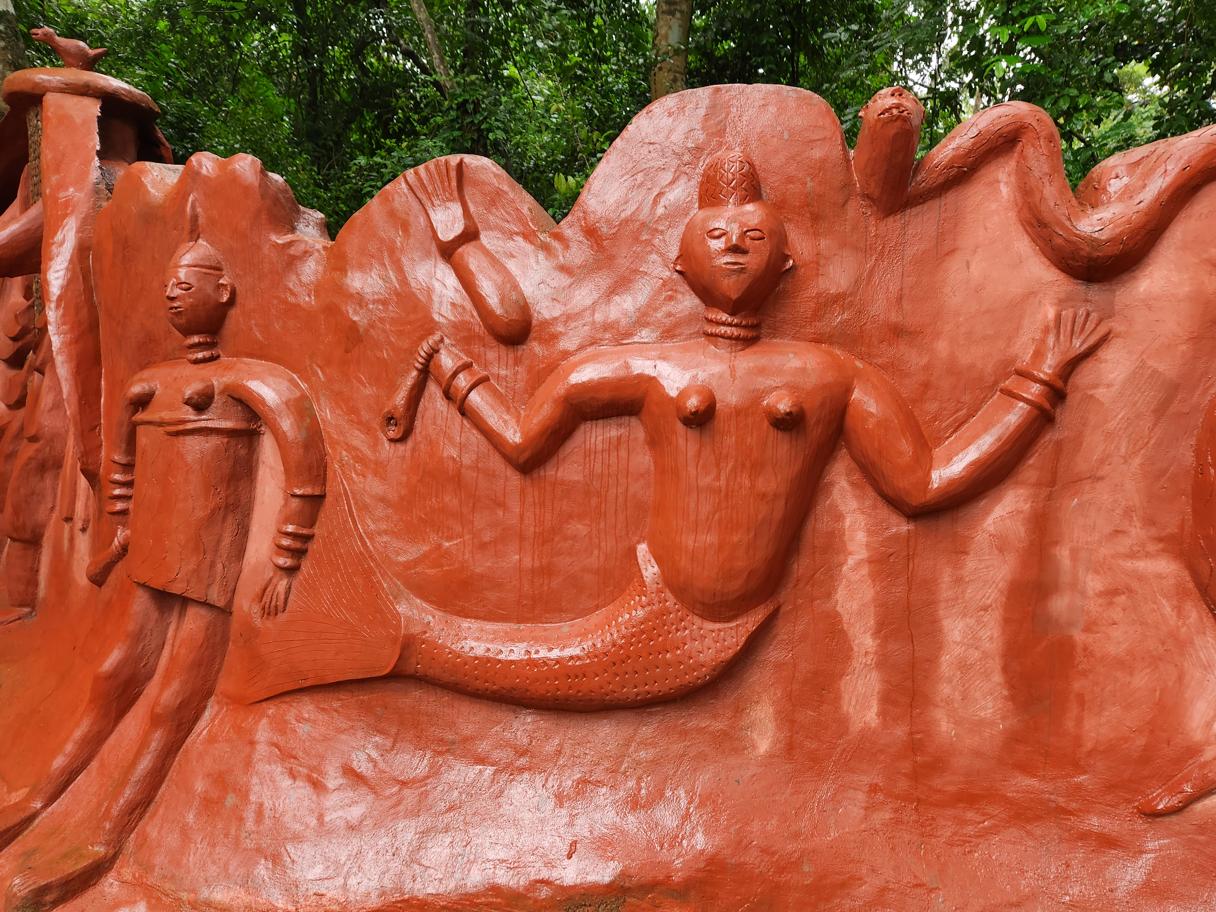
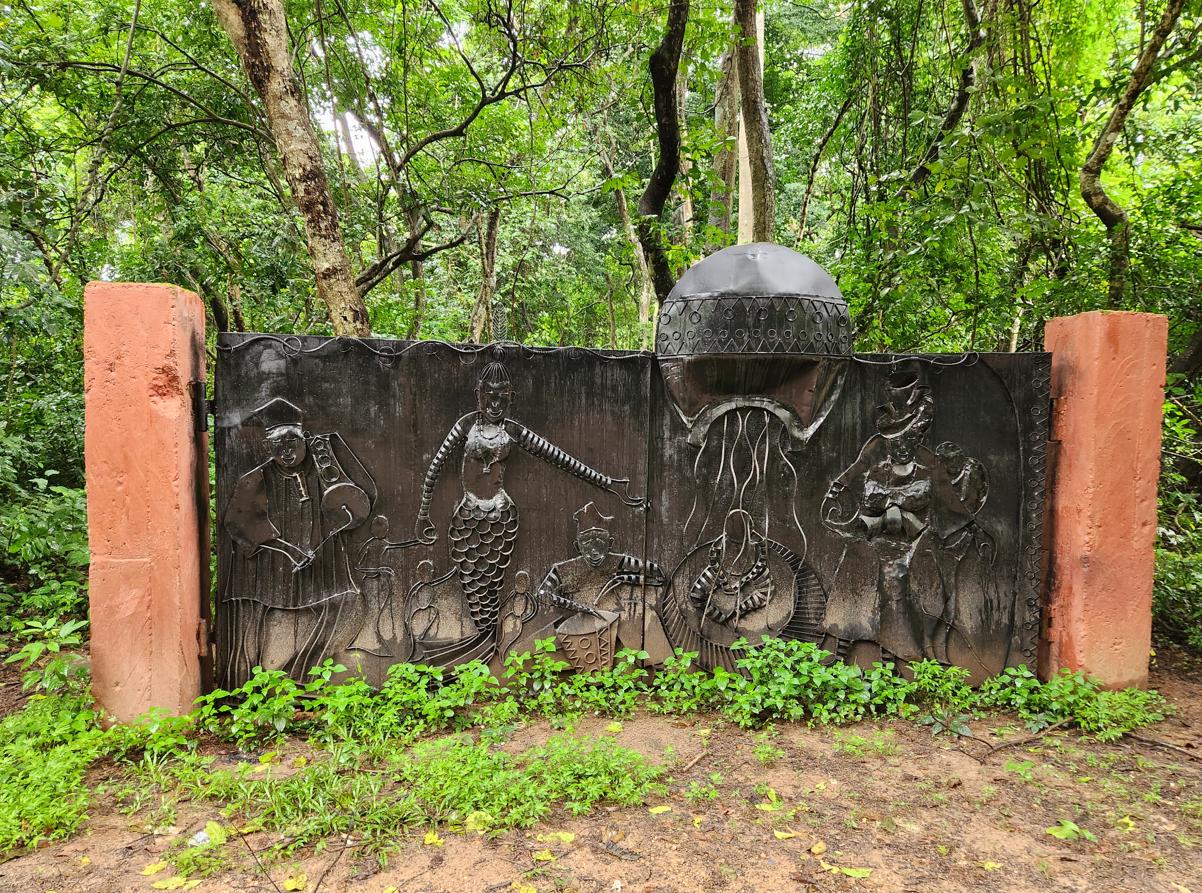
A long bas-relief frieze running along one of the grove's pathways tells the founding myth of Osogbo in sequential panels: a mermaid figure with a scaled lower body — Osun herself — on the left, followed by figures carrying vessels, drumming, processing toward a shrine. The frieze is darkened with age and the accumulation of offerings, the surface blackened in a way that gives it the weight of something very old, though parts of it were created well within living memory. This is the paradox at the heart of Wenger's project: work that is new but functions as ancient, sacred art that is also contemporary art, a World Heritage Site that is also a living place of worship where offerings are left and prayers are made.
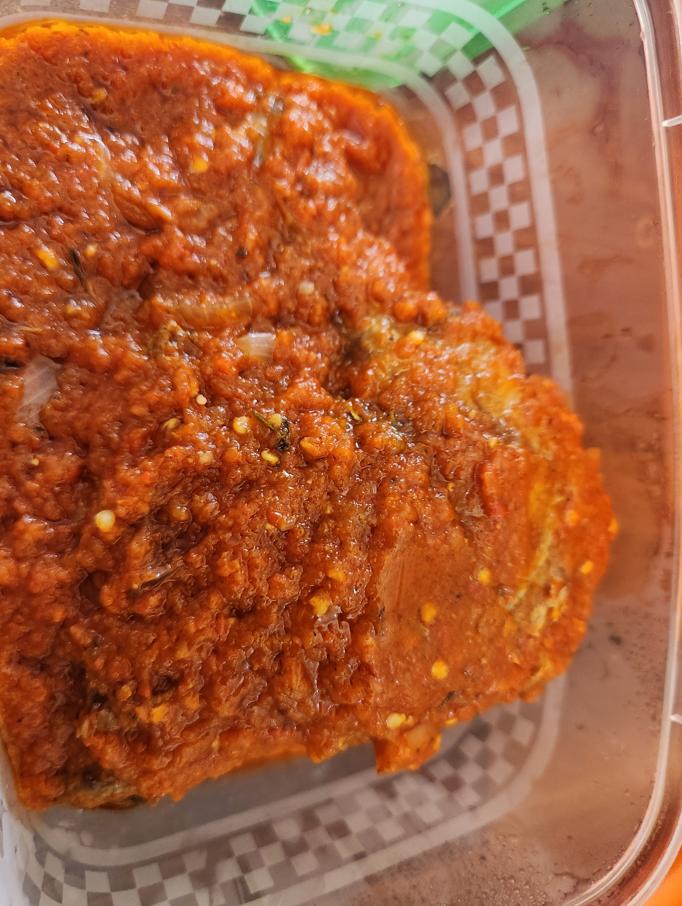
Before leaving the grove, we stopped to eat. The meal was the same grammar as lunch: a red plastic container, this time filled with pieces of grilled catfish blanketed in a rough-ground sauce of tomatoes, peppers, and aromatics — intensely red, coarsely textured, smelling of char and chilli and the specific dosage of smoked fish. The pepper, as ever, was an act of aggression that I had begun to regard as a form of affection.