Chapter 4: Abeokuta: Under the Rock

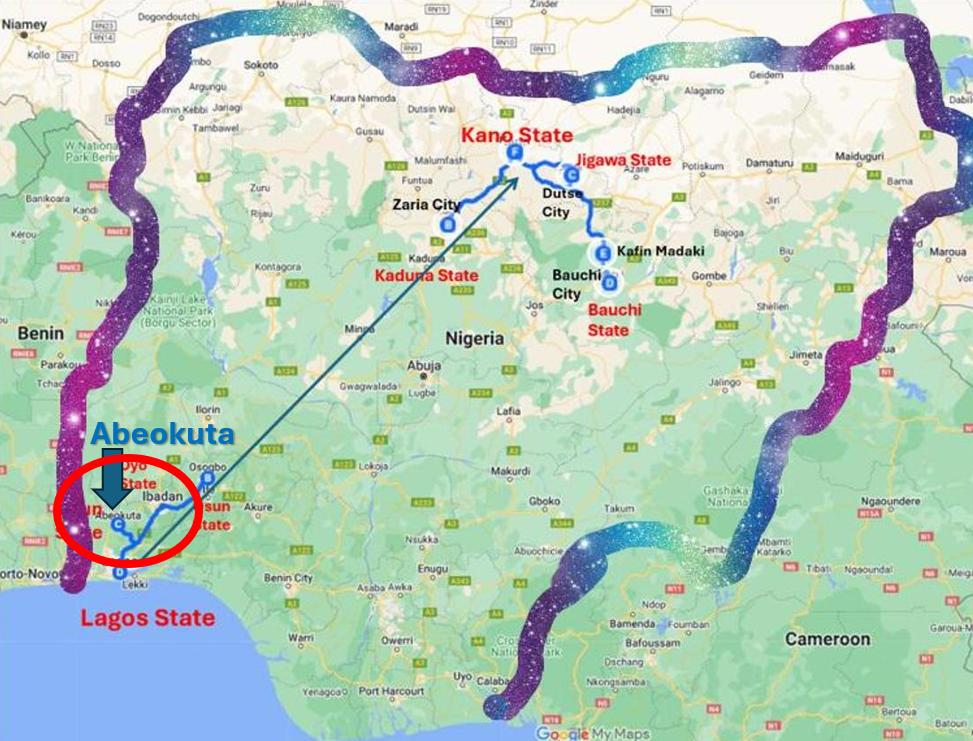
Abeokuta means, in Yoruba, “under the rock.” The city takes its name and its identity from a single geological fact: a vast granite inselberg, 137 metres high, that rises from the surrounding plain and has dominated the lives of the Egba people since they settled in its shadow in the nineteenth century. The name is not a metaphor. It is a description. The city exists because the rock was there first.
The Egba were originally part of the Oyo Empire, which collapsed under the pressure of Fulani jihad and internal conflict in the early decades of the 1800s. Driven from their homelands in successive waves of inter-tribal warfare, different Egba clans converged on Olumo Rock in the 1830s and found in it something they had not had for years: a defensible position. The rock is a natural fortress of the first order. Its caves and overhangs sheltered fighters and families. Its elevation gave defenders a clear view of enemy approach across the plain. The hunter Adagba, credited in oral tradition with first recognising the rock’s strategic value, would have understood immediately what any military man understands: that height is survival. Around the rock, over the following years, the Egba built what became Abeokuta. The city is, in origin, a refugee settlement that outlasted its emergency.
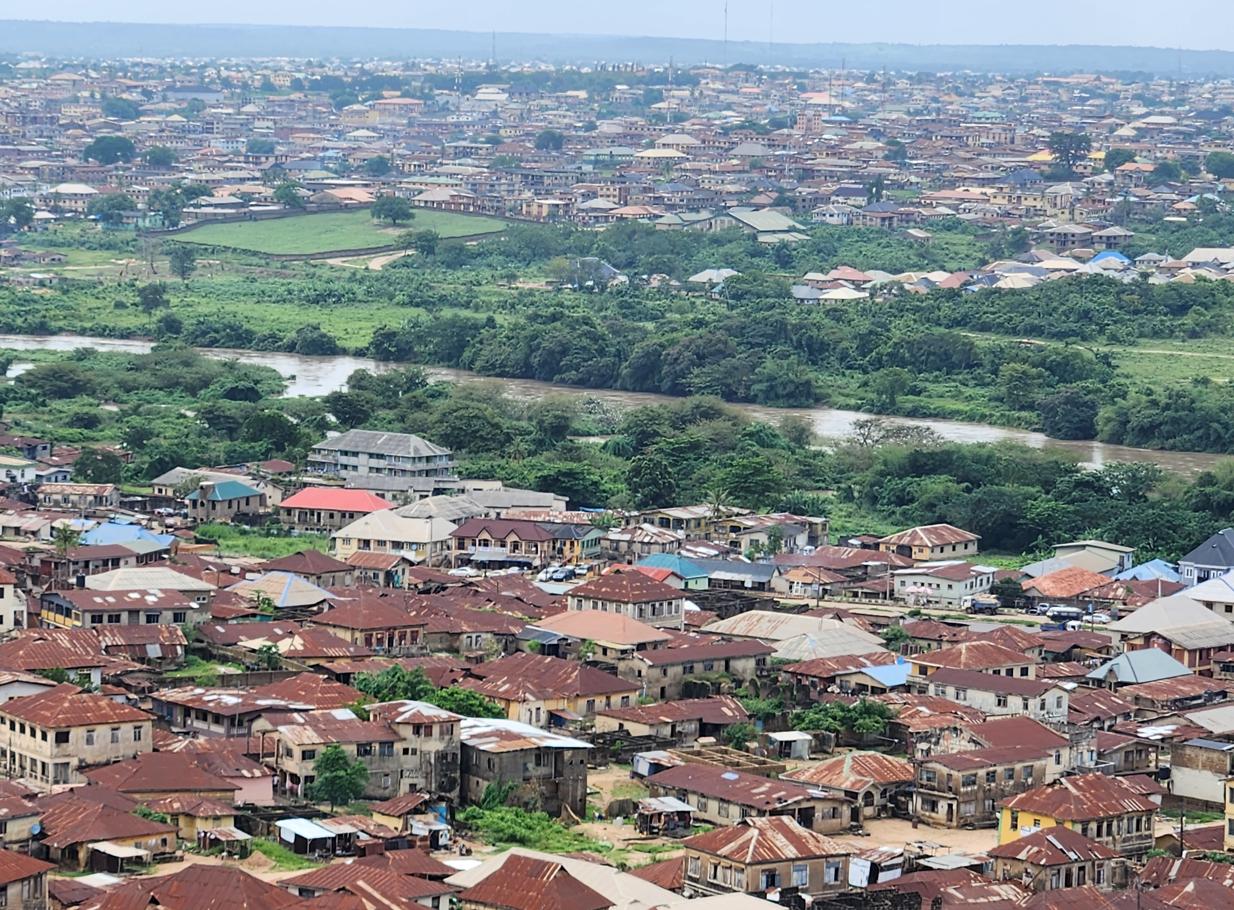
Abeokuta is also the city of Wole Soyinka and Fela Kuti — a fact the city mentions often, as cities tend to do with their most famous sons. It is the capital of Ogun State, which styles itself the “Gateway State,” a reference to its position between Lagos and the interior. It is known for adire, the traditional Yoruba indigo-resist textile, whose production remains a live craft industry in the markets near the rock. And it is the city where the Church Mission Society (CMS) missionary Henry Townsend established Nigeria’s first printing press in 1859, producing the country’s first newspaper, Iwe Irohin, in both Yoruba and English. Abeokuta was, for a time, one of the most literate cities in West Africa — a distinction earned in part because the Egba, hemmed in by enemies and dependent on British protection, concluded early that literacy was a form of armament.
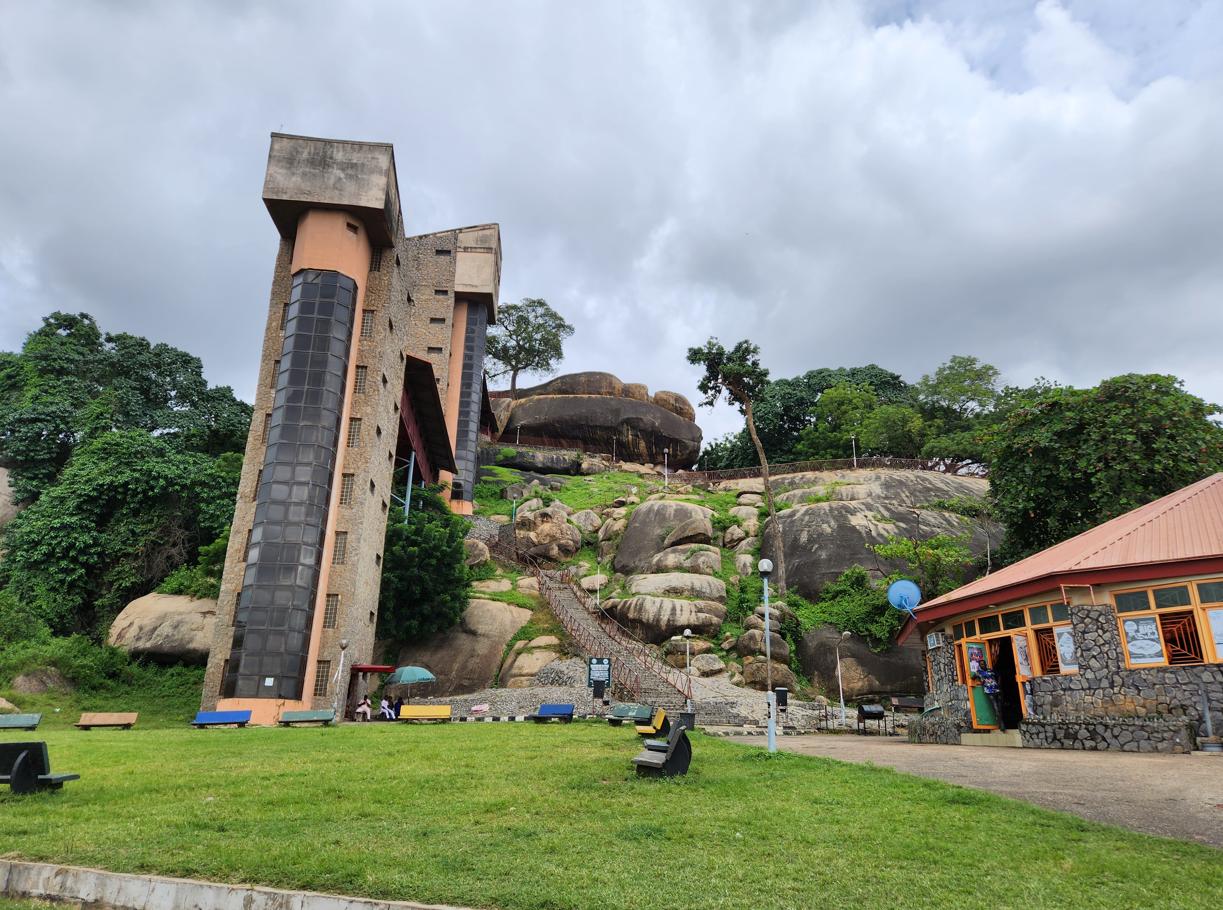
We arrived at the Olumo Rock Tourist Complex in mid-morning, when the light was still low enough to make the granite glow. The approach from below is theatrical: two stone-clad lift towers rise from the rock face, connected at height by a red steel bridge, with stone stairs and iron railings cutting diagonally up the slope between them. The complex was commissioned in 2006 by former President Olusegun Obasanjo, himself an Abeokuta man, in what might be read as an act of homecoming as much as heritage policy. The infrastructure is government-issue and has aged accordingly — the concrete stained, the paintwork peeling in the humidity — but the rock itself is indifferent to such things. It predates every government Nigeria has ever had by approximately 1.5 million years.
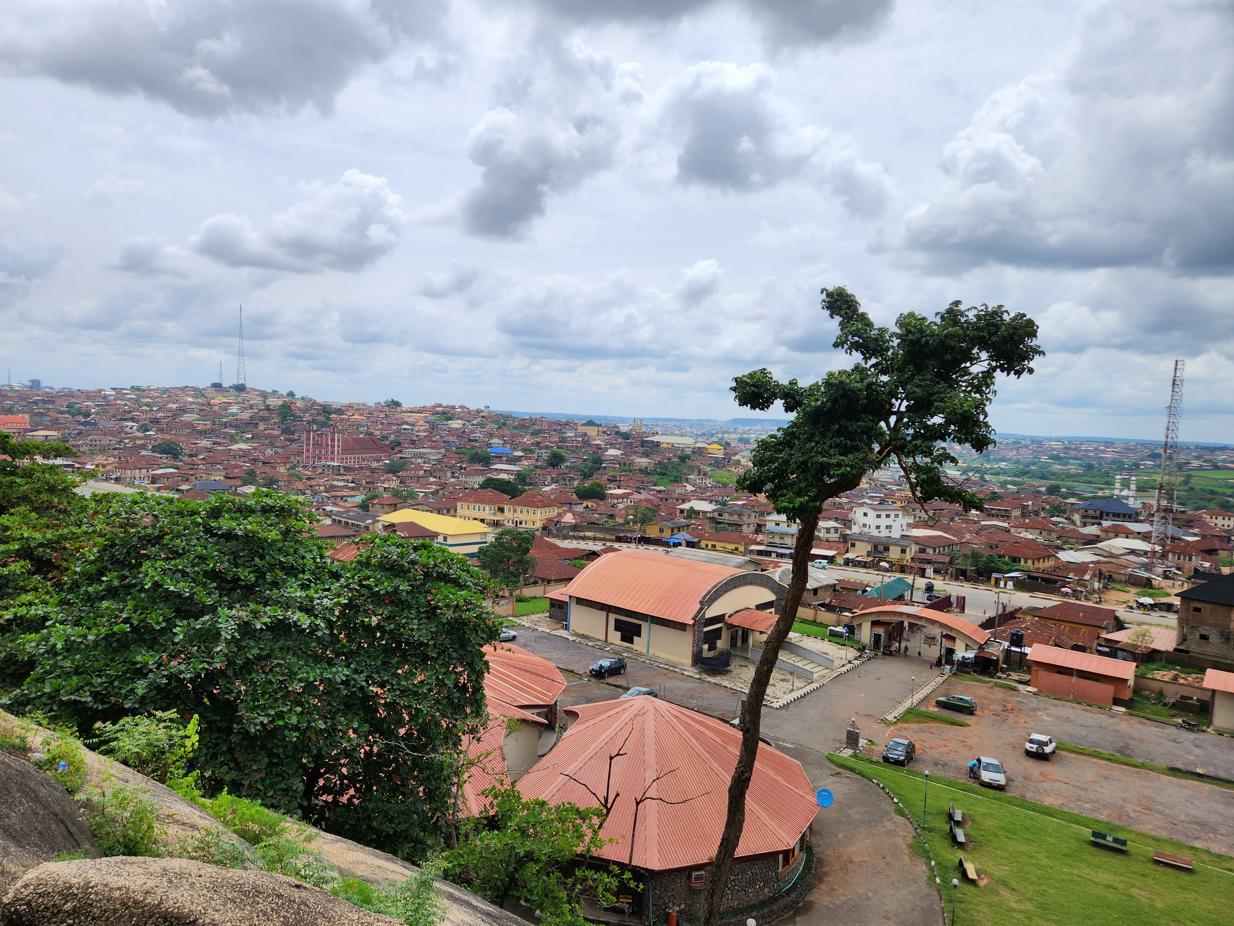
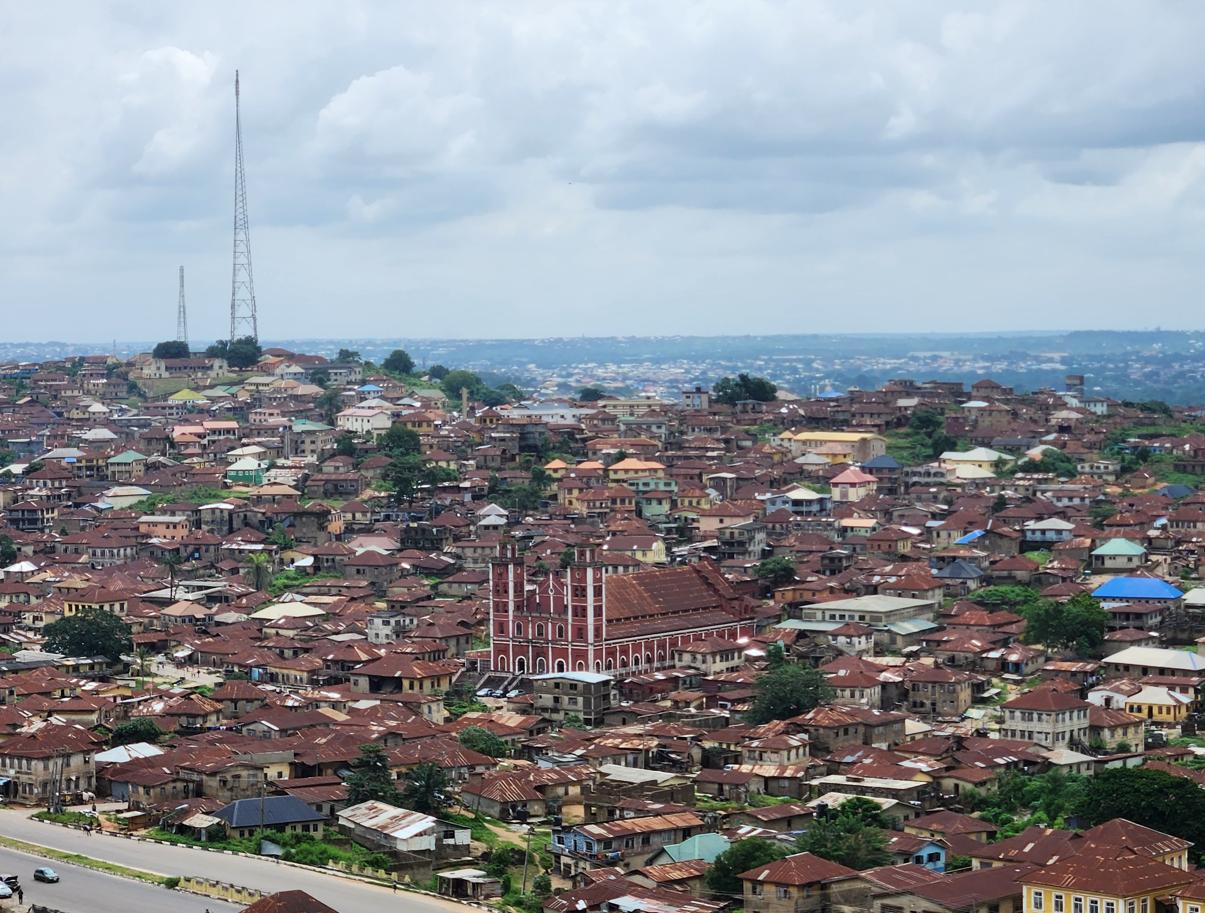
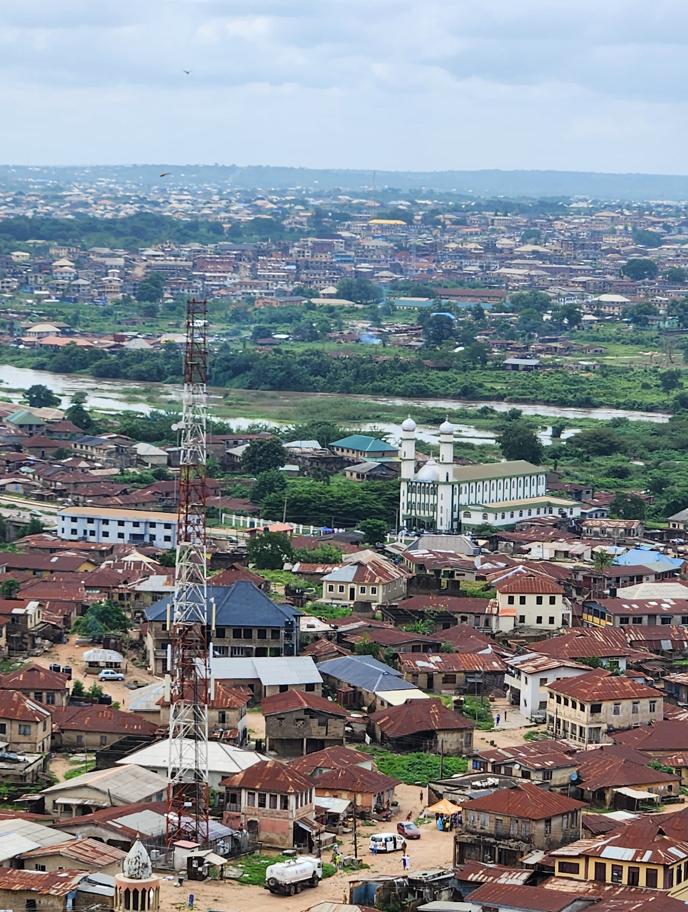
Red and I took the lift. It is the sort of lift that makes you grateful it exists and aware that it probably shouldn’t be entirely trusted. At the top, the rock opens into a succession of ledges and plateaus, each offering a wider view than the last. The city below is a sea of terracotta rooftops extending to every horizon, broken by the white minaret of a mosque, the glint of the River Ogun in the middle distance, and, here and there, the improbable green of trees that have somehow persisted between the compounds. It is immediately clear why the Egba chose this vantage point: from up here, you could see an army forming before it had assembled. The view is the whole argument.
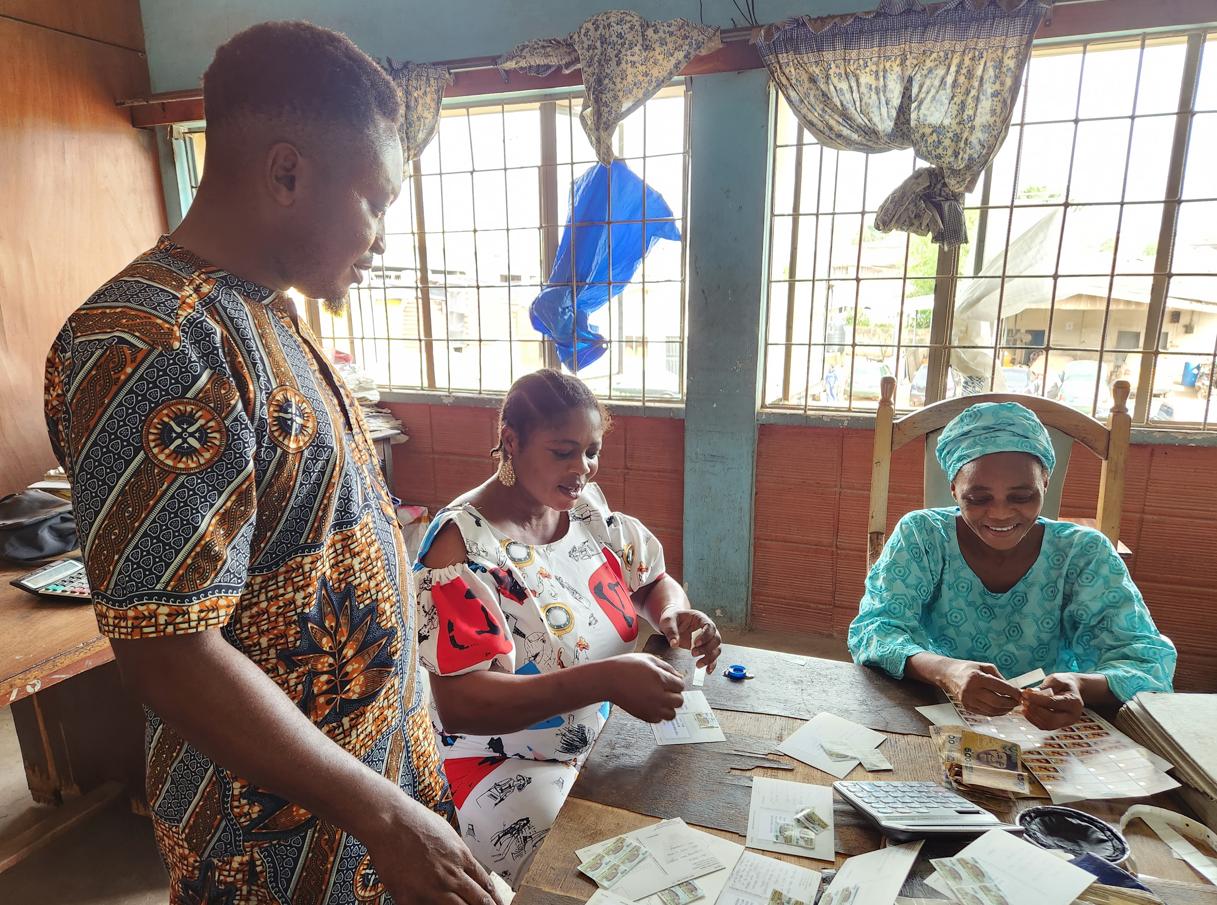
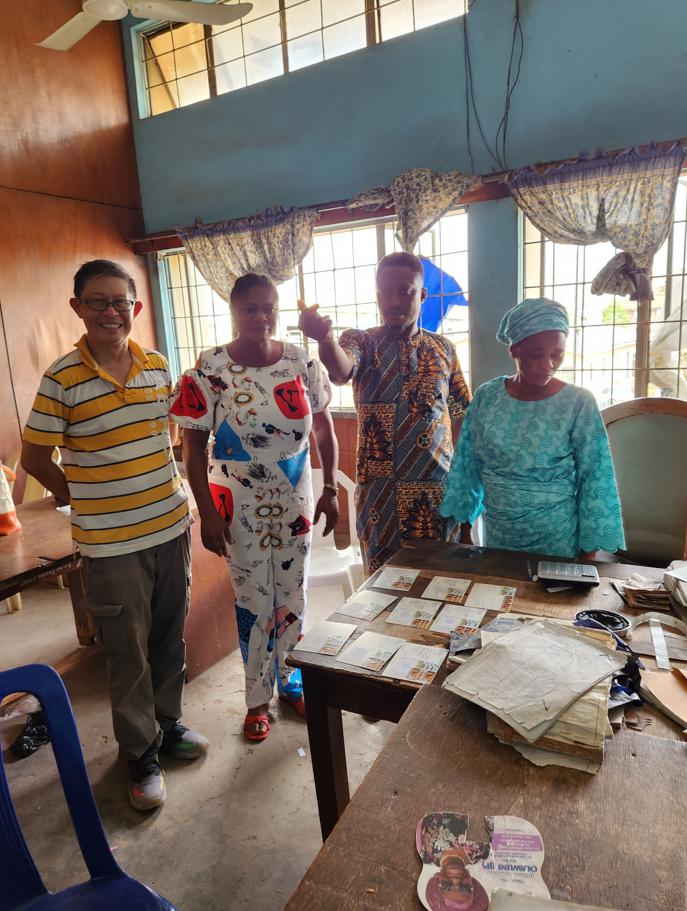
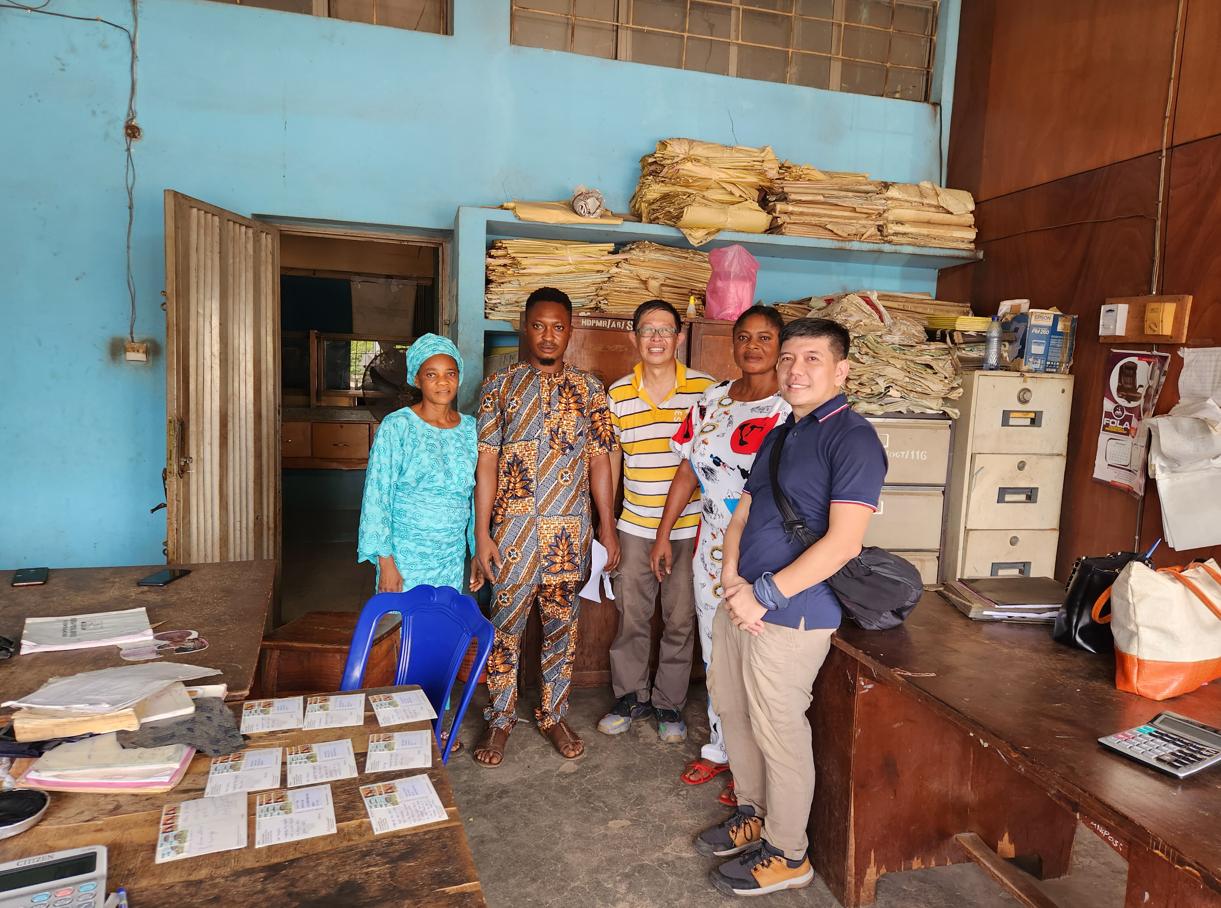
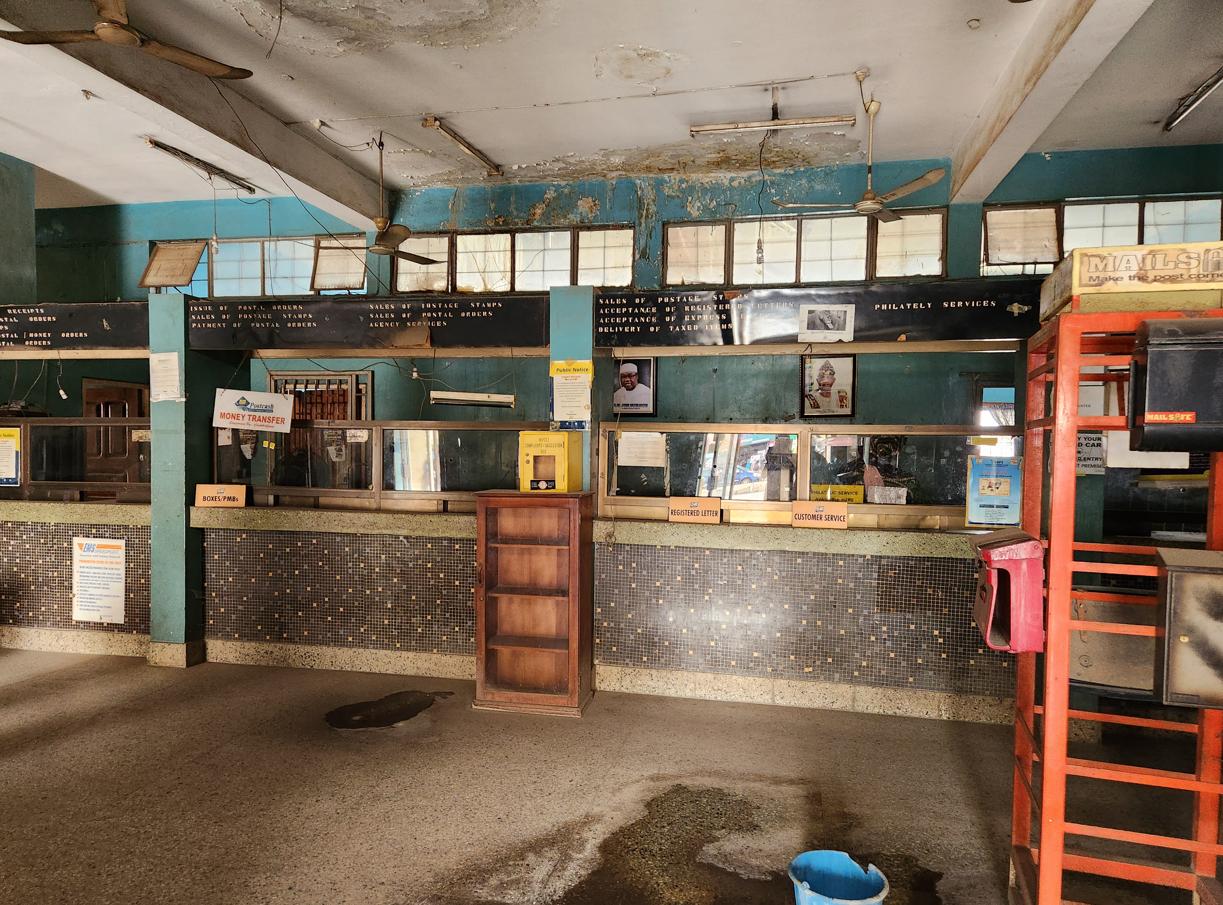
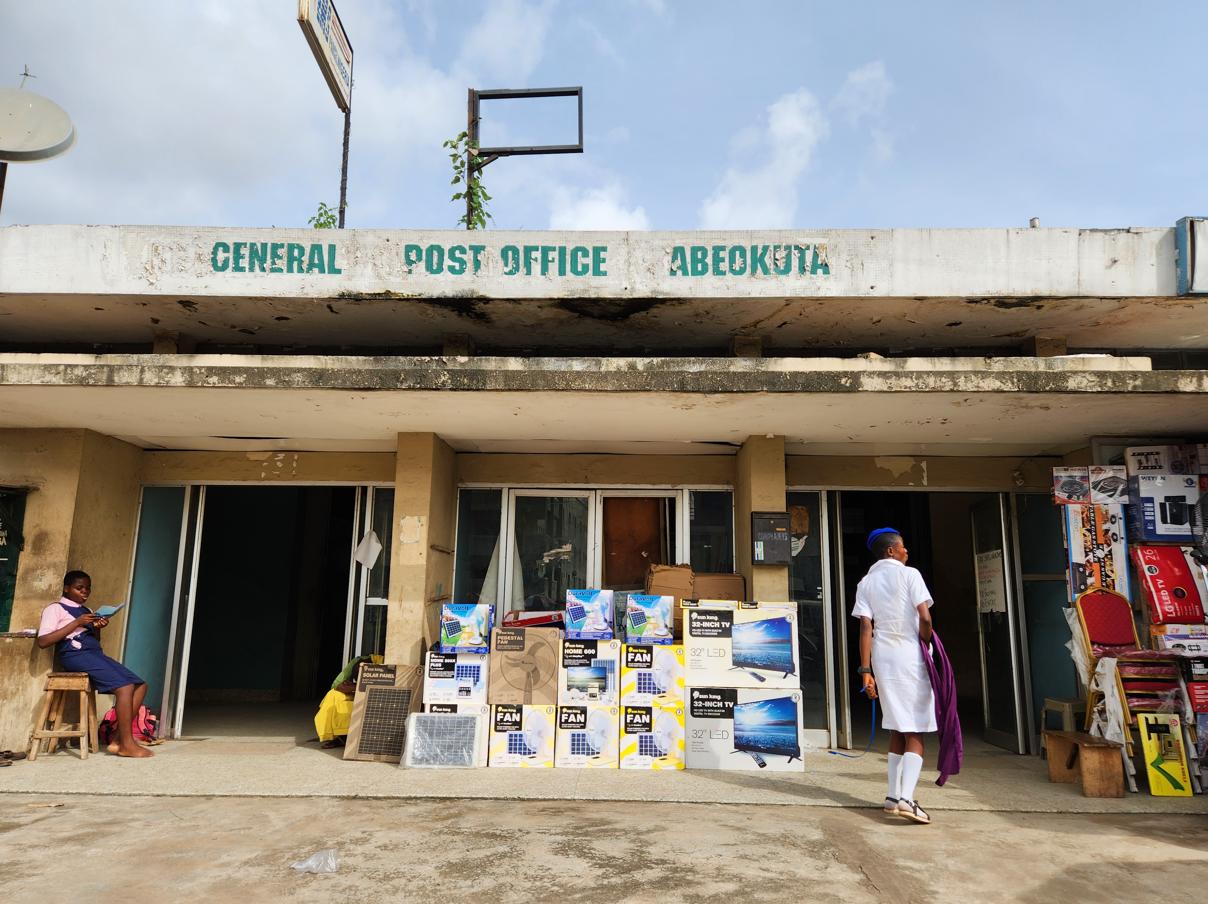
Friendly post office staff helping us to send post cards.
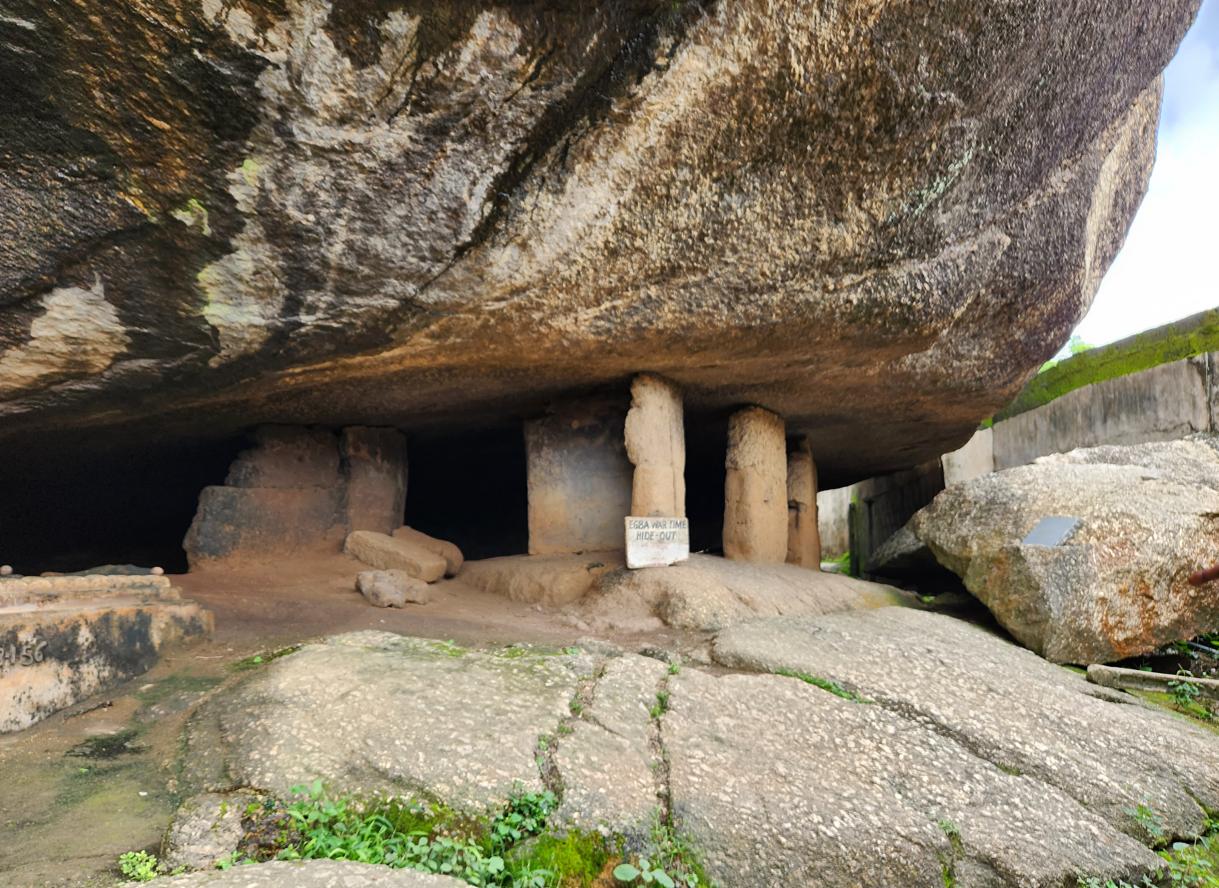
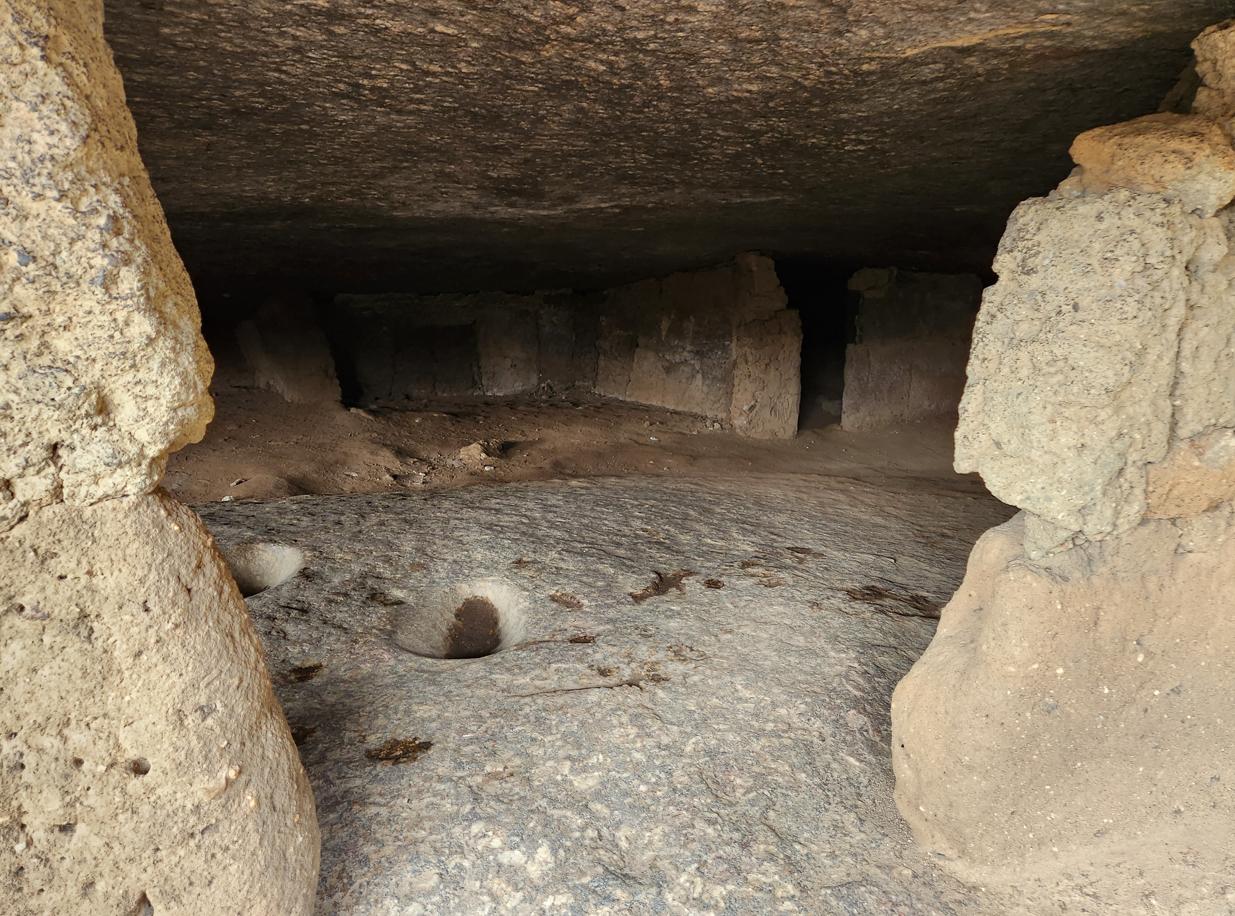
Tucked into the rock’s lower flanks is the section the guides call Abe Okuta — the original inhabited space, where the first Egba settlers lived within the overhangs and caves. Here the rock forms a natural roof several metres above a sandy floor, supported by columns of stone that the earliest occupants supplemented with carved wooden pillars. The caves were not merely shelters. They were, for a time, a city. Depressions ground into the rock surface mark where grain was processed; the tomb of Chief Sanni, the rock’s first caretaker, is preserved here still. The space is cool and dim and smells of earth and old stone. A small sign in front of the innermost chamber says, with quiet authority: “EGBA WAR TIME HIDE OUT.”
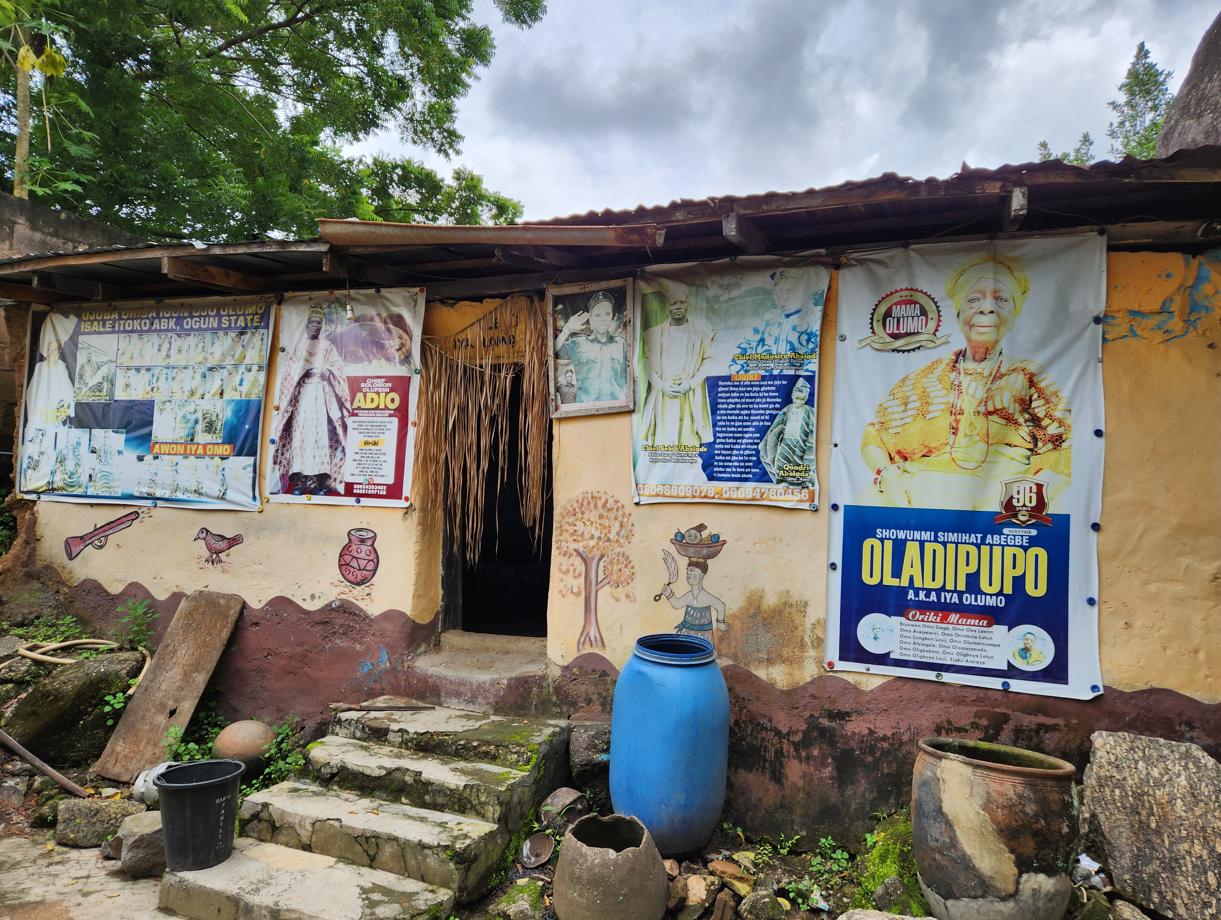
Alongside the cave area, a small compound sits against the rock face: a low building of painted concrete, its exterior walls hung with printed vinyl banners and its forecourt crowded with clay pots, black buckets, and the general paraphernalia of devotion. The banners announce, in large type, “MAMA OLUMO” and identify her as Showunmi Simihat Abegbe Oladipupo, known as Iya Olumo. The rock, in the Yoruba religious tradition, has its own Orisha, its own animating spirit, and the women who serve as its custodians are understood to partake of that spirit. Iya Olumo is both a religious office and, one suspects, a practical necessity: the rock requires tending, and someone must tend it. The walls behind the banners carry older painted murals — a woman balancing a load on her head, a bird, a calabash — and photographs of previous title-holders going back several generations, their faces looking out from frames half-obscured by the newer, glossier commercial imagery. The sacred and the promotional in unforced adjacency: again, that distinctly Nigerian arrangement.
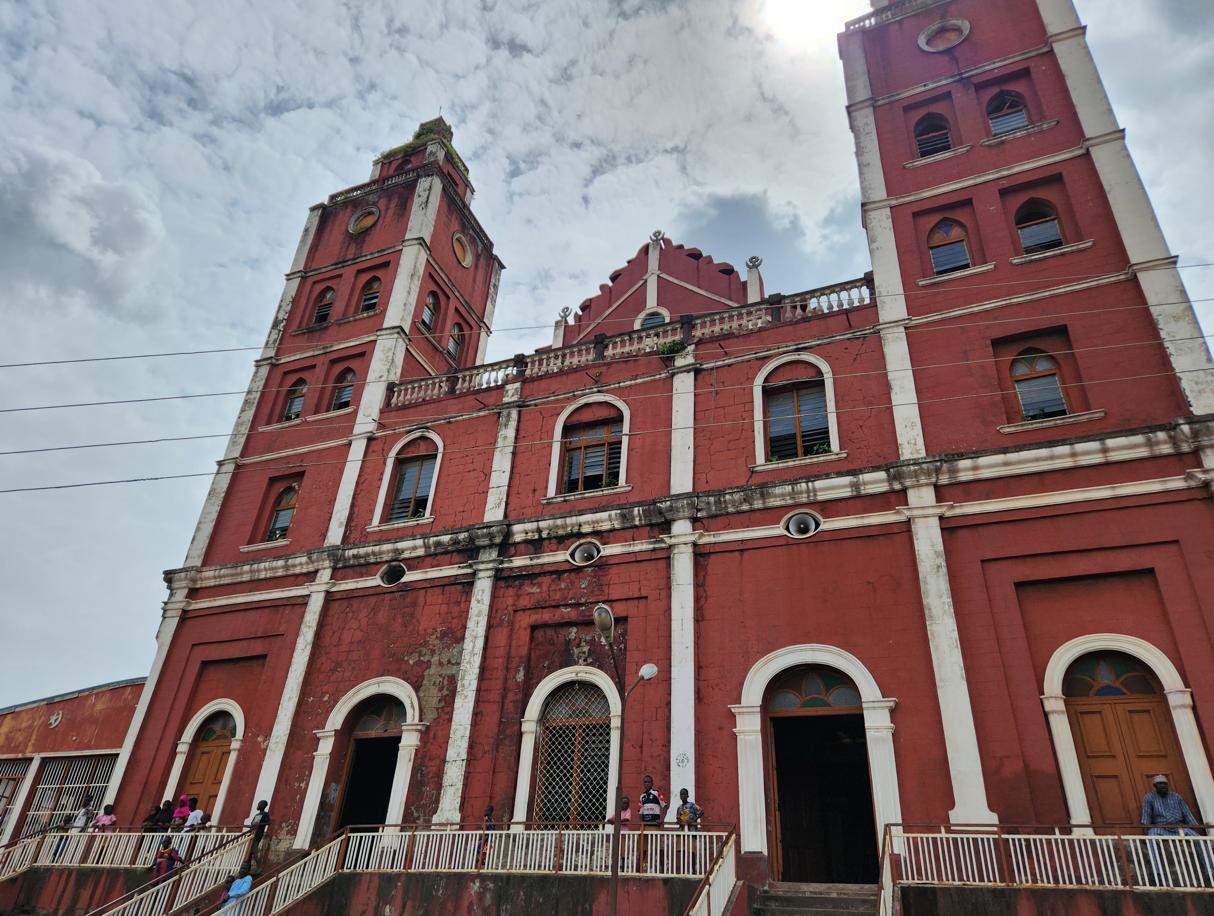
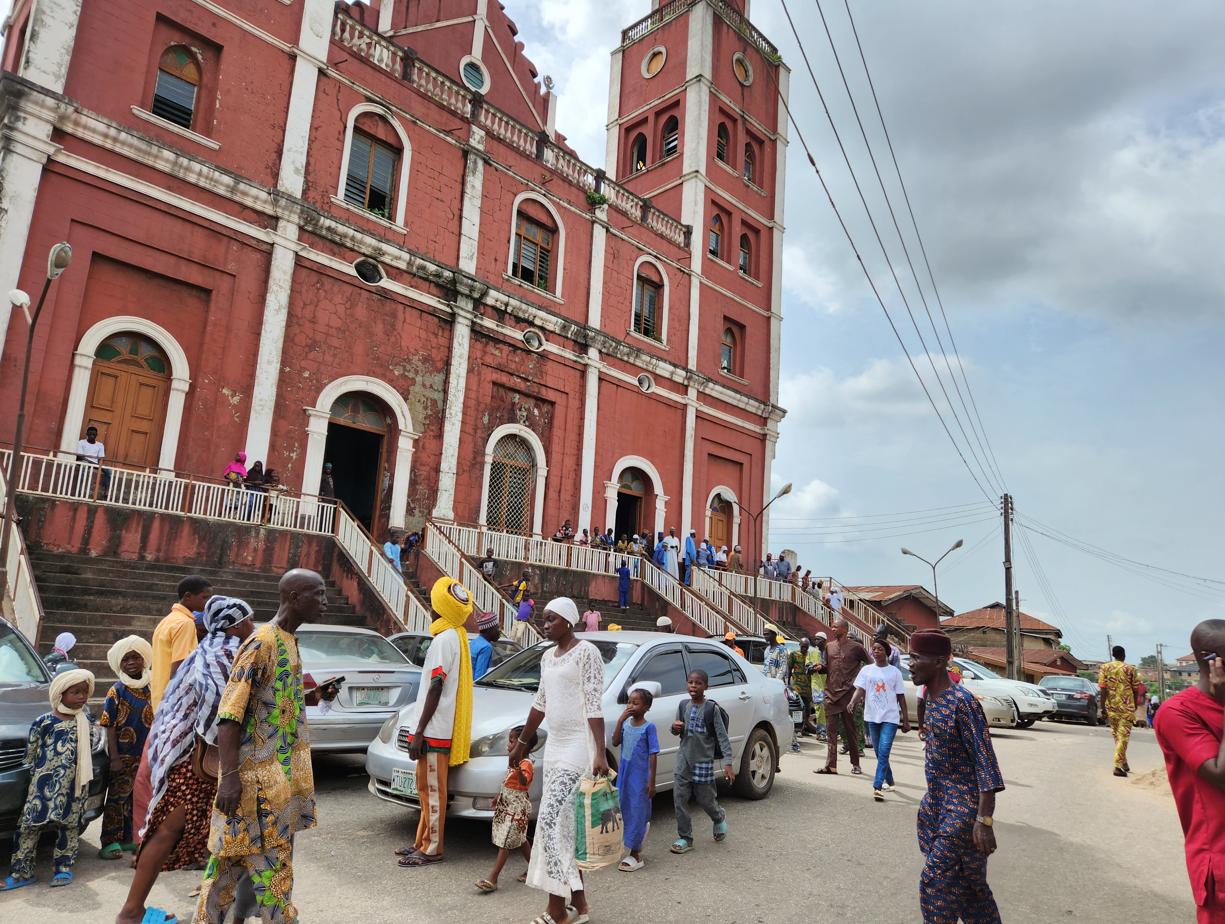
Beyond the rock, the city offers other legacies. Abeokuta was one of the principal points of contact between the Yoruba world and the nineteenth-century missionary enterprise, and the architectural result is still visible in the streetscape. On one street we passed a large church of red laterite brick, its façade flanked by twin towers in a Baroque-inflected style that has its closest relatives not in England but in Brazil — a consequence of the returnee community of freed slaves, the Aguda, who came back from Bahia in the second half of the nineteenth century and brought with them a hybrid architectural vocabulary that grafted Catholic church forms onto West African urban fabric. The building stands on a slight rise, its red walls peeling in long vertical strips, the mortar between the bricks darkened with a century and a half of harmattan dust and tropical rain. It looked simultaneously ancient and recently abandoned, though it was neither: people were sitting on its front steps in the manner of people who sit on steps every day.
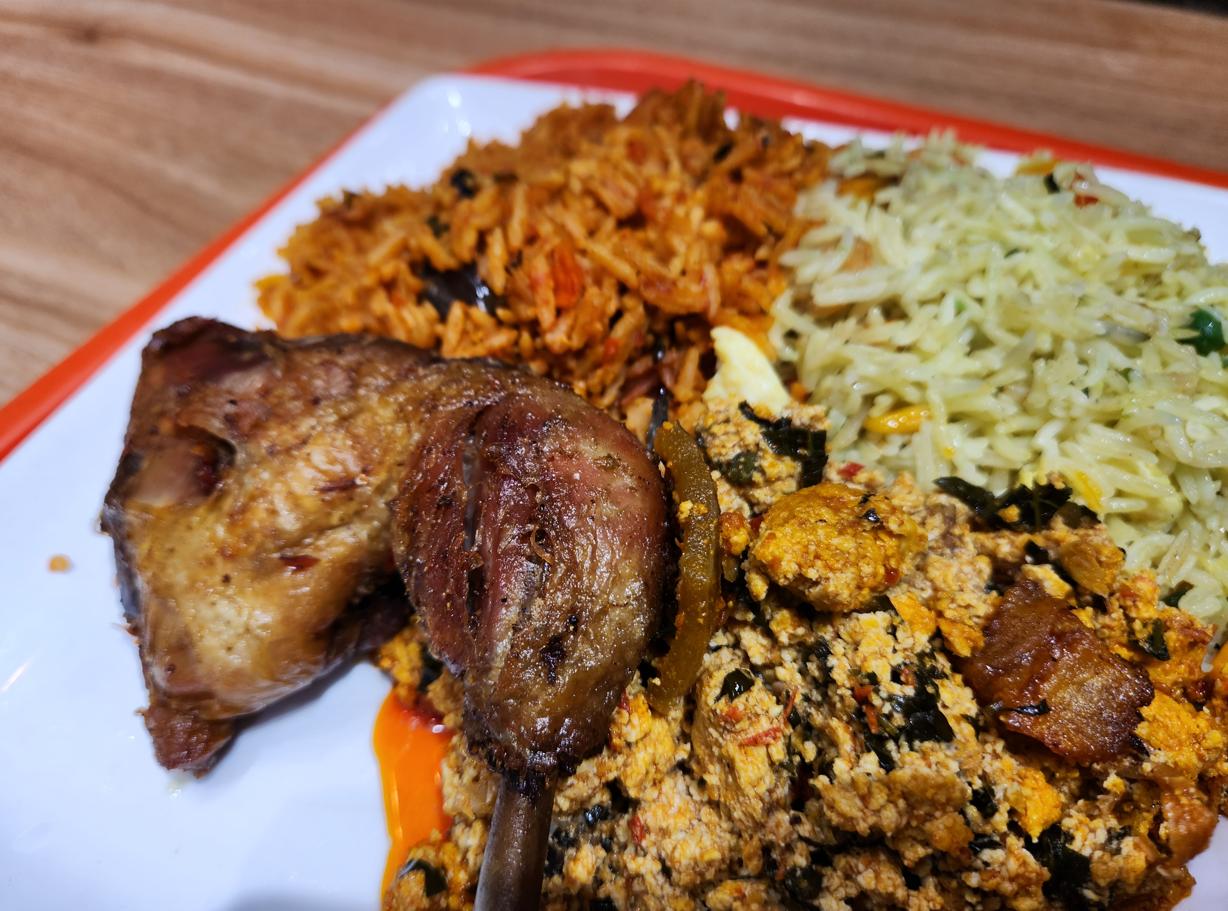
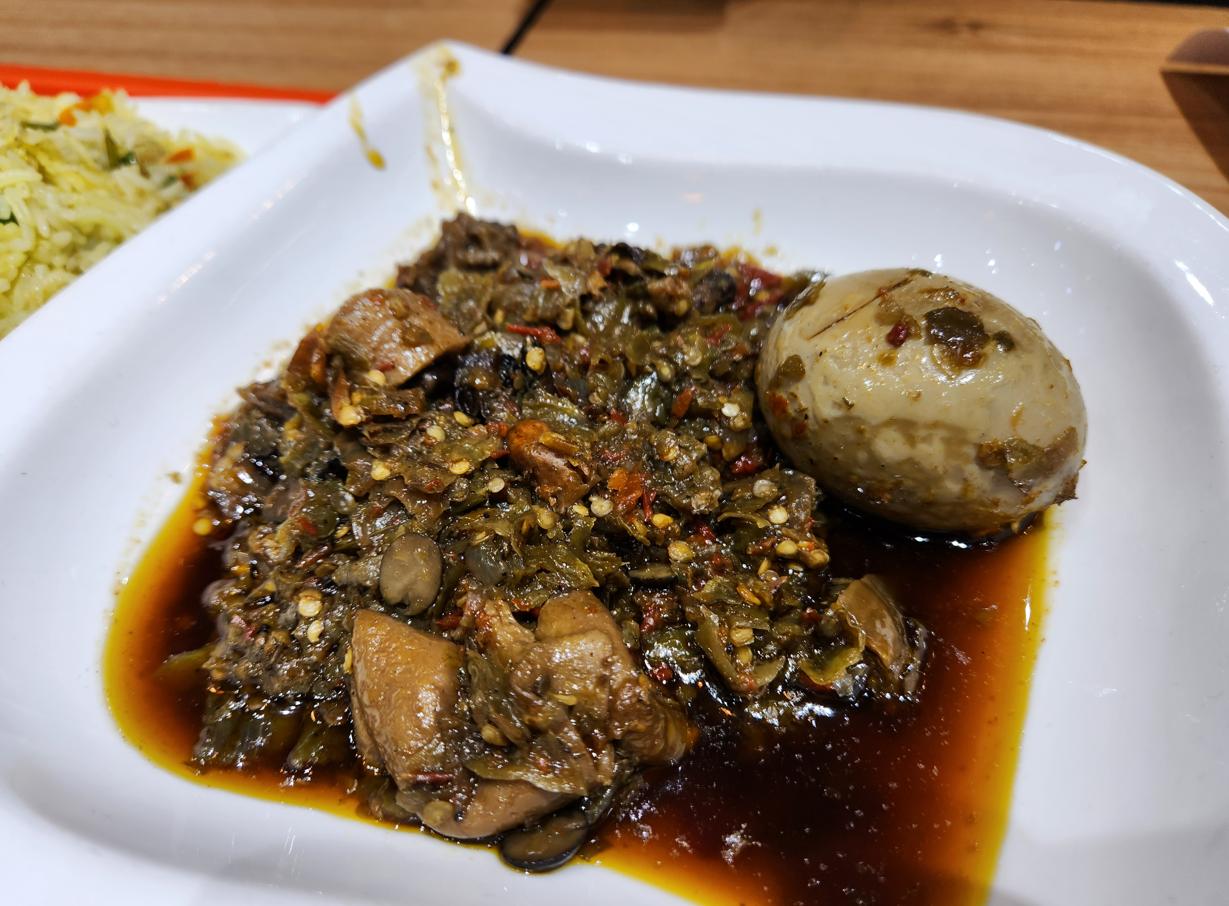
We ate in the afternoon: a plate arranged with jollof rice alongside fried rice, egusi stew thick with dark greens and pieces of meat, and a skewer of grilled offal — the small, dense spheres that Nigerians call ponmo or that arrive on a stick and require no further identification. This was not the bukateria roughness of Osogbo but a cleaner, more deliberate presentation: the red and yellow of the two rices side by side, the egusi’s deep ochre sauce catching the light. It tasted, as Nigerian food consistently does, of a cook who had made no concessions to foreign palate or to hurry. The pepper, as ever, arrived late and stayed long. A second dish came: efo riro or something close to it, a dark stew of fermented locust beans, goat, and sliced greens so thoroughly cooked they had become part of the sauce, with a single boiled egg sitting at the rim of the bowl like a full stop. Red, whose tolerance for chilli runs considerably ahead of mine, greeted each escalation in heat with the quiet satisfaction of someone whose expectations are finally being met.
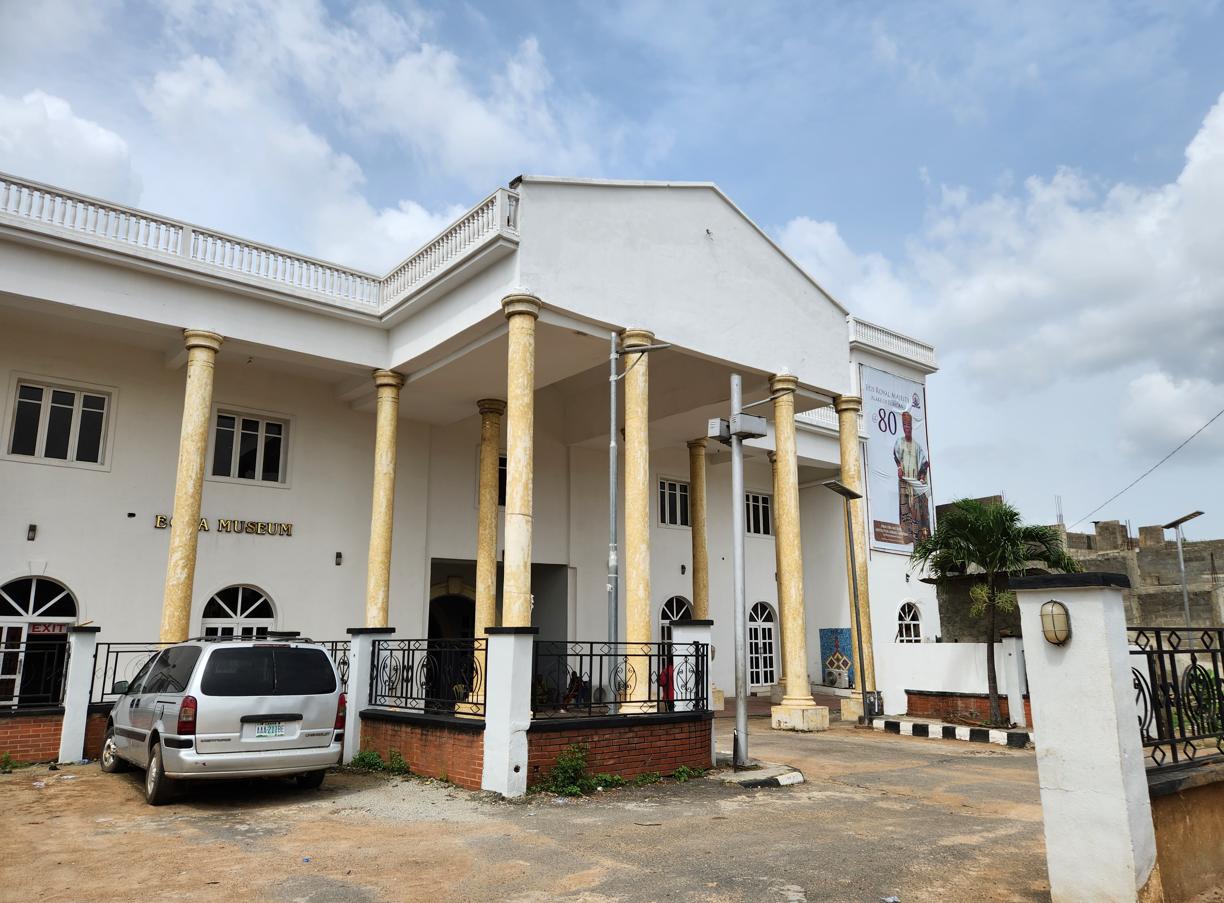
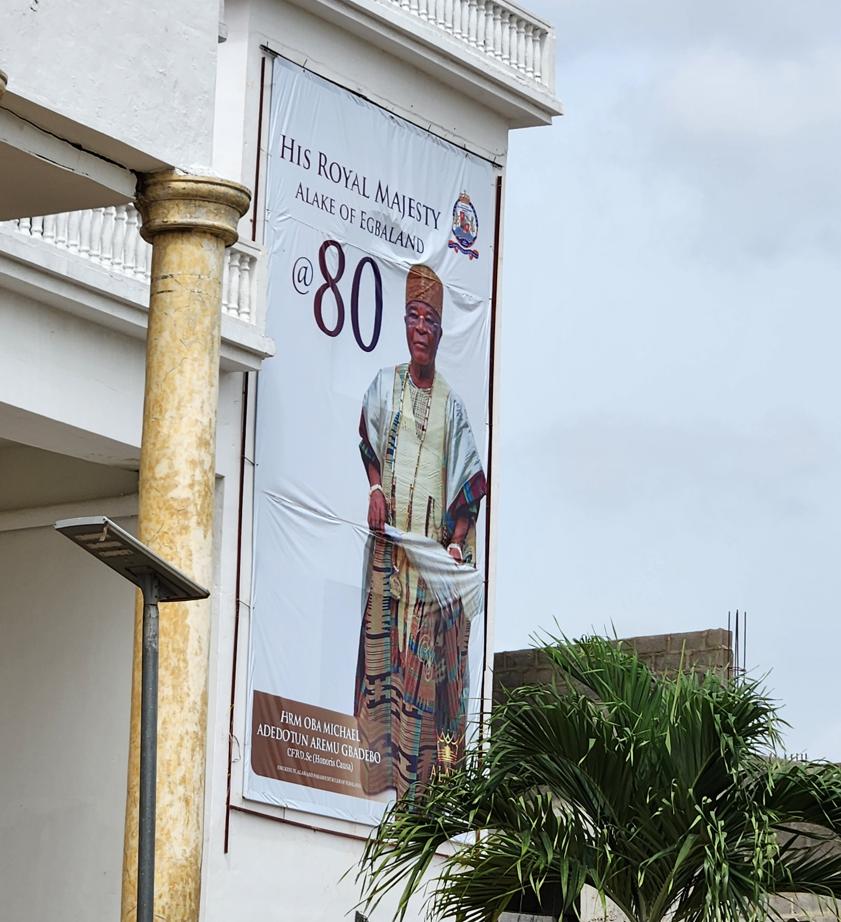
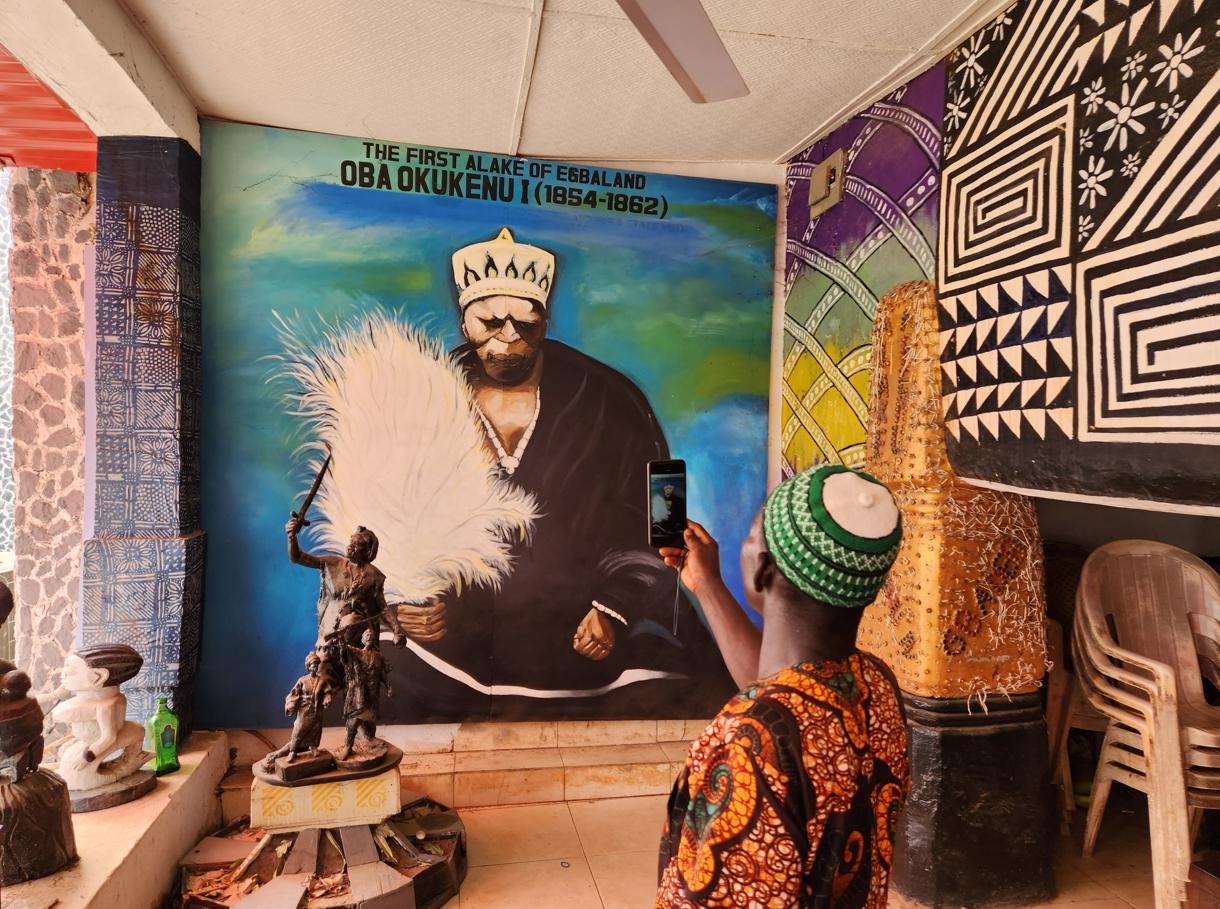
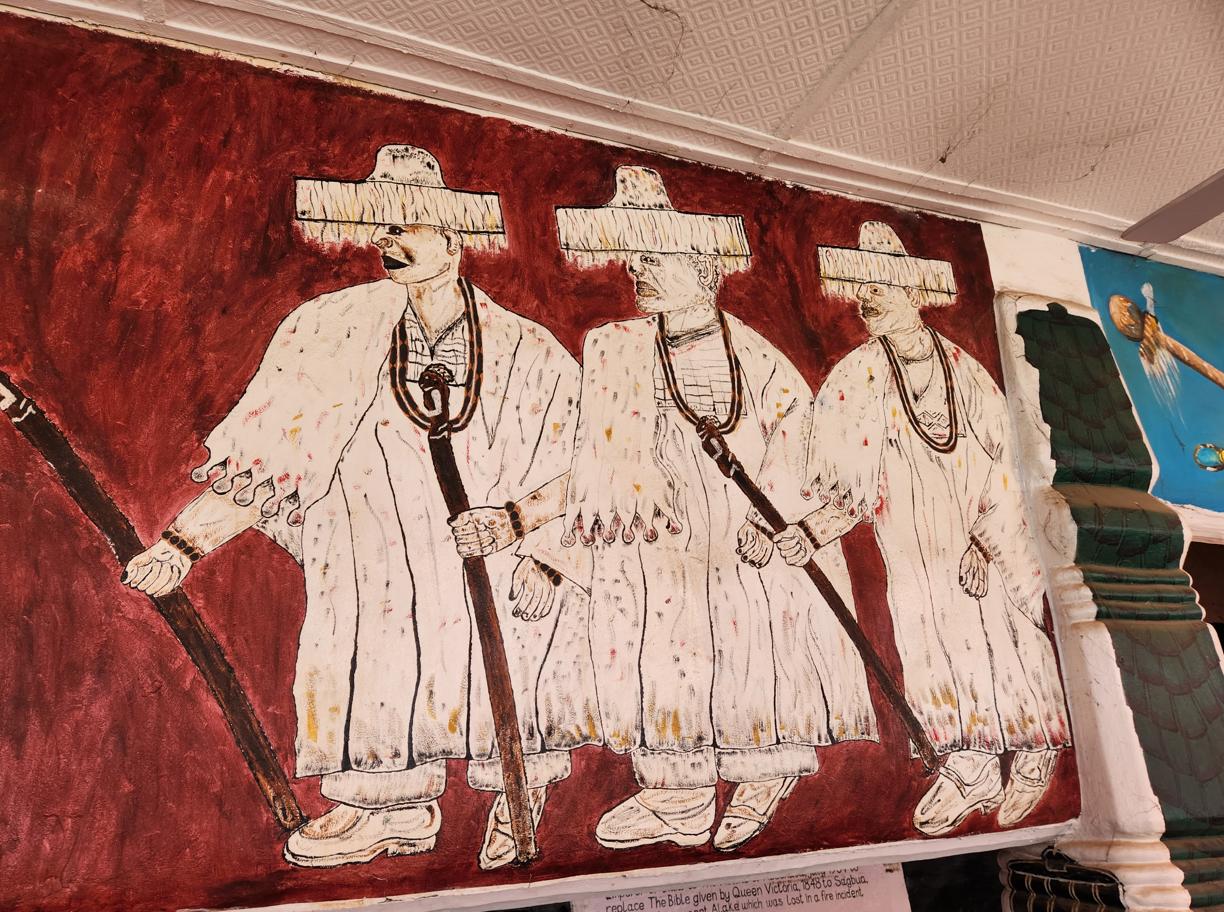
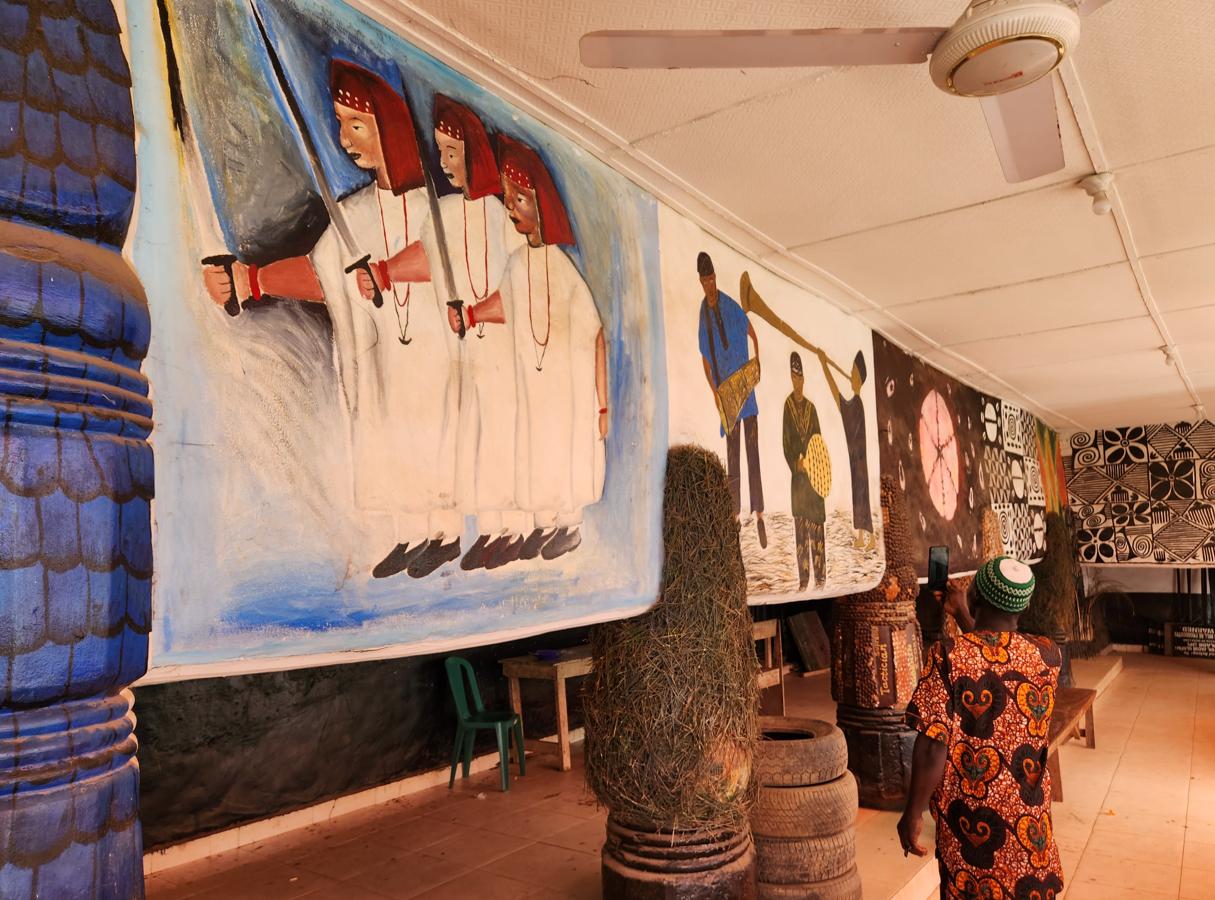
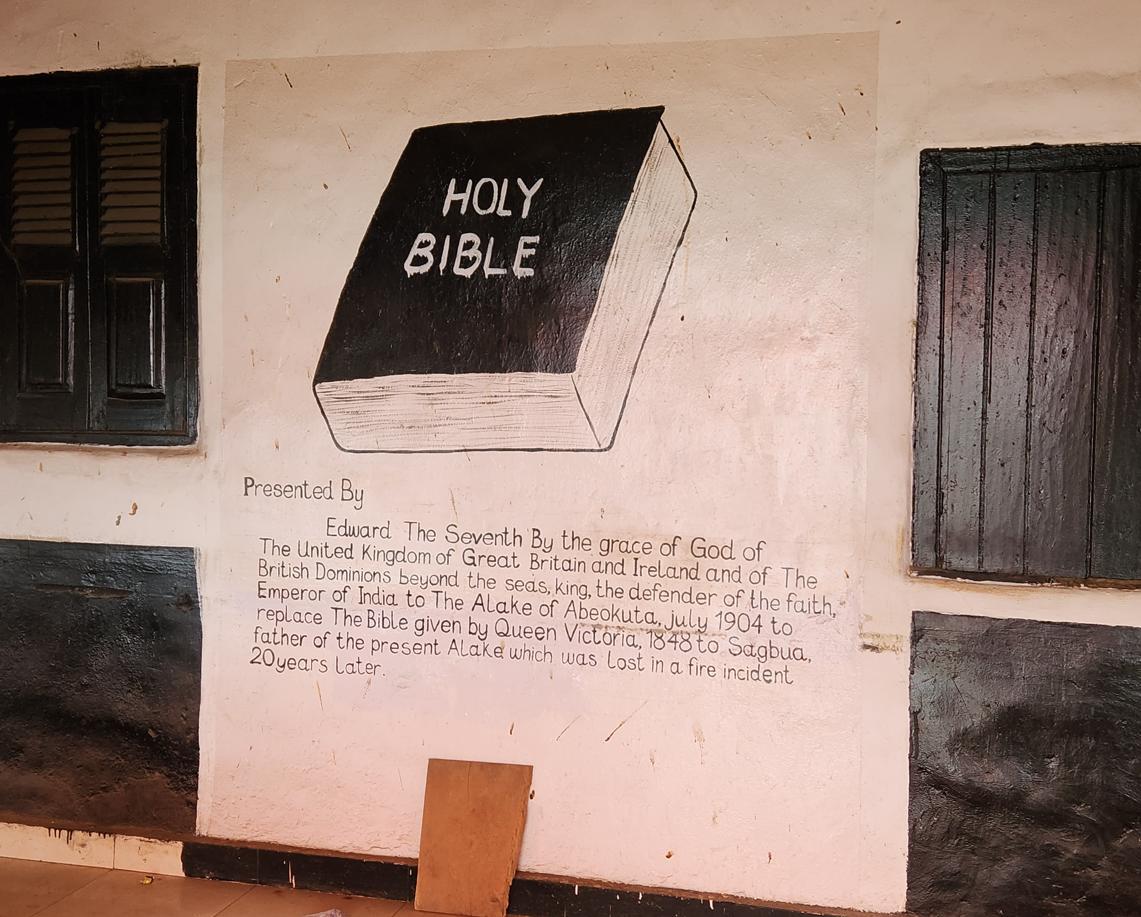
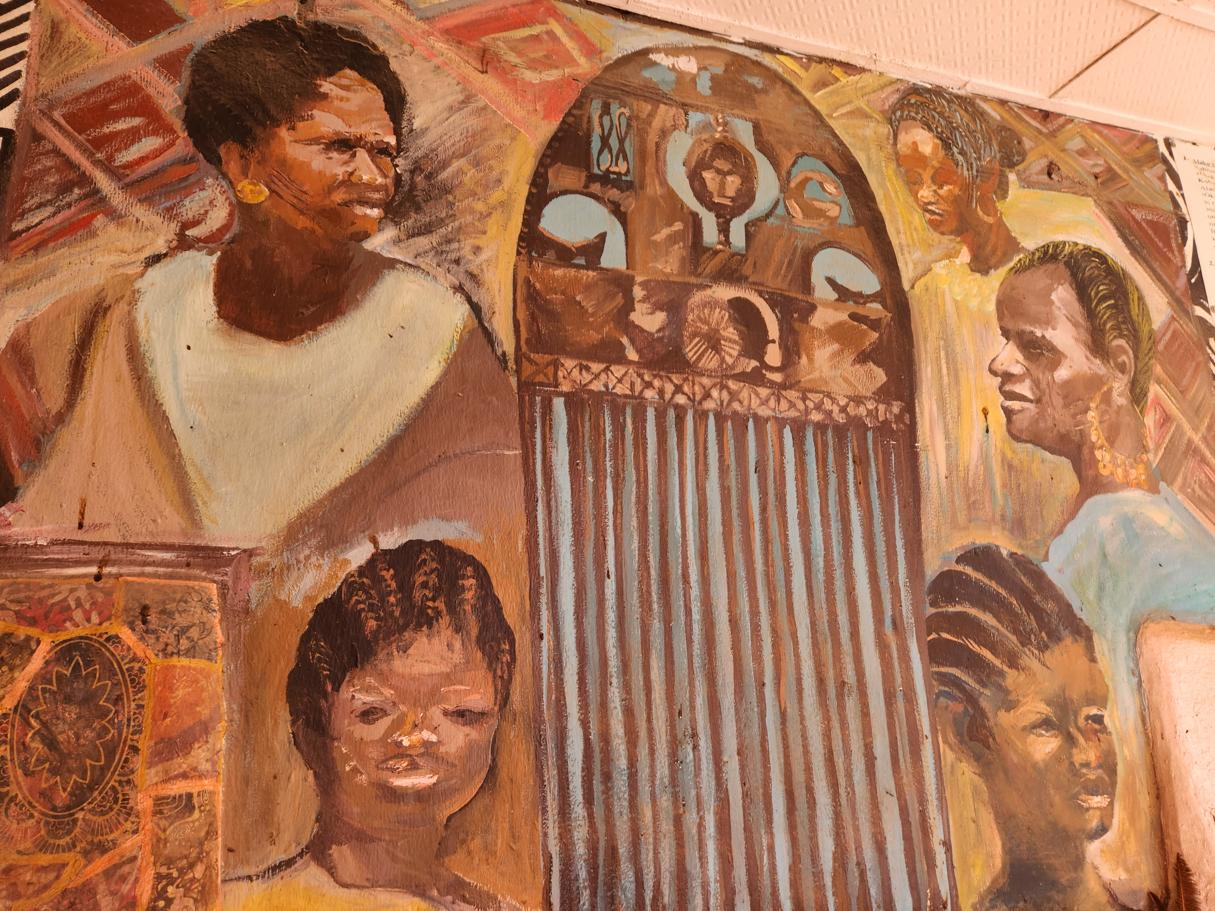
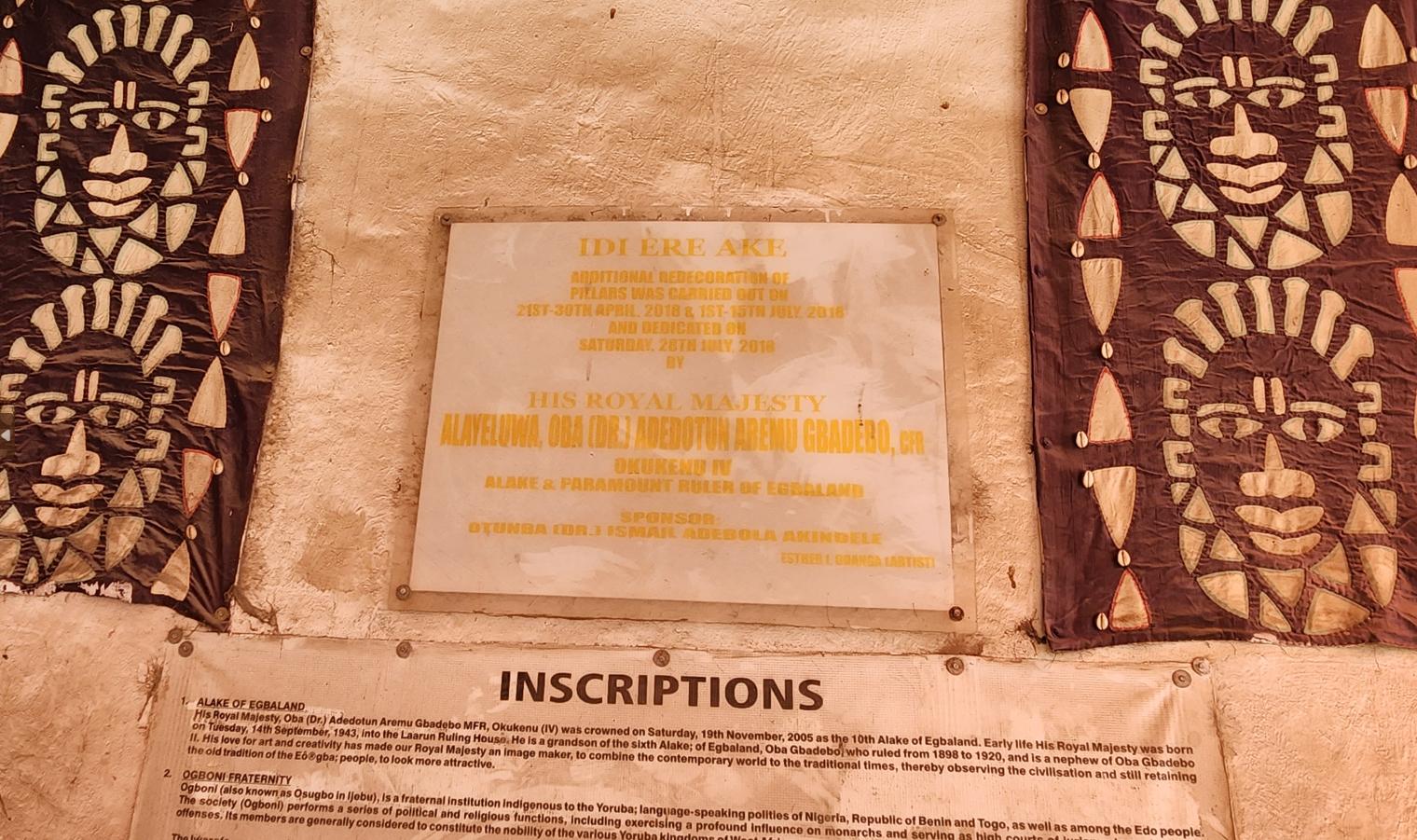
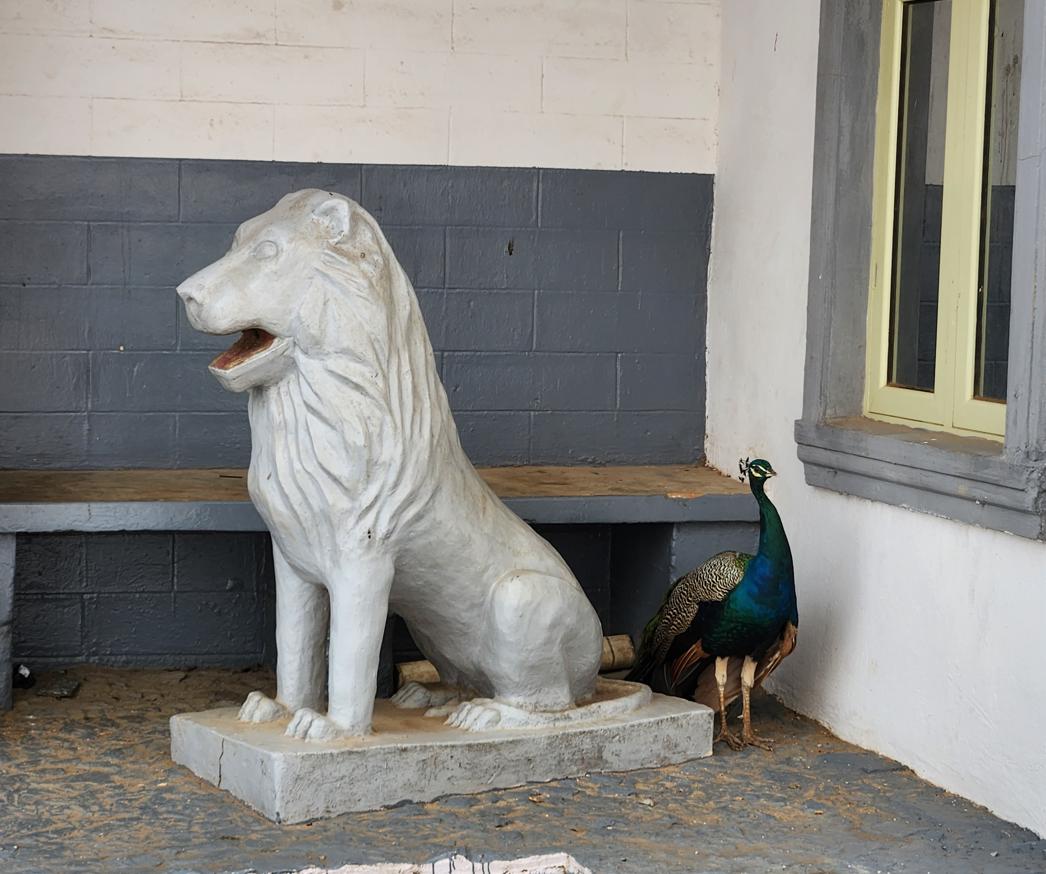
The Ake Palace sits a short distance from the rock, in the older part of the city. The Alake of Egbaland — the paramount traditional ruler of the Egba people — is among the most significant royal offices in Yorubaland, a title with a history reaching back to the consolidation of Abeokuta in the nineteenth century. The first Alake, Oba Okukenu I, reigned from 1854 to 1862; his portrait occupies the entrance mural of the adjacent Egba Museum, a large painted figure in black robes and a crown of upswept white feathers, holding a fly-whisk, a small bronze warrior statue standing at attention before him. The continuity implied by the succession of portraits — sketches and photographs running from Okukenu I to the present incumbent, HRM Oba Adedotun Aremu Gbadebo, Okukenu IV — is one of those quietly remarkable facts that Nigerian traditional institutions produce without apparent effort: the same office, in the same place, across nearly two centuries of colonial rule, military juntas, and democratic turbulence. A birthday banner for Okukenu IV — “Alake of Egbaland @ 80” — hung from the museum façade on the day we visited, the Oba rendered life-size in ceremonial dress, staff in hand.
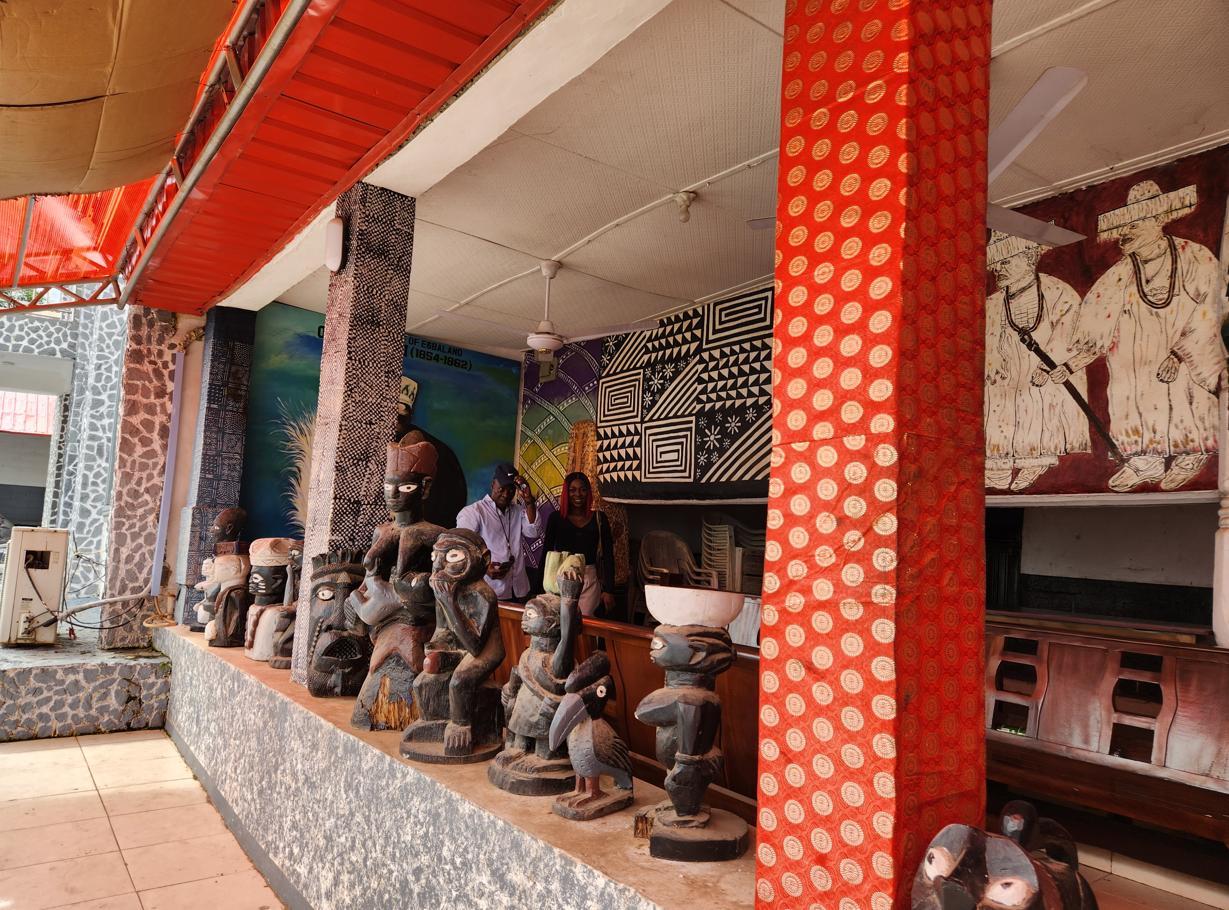
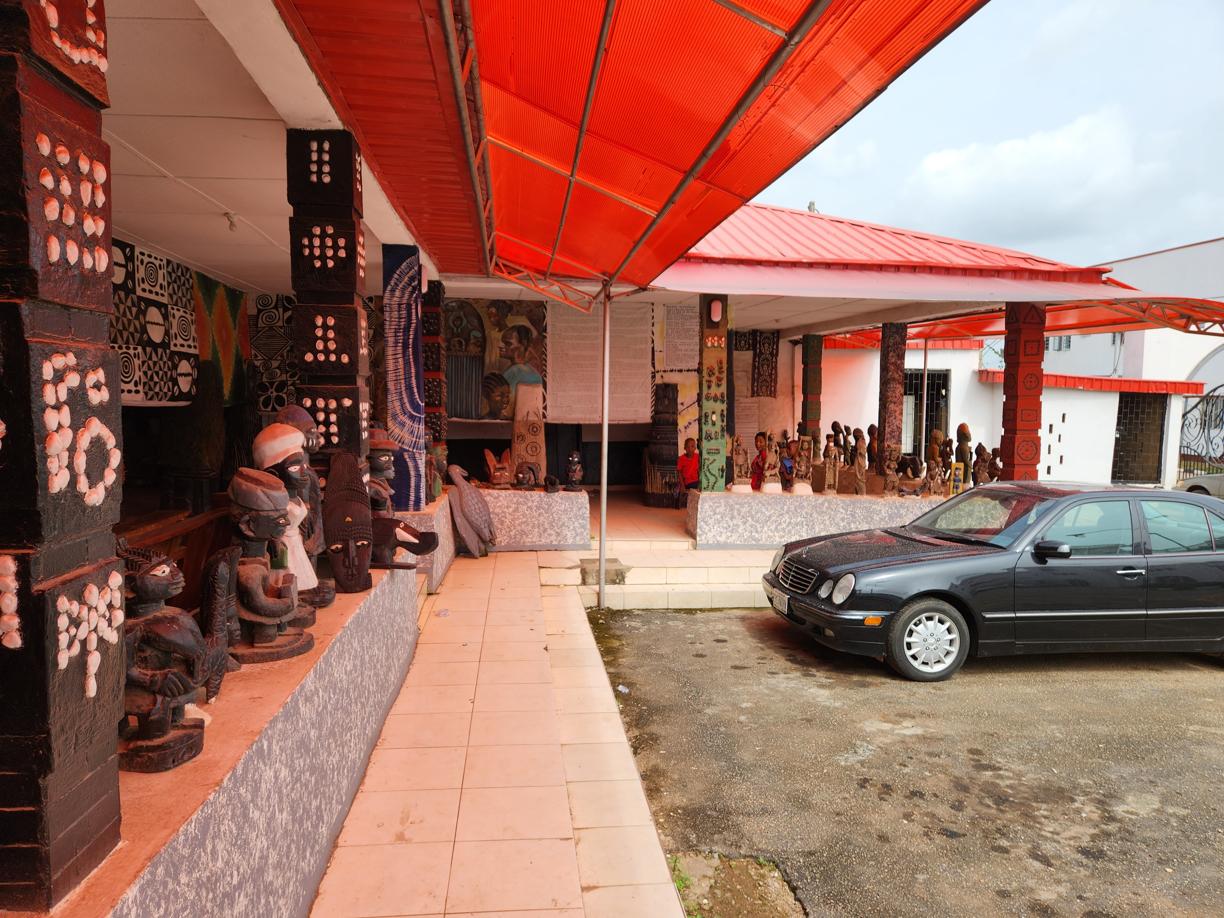
The Egba Museum itself occupies a colonnaded white building adjacent to the palace, its façade hung, on the day we visited, with a large birthday banner for Okukenu IV — “His Royal Majesty, Alake of Egbaland @ 80” — the Oba rendered in full ceremonial dress, staff in hand, the image blown up to the scale of a building. Inside, the exhibition extends under a long covered veranda whose concrete pillars have been decorated with painted and cowrie-studded panels in bold geometric patterns: interlocking diamonds, dots in grids, chevrons in black and deep red. Against these pillars, and along the low walls of the gallery space, stand dozens of carved wooden figures — ancestral effigies, deity representations, court attendants, warrior forms — their surfaces darkened with age and the accumulation of handling. The overall effect is somewhere between a museum and an active treasury: the objects look as if they have been brought in from use, not donated from a distance.
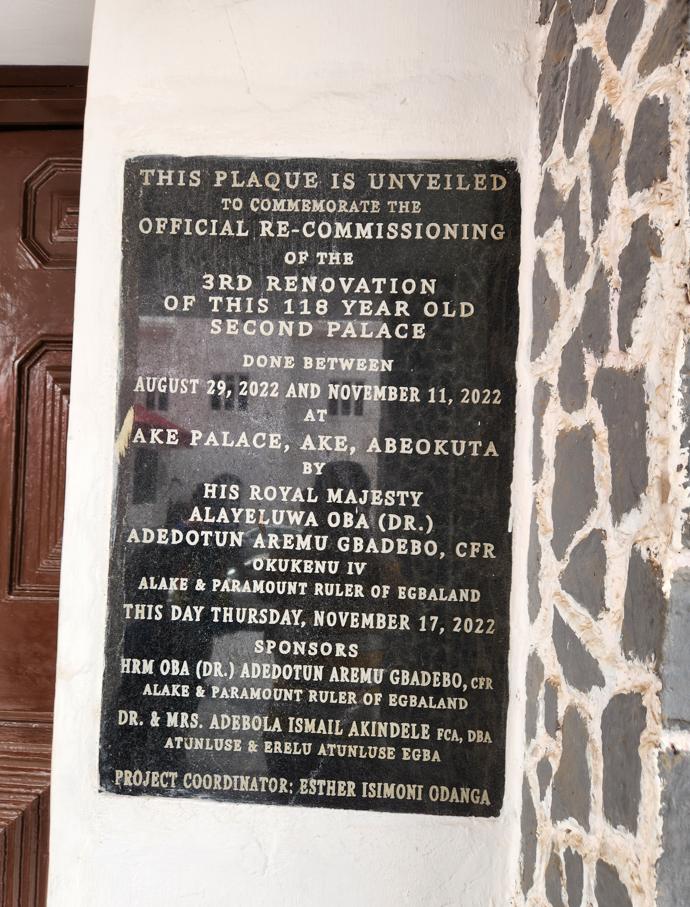
The Ake Palace proper — what the plaque on its gate calls a “118 year old Second Palace,” most recently renovated in 2022 and re-commissioned by Okukenu IV — offered a guided tour that moved through the crown jewels and the elaborate system of chieftaincy titles conferred by the Alake on the great and distinguished of Egbaland. Photography inside was not permitted, which meant that what followed was experienced as pure encounter: a series of rooms, a guide’s commentary, and the growing realisation that the chieftaincy system, for all its ceremonial dignity, operates on principles not entirely unlike those of honours systems elsewhere. The titles, numerous and specific to the point of poetry, are purchased as much as earned. Other visitors on the tour noted, not entirely under their breath, that several of the more colourful honorifics seemed calibrated to the profession or commercial activity of their holders: a title that translated approximately as “Mother of Commerce” for a successful businesswoman; “King of Books” for a distinguished professor; “Saviour Surgeon” for a physician of some renown. The Egba equivalent, in other words, of the honorary datukship — a dignified recognition of achievement, available to those with the achievement and the means to mark it appropriately. The Alake has been conferring such honours since 1854. The practice shows no sign of waning.
The Three Portraits
In almost every public institution across Nigeria — local government offices, hospital waiting rooms, police stations — three framed portraits hang in sequence: the federal president, the state governor, and the traditional ruler. The arrangement captures something fundamental about how this country actually works. Nigeria operates as a modern federal republic on paper, yet traditional monarchies permeate daily life in ways that have no equivalent in most republics.
Nigerian traditional rulers are non-sovereign monarchs who derive their titles from the rulers of independent states and communities that existed before the formation of modern Nigeria. They have no formal political power. In practice, they continue to command the kind of influence that most constitutions do not know how to accommodate — community loyalty, moral authority, and networks that elected officials routinely co-opt for political legitimacy. Their independent activities and their relations with the central and state governments are, in substance, closer to those of the high nobility of old Europe than to actual reigning monarchs.
The decisive turning point was 1976, when the military administrations of Generals Murtala Muhammed and Olusegun Obasanjo stripped traditional rulers of the executive, legislative, and judicial powers they had previously held under customary law. Elected local councils assumed those responsibilities; the monarchs were relegated to advisory councils of chiefs and barred from partisan politics. Yet dethronement cannot strip a man of the authority that two hundred years of court tradition confers. The governor controls the legal instrument. The Oba or Emir controls the room.
The number of traditional rulers across Nigeria’s 36 states runs into the thousands. A single state — Abia — pays stipends to over five hundred of them; Akwa Ibom had 116 holders of official certificates by 2010. At one extreme sits the Sultan of Sokoto, whose spiritual authority is acknowledged by tens of millions of Nigerian Muslims. At the other, village-level community heads whose domains encompass a few thousand souls. Between these poles, state governments classify their monarchs into grades: First Class, Second Class, Third Class, and ungraded — each with its own protocol, its own access to federal events, and its own monthly stipend. In Kogi State, a First Class ruler receives ₦199,000 (around $145) per month from the government; an ungraded chief receives ₦30,000 (around $22). The government stipends are largely symbolic. The palaces, the courts, and the elaborate ceremonial apparatus are sustained through other means: land accumulated over centuries, the fees charged for conferring honorary chieftaincy titles, and the gifts of a community that still believes, with considerable practical justification, that the ruler intercedes on its behalf.
That belief is not irrational. Traditional rulers play a critical role as intermediaries — between communities and the state, between rural populations and institutions that communicate exclusively in English, between local disputes and a formal legal system that rural Nigerians navigate with great difficulty. In the north, where the emirate system has deep roots and the state apparatus penetrates unevenly into the hinterland, emirs are increasingly leaned on to manage banditry, farmer-herder conflicts, and communal tensions that the police and courts cannot reach. No serious Nigerian politician campaigns in a significant constituency without first paying his respects to the traditional ruler. The endorsement or opposition of a major monarch can move votes on a scale no campaign rally can match. Emirs have no constitutional role in Nigeria — and wield enormous king-like influence over their subjects.
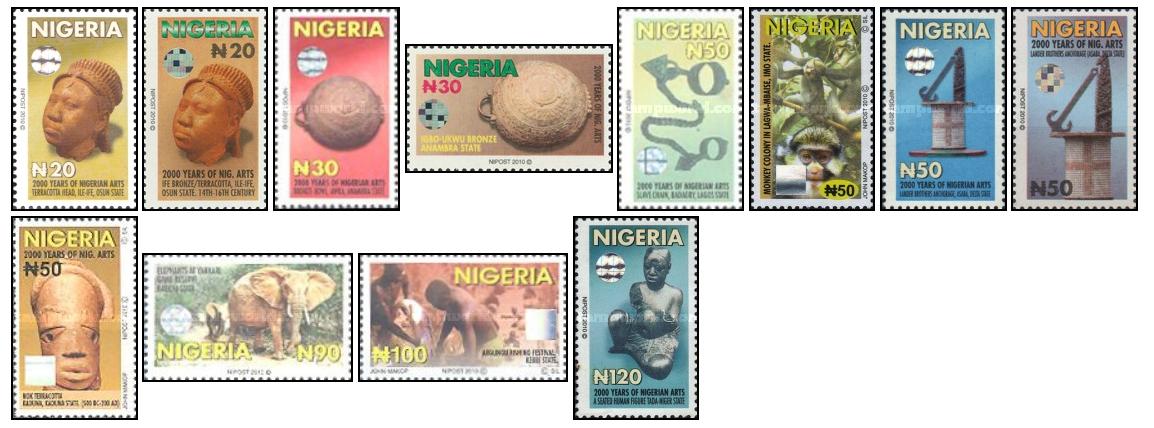


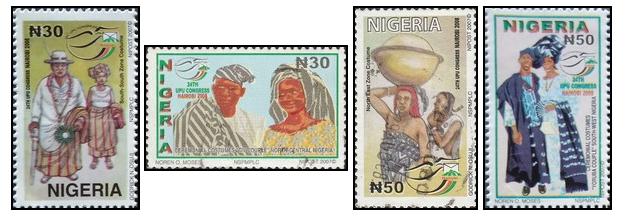
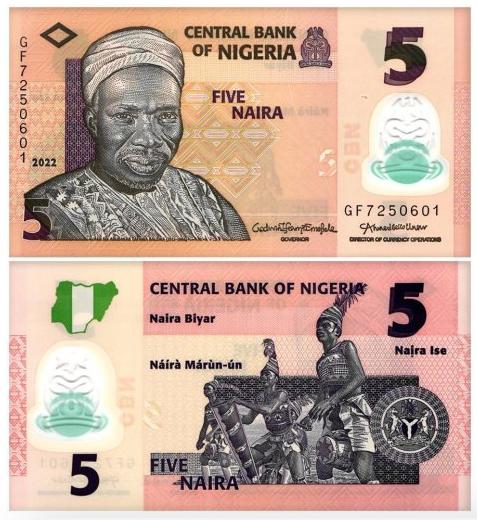
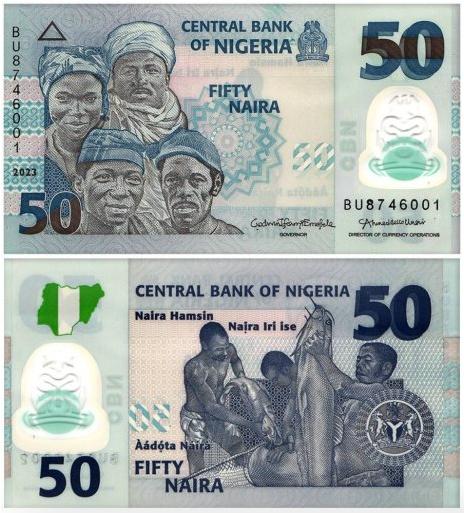
Images courtesy of stampworld.com & banknoteworld.com
The Yoruba chieftaincy system adds its own complexity. Four distinct ranks — royal chiefs, noble chiefs, religious chiefs, and common chiefs — operate beneath the paramount Oba. Chieftaincy titles, numerous and specific to the point of poetry, are conferred as recognition of achievement, and are purchased as much as earned. The more distinguished the title, the more substantial the expectation. Wealthy businesspeople and politicians place great value in acquiring them; appointment as a high-ranking Yoruba title-holder carries with it positions in the Oba’s administration and a place in the ceremonial order. It is not unlike the European orders of chivalry in their late medieval phase: the institution survives by finding new reasons to be useful.
What governors give, governors can take away. State executives possess the power not only to depose traditional rulers — for “insubordination,” political disloyalty, financial mismanagement, or reasons stated and unstated — but also to create entirely new ruling houses, to subdivide existing domains, and to upgrade or downgrade a ruler’s official classification. Since Nigeria’s independence in 1960, at least eleven notable traditional rulers have been dethroned and exiled by elected officials. The Kano Emirate has been the most politically contested royal seat in the country: in 2020, Governor Abdullahi Ganduje deposed the outspoken reformer Muhammadu Sanusi II — a former governor of the Central Bank of Nigeria — had him bundled under police escort to another state, and simultaneously carved the ancient emirate into five separate entities, creating four new emir positions to dilute the influence of the old one. In 2024, his successor reversed the entire arrangement, reinstating Sanusi and dissolving the four new emirates, for the opposite political reason. The people, as Kano’s history has repeatedly demonstrated, tend to notice when their emir is removed. Riots broke out when Sanusi’s grandfather was deposed in 1963; deadly violence erupted when his predecessor Ado Bayero was threatened in 1981. The power to depose is real. The consequences are unpredictable.
Much of this structure was the work of the British. Frederick Lugard’s system of indirect rule — governing through existing traditional hierarchies rather than replacing them — formalised and in some cases invented the chieftaincy structures that persist today. The Tiv people of the Middle Belt had always been radically decentralised and had no paramount ruler; the British created the office of Tor Tiv in 1947 and appointed a man to fill it, because the colonial administration needed someone to sign papers on behalf of the Tiv. The institution has outlasted the need that produced it. So has the Lugardian model, more broadly. What the three portraits in the waiting room suggest is that Nigeria has not yet decided — and perhaps does not need to decide — exactly what traditional rulers are for. They are not elected. They are not ceremonial. They are not vestigial. They are something else: a prior layer of authority that the modern state has overlaid but never replaced, and which the people of their communities have never stopped consulting.
Abeokuta left a particular residue. It is a city that has spent nearly two centuries navigating between the rock and everything beyond it — between the Egba’s original self-sufficiency and the missionary enterprise, the colonial administration, the federal state, the demands of a modernity that arrives unevenly and stays incompletely. The rock endures. The palace endures. The adire is still made in the markets by the same processes, the same resists, the same indigo. Whether this constitutes continuity or persistence is a question the city seems entirely untroubled by. It does not explain itself. It simply continues.