The Country
That Would
Not Let Me Go
A travelogue from the edge of ancient worlds to the spine of the Karakoram.
There is a particular kind of longing that attaches itself to places one has never visited — a longing fed by childhood textbooks, by the black-and-white photographs of a forgotten world, by names that ring with the cadence of history itself. For me, that place was Pakistan. I first encountered it not as a country but as a syllable — Mohenjo-daro — in a primary school textbook, accompanied by a blurry photograph of brick streets and the famous bronze Dancing Girl. That image burrowed into me and stayed.
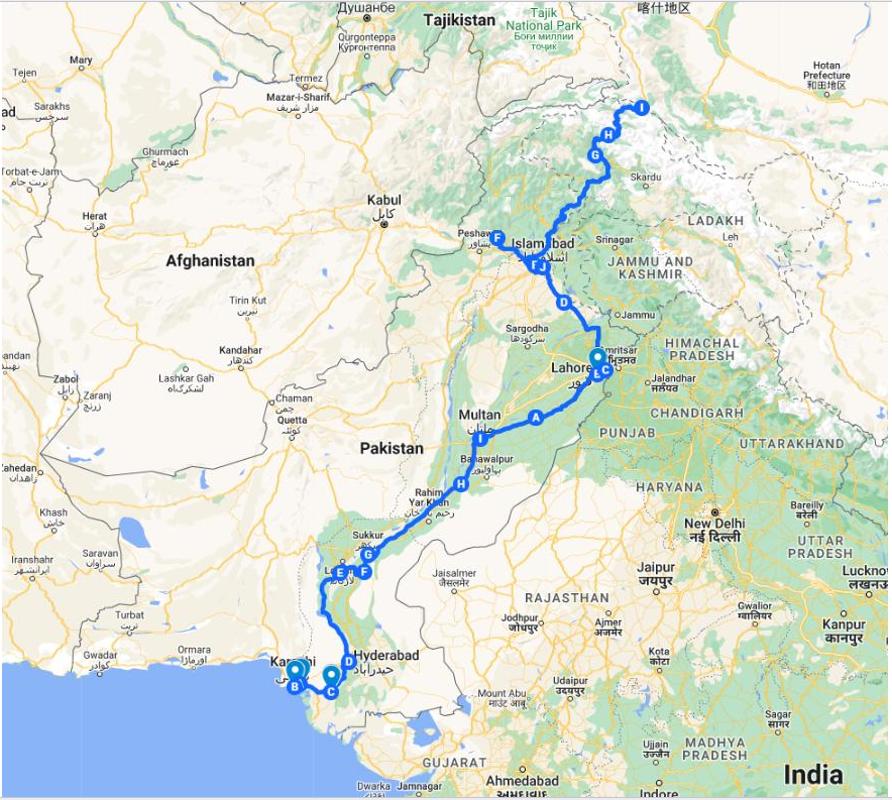
The trip was repeatedly cancelled or postponed since 2015. Visa rules changed so frequently that itineraries had to be scuttled and rebuilt more than once, companions deterred by news of bombings and coups. Pakistan, as it is understood in the popular imagination of the world — and particularly of Southeast Asia — is not a tourist destination. It is a country that exists somewhere between the war on terror and a nuclear standoff; between images of flood refugees and cricket-mad crowds; between two great rivals, India and China, and a third great power, the United States, all pulling at its seams.
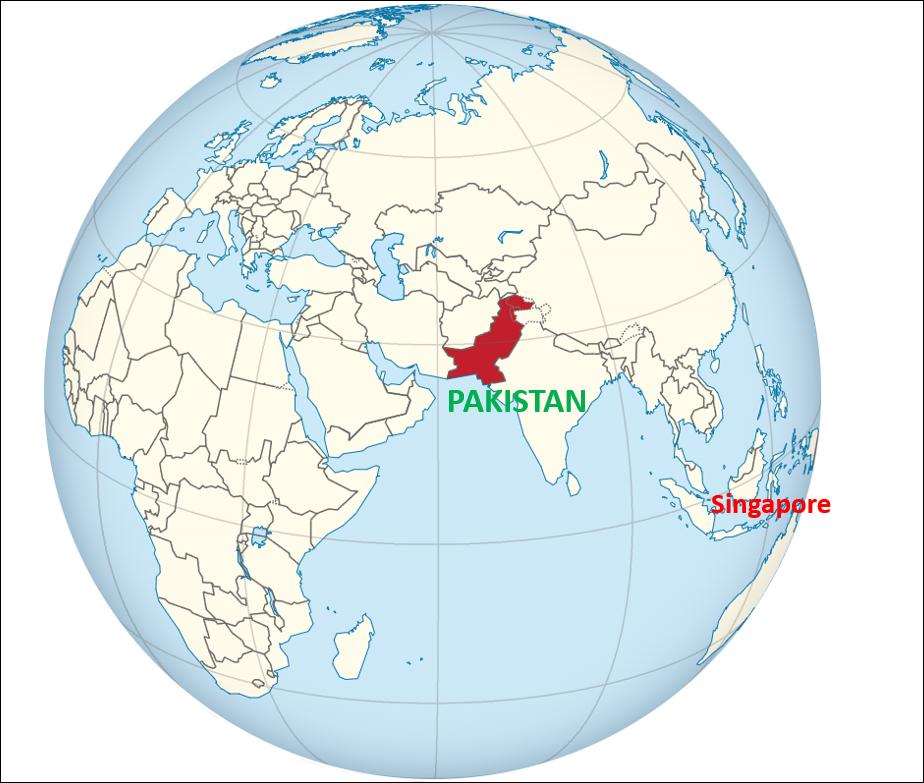

But in July of 2023 I finally went, travelling south to north over sixteen days, from Karachi on the Arabian Sea to the Khunjerab Pass on the Chinese border — 3,000 kilometres in a private car with three Singaporean companions, Kelly, Alan, and Shaun. What I found was not the country of the news cycle. What I found was something far older, far stranger, and in many ways far more beautiful.
This is the account of that journey.

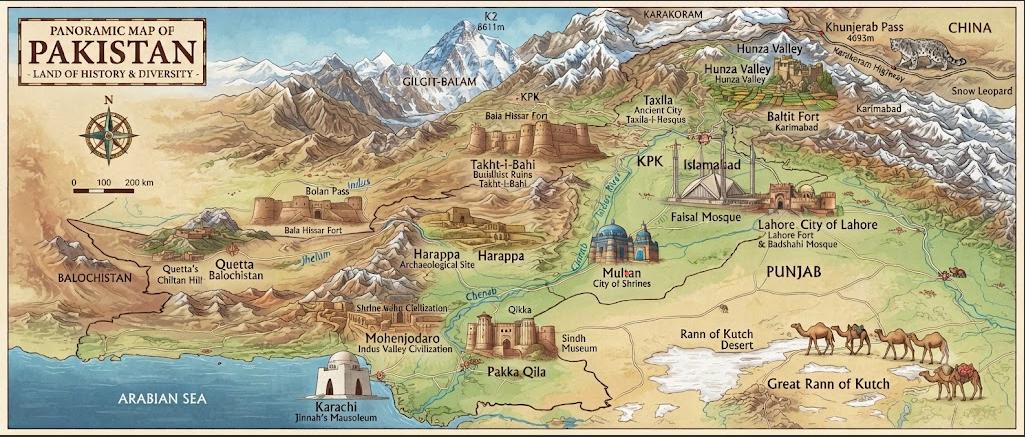
Pakistan's name was coined by a Cambridge student in 1933. In a pamphlet titled Now or Never, Choudhry Rahmat Ali proposed an acronym: P for Punjab, A for Afghania, K for Kashmir, S for Sindh, TAN for Baluchistan. It was, he explained, both a Persian and Urdu word meaning the land of the Paks — the spiritually pure and clean.
Rahmat Ali's vision of Pakistan, it is worth noting, related only to this north-western corner of the subcontinent; for the Muslim-majority areas of Bengal he separately proposed the name “Banglastan,” and for the princely state of Hyderabad — the great Deccan kingdom in the heart of India, no relation to the Sindhi city of the same name we would visit weeks later — “Osmanistan,” after its ruling Asaf Jahi dynasty, who styled themselves Nizams but traced descent from Turkish Osmanli stock. He imagined the three as a loose political federation, a vastly more fragmented Muslim South Asia than the one country that eventually, messily, emerged. It is a name of almost impossible ambition, a country that aspired to embody purity at the very moment of its most violent birth.
For a Singaporean traveller — a Chinese by ethnicity but not by nationality, carrying a passport that opens most doors but is treated, in Pakistan, as practically indistinguishable from the passport of the People's Republic — the journey carries layers of meaning unavailable to Western visitors. I would discover, over sixteen days, how thoroughly China has inserted itself into this country, and how ambivalently, but warmly, Pakistanis have accepted that insertion.
I would also discover how this small corner of the Indo-Pakistani subcontinent manages to contain, within its borders, nine thousand years of human civilisation and five of the world's fourteen eight-thousander peaks, Sufi poetry of startling beauty, some of the finest Mughal architecture on earth, and mangoes that cost one Singapore dollar a kilogram.
Journey Onwards
Chapter One: Arrival in the City of LightsA Note on Process
The travelogue on this site are based on my own journeys, photographs, Facebook posts, and field notes. I work with Claude (Anthropic's AI assistant) as a drafting and editorial partner — giving it my raw material and working iteratively to shape it into finished prose. The AI helps me draft quickly, maintain a consistent voice across long narratives, and edit at the document level. The website's HTML and coding are built with the assistance of Gemini (Google). Audio versions of the essays are produced using NotebookLM (Google). Every observation, opinion, and conclusion in the written work is mine. The AI tools are the instruments; I am the author.