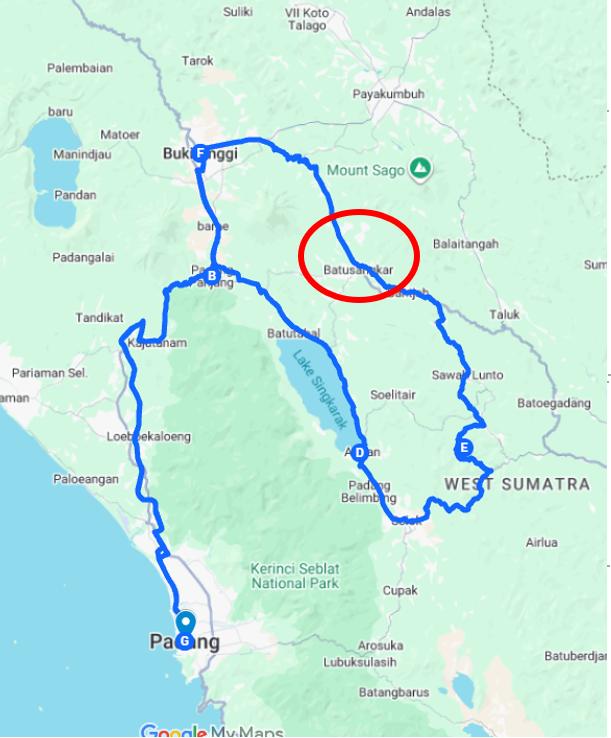
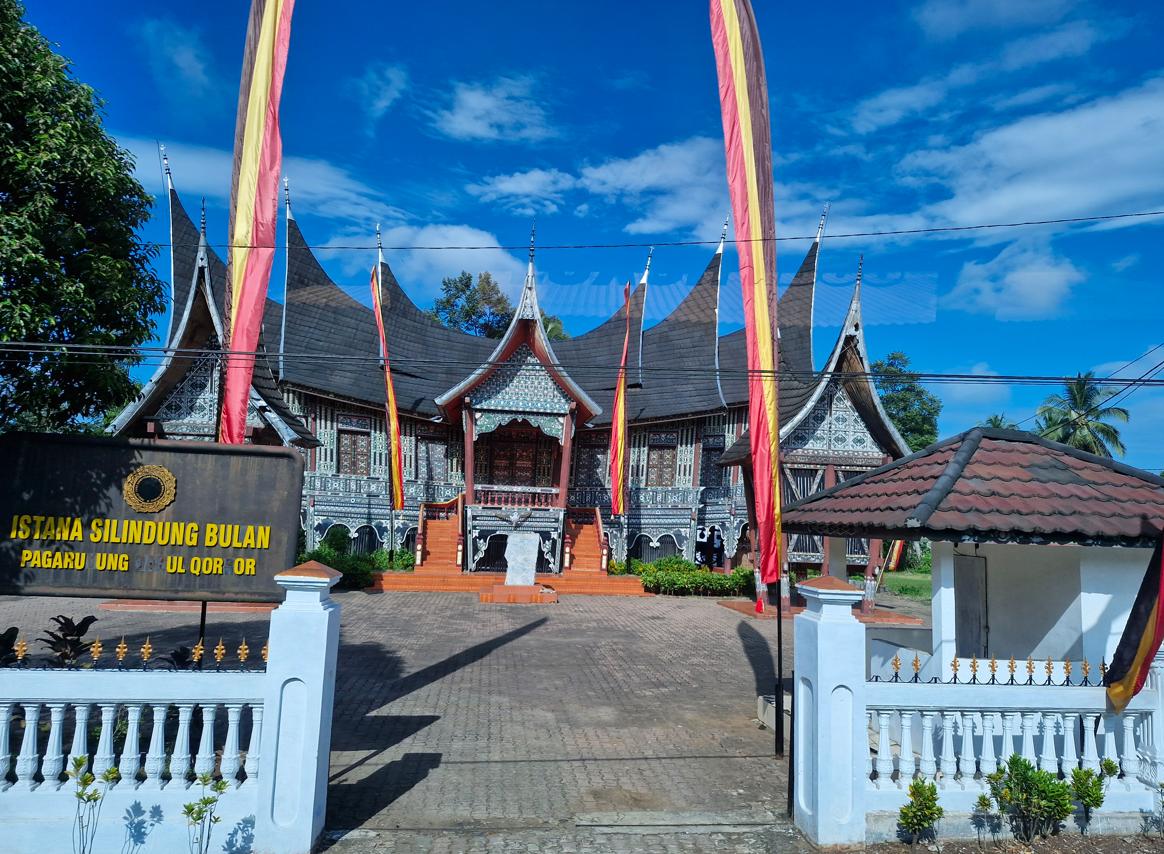
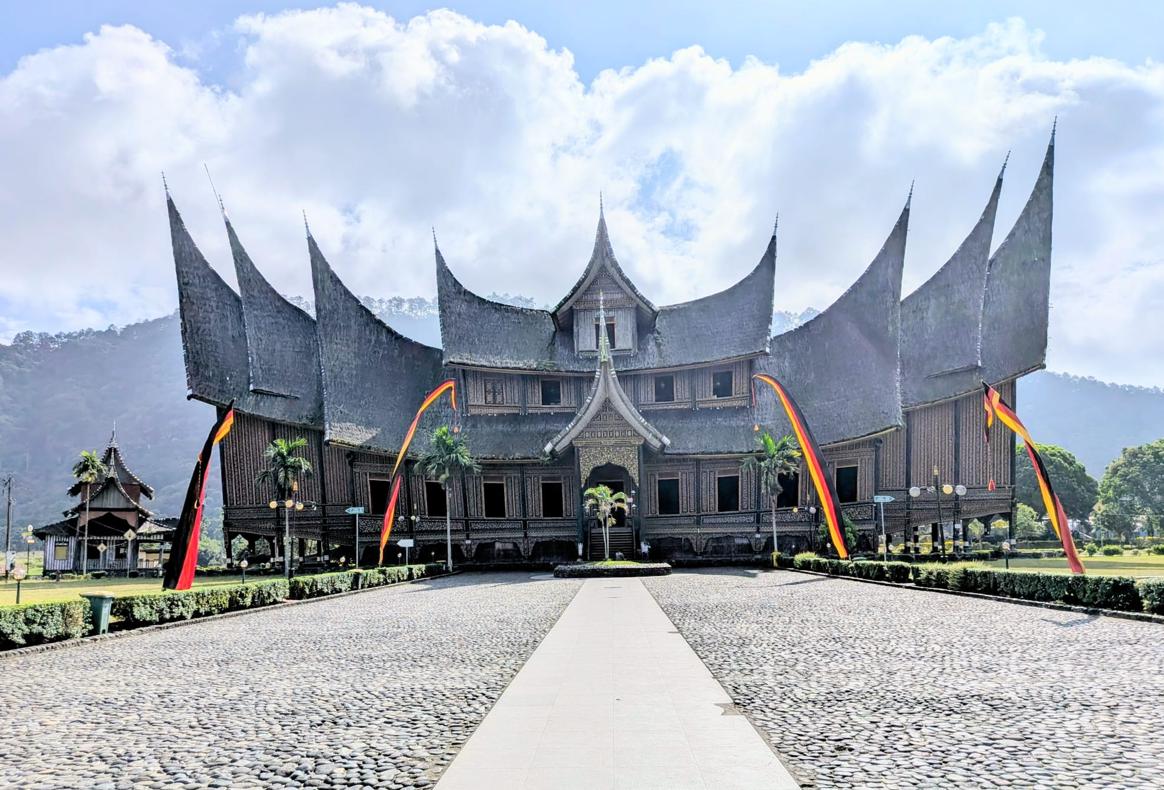
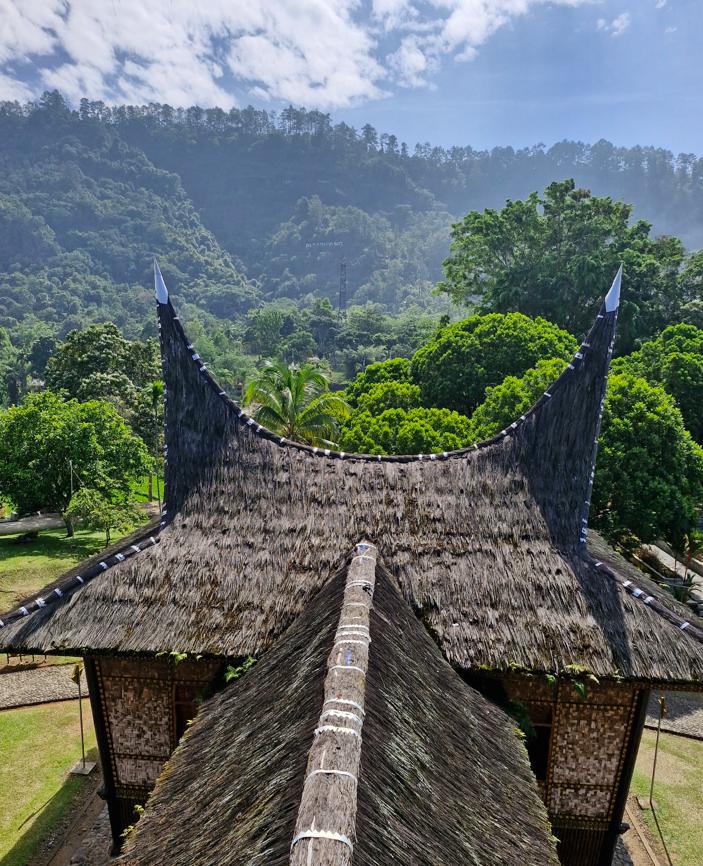
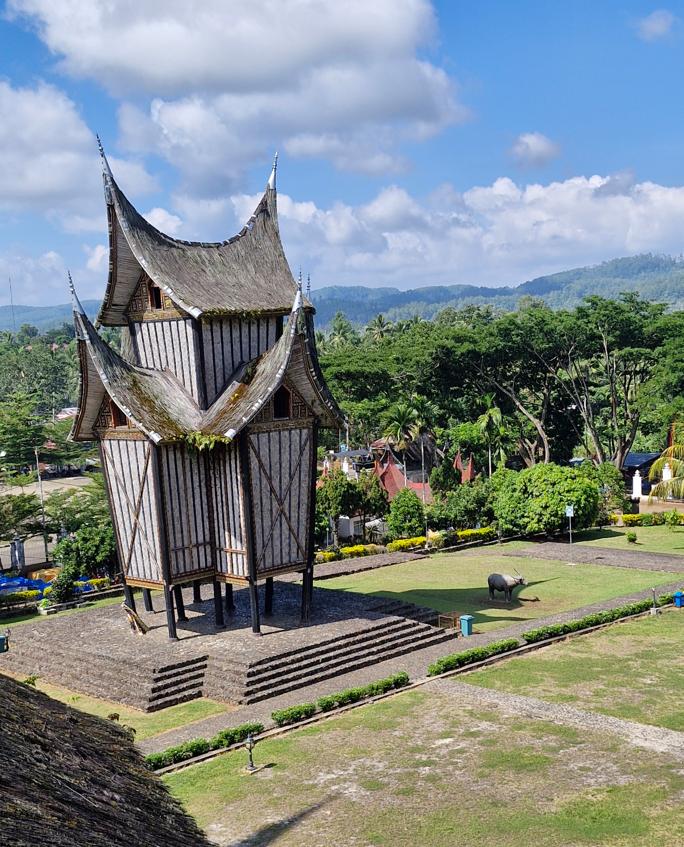
Istano Basa Pagaruyung rises above Batusangkar in a cascade of eleven golden-horned spires, the tallest concentration of gonjong roofline anywhere in the Minangkabau world, and it is, in the strictest sense, a fraud, a magnificent one. Nothing standing here is original, and it is worth being precise about just how little of it Raffles himself ever saw: by the time he reached this hilltop in 1818, there was no palace left to walk through at all. Batu Patah had already been ash and cold foundations for fourteen years, the original torched in 1804 and never rebuilt on that same spot.
A later reconstruction, raised at some point in the following century, was itself lost to an electrical fire in 1966; the replica that eventually rose on a new site slightly south of the original, completed in 1985, was gutted in turn by a lightning strike in 2007; and the building open to visitors today dates only to a careful, government-funded reconstruction finished in 2013. Three real fires, then, spread across two centuries, and the building seems, perversely, to insist on its own permanence precisely because it has never once achieved it: a phoenix that keeps drawing the same architectural blueprint from memory each time the ashes cool.
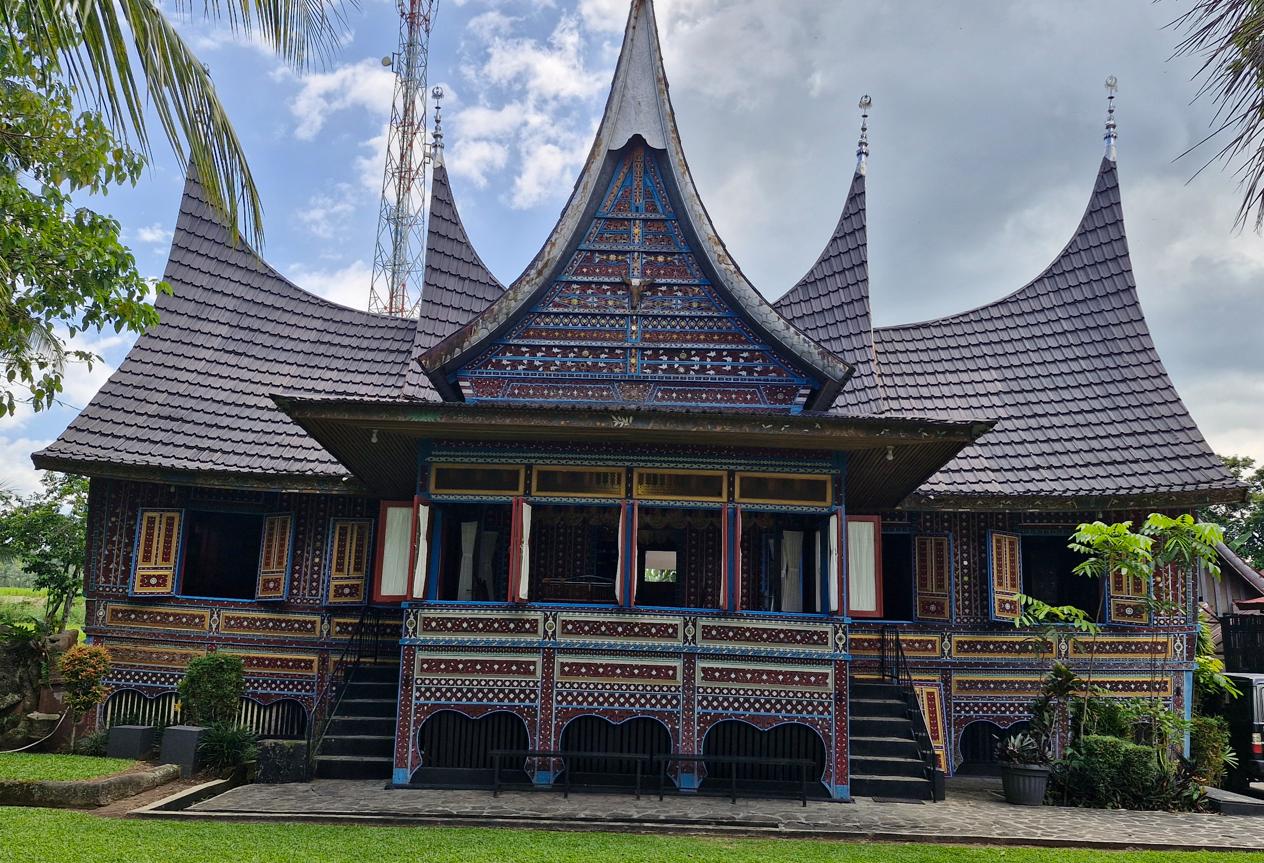
The eleven gonjong are themselves an argument in timber: an ordinary rumah gadang carries four or five upswept horn-peaks; Pagaruyung's eleven declare, without a single word of inscription, that this was no ordinary house but a paramount seat of kings. The horned form traces back to the founding legend every Minangkabau child still learns: a clever, deliberately starved calf, its tiny horns fitted with iron blades, sent into an arena against a Javanese invader's massive bull. Desperate for milk, the calf thrust its head up beneath the bull's belly and the hidden blades did the rest; the invaders, watching their champion gored by an animal a fraction of its size, withdrew, and the locals' triumphant cry, Manang kabau, “the buffalo has won,” furnished both the name of a people and the architectural obsession of everything they have built since.
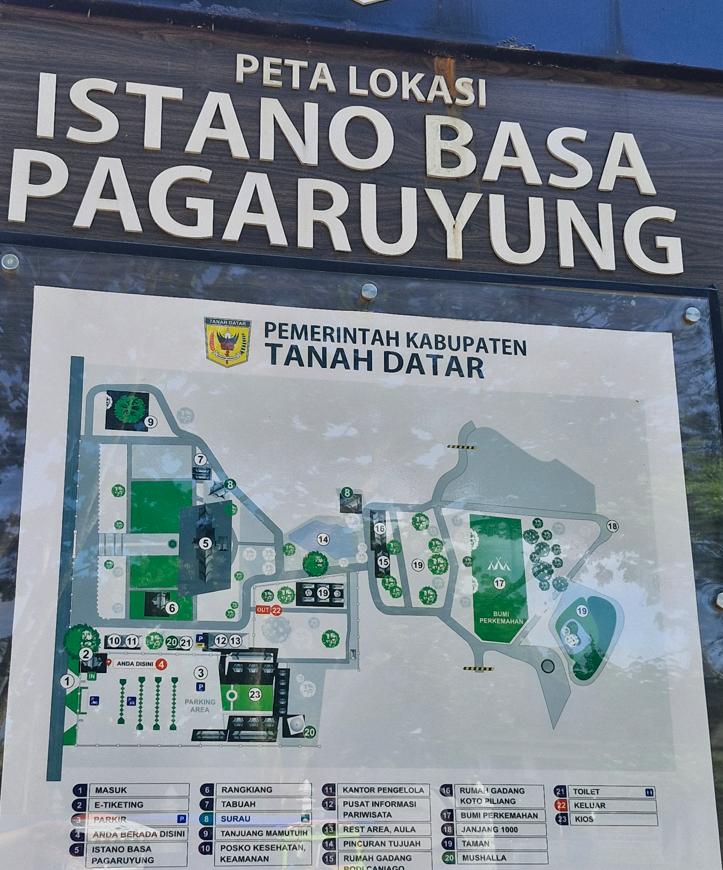
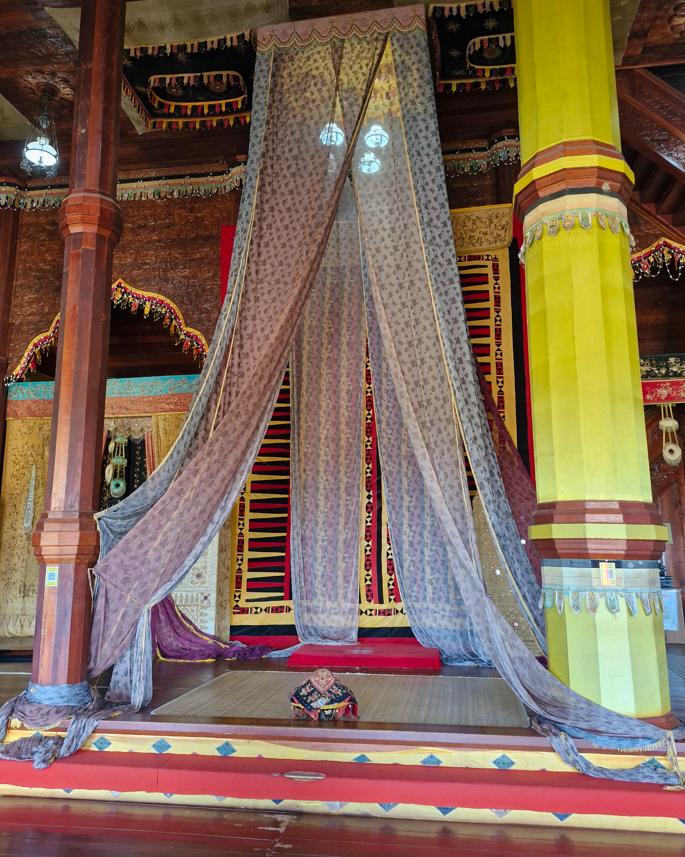
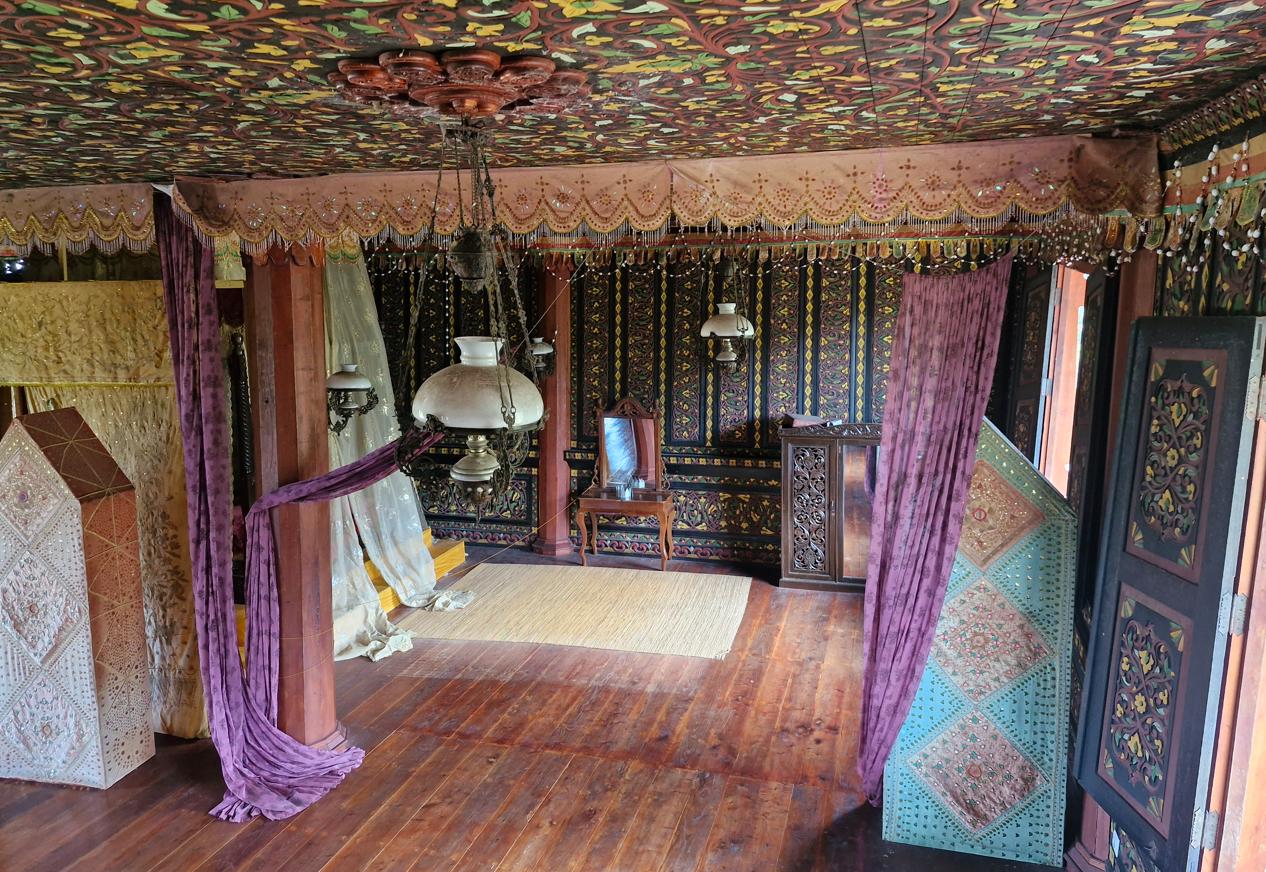
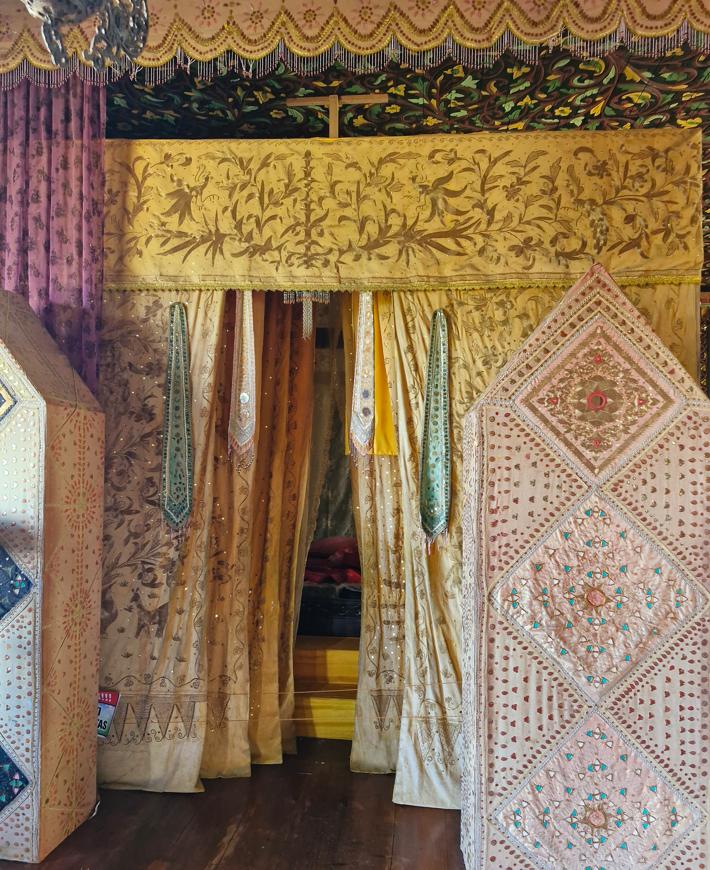
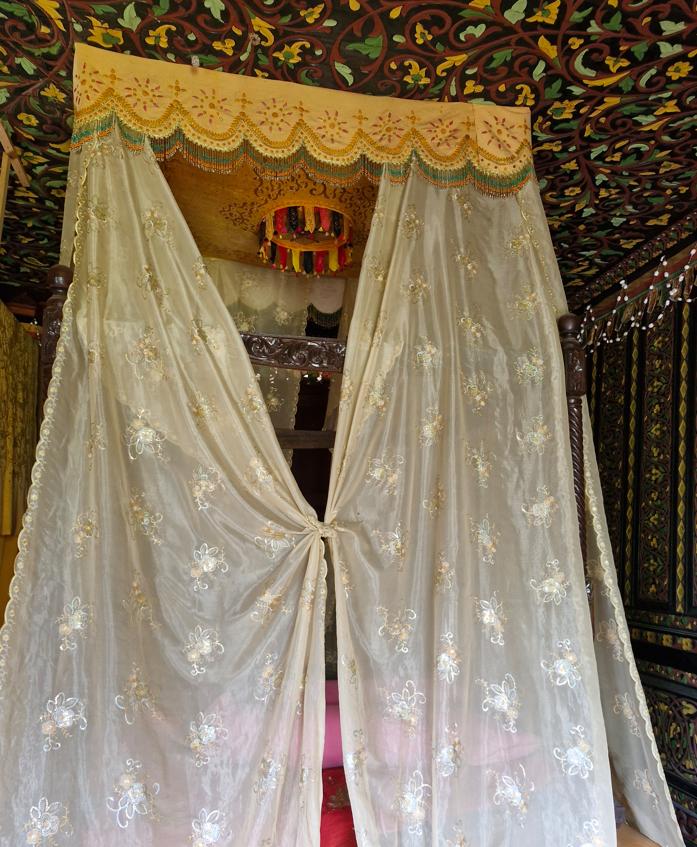
The first thing every visitor actually meets on stepping inside, though, is not history but a small ceremonial throne, modest in scale next to everything looming above it, set on a low dais and half-swallowed by a fall of sheer grey drapery hung from the rafters like a canopy sized for someone far larger than whoever actually sat there, a backdrop of black, red and gold songket-patterned tekat cloth behind it in the same tight geometric bands as the palace's carved exterior, the only real colour in an otherwise dim, deliberately hushed room. It is, our guide told us, the seat reserved for the Bundo Kanduang, the clan's royal matriarch, the one throne in this whole three-tiered hierarchy that outranks even the king's own, tucked just inside the front door, ahead of any grander room upstairs, a small and easily missed reminder of exactly whose authority a matrilineal kingdom was actually built to protect. Outside, a short walk from the palace steps, a single rangkiang, a rice barn raised high on stilts and capped with its own miniature gonjong horns, stands taller than most two-storey houses, a reminder that a court this ceremonially loaded never fed itself on symbolism alone.
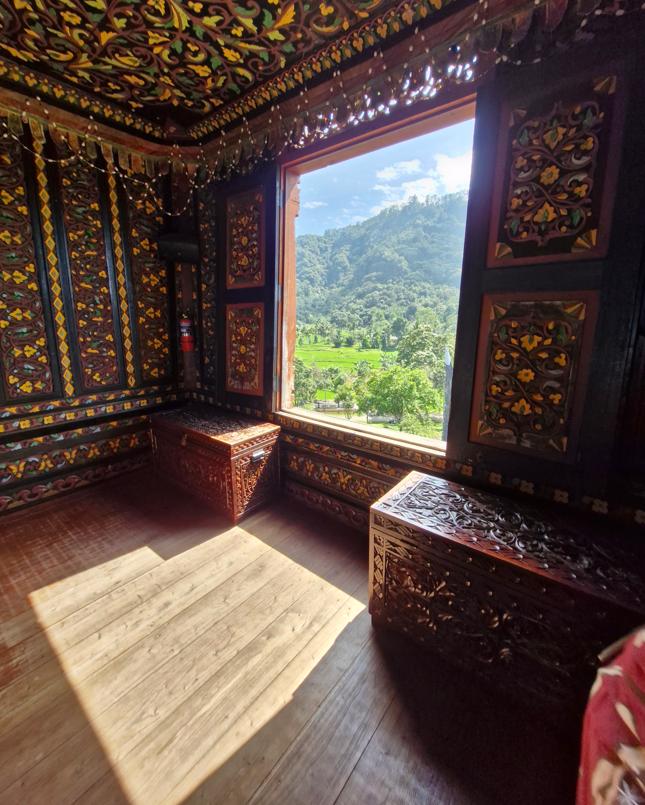
Beneath the roofline the palace performs a quieter engineering trick, and it is worth being honest about what it was actually built to survive: not fire, which timber, thatch and twenty-six tonnes of dried sugar-palm ijuk fibre were never going to outlast an arsonist's torch or a lightning strike, as the building's own scorched history keeps proving, but the ground itself. The walls lean gently outward as they rise, seventy-two great pillars tilted just enough that the heavy sweeping roof is braced rather than top-heavy, every joint pegged in interlocking wood with not a single iron nail anywhere in the structure, so that in an earthquake, and this is a highland shaken often, sitting as it does above some of the most active fault geology on the island, the whole frame is designed to sway rather than shatter. There is a Minang phrase for this philosophy of engineered flexibility that could serve as an epigraph for the whole culture: condong nan indah mambao rabah, beautiful though it leans, it will not fall. Against flame the palace has never once held; against the earth's own shrug, it was built, deliberately and rather beautifully, to bend.
It was here, walking the palace's three tiered floors, governance below, royal privacy above, sacred treasure highest of all, tucked just beneath the point where the central spire reaches hardest for the sky, that the region's darkest political rupture came fully into focus for me. The spark, as our guide told it, was almost absurdly specific: three Minangkabau pilgrims, Haji Miskin, Haji Sumanik and Haji Piobang, returned from Mecca in 1803 steeped in a puritanical reading of Islam that owed something to the Wahhabi revolution then sweeping Arabia, and launched a moral crusade against gambling, cockfighting, opium, betel-chewing, alcohol, and, more dangerously for the old order, the matrilineal adat customs at the very heart of Minangkabau society.
Their most militant faction, the Harimau Nan Salapan, the “Eight Tigers,” pressed the royal court and its penghulu, the customary elders, to abandon adat outright; when the court refused, the Padri commander Tuanku Pasaman gathered an armed force and struck at night, in 1804, at the royal compound on Batu Patah hill. Firearms bought through coastal trade breached the grounds; the rumah gadang, built entirely of timber, bamboo and thatched ijuk palm fibre, went up fast once the first torch caught, and by morning the seat of a kingdom that had stood for four centuries was cinders. The elderly Sultan Arifin Muningsyah was smuggled out through secret mountain paths into the forests of Lubuk Jambi, in what is now Riau; his young kinsman and heir, Bagagarsyah, not yet out of his teens, fled the opposite way, toward the coast near Padang, where he lived for years afterward under a commoner's name, a prince nobody but his own household knew to bow to.
Local memory reserves its darkest name not for that first burning but for what came eleven years later. In 1815, at Koto Tangah, a Padri leader named Tuanku Lintau lured what remained of the Pagaruyung nobility into what was presented as a peace negotiation and killed more than a hundred of them in a single organised stroke, a betrayal grim enough that Indonesian accounts still call it, without much need for embellishment, the Koto Tangah massacre, and that I found myself thinking of, walking the palace's rebuilt tiers, as this highland's own Night of the Long Knives. What remained of the royal line appealed, in the chaos that followed, first to the British and then to the Dutch for protection against their own countrymen, a plea that would in time cost the kingdom its independence far more thoroughly than the Padri ever had.