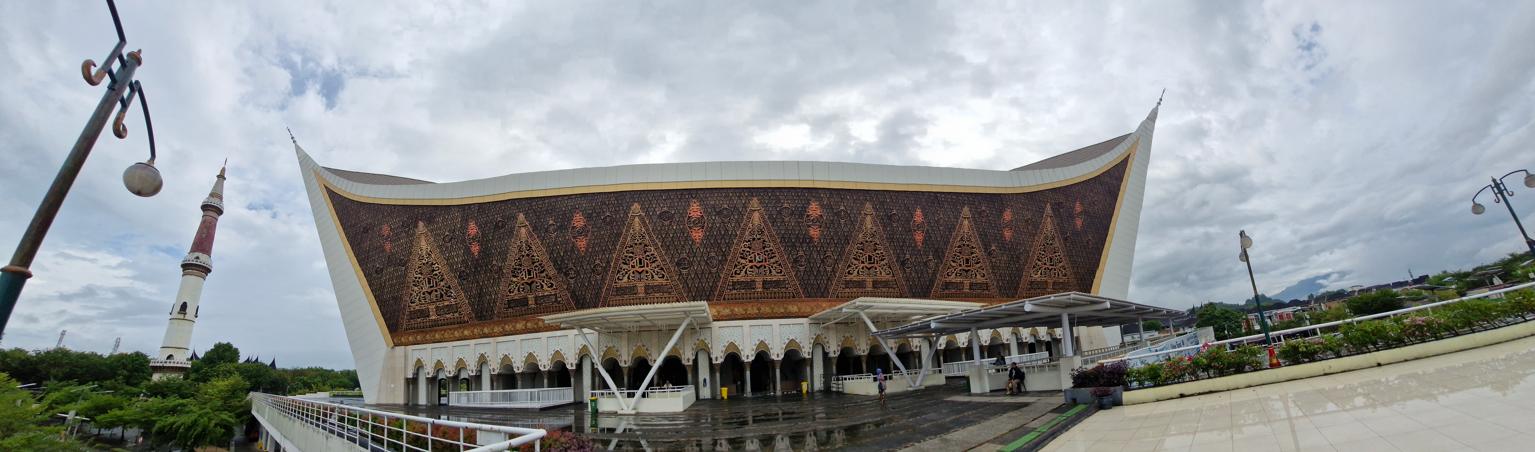
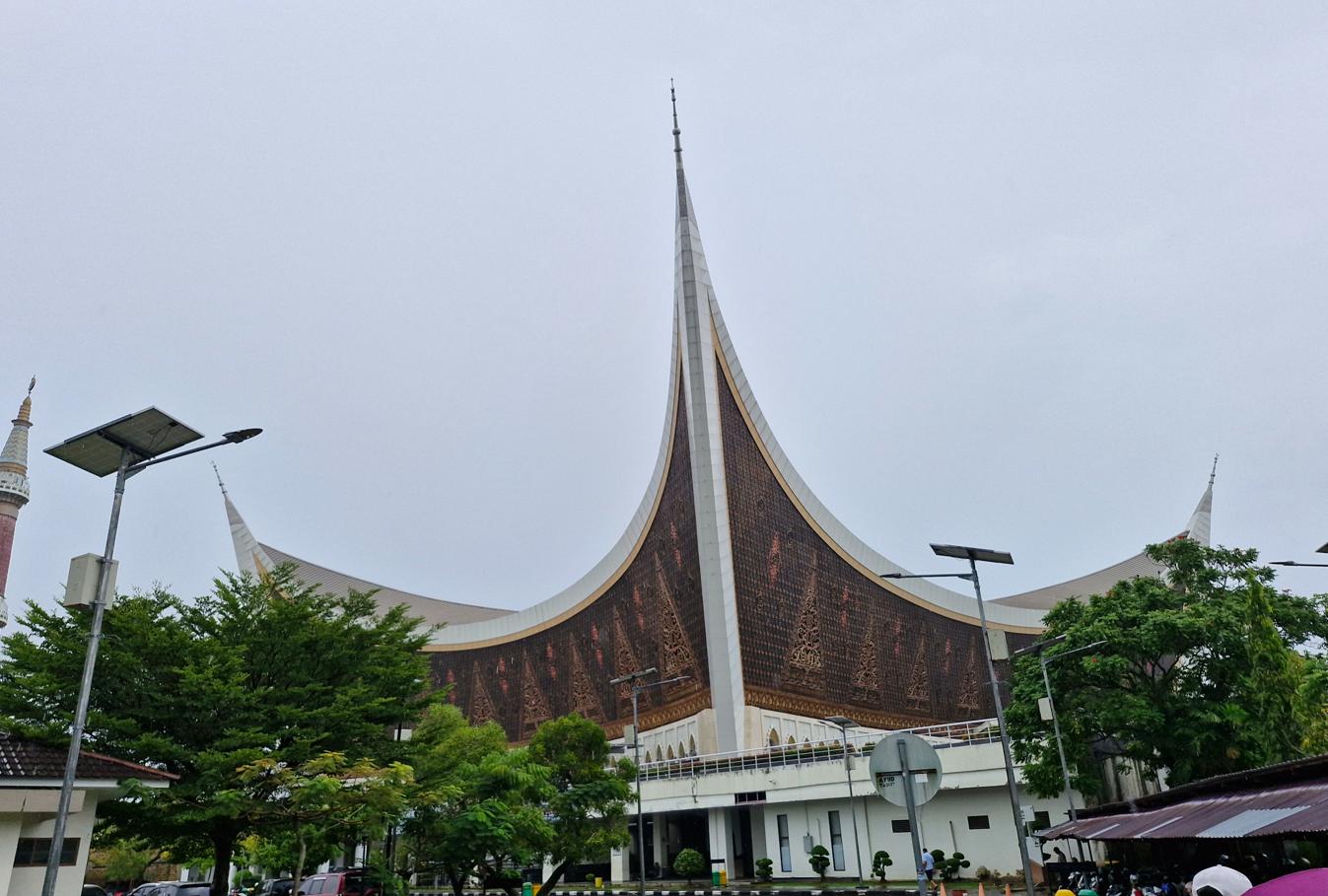
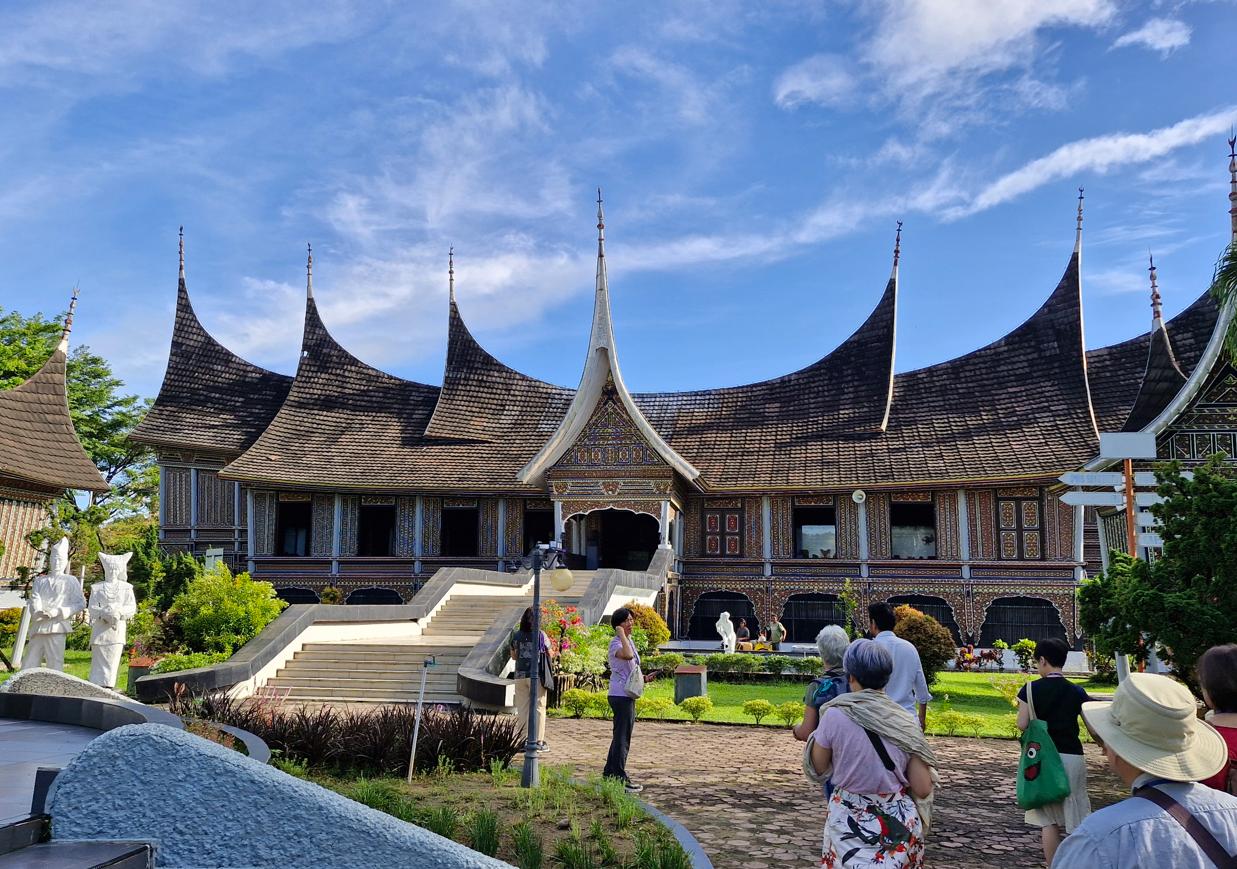
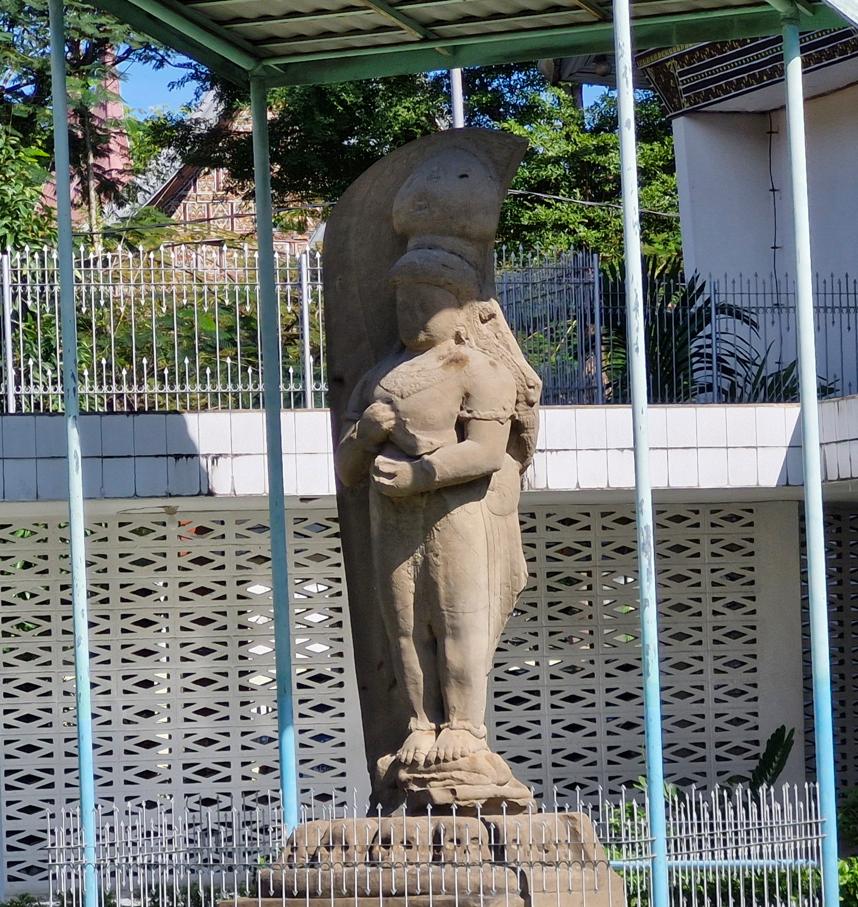
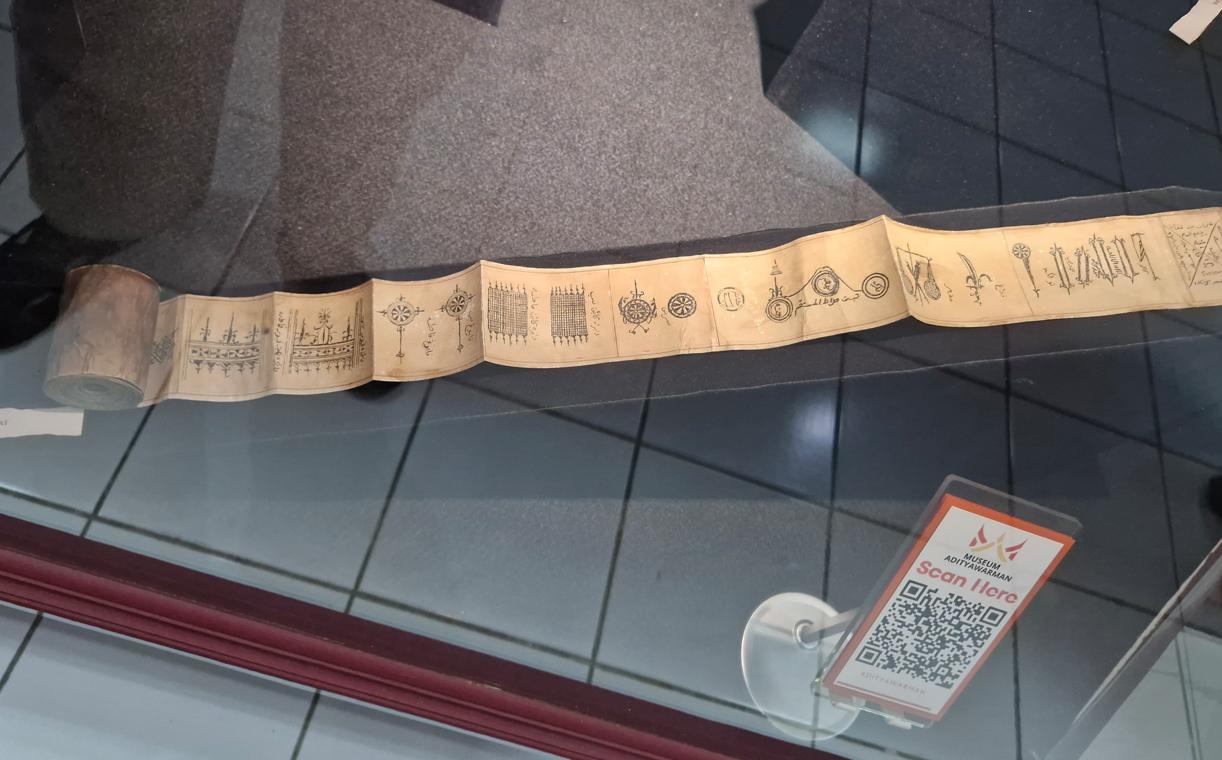
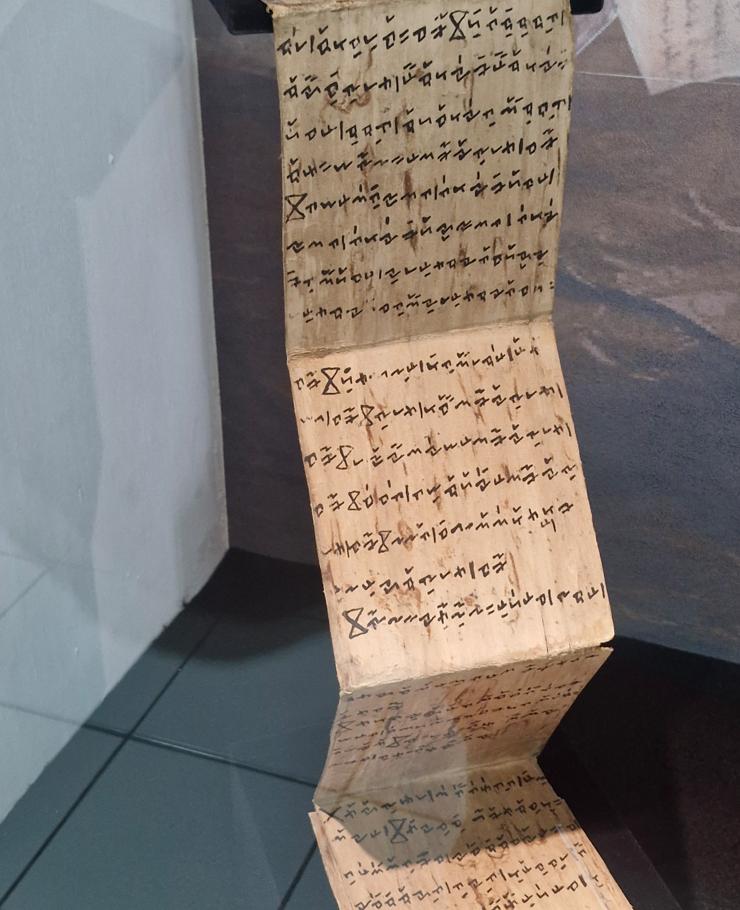
At the Adityawarman Museum the following morning, I found the city's deeper memory laid out in wood, gold and stone. The building itself wears its Minangkabau ancestry proudly, soaring buffalo-horn roofs stacked in tiers like a house dressed for a wedding, and is named for the fourteenth-century prince who is, in effect, the founding father of everything I had come to see. Adityawarman was the product of one of the more interesting royal unions in Southeast Asian history: his mother from the old Melayu line of the Batang Hari, his father a Majapahit nobleman from Java. He served the Majapahit court, then broke from it, marched into these highlands, crowned himself maharajadhiraja, and founded the Pagaruyung line that Minangkabau adat still claims as its ancestral root. Inside the museum stands a nearly 4.4-metre replica of the most extraordinary object connected to his memory: a snarling, fanged colossus trampling a heap of human skulls, understood by most scholars to be Adityawarman himself, portrayed in the terrifying tantric guise of Bhairava, the death-conquering form of Shiva, a reminder, standing incongruously beneath a curved Minangkabau roof in an overwhelmingly Muslim province, that Islam here was laid down over a much older Hindu-Buddhist tantric bedrock that has never entirely been erased, only built upon.
I asked a young museum attendant, half in jest, whether the statue frightened the schoolchildren who came through on excursions. She laughed. “No, they like the skulls best of anything in the museum,” she said. “They ask if it's real. I tell them it is a king who conquered death. They think that is very cool.” Cool was, more or less, the word she used, delivered in the easy code-switched English of a generation raised on YouTube and TikTok, standing in a room devoted to a six-hundred-year-old god-king.
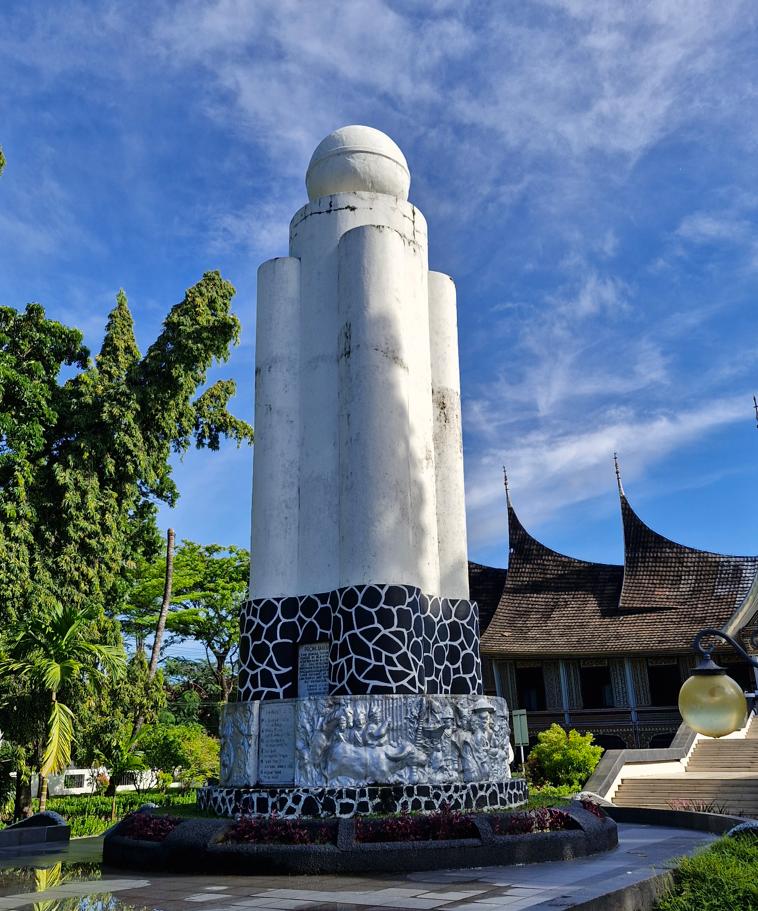
Out in the forecourt, facing the museum's main rumah gadang building, stands a tall independence-struggle monument that is, whatever its sculptor intended, unmistakably, almost heroically, phallic, a fact our group clocked within about four seconds of stepping off the bus and then spent the rest of the visit failing politely to unsee. I offer no great art-historical theory here, only the observation that a monument to Minangkabau resolve, standing bolt upright directly in front of a building whose entire roofline is devoted to the horns of a buffalo, achieves a kind of accidental symbolism that no committee, one suspects, ever discussed out loud in the planning meetings.
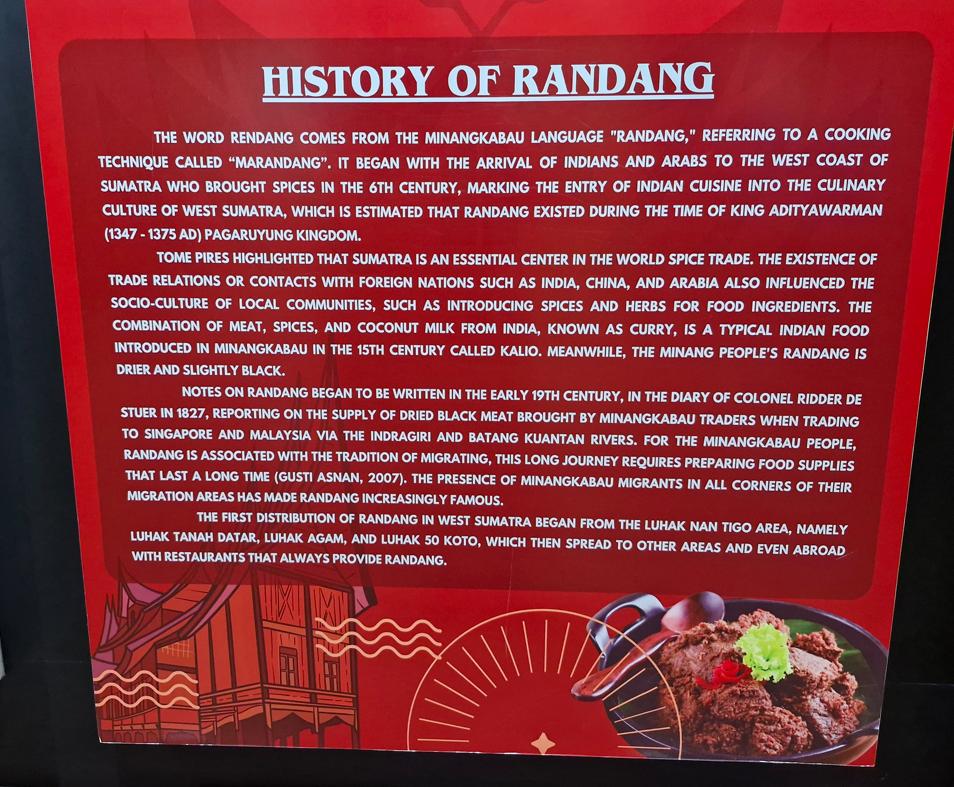
Inside, a dedicated hall gives rendang the kind of curatorial seriousness usually reserved for a national language or a founding constitution: four panels covering its history, its philosophy, its nutrition, and its rise to global fame. The history panel traces the word to marandang, the Minangkabau cooking technique, links the dish's roots to Indian and Arab spice traders arriving as early as the sixth century, and dates its likely emergence to the Adityawarman-era Pagaruyung kingdom I had just spent twenty minutes admiring a few rooms back, carefully distinguishing true rendang, dry, dark, cooked until the liquid is gone, from kalio, its wetter, curry-like precursor.
An 1827 diary entry from a Dutch colonel describing dried black meat carried by Minangkabau traders earns a citation, as does Tomé Pires on the old spice trade, and the panel credits merantau itself for the dish's spread: a food invented to survive a long journey travels, unsurprisingly, wherever its cooks do. The philosophy panel is the most unexpectedly affecting of the four, reading rendang's core ingredients as a social allegory of consensus-based Minangkabau governance: beef for the clan leaders, coconut for the intellectuals, chilli for the religious scholars, spices for the wider community, the whole simmering pot standing in for musyawarah mufakat, deliberation until agreement is reached, a more elegant civics lesson, I thought, than anything I was ever taught in a classroom.
The nutrition panel is where I lingered longest, less out of hunger than a travel writer's habitual suspicion of tidy numbers. It cites a 2012 food blogger site’s reference for a full nutrient breakdown of beef rendang, 193 kilocalories and 22.6 grams of protein per 100 grams among other figures, and the arithmetic actually holds up: protein, fat and carbohydrate, multiplied out by their usual calorie factors, land within a rounding error of the stated energy value, so nobody simply invented these numbers. A national museum, I thought, a touch uncharitably, might have cited its own government's food data directly rather than a general trivia site. More to the point, 193 kilocalories and under 8 grams of fat per 100 grams is a strikingly lean figure for a dish famous for being reduced in coconut milk until the oil separates and fries the meat in its own fat; other estimates for rendang cooked the traditional, more reduced way run considerably richer. The panel's advice to pair rendang with boiled vegetables and fruit to “neutralise” its saturated fat is, chemically, more aspiration than mechanism, fibre does not neutralise fat already eaten, though its closing line needs no such caveat at all: don't forget to exercise and get regular checkups is the one piece of advice on the whole panel that is correct regardless of how the fat and carbohydrate figures shake out, a fitting note to end an exhibition about a dish this rich in coconut oil.
The introduction panel, for its part, stakes rendang's claim to the world stage without much modesty and not much need for it: introduced internationally by chef William Wongso in Berlin in 2010, voted the world's most delicious dish by CNN International readers in 2011, and declared one of Indonesia's five national dishes in 2018. Glass cases nearby hold replicas of eight regional variants, beef, duck, eel, lung, jengkol, clam, jackfruit and fiddlehead fern rendang, though the printed panel lists jackfruit twice, less a secret ninth variant, I suspect, than the kind of small labelling slip that, oddly, made the whole exhibition feel more human rather than less.