Chapter Seven

PALEMBANG, WHERE AN EMPIRE RULED THE SEA

A journey through thirteen centuries along the Musi River, the lost hydraulic capital of Srivijaya, sacred tombs on Bukit Siguntang, and the maritime crossroads of Sumatra.

By Tan Wee Cheng

Scroll to Explore
Palembang Musi Riverfront
Expand
Ampera Bridge and River
Expand
Palembang Waterfront Scene
Expand

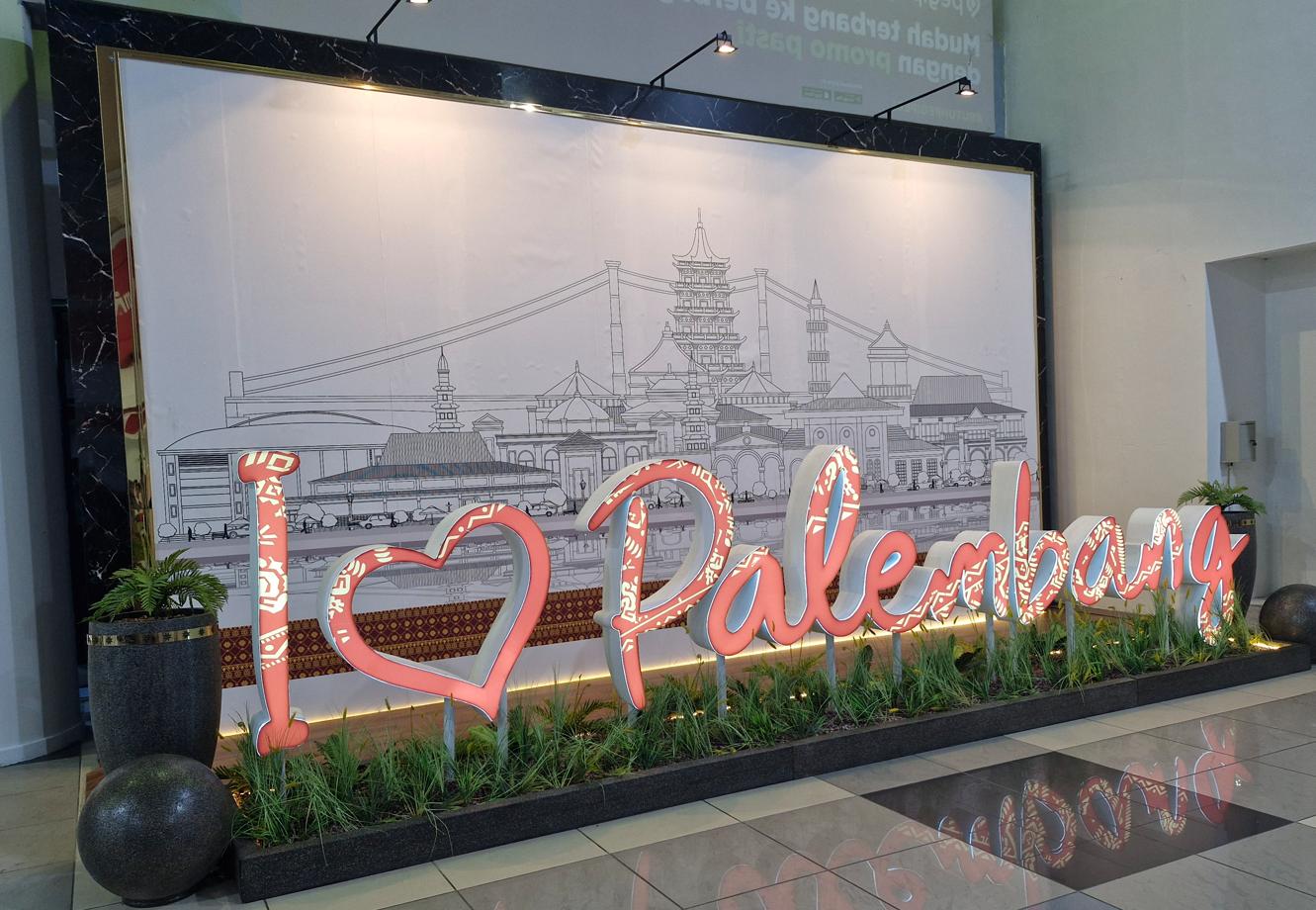
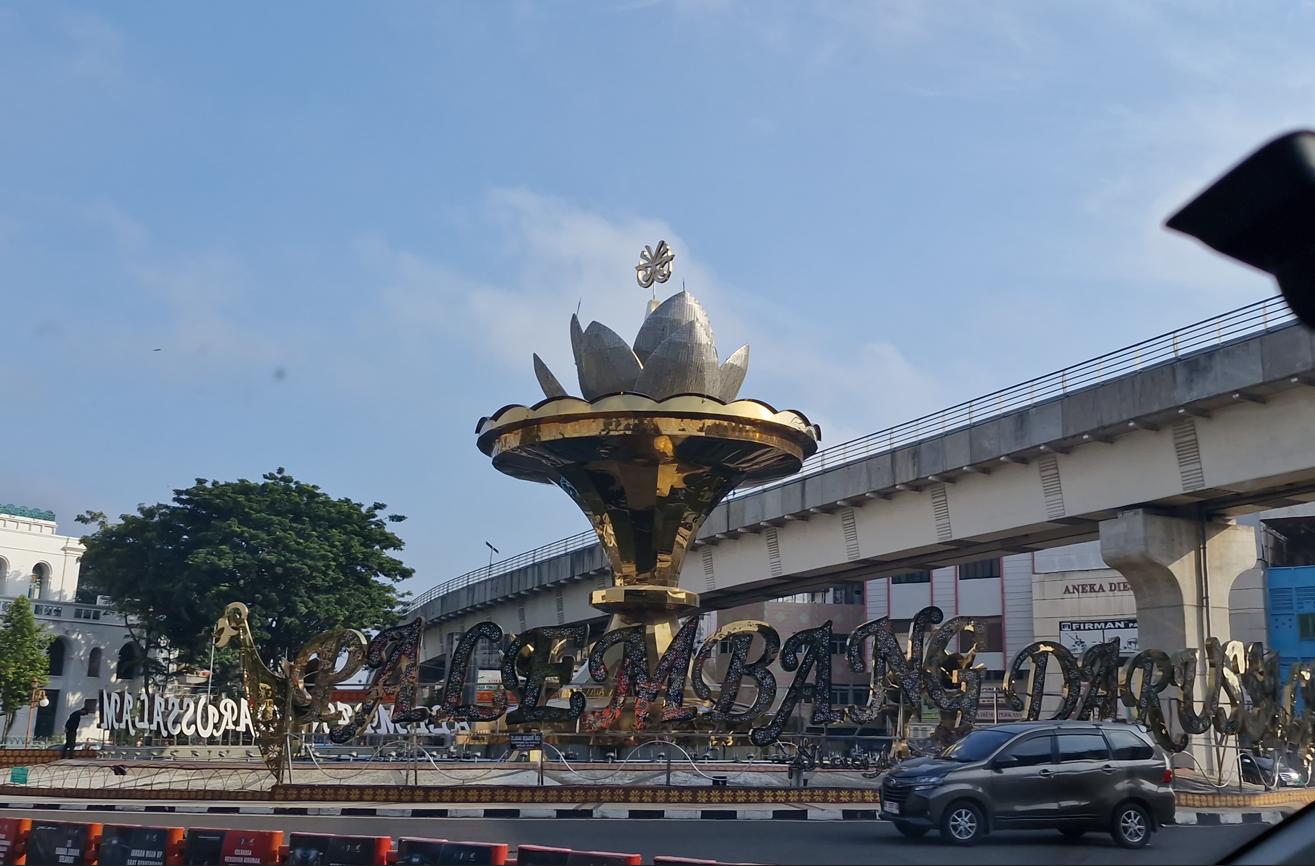
Palembang announces its age before it announces anything else. Thirteen hundred years of continuous urban life sit along the banks of the Musi River here, a stretch of water the city has long since earned the right to be called, with only a little civic exaggeration, the Venice of the East, anchored by the great cantilevered silhouette of the Ampera Bridge, completed in 1965 with a lifting span for large ships that has sat dormant for decades but still glows, floodlit gold and red, over the water each night.

Sriwijaya Archaeological Landscape
Expand Full Width Image
Srivijaya Artifact
Srivijaya Artifact
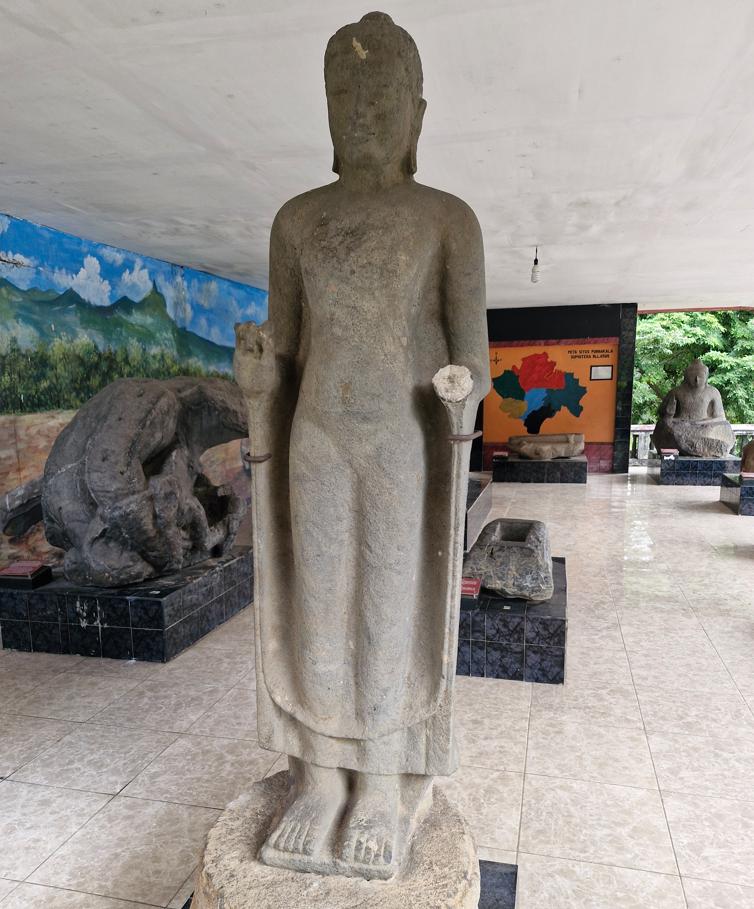
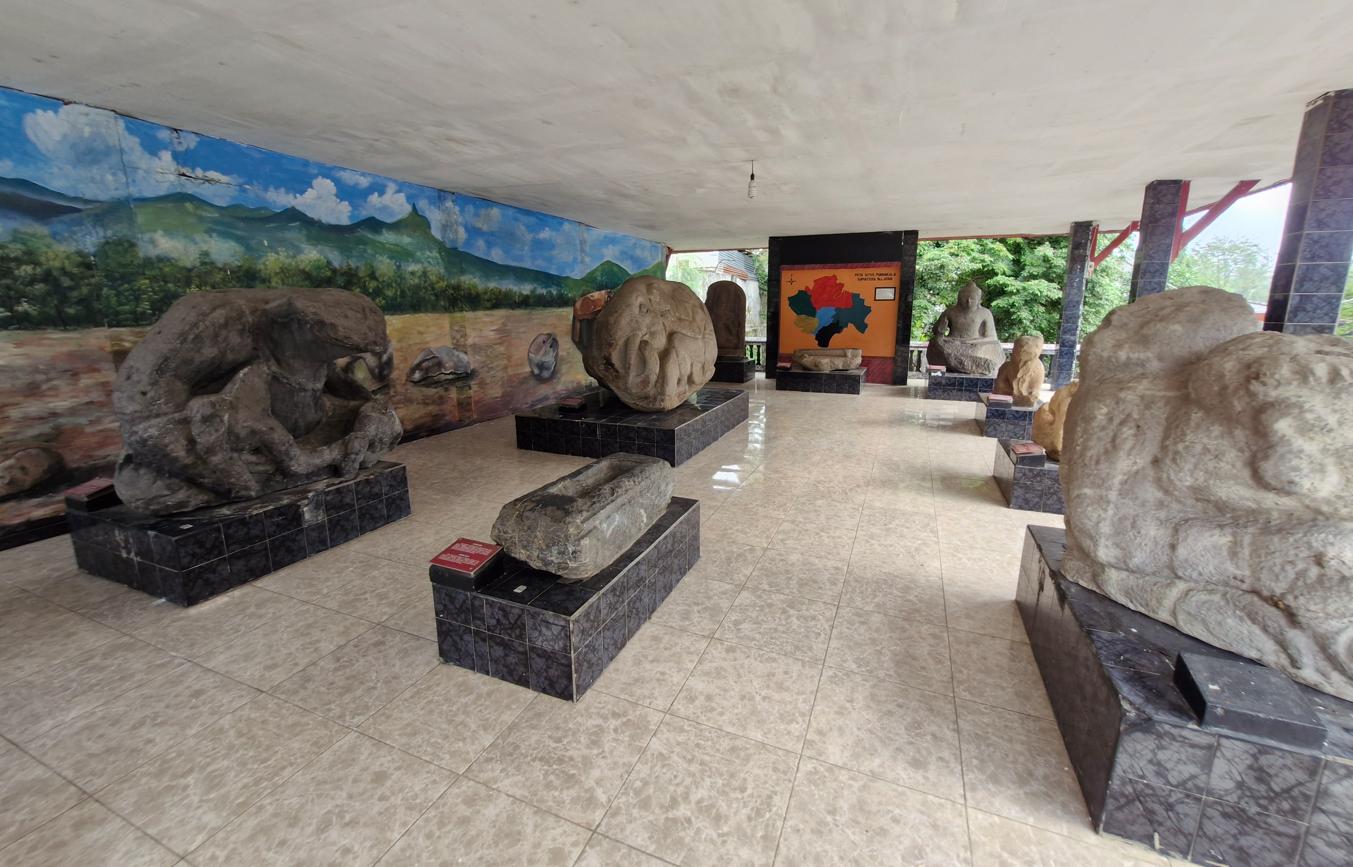
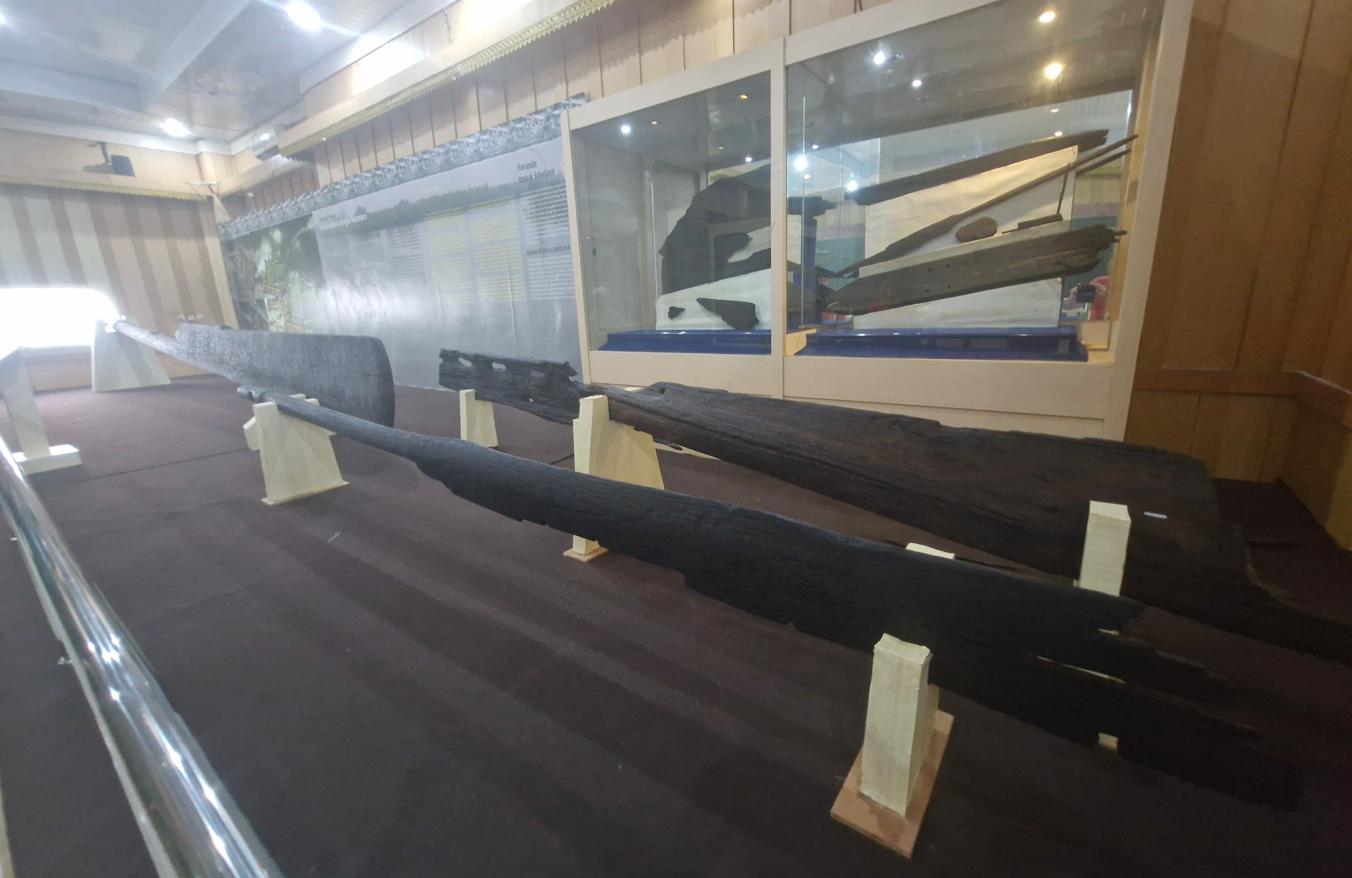
Srivijaya artifacts at Balaputradewa State Museum of South Sumatra Province
Srivijaya Artifact
Srivijaya Artifact
Srivijaya Artifact
Srivijaya artifacts at Sultan Mahmud Badaruddin II Museum
Srivijaya Archaeological Site
Srivijaya Park canal
Srivijaya hydraulic park
Archaeological grounds
Srivijaya pond and park
Srivijaya archaeological expanse
Srivijaya artifact detail
Srivijaya stone detail

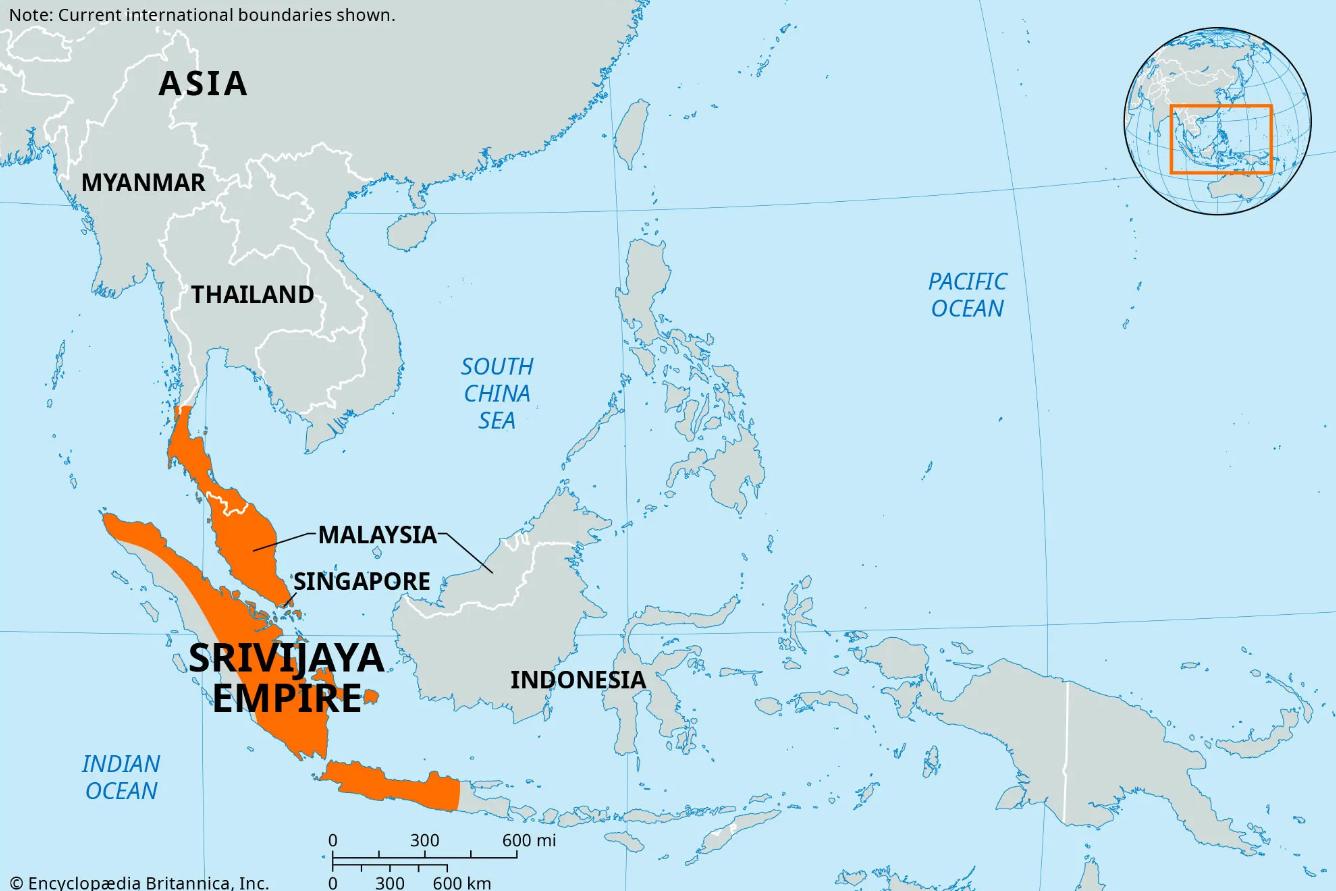
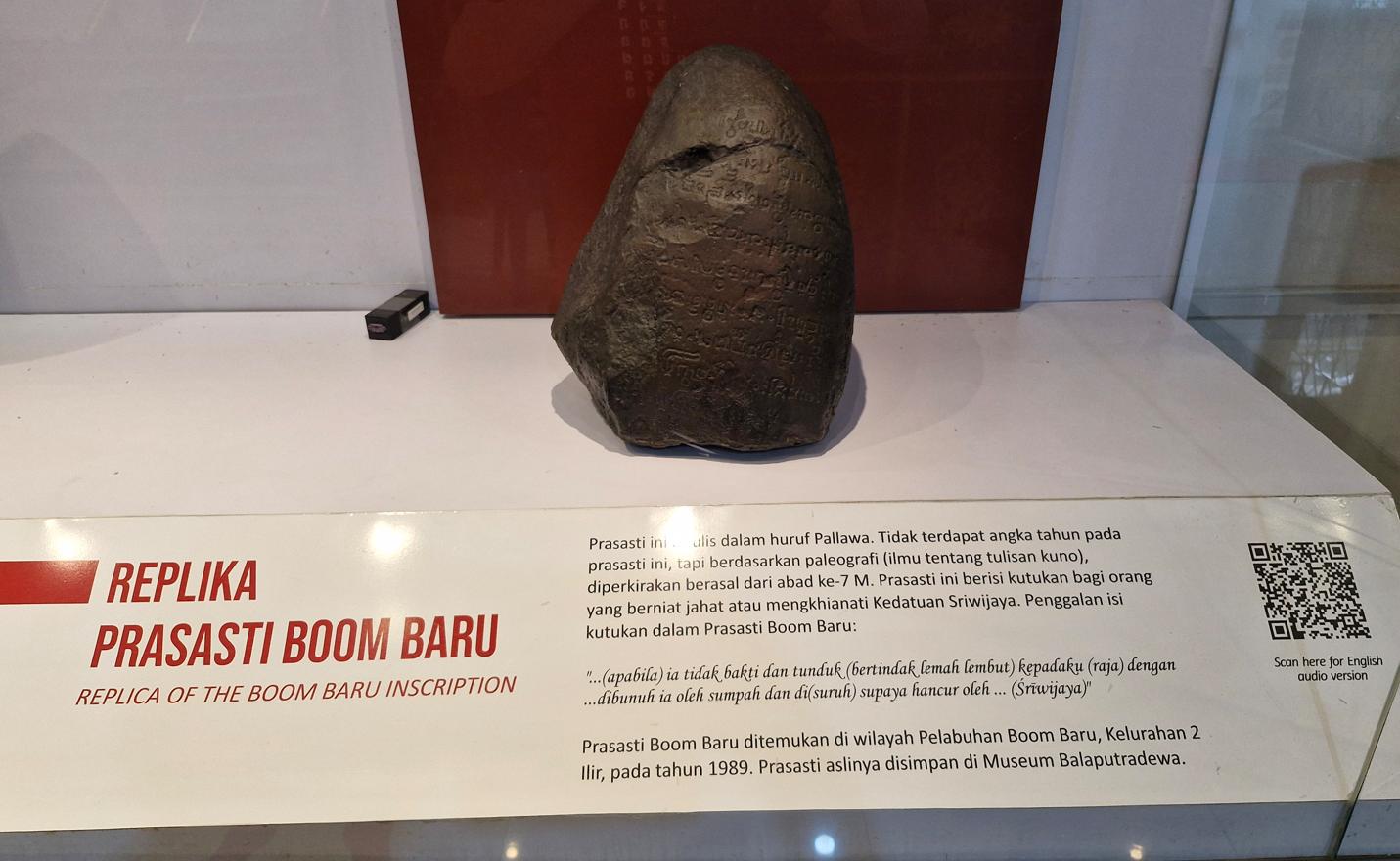
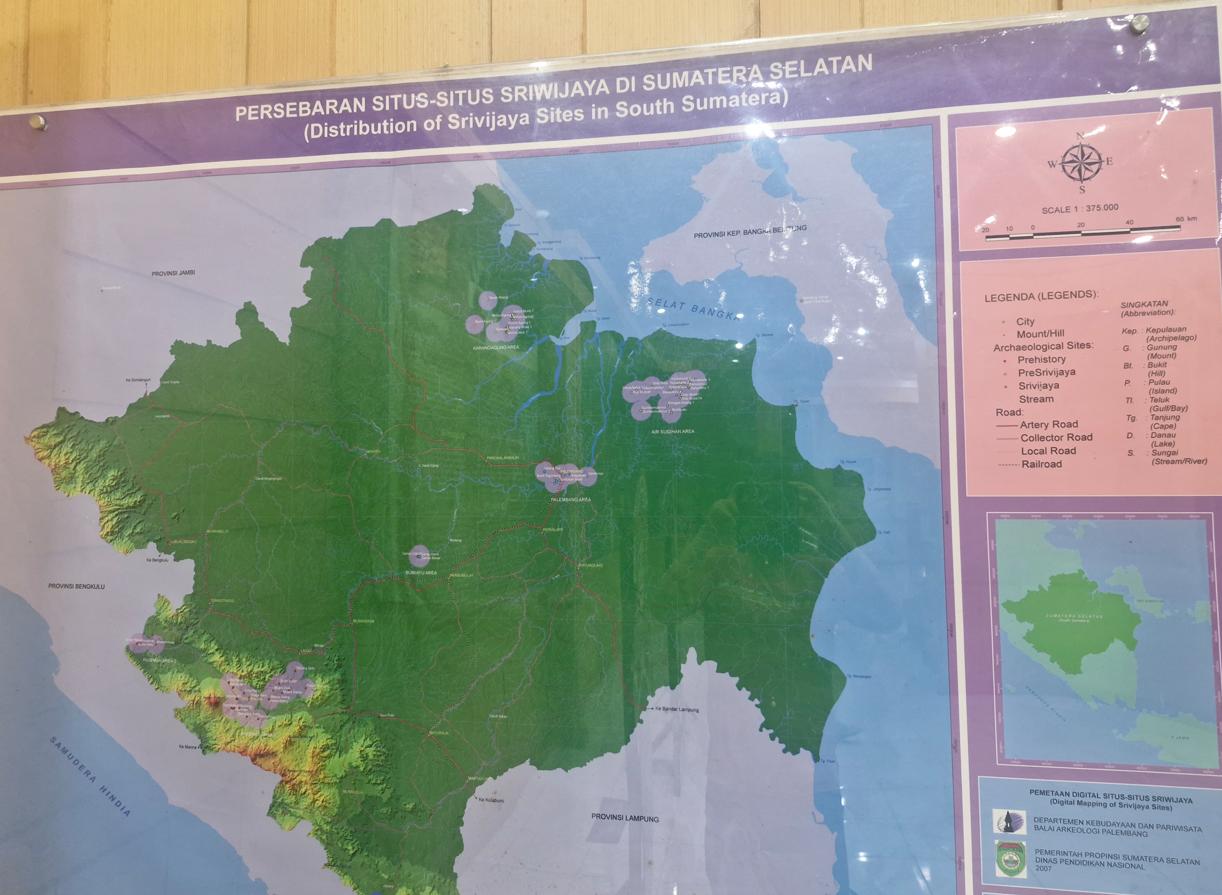
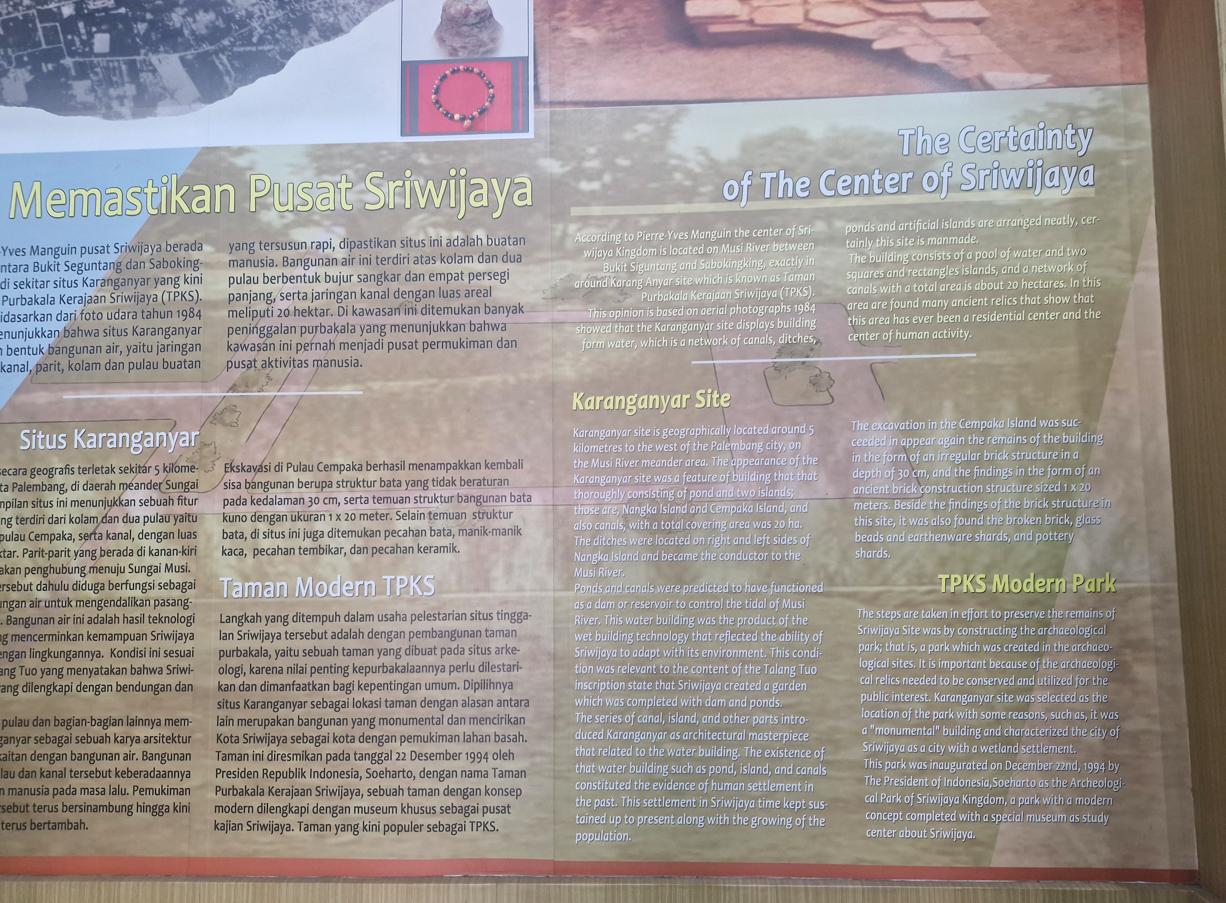
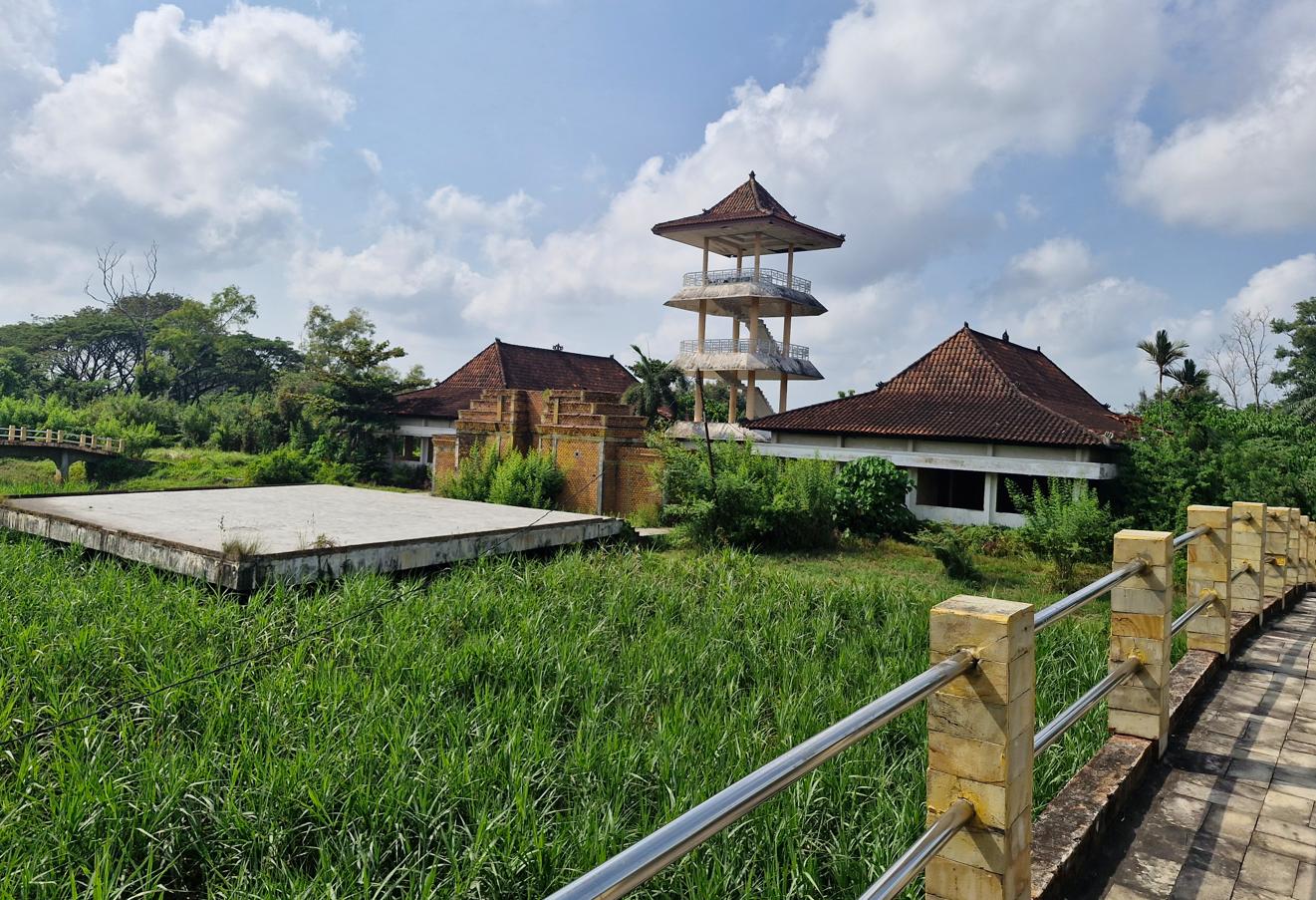
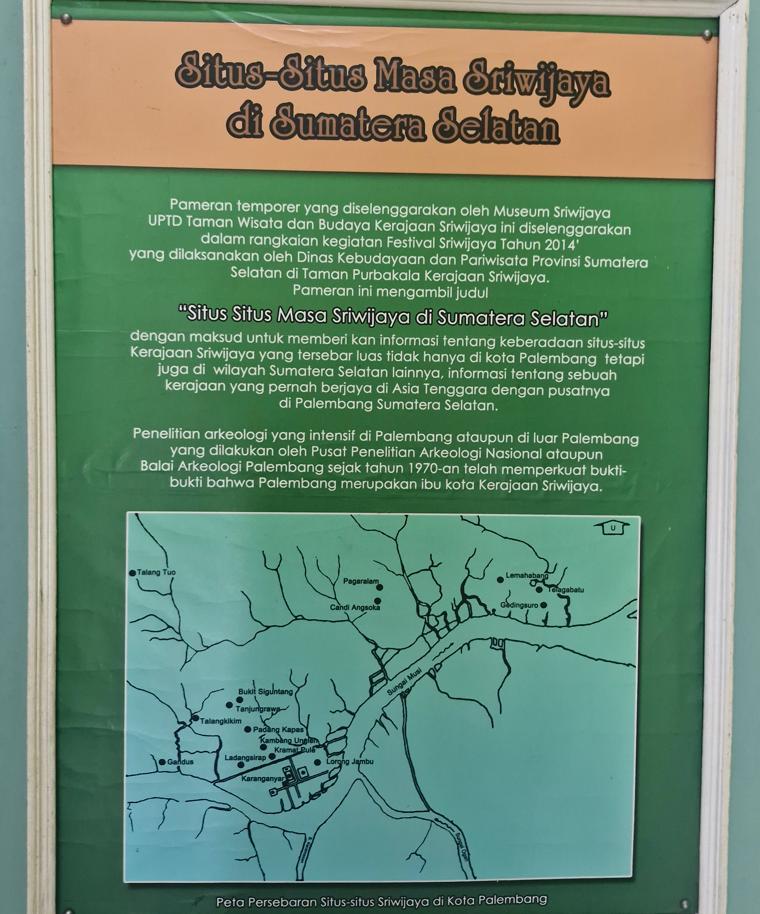
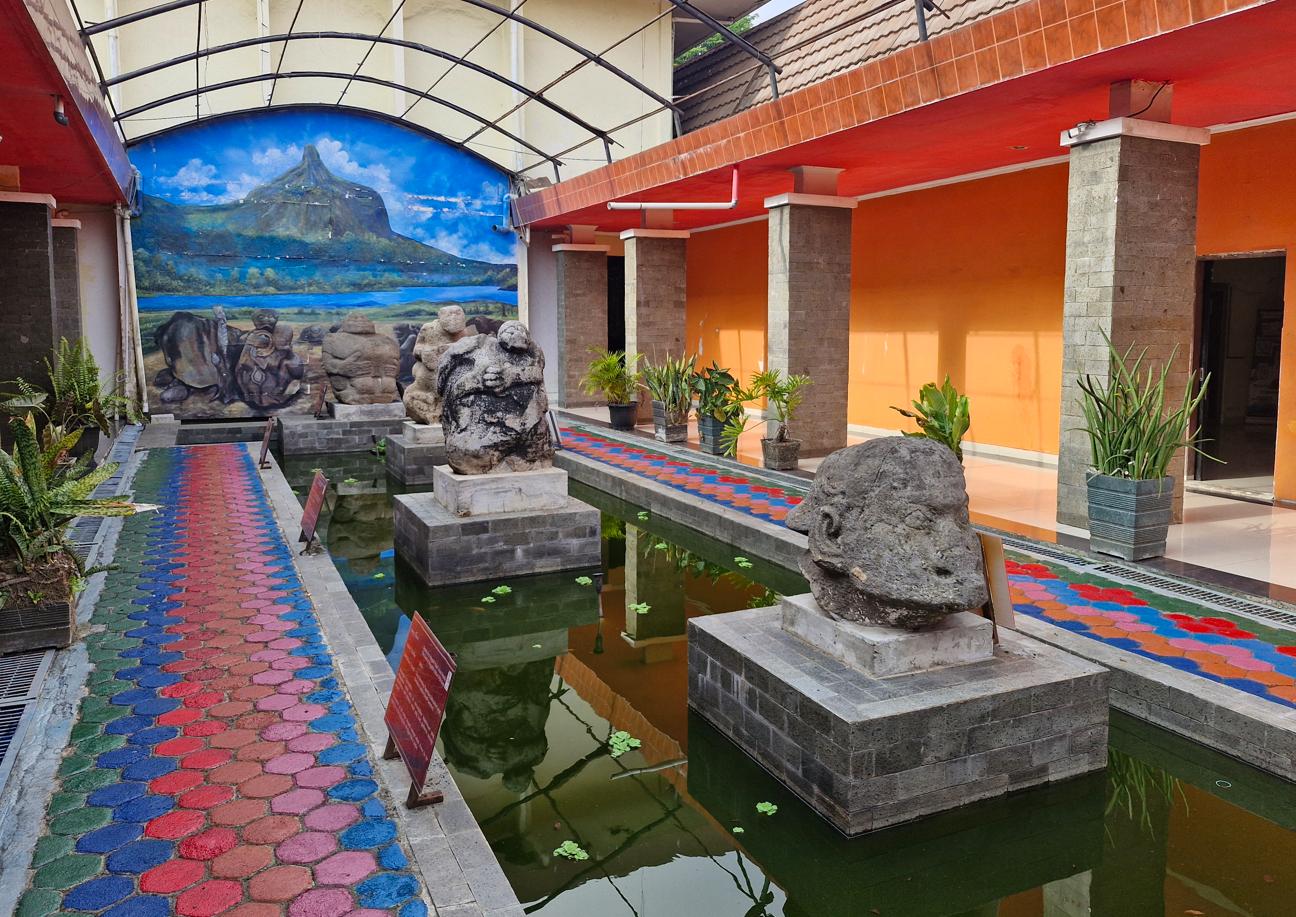
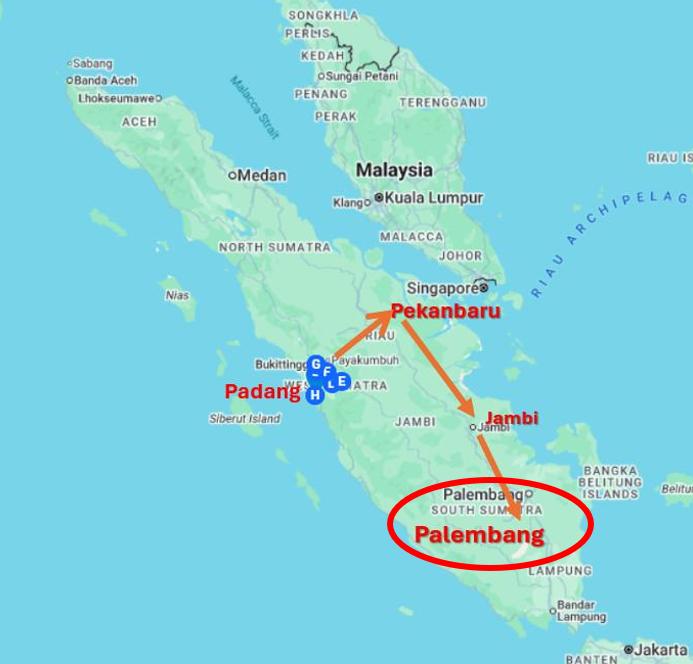
At the Sriwijaya Kingdom Archaeological Park, on the alluvial flats where the Musi meets the Ogan and Keramasan rivers just south of Bukit Siguntang, I went looking for the physical remains of an empire that once, by taxing the entire flow of trade between China, India and Arabia through the Strait of Malacca, grew wealthier than almost any land power of its age, and found, in the end, almost nothing standing at all. No temple, no candi, no monumental stone anywhere on site. That absence, I came to understand walking the quiet, half-deserted grounds, is itself the lesson. Srivijaya was never a land empire that raised stone capitals the way Java's kingdoms or Angkor did; it ruled through naval supremacy and trade taxation, a loose confederation of port cities held together by control of the sea lanes rather than by fortified capitals, and its true monuments were hydraulic rather than architectural: a vast engineered water landscape whose outline can still, if you know where to look, be traced in the earth, a rectangular pond some six hundred by three hundred metres with two artificial islands at its centre, a network of canals, the largest running a full three kilometres and wide enough to open directly onto the Musi at both ends. What a thousand years of tropical humidity and seasonal flooding have not erased is the shape of the water itself; what they have long since dissolved is the wood, thatch and packed earth that once stood beside it. A thalassocracy's power, I found myself thinking, lives on the water and in the ledgers of passing ships, not in stone walls, and the water, in the end, is exactly what remains of it.

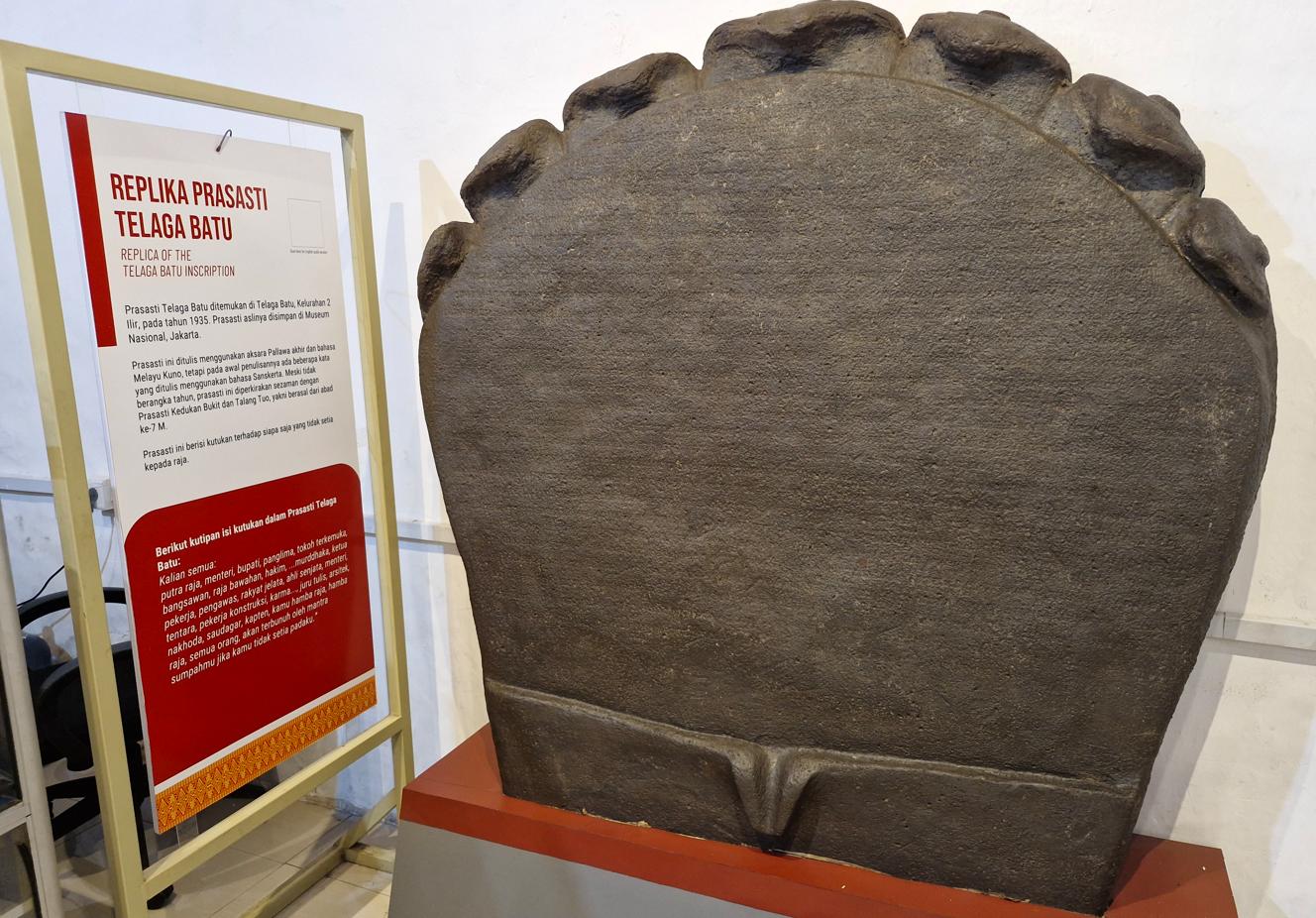
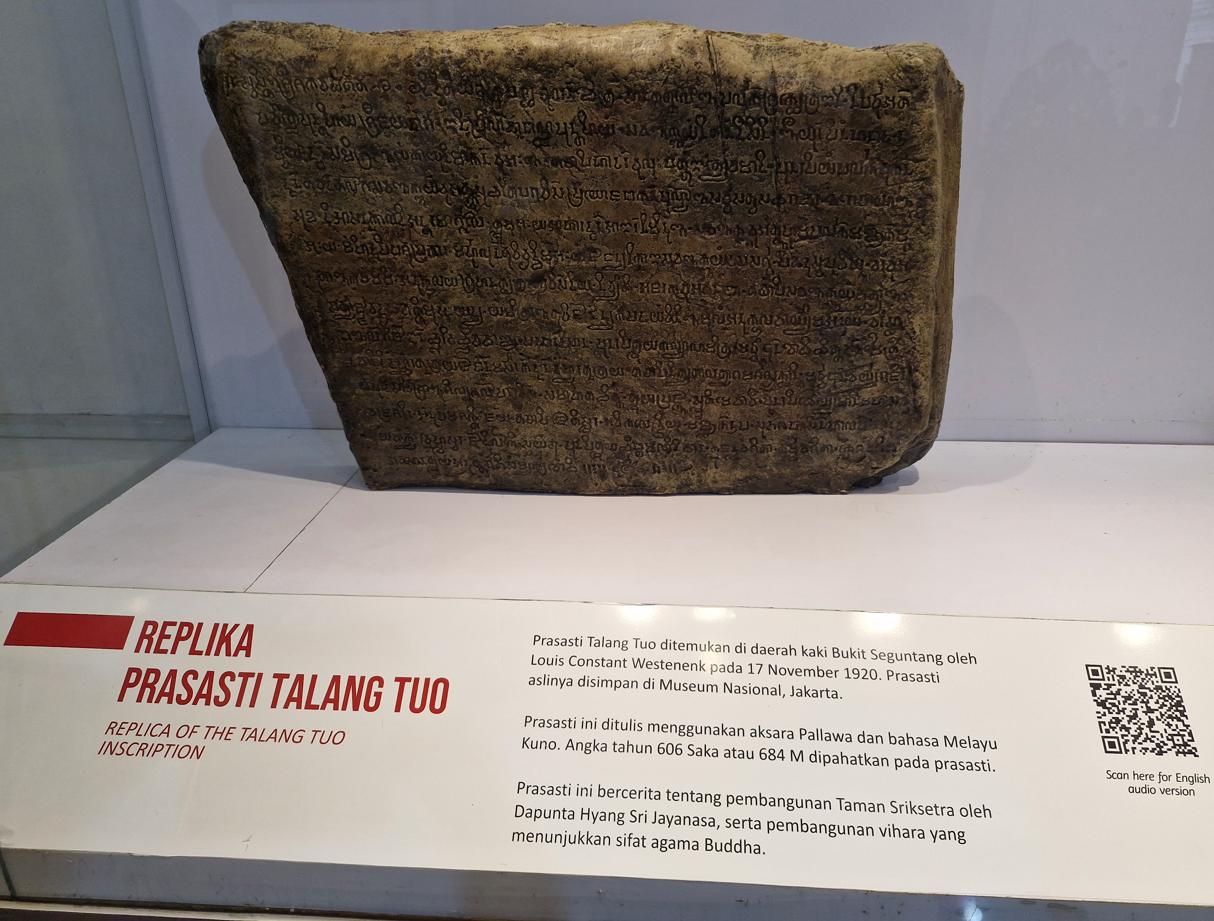
The founding of that empire, and the manner of its unravelling seven centuries on, are both written in stone, and both stones surfaced within a few kilometres of where I was standing. The Kedukan Bukit inscription, unearthed near Palembang in 1920 and dated to 683 CE, is written in Old Malay in Pallava script, the oldest surviving specimen of the Malay language anywhere, and records a siddhayatra, a sacred and prosperous journey, undertaken by Dapunta Hyang Sri Jayanasa, Srivijaya's founder-ruler, who departed a port called Minanga Tamwan with a force later interpretations put anywhere between twenty thousand and two hundred thousand men, endured twenty-five gruelling days by water and land, and arrived to found a new wanua, a settlement, that would in time become an empire spanning the whole Strait. A second stone, the Telaga Batu inscription, found at Kelurahan 2 Ilir in 1935 and dated to roughly the same century, reveals what held that empire together once founded: not treaty or tribute alone but oath and curse, a text addressed to “all of you,” princes, ministers, regents, commanders, judges, guild leaders, ship captains, common soldiers and servants of the king alike, warning every one of them, by name of office if not by name of person, that disloyalty to the ruler would be answered with death by the king's own curse-mantra. It is, in effect, a loyalty oath carved permanently into rock, sworn not by the king to his subjects, as the Sang Sapurba covenant across the water would later have it, but by every subject downward to the king: a considerably harder-edged bargain than the one that would define Malay kingship on the Peninsula generations later.

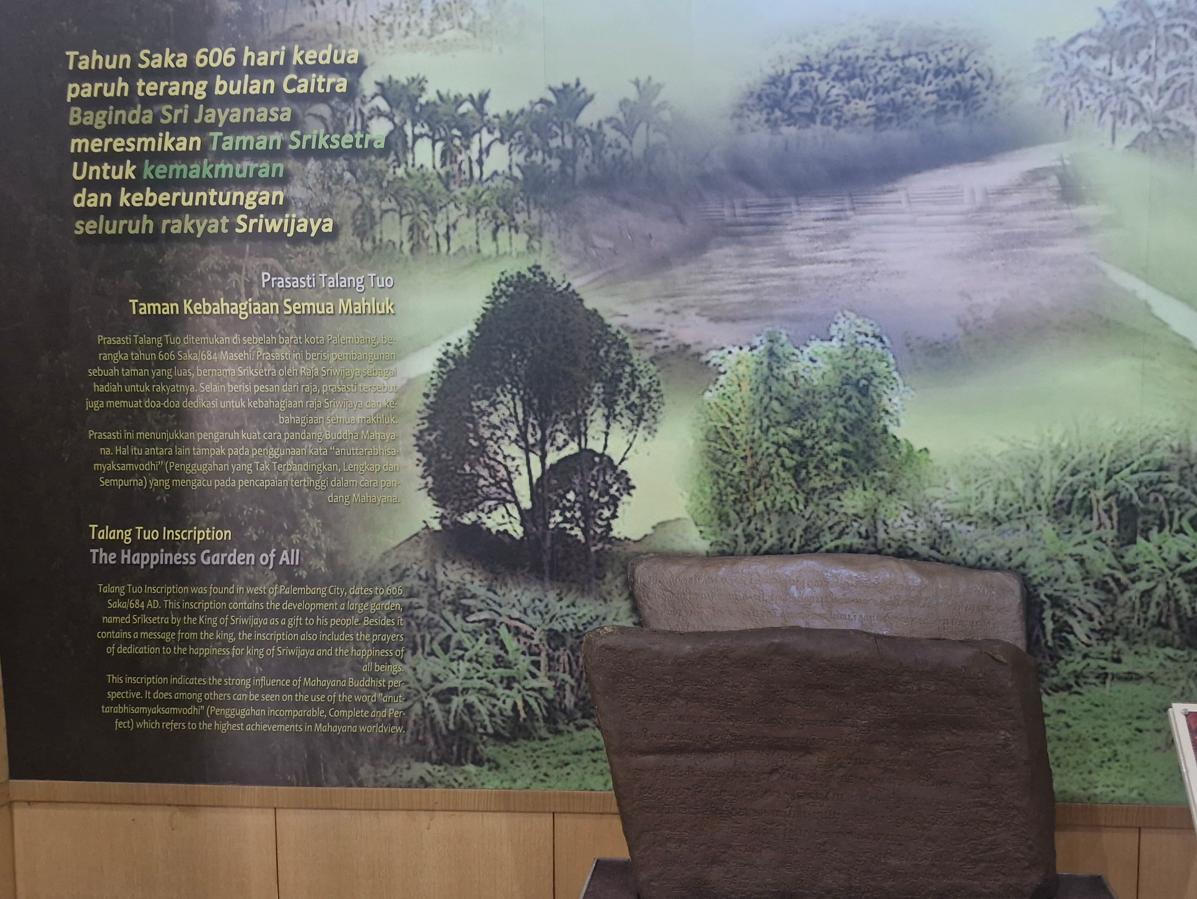
A third inscription, Talang Tuo, found west of the city and dated by its own text to Saka year 606, 684 CE, strikes an entirely different note from Telaga Batu's curse-laden loyalty oath. It records King Sri Jayanasa dedicating a public garden, Sriksetra, for the prosperity and good fortune of all Sriwijaya's people, its Old Malay reaching for genuinely Mahayana Buddhist ideals of universal welfare rather than royal power alone, the same king who elsewhere demanded blood loyalty by curse apparently also capable of dedicating a garden to everyone's happiness in the same breath. A fourth stone, Kota Kapur, raised on Bangka in Saka year 608, 686 CE, to mark the empire's expansion there and its campaign against a still-defiant Java, returns to the harder register, invoking curses on anyone, subject or rival, who failed to submit to Sriwijaya's authority. Between the four of them, siddhayatra, oath, garden and conquest, the inscriptions read less like scattered archaeological finds than like the full operating manual of an early Malay empire: how it was founded, how it disciplined its own people, how it cared for them, and how it dealt with everyone else.

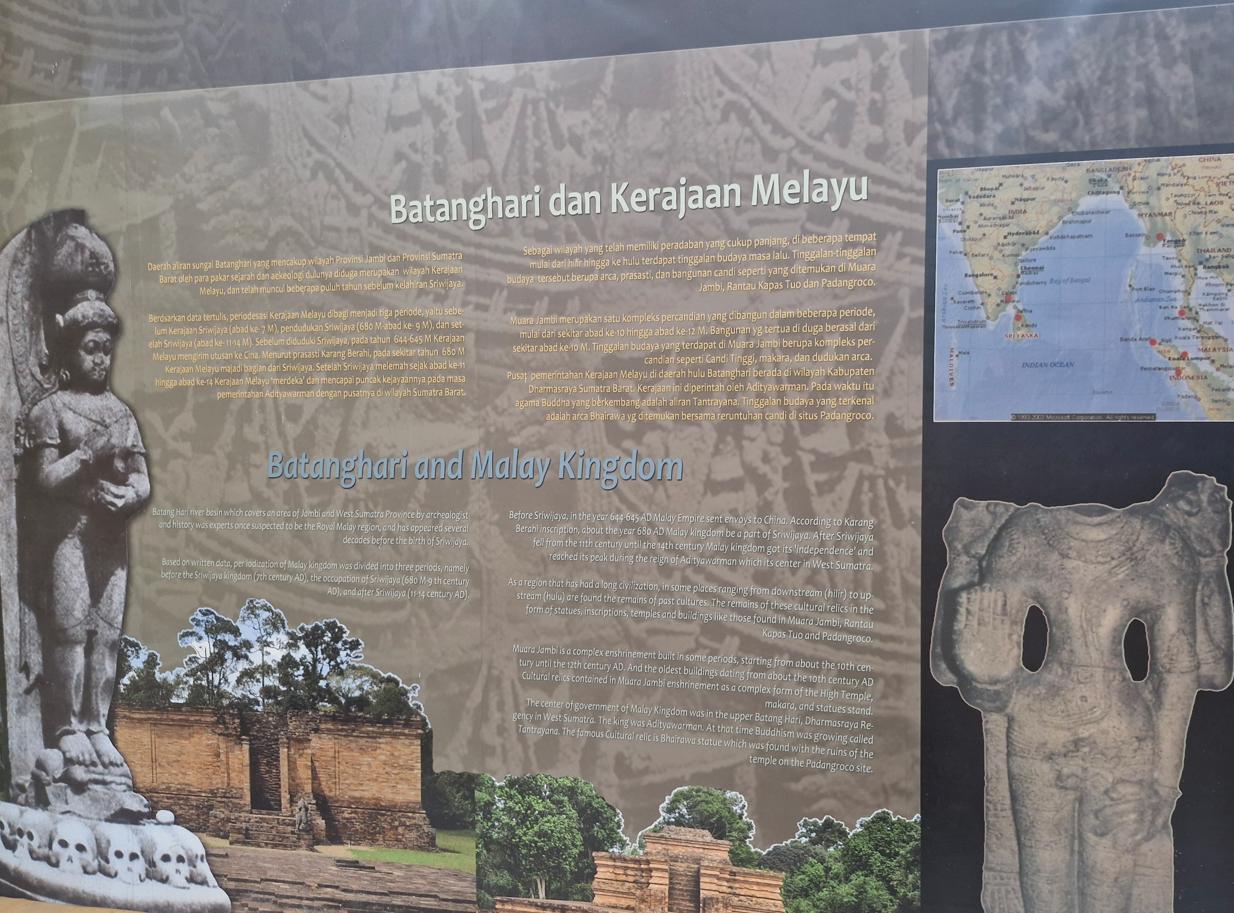
That bargain held for the better part of four centuries, until it broke in a single, devastating naval campaign. In 1025 CE the Chola emperor Rajendra I of South India, his eye on the same lucrative strait trade Srivijaya had spent centuries taxing, sent a fleet that bypassed Srivijaya's own navy, stationed north at Kedah and watching the wrong approach, by sailing around Sumatra entirely and striking Palembang itself without warning. The Cholas sacked the capital, looted the royal palace of its ceremonial gateway, and carried King Sangrama Vijayottunggavarman off as a prisoner to be paraded, eventually, through the Chola capital of Thanjavur, where an inscription on the stone base of the Brihadisvara Temple still boasts of the conquest in old Tamil verse. Palembang never fully recovered the primacy it lost that year; with its docks burned, its king humiliated, and its vassal states realising, in the way vassal states always eventually do, that a captured sovereign could no longer protect or punish them, the empire's political centre of gravity drifted north over the following decades to Jambi's better-shielded position on the Batang Hari, the very river I had followed, without quite realising the fuller weight of the connection, from Muaro Jambi's temple mounds to a sunken Catalina flying boat, four days and one province before I ever reached Palembang at all.

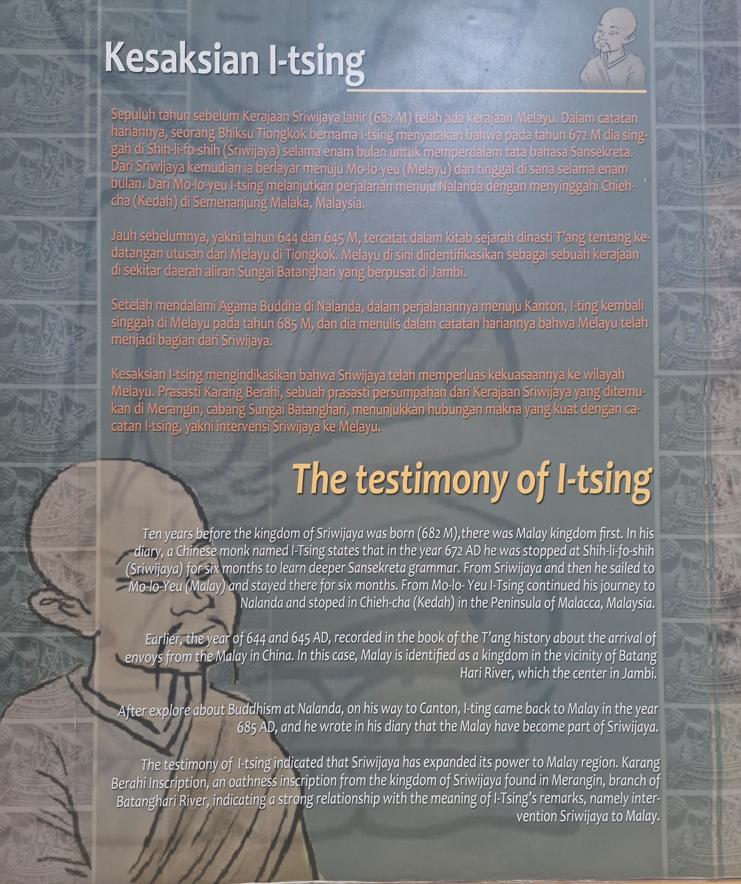
I-Tsing, who stopped here on the same journey that later brought him to Melayu upriver in Jambi, left the single most vivid eyewitness account any traveller of this era committed to writing anywhere in maritime Southeast Asia: “In the fortified city of Bhoga [Palembang], Buddhist priests number more than one thousand, whose minds are bent on study and good works... If a Chinese monk wishes to go to the West [India] to understand and read the original scriptures, he had better stay here one or two years to learn the proper rules.” Eight centuries later, Tome Pires, the Portuguese apothecary whose Suma Oriental remains one of the great trading manuals of the early modern world, found the same rivers still doing the same commercial work they had always done: “Palembang and Jambi are lands of immense wealth in pepper and gold... Great rivers carry goods from the interior high mountains down to the sea, where ships from China, Java, and Malacca gather to trade.”

Sriwijaya's own outward reach shows up independently in Arabic sources far from Palembang. Arab geographers of the Umayyad and early Abbasid period knew the kingdom as Zabaj or Sribuza and recorded its rulers corresponding directly with the Caliphate in Damascus and Baghdad; one surviving exchange has a Sriwijayan king writing to Caliph Umar bin Abdul Aziz around 717 CE with gifts of camphor, aloeswood and spices, and asking, with striking specificity, to be sent someone who could teach Islam properly to his people, a request the Caliph is said to have answered with a hadith scholar rather than merely a trade envoy. Whether every detail of that exchange survives intact through centuries of retelling is impossible to settle from a museum placard alone, but the underlying claim, that Sriwijaya's rulers were corresponding as equals with the Umayyad and Abbasid courts a full four centuries before Islam took root among the Malay courts of the Strait themselves, fits everything else the inscriptions already show about an empire that thought of itself as a serious participant in a very large world.

Bukit Siguntang Shrine
Bukit Siguntang Sacred Site
Bukit Siguntang Tomb Enclosure
Royal Tomb complex
Bukit Siguntang Monument
Bukit Siguntang Devotional Marker
Bukit Siguntang Grounds
Keramat Tombs
Devotional offerings
Bukit Siguntang Canopy
Hilltop forest path
Archaeological pavilion

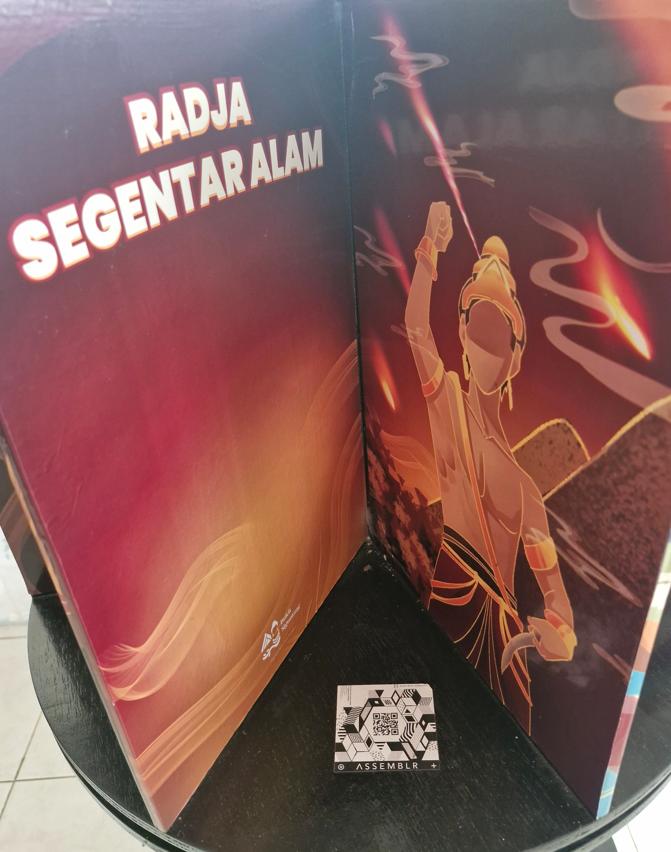
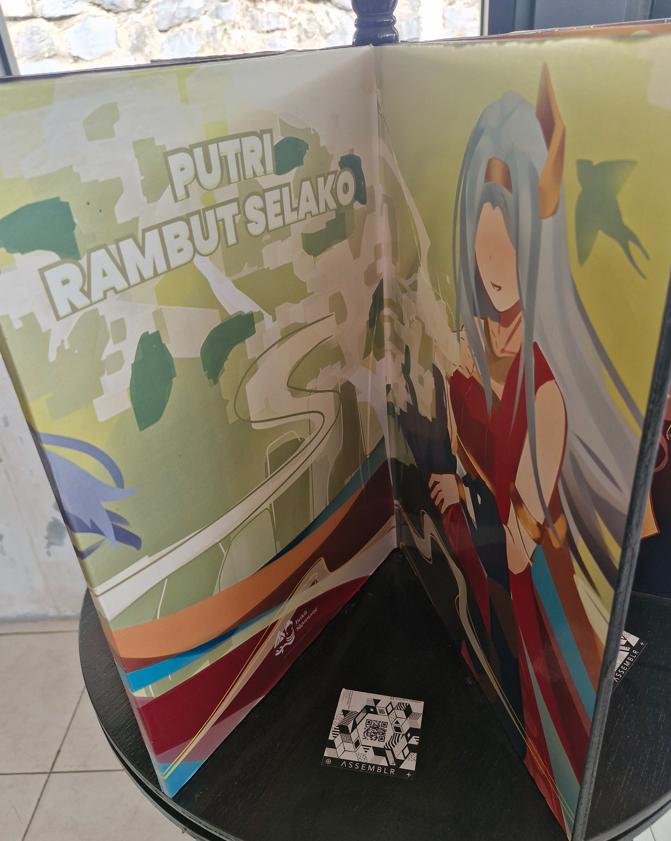
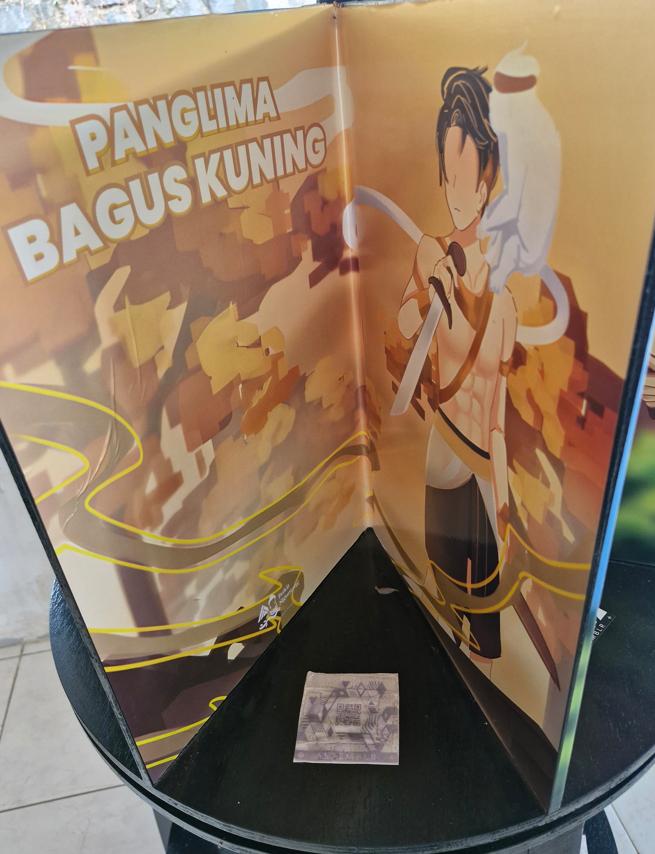
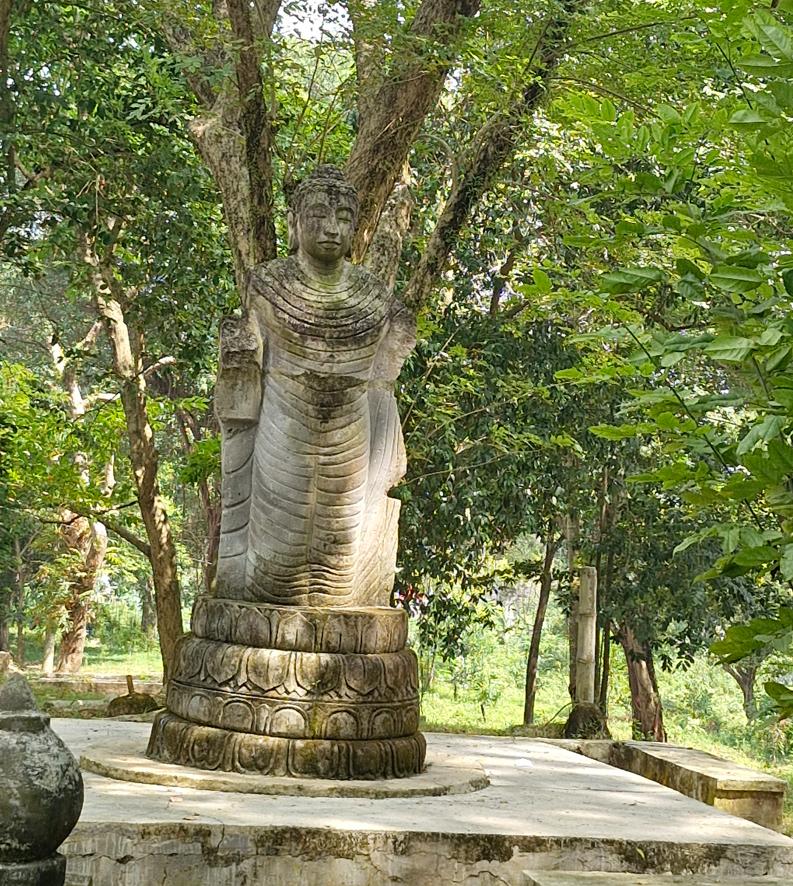
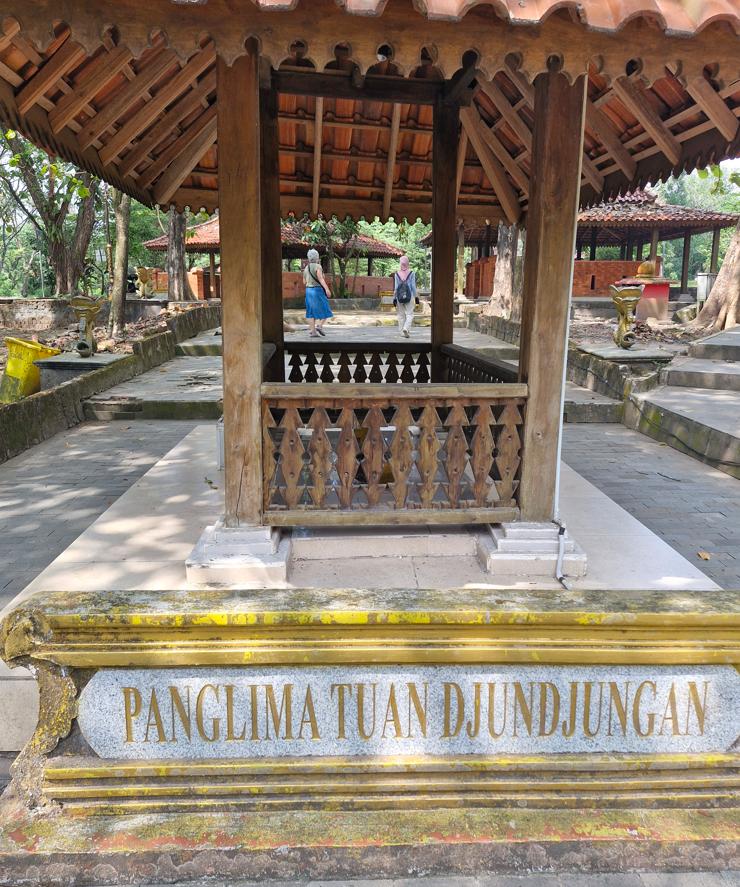
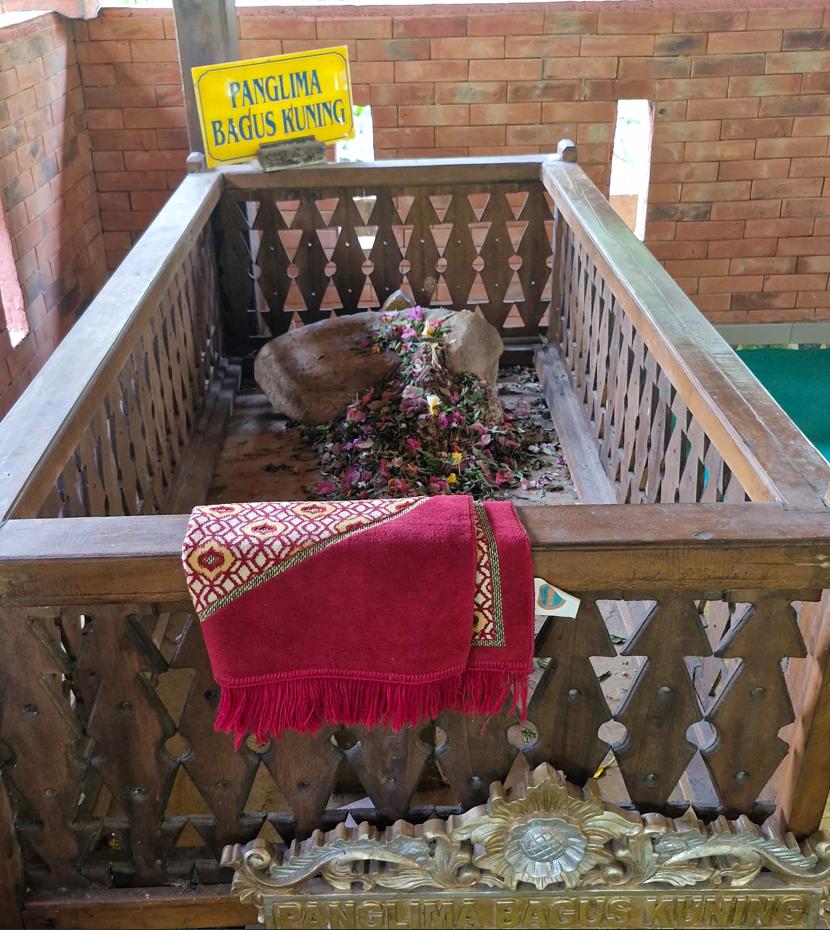
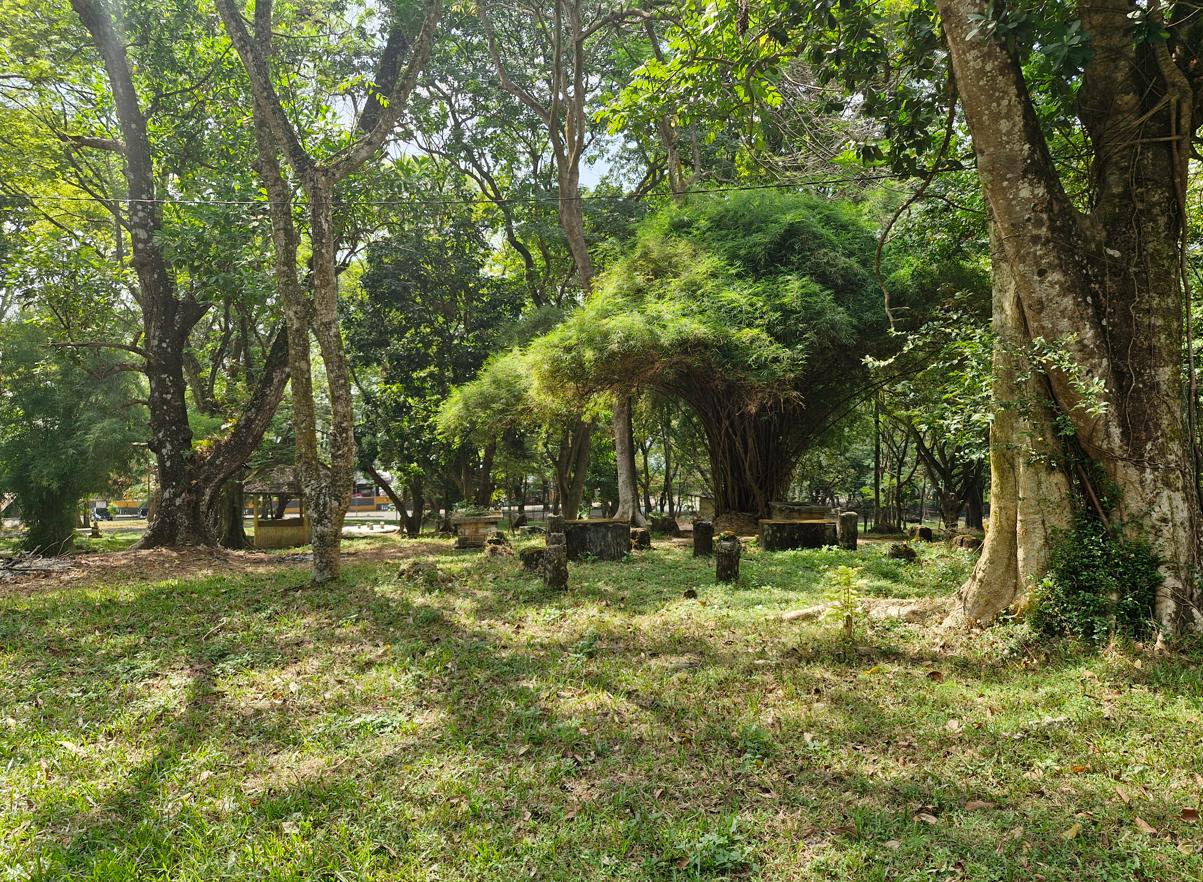
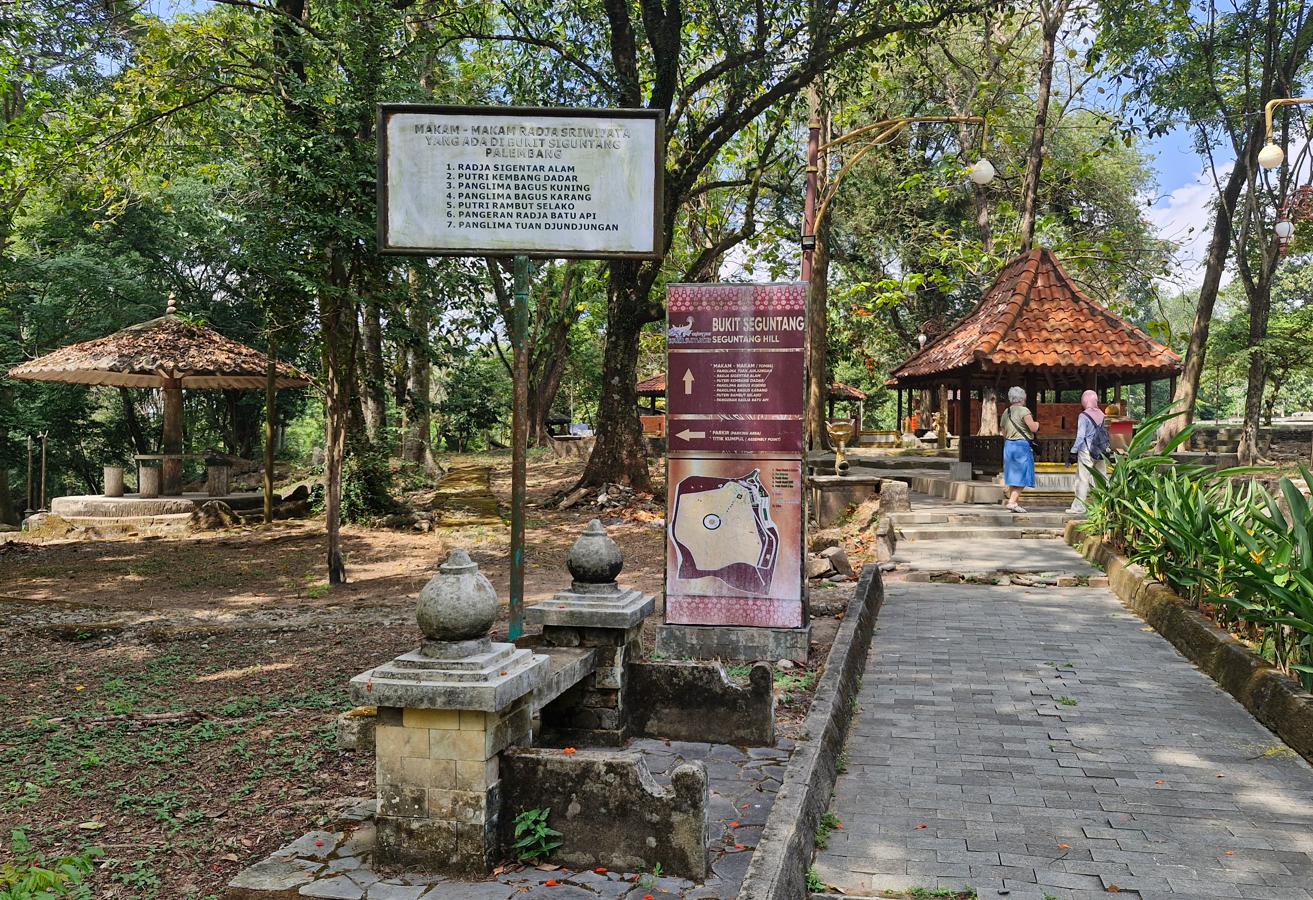
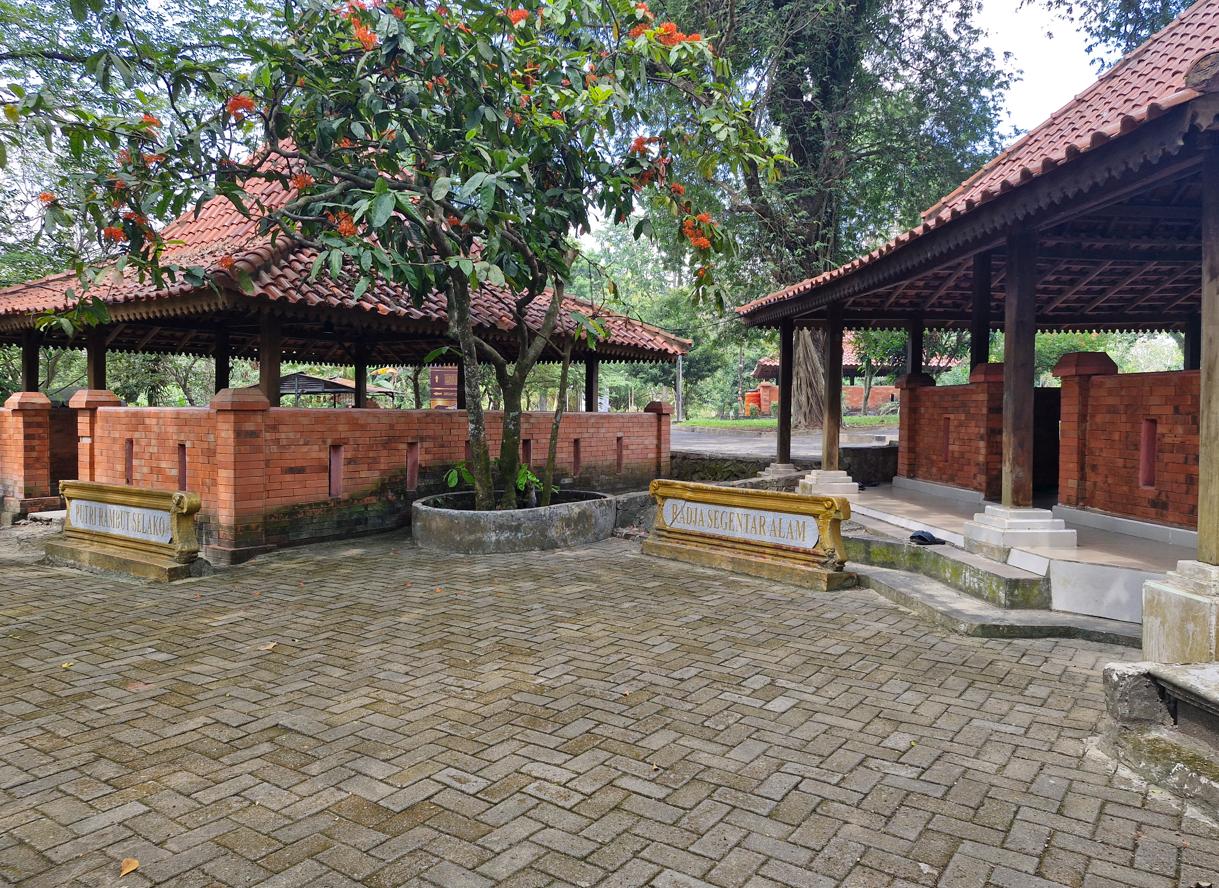
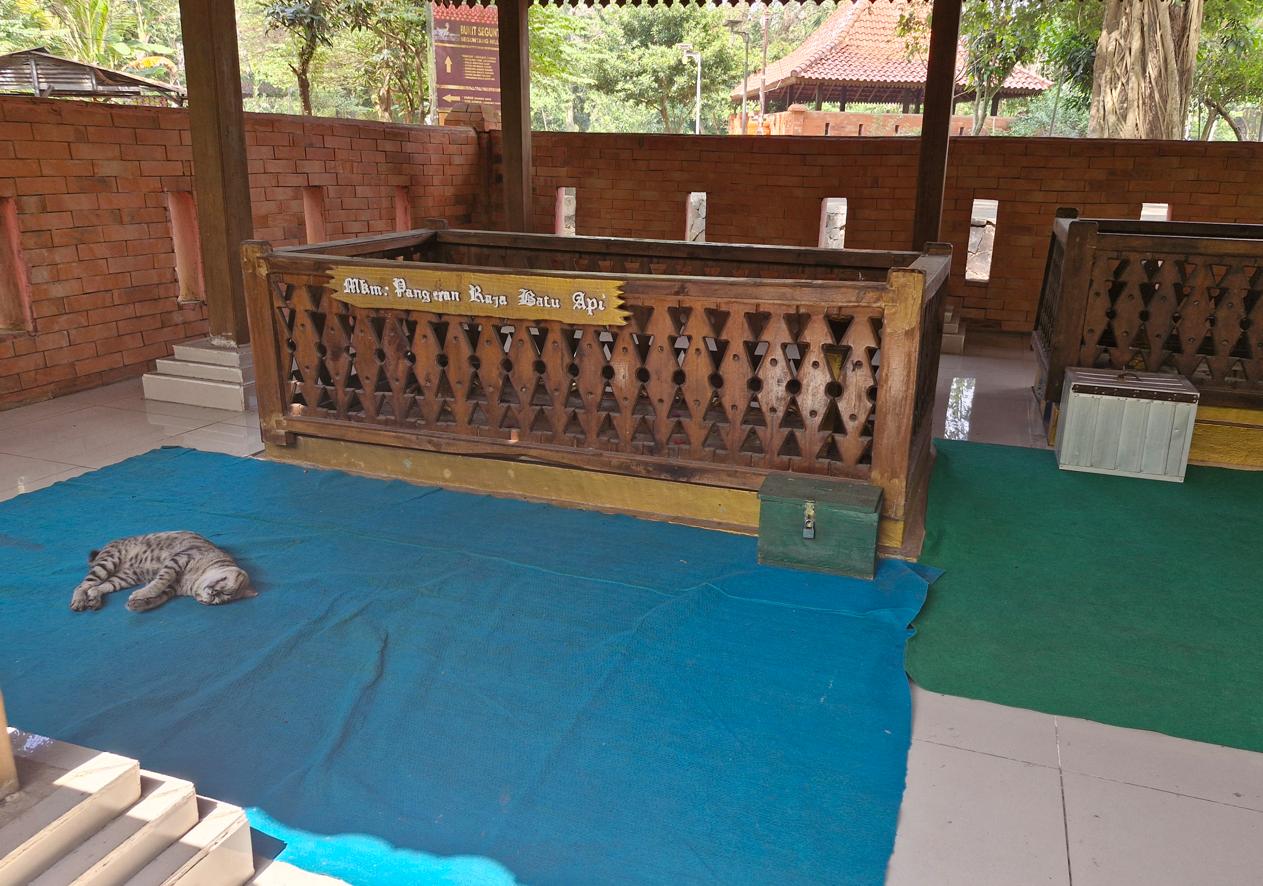
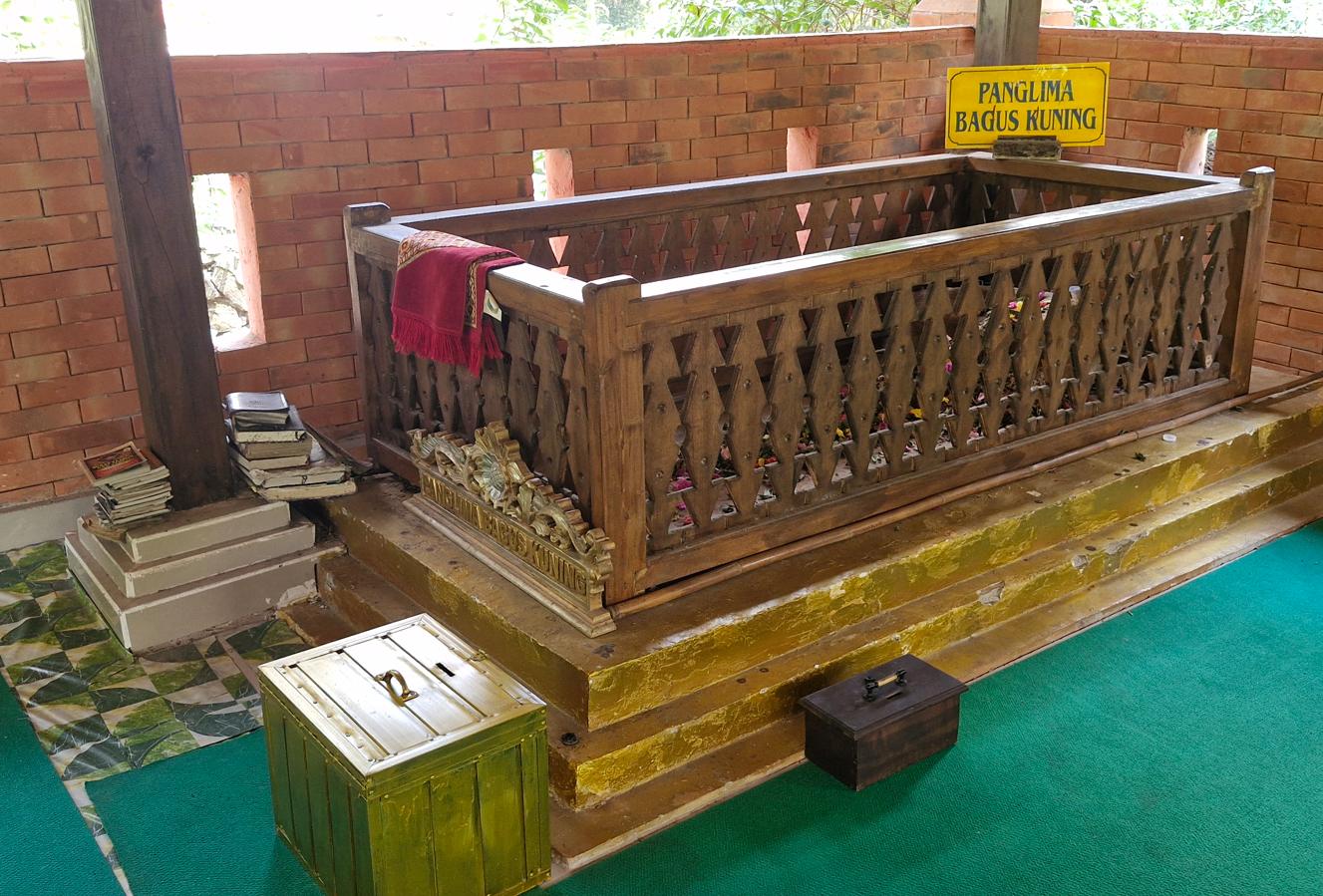
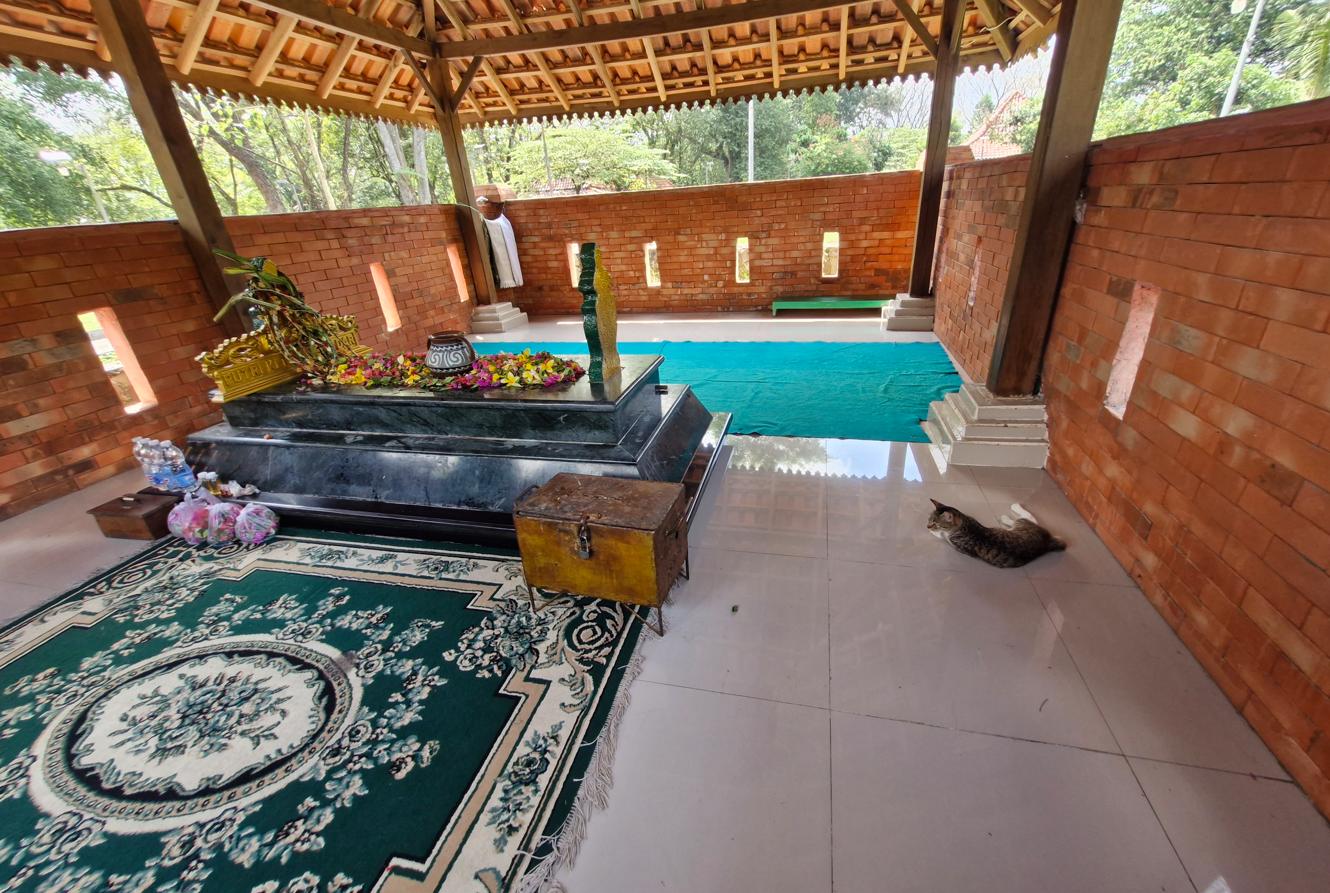
Up on Bukit Siguntang, the highest point in the city and, in local cosmology, a hill believed to symbolise Mount Meru itself, I found a stranger and more intimate kind of history: a cluster of royal tombs venerated as the graves of seven legendary founder-figures, each with a devotional specialism precise enough to feel almost bureaucratic. Businesspeople pray at the tomb of Putri Kembang Dadar for success in trade; those seeking promotion or authority pray at the tomb of Raja Sigentar Alam, said in some tellings to be Iskandar Zulkarnain, Alexander the Great, himself, arrived from Mataram to conquer nearly all of Sumatra and as far as Johor and Malacca, a sailing song about his voyages reportedly still sung in Medan, Johor and Malacca today. Two commander-generals, Panglima Bagus Kuning and Panglima Bagus Karang, share a single, matched role as his loyal bodyguards; two wandering Arab missionaries, Panglima Tuan Junjungan and Pangeran Raja Batu Api, represent the arrival of Islam itself, the same “wandering foreign saint” archetype that recurs at keramat graves across the whole Malay world. It is, all at once, a fully functioning devotional economy layered directly on top of a UNESCO-adjacent archaeological landscape, and it is precisely this layering, sacred and scholarly occupying the same low green hill without apparent friction, that felt to me most distinctively, unmistakably Sumatran.
Andaya would recognise the hill immediately. Sang Sapurba's descent here, and Raja Sigentar Alam's own conflation with Iskandar Zulkarnain, are exactly the kind of founding genealogy he means by the “Sea of Melayu”: a shared origin myth, radiating outward from this one low green summit, that gave the whole Straits world a common cultural currency to draw on, or to declare independence from, as circumstances required. Adityawarman, the Majapahit-Melayu prince whose statue I had stood before days earlier in Padang, carried this exact bloodline into the highlands and used it to found Pagaruyung; the Malay Annals carried the same Sang Sapurba genealogy onward to Melaka, then Johor, and, in time, to Singapore's own founding myth, a thread I would only pull all the way through on the flight home. Alexander the Great, real conqueror of Persia, never came within four thousand kilometres of this hill, but the claim never needed to be literal to do its work: it only needed every court from Palembang to Singapore to keep finding it useful to repeat.

Masjid Agung Palembang
Masjid Agung Minaret
Masjid Agung Interior

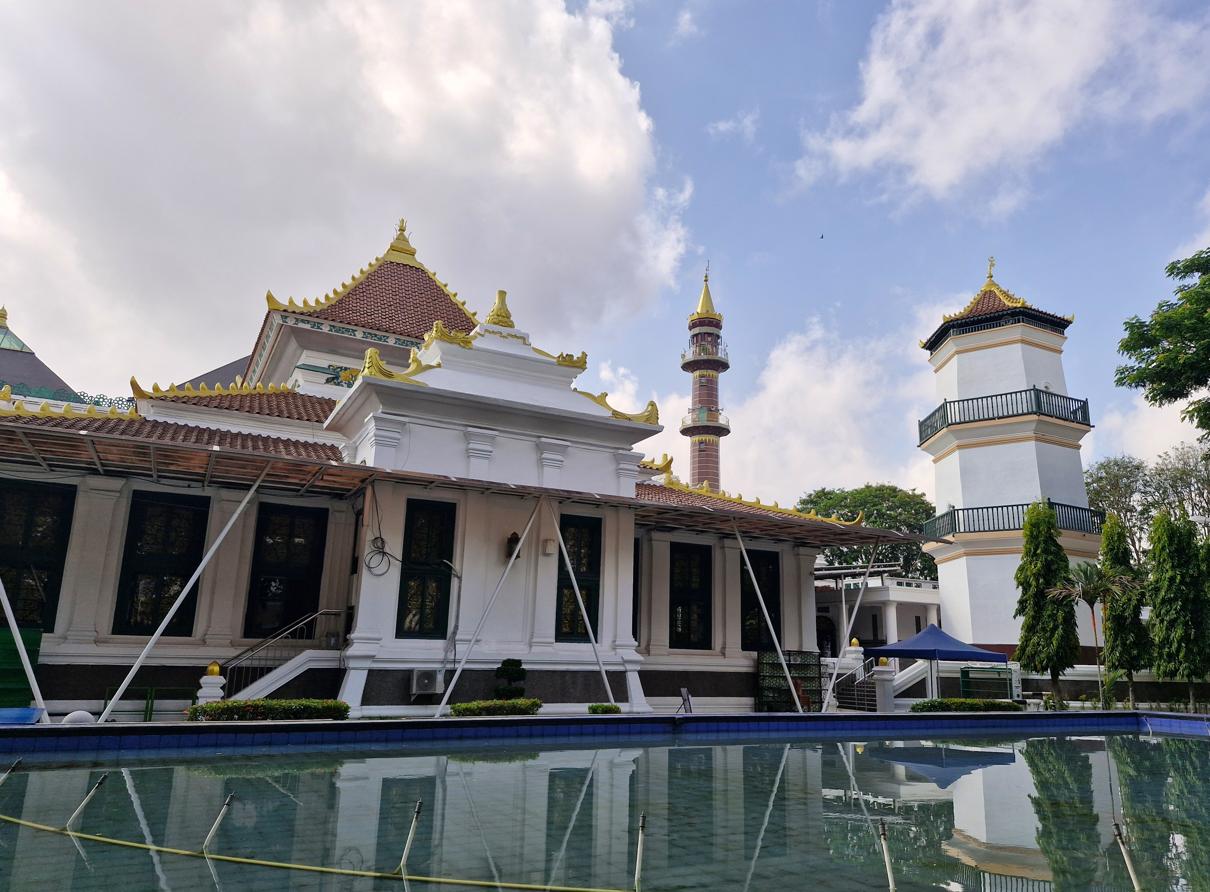
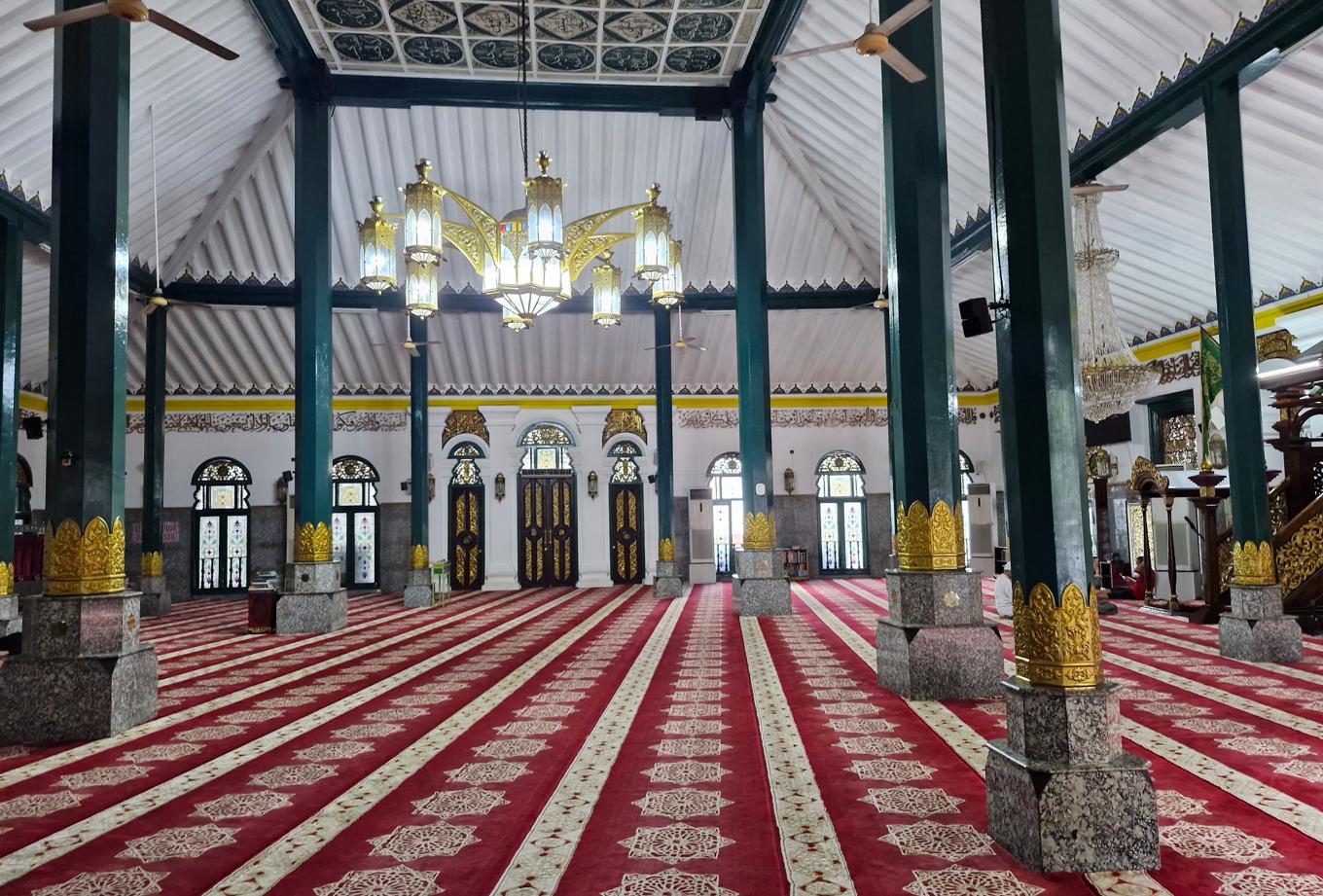
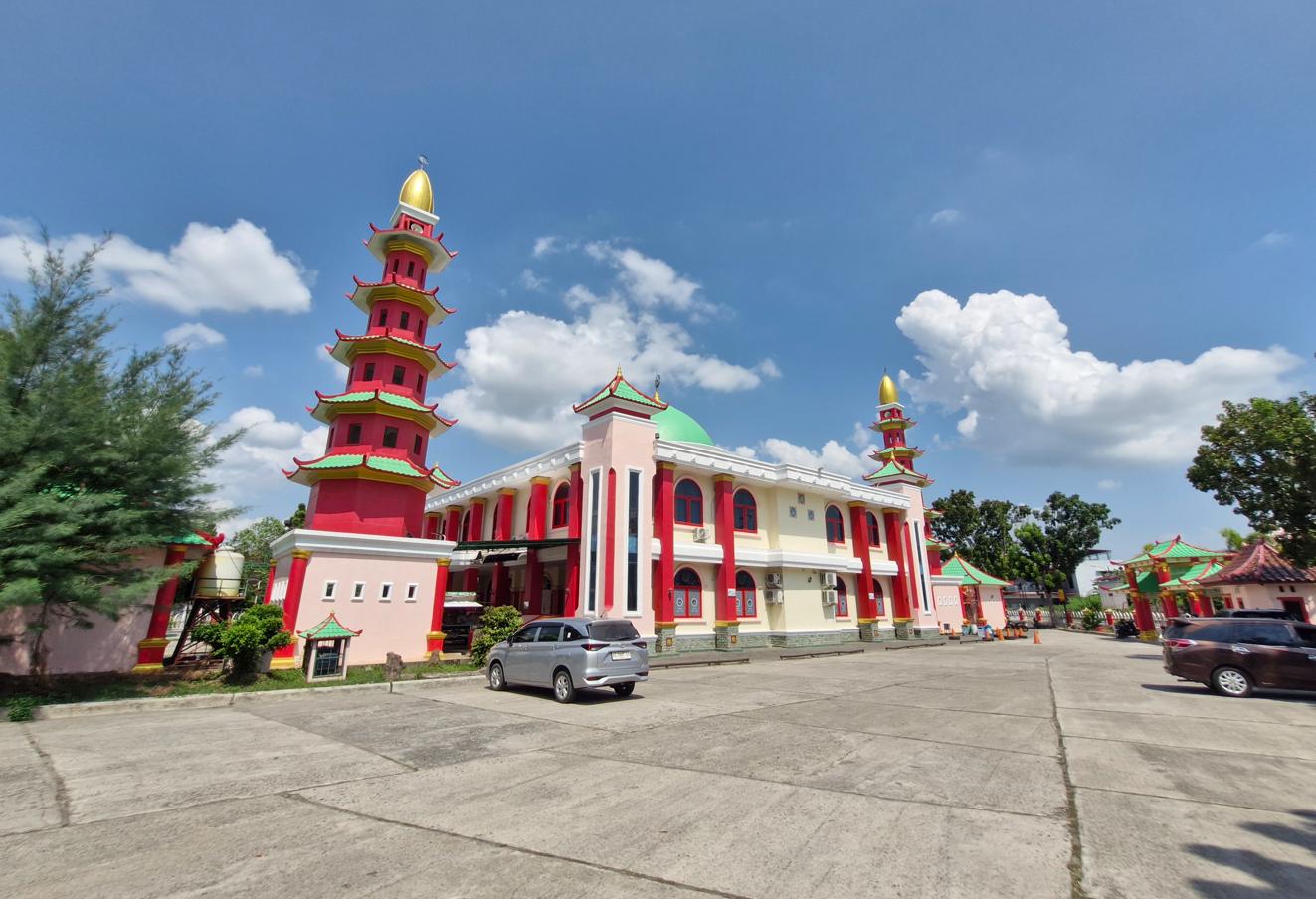
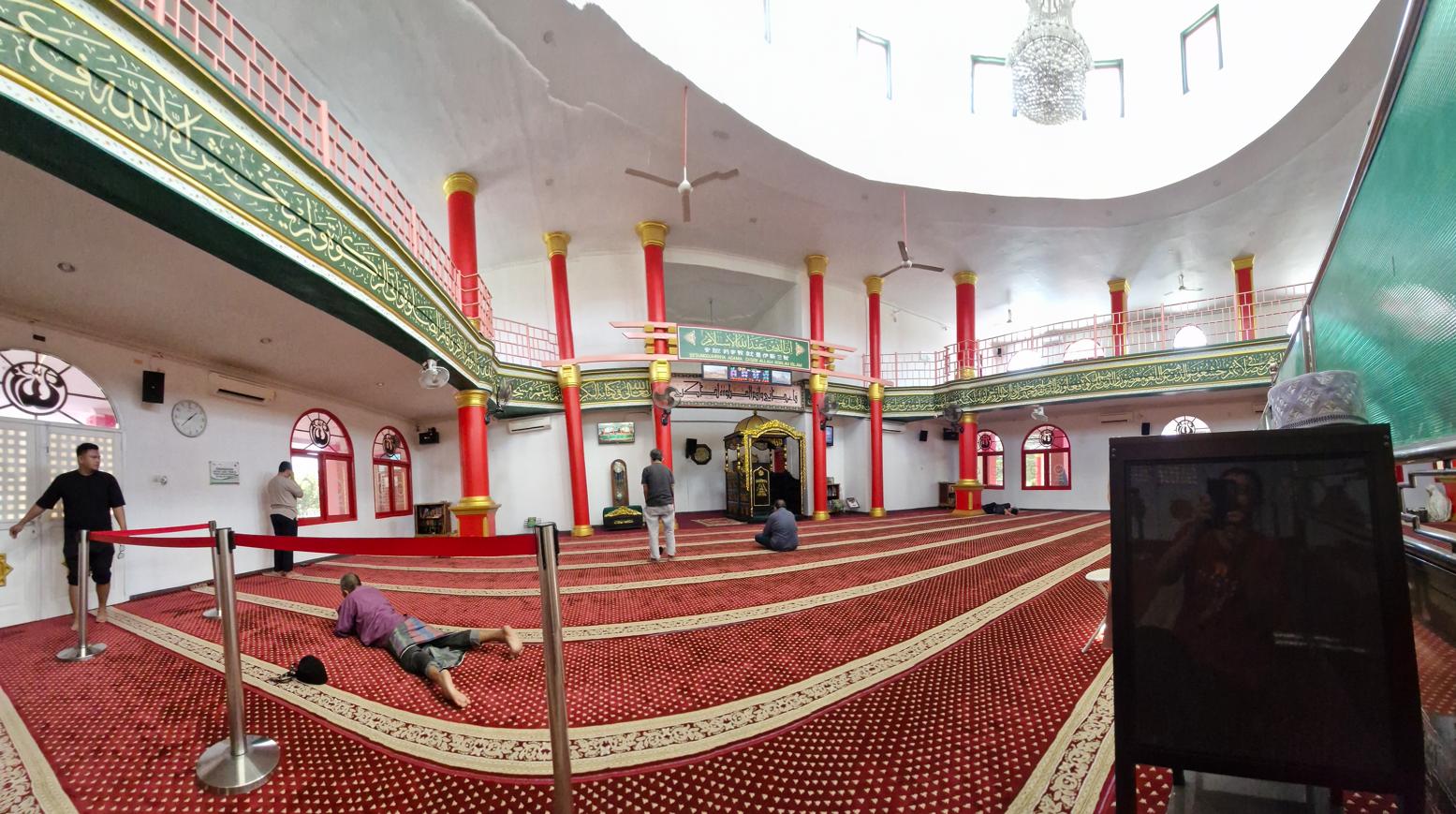
A short walk from the Musi's edge, the Masjid Agung, Palembang's grand mosque, supplied the missing Islamic-era chapter between Sriwijaya's water empire and the Chinese and Arab quarters still to come. Sultan Mahmud Badaruddin I, styled Jayo Wikramo, laid its first stone in 1738 and opened it a full decade later, in 1748, a building whose green three-tiered pyramidal roof and twin minarets read, even at a glance, as a genuine regional hybrid: Nusantara joinery, Chinese roof engineering, and a European-inflected symmetry to the facade, built by a sultanate wealthy enough on pepper and tin revenue to import craftsmanship from every direction trade could reach. It was, by most local accounts, the largest mosque in the archipelago at the time of its completion, and it remains, after a careful early-2000s restoration, a working mosque rather than a museum piece, Friday crowds spilling out onto the same riverside ground where the sultanate's own downfall would play out two generations later.

Balaputradewa State Museum of South Sumatra Province

Balaputradewa Museum Gallery
Balaputradewa Artifact Exhibit
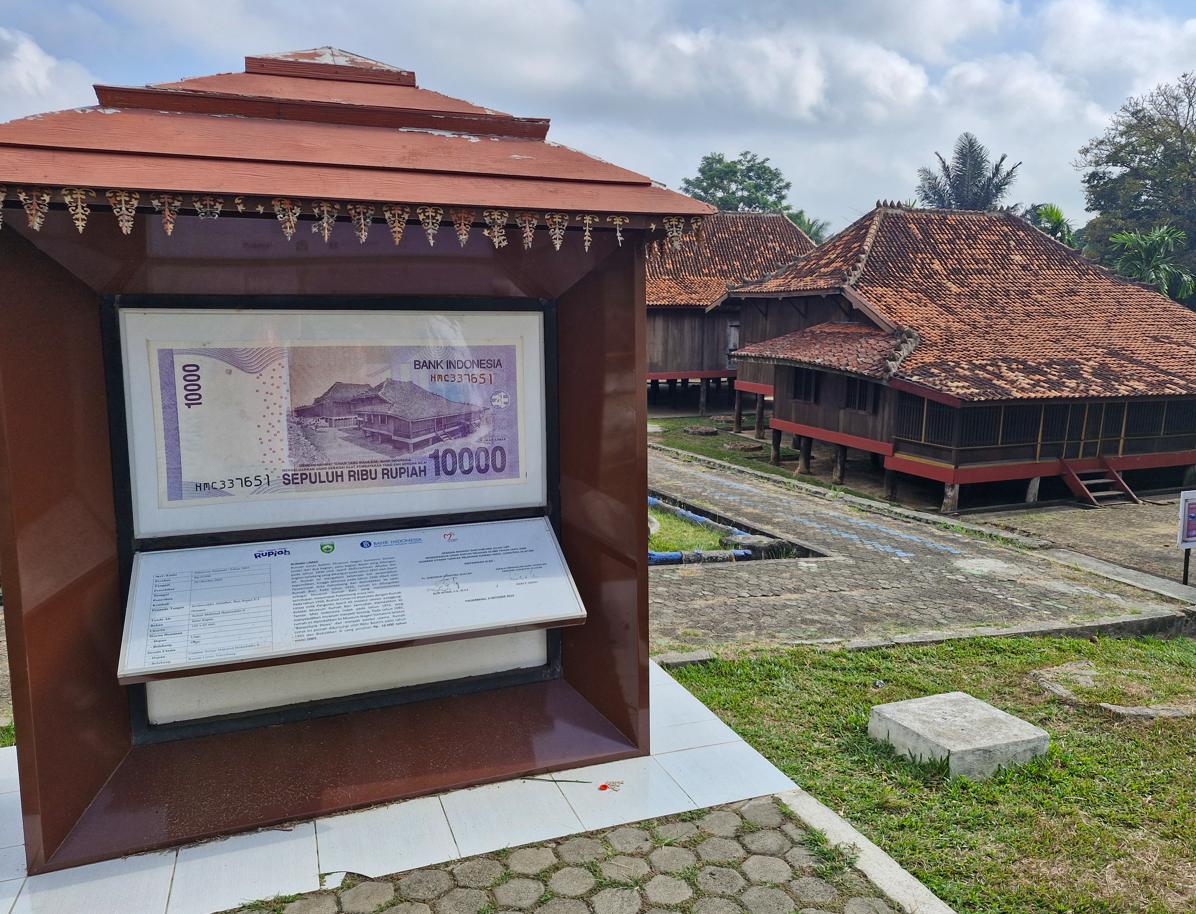
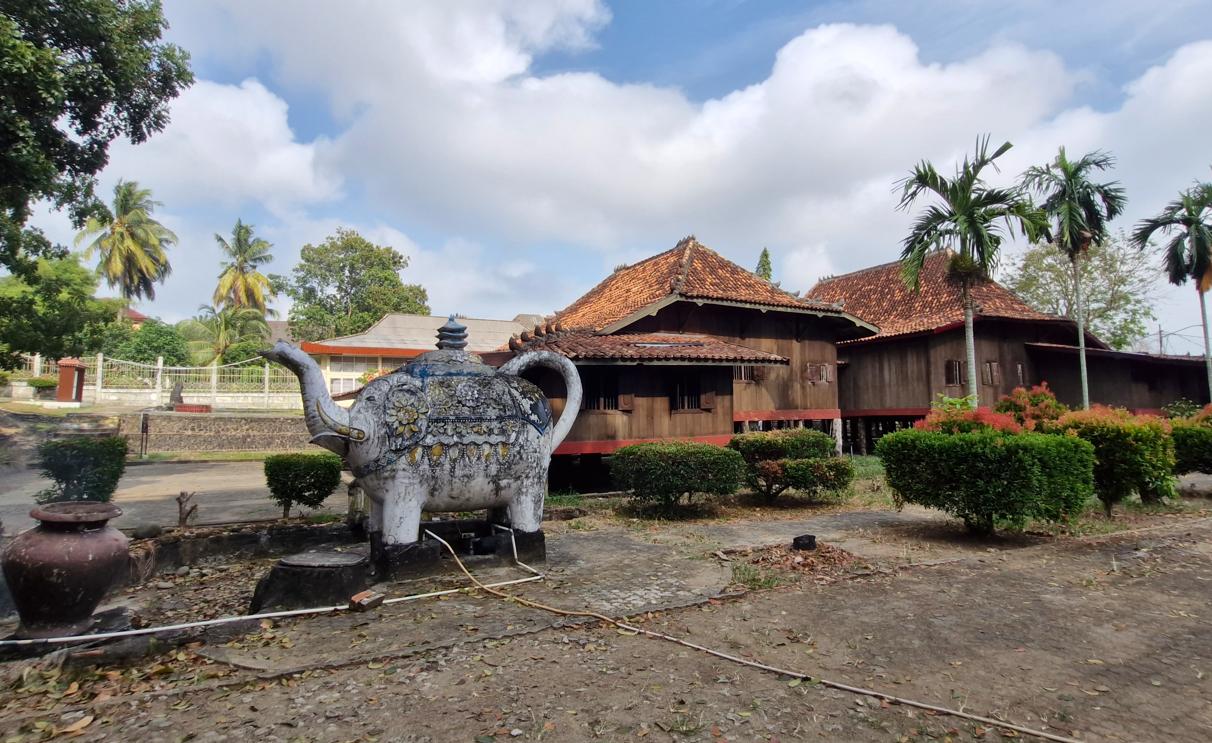
Balaputradewa Rumah Limas Traditional House
Museum Courtyard
Traditional Architecture Display
Museum Hall
Heritage Wood Carvings
Flag of Palembang Darussalam Sultanate
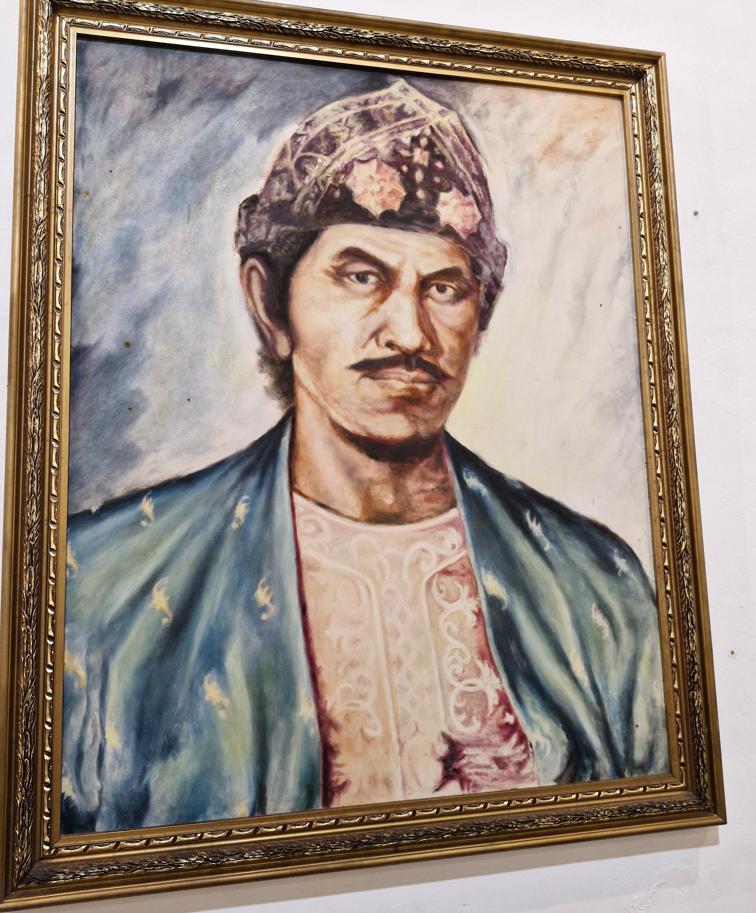
Sultan Mahmud Badaruddin II Portrait
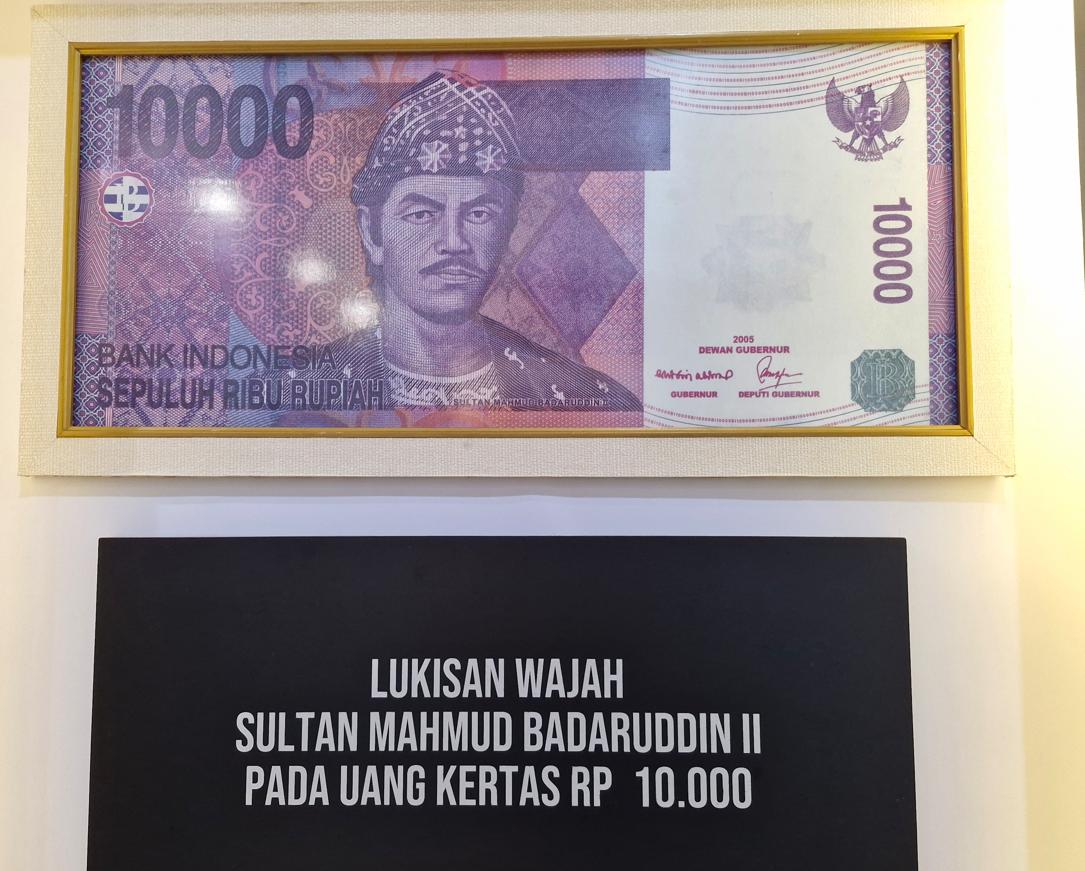
Flag of the Sultanate of Palembang Darussalam and portrait of its last sultan and Indonesian national hero, Sultan Mahmud Badaruddin II
Sultanate Regalia
Palembang Royal Weapons
Palembang Sultanate Artifact
Historical Documents
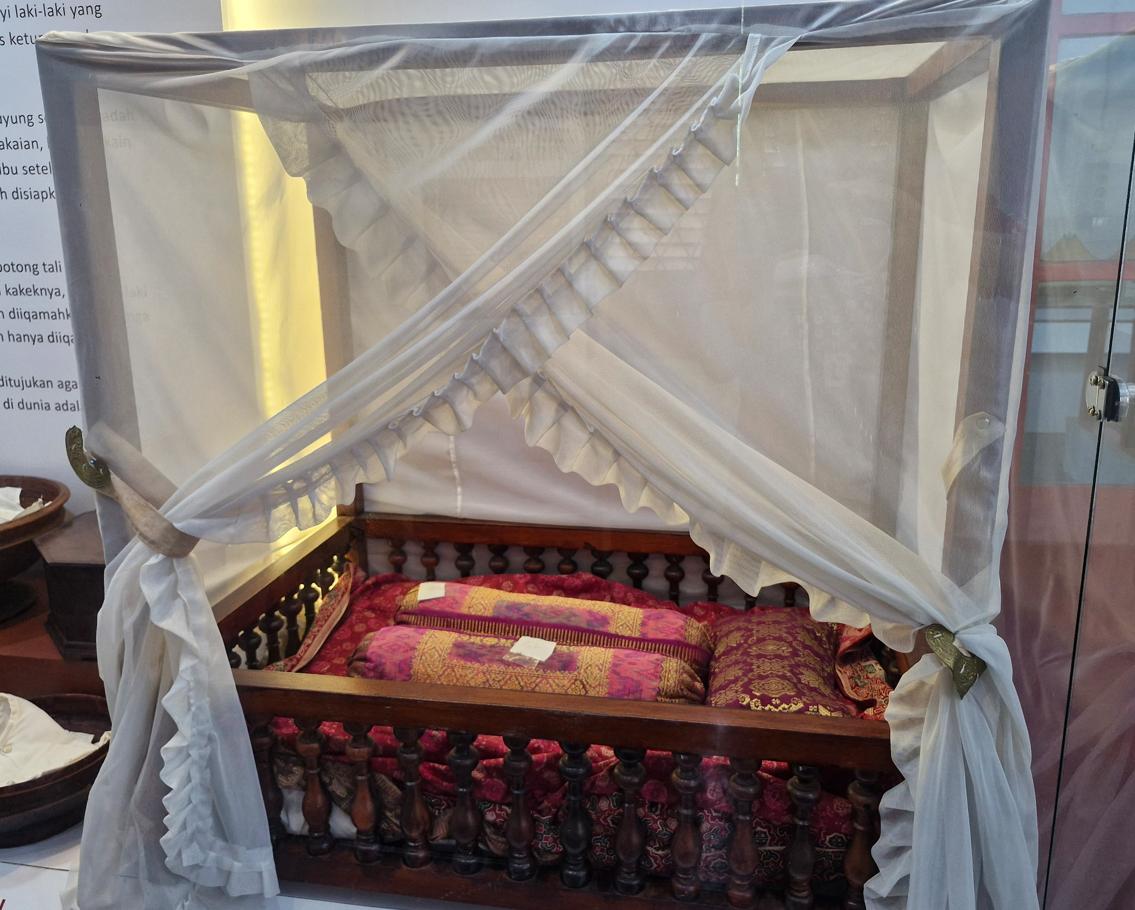
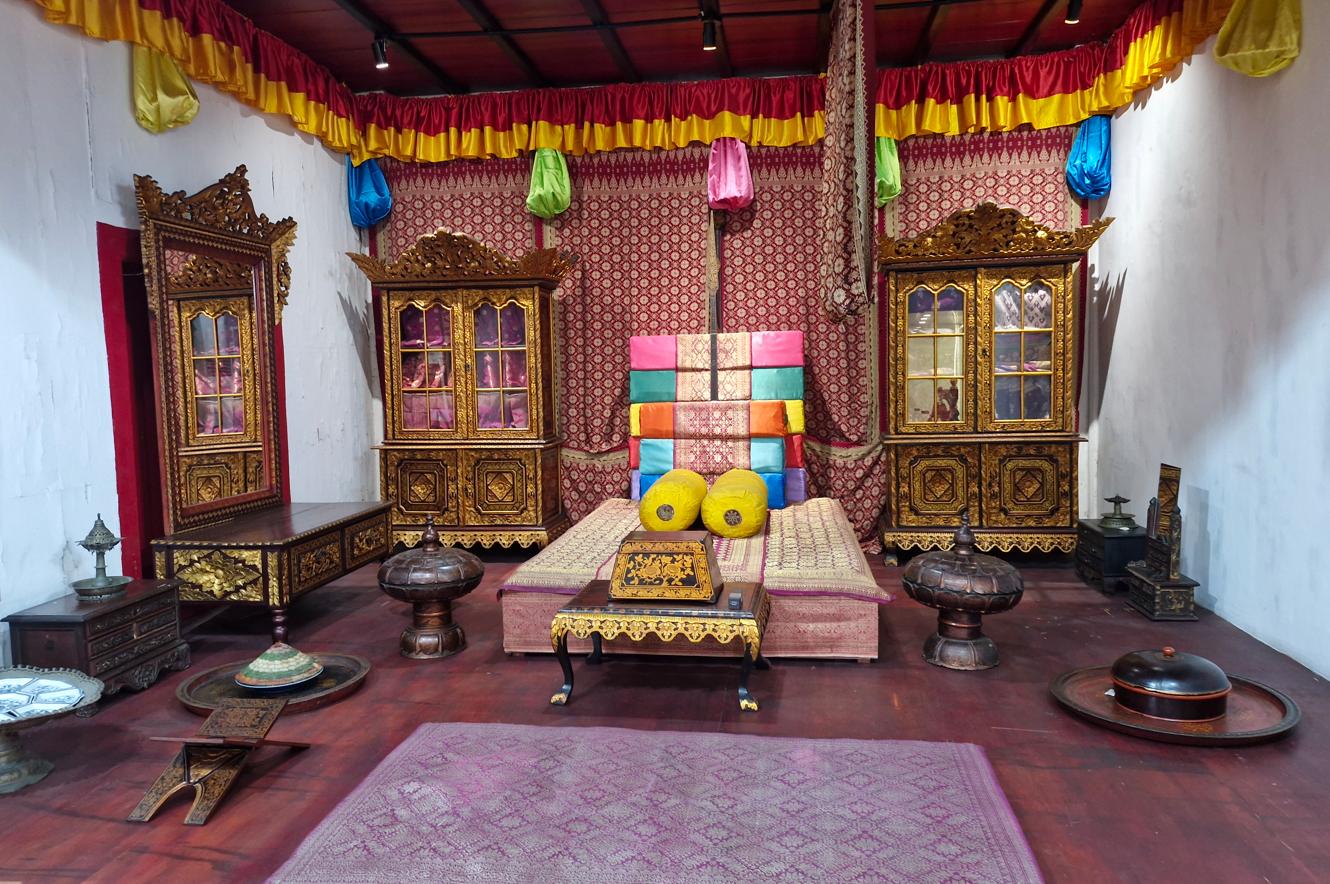
Palembang Royal Bed
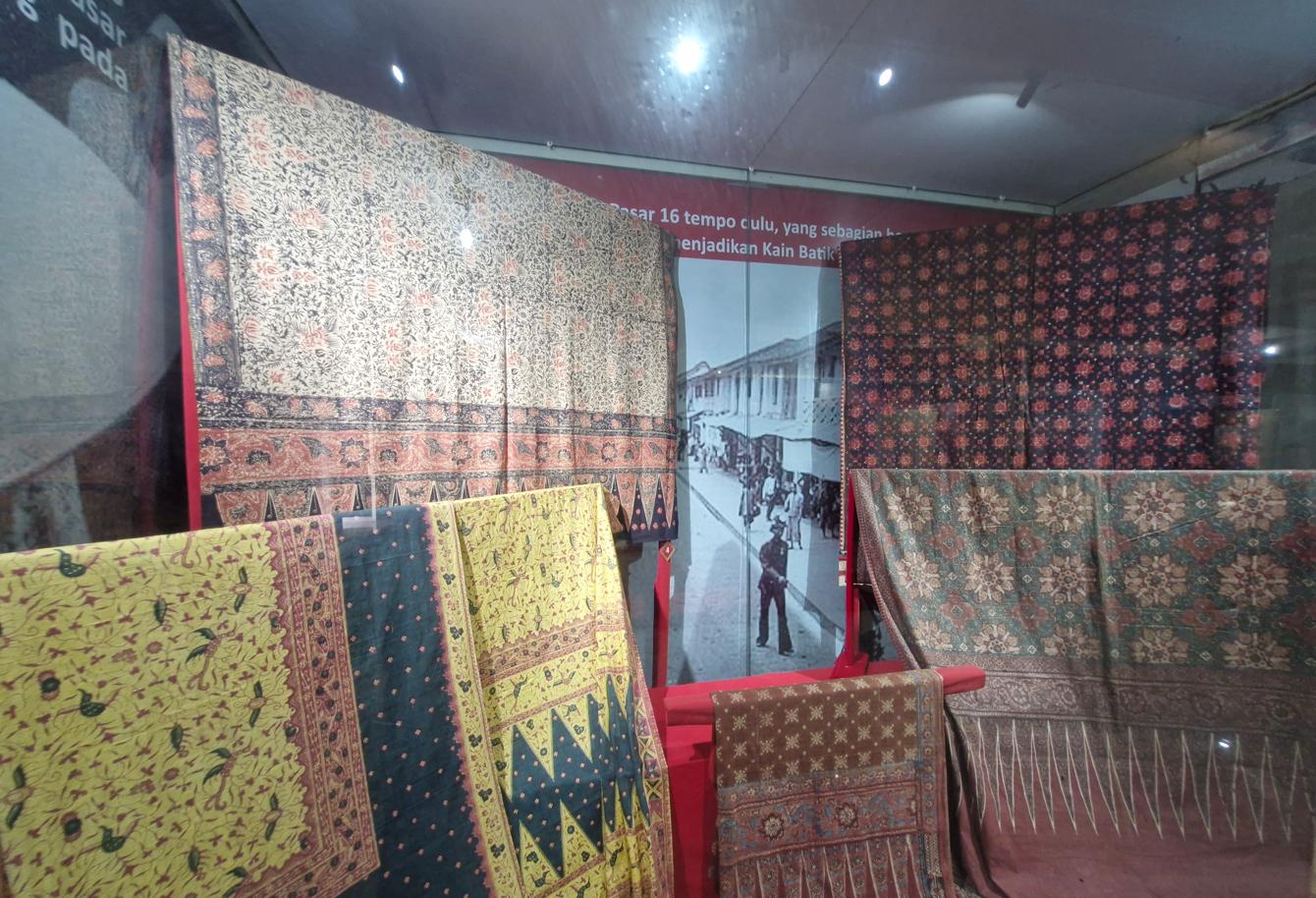
Courtly Textiles
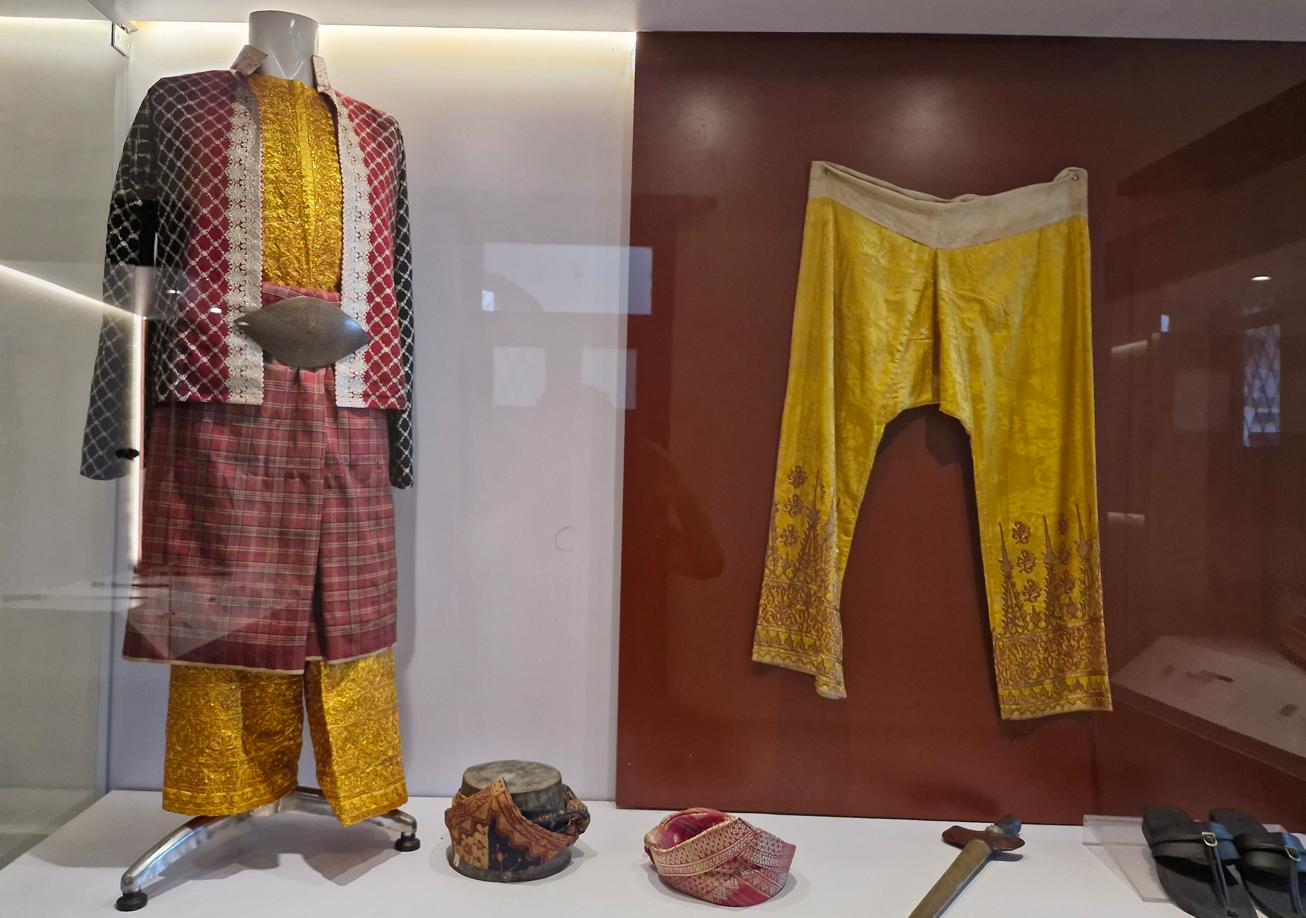
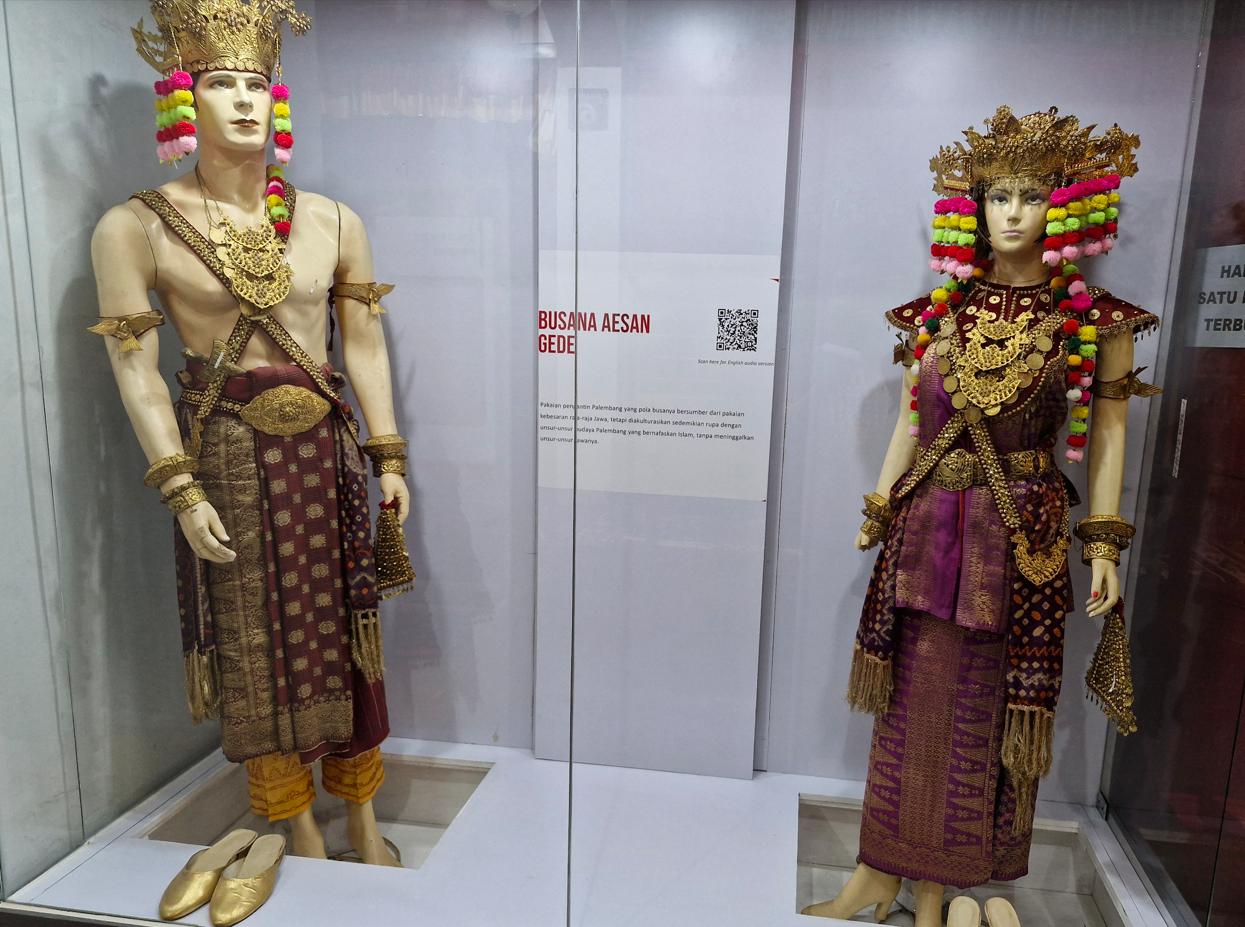
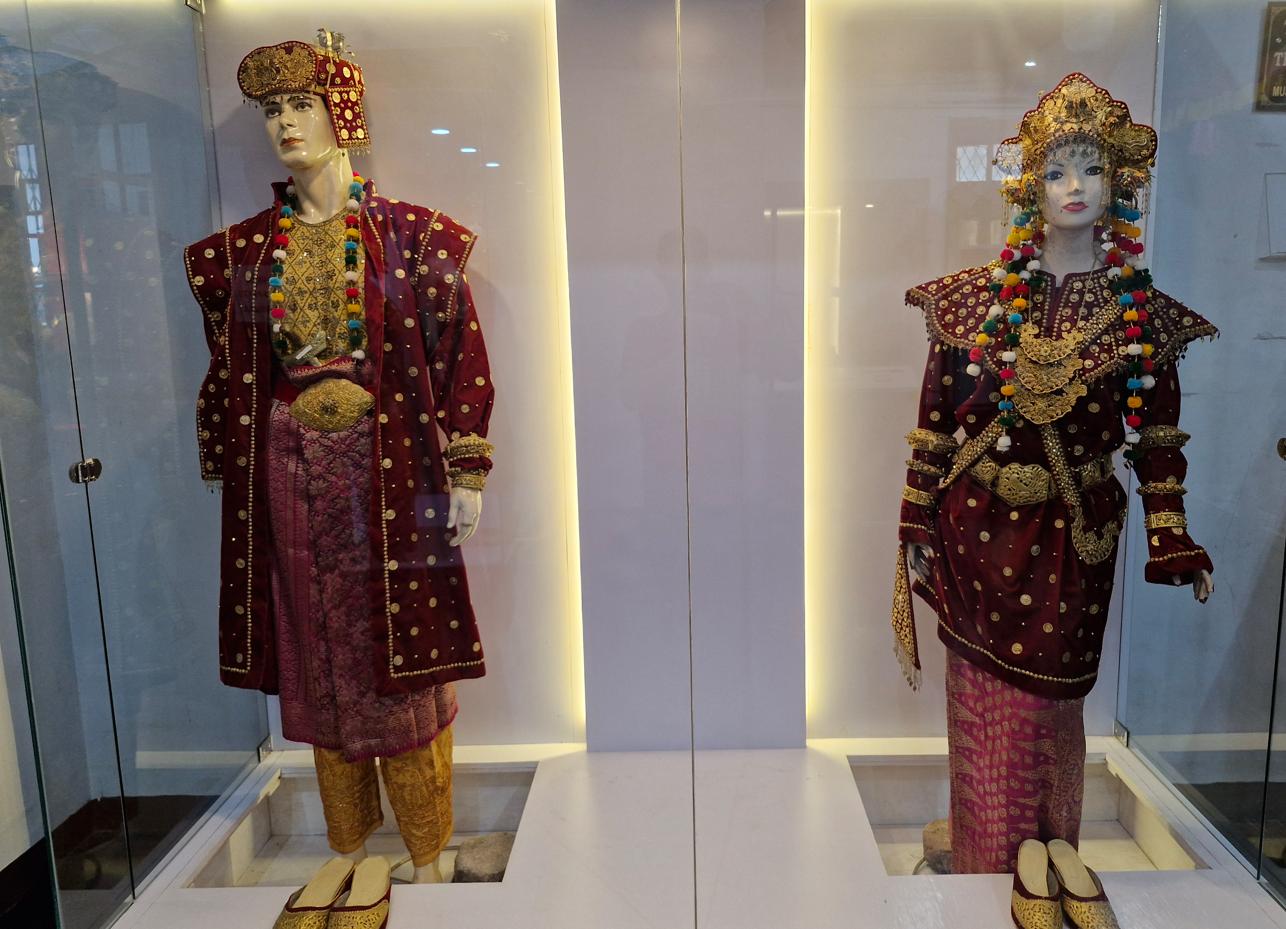
Ceremonial dress
Traditional Songket Textiles
Royal accessories
Sultan Mahmud Badaruddin Museum Exhibits
Historical Colonial Map
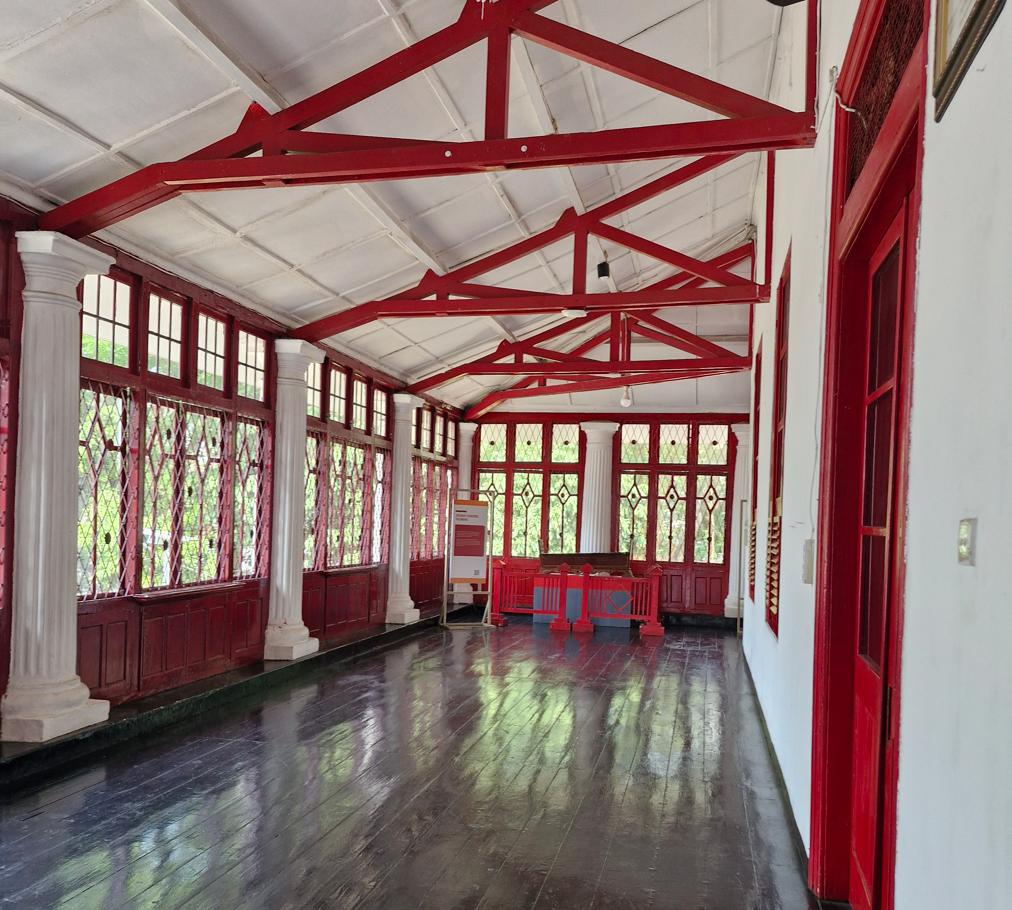
Museum exterior view

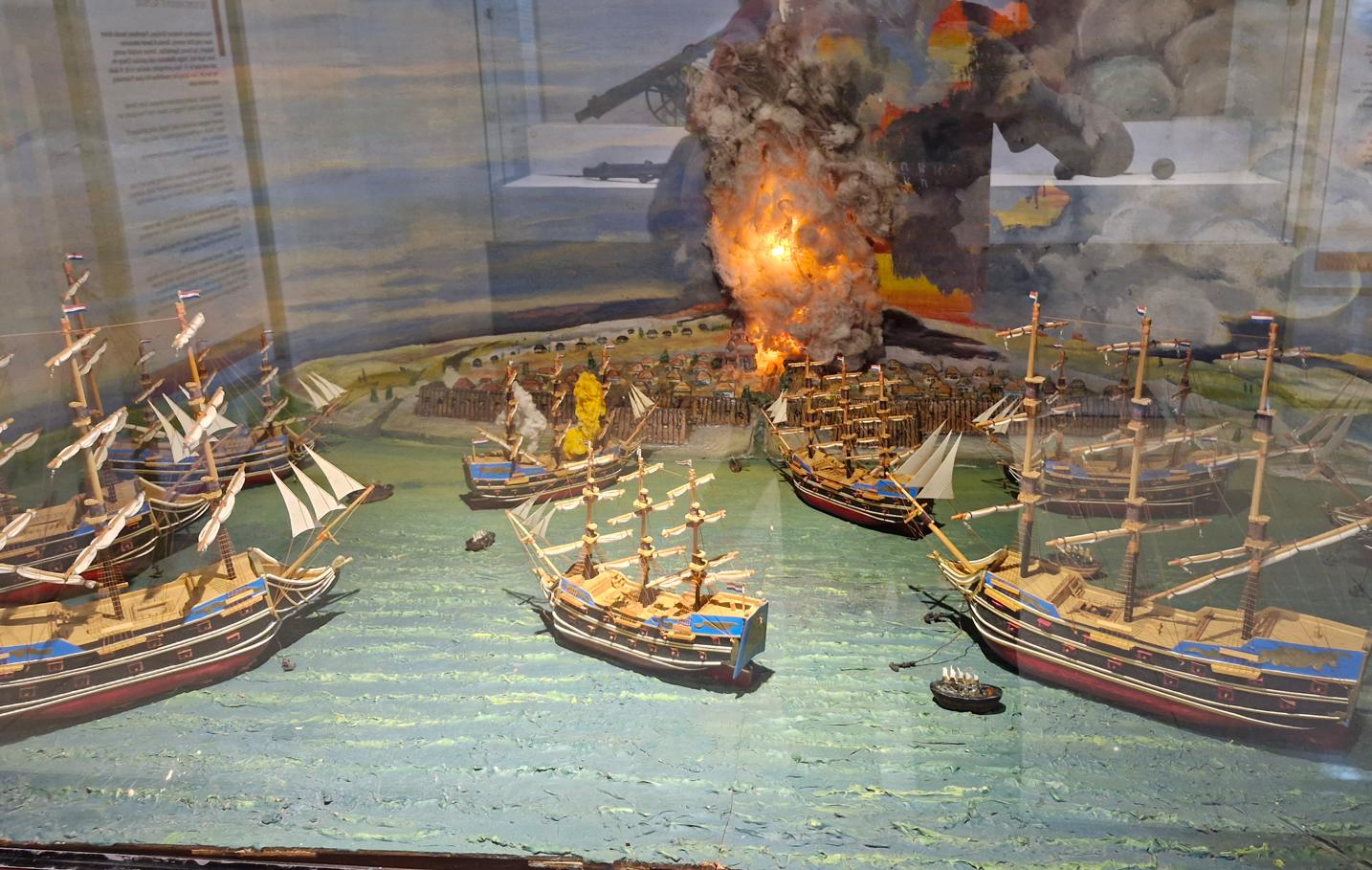
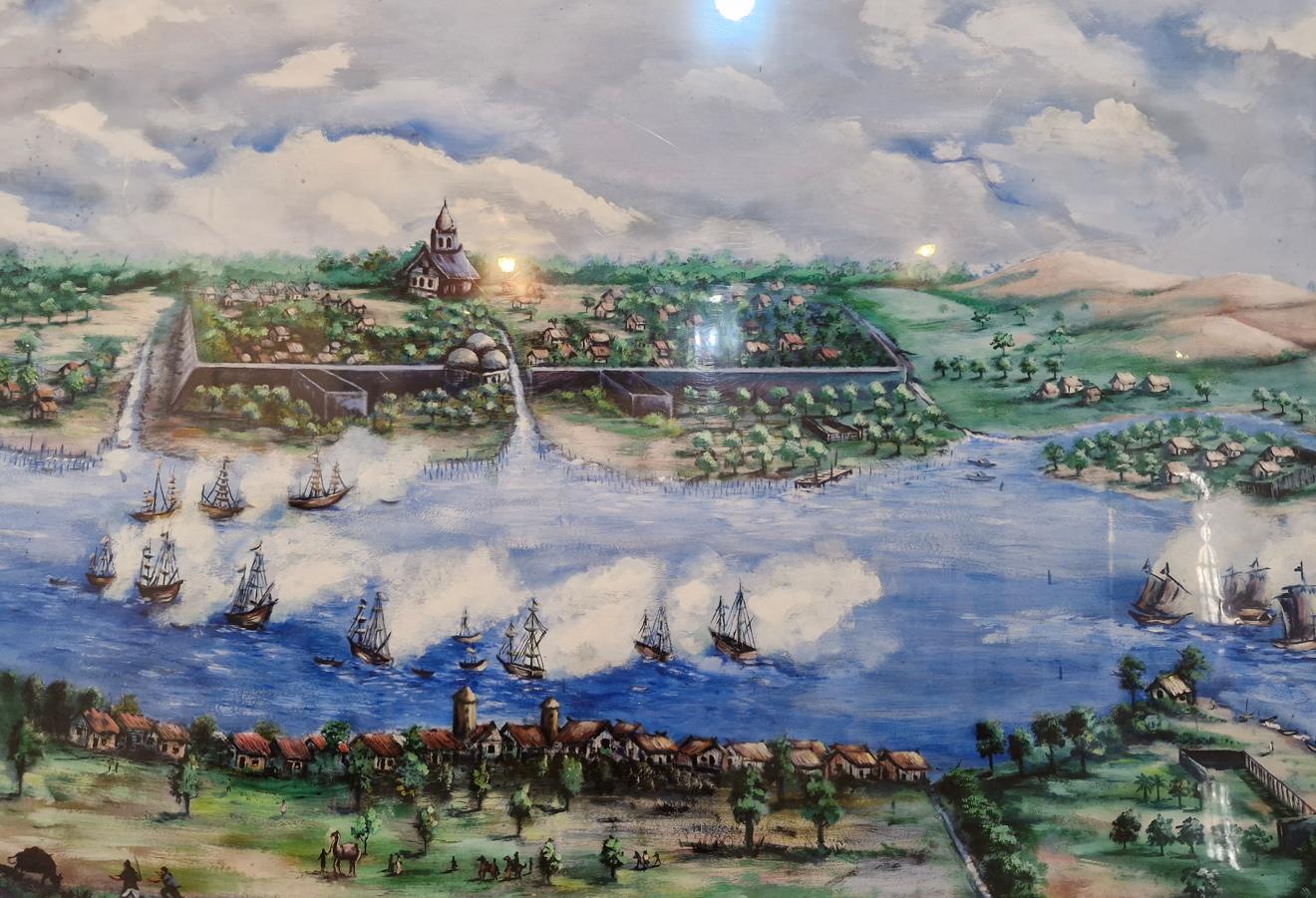
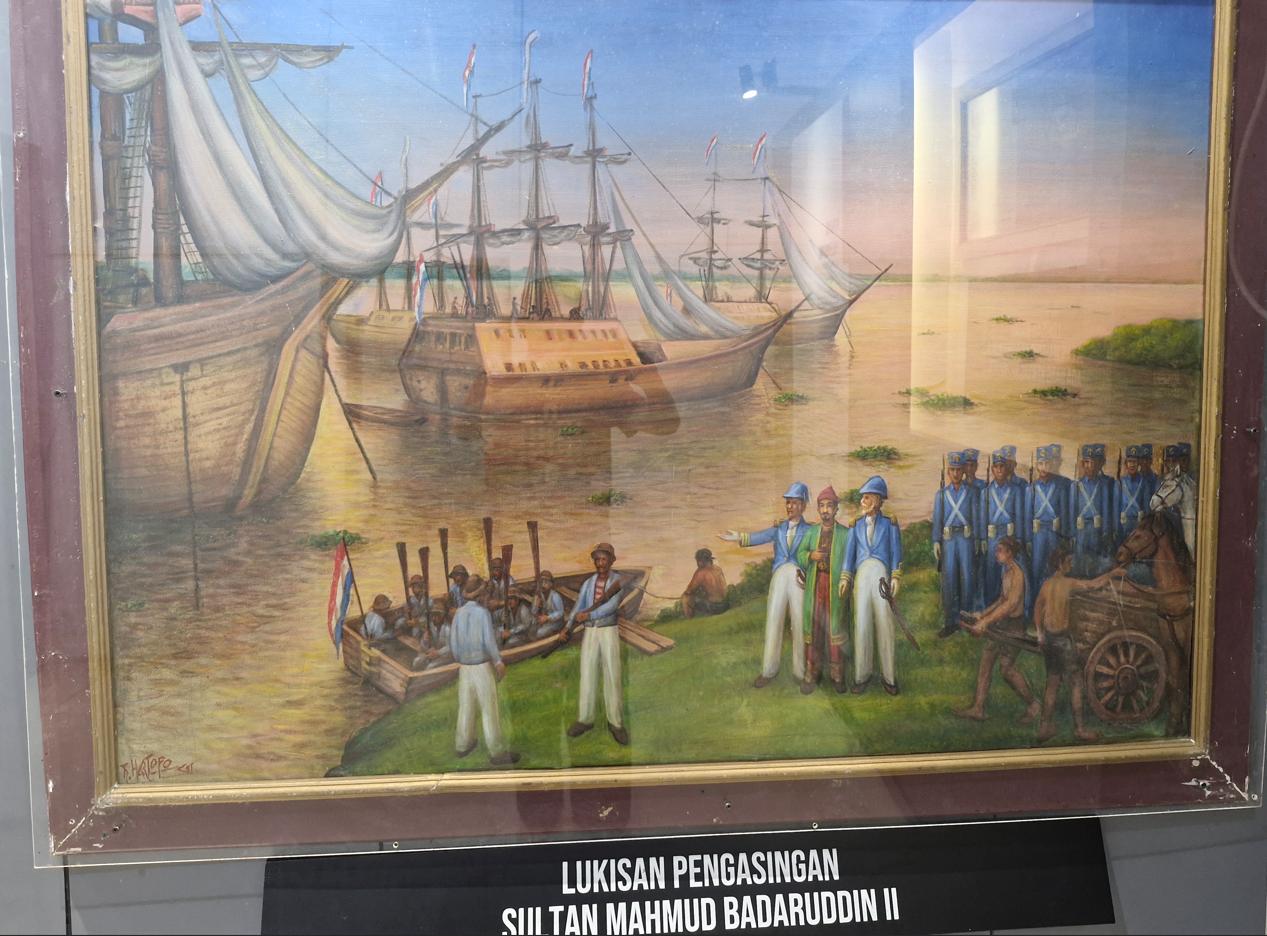
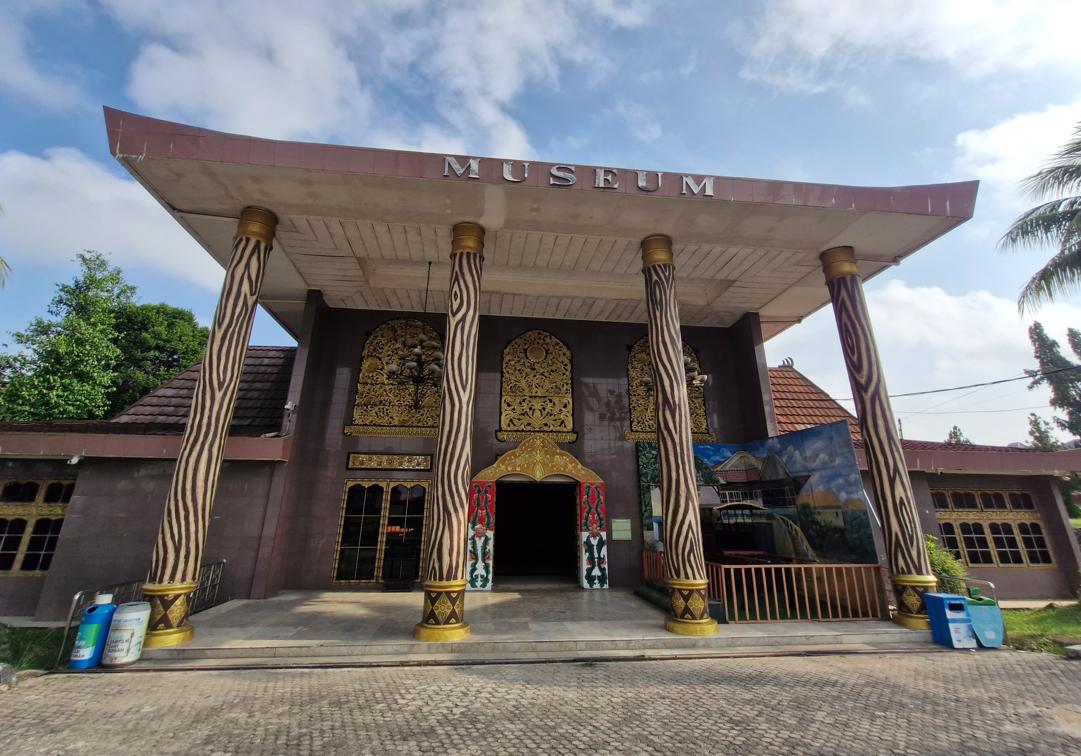
That downfall belongs to Sultan Mahmud Badaruddin II, Jayo Wikramo's own descendant, and to Stamford Raffles, whom Singaporeans know almost entirely as Singapore's own founder and rarely at all as the man who helped end a Sumatran sultanate. Working the Strait as a British agent out of Malacca ahead of the 1811 invasion of Java, Raffles corresponded secretly with Badaruddin II, offering arms and support to help drive the Dutch garrison out of Palembang; when local nobles massacred that garrison's occupants in September 1811, the Dutch, not without reason, laid the killing at Raffles' door. Raffles turned the massacre to full advantage the following year, citing it as justification when Badaruddin refused to hand over Bangka's tin reserves, and in April 1812 he sent Colonel Robert Rollo Gillespie up the Musi with a full expeditionary force. Gillespie took the city by the end of the month; Badaruddin fled, his own brother accepted the throne as Sultan Ahmad Najamuddin II on British terms, and Bangka and Belitung passed into British hands as the price of the arrangement, islands that would revert to the Dutch only a few years later under the Anglo-Dutch Treaty of 1824, the same treaty that quietly erased most of what Raffles had built on Sumatra's eastern rivers at Jambi and Siak alike. The founder of modern Singapore, in other words, spent his Sumatran years deposing a sultan barely two hundred kilometres from where his statue now stands on the Singapore River, a piece of the story our own school textbooks tend to leave out.

Monpera Monument Palembang
Monpera Architecture Detail

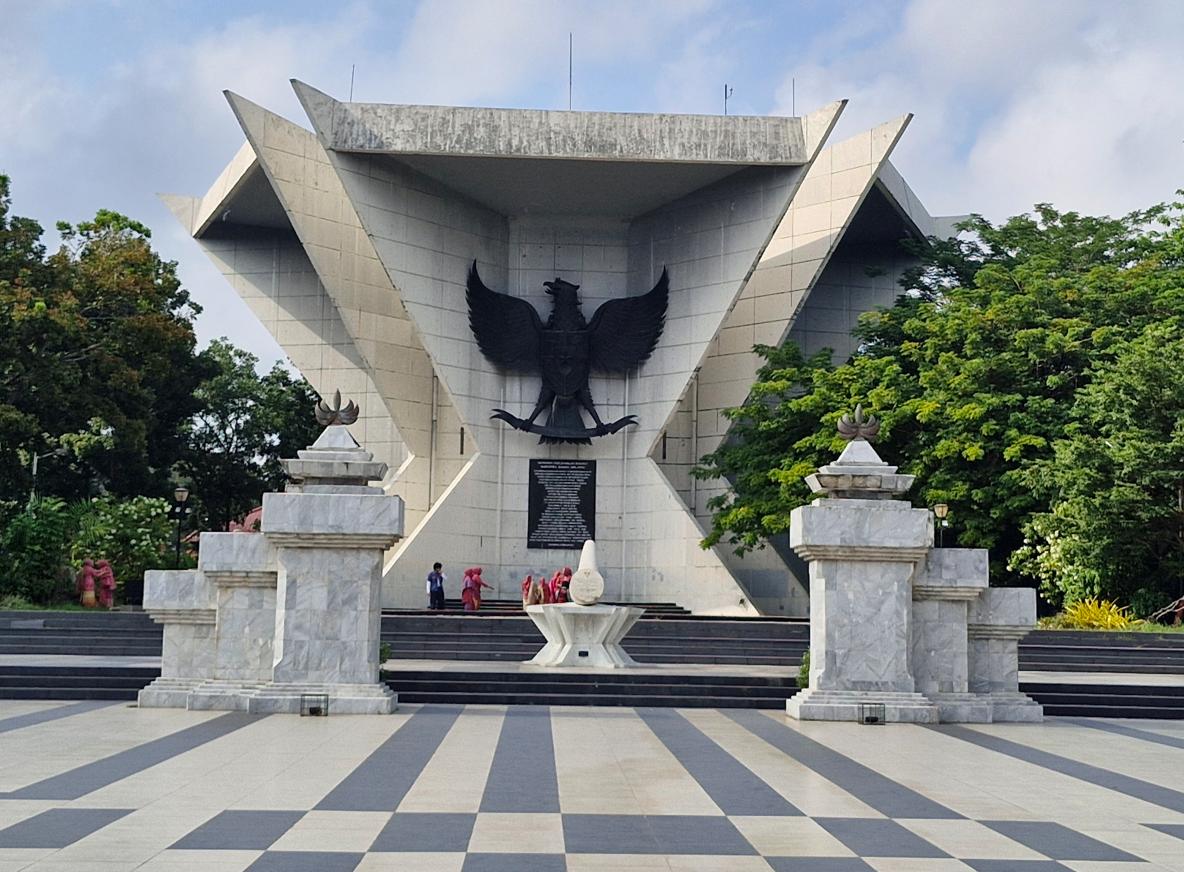
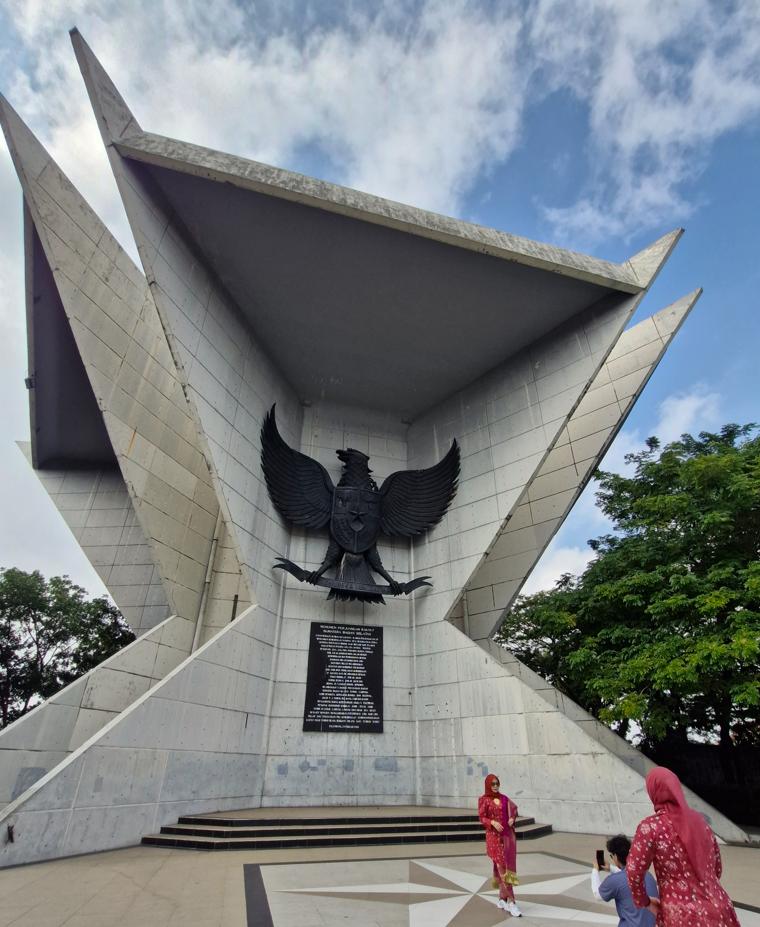
A century and a third later, Palembang's people answered a different colonial return with considerably less patience. When Allied forces handed the city back to Dutch control in March 1946, the peace held only uneasily, and on New Year's night 1947 Dutch troops, by most local accounts drinking heavily in celebration, began firing shots through the city; Republican soldiers, youth militias and ordinary citizens took the provocation as their opening and spent the next five days and five nights fighting the Dutch across three fronts at once, land, river and air, in what is often reckoned Indonesia's first battle fought that way, centred on Kuto Besak Fort, the Grand Mosque and the Talang Betutu airfield. Outgunned and, by the fifth day, out of ammunition, the Republican side agreed to a ceasefire on 6 January 1947, brokered by Dr. Adnan Kapau Gani, on terms that pushed Indonesian troops twenty kilometres back from the city centre and confined Dutch forces to a fourteen-kilometre radius, an arrangement that left much of the city itself in ruins.
Monpera, the Monumen Perjuangan Rakyat, was raised to hold that week's memory permanently in place, its petalled silhouette borrowed deliberately from the jasmine flower, purity and struggle folded into the same shape, ground broken on Independence Day 1975 and the finished museum, its galleries of photographs, captured weapons and yellowing despatches, finally opened to the public in 1988. Standing before it, not far from the Ampera Bridge I had been admiring lit gold each night, the city's two great symbols of connection and defiance turned out to share almost the same small stretch of riverbank.

Kampung Kapitan Architecture
Kampung Kapitan House
Historic Altar
Historic Ancestral Hall
Dutch-era Appointment Document
Old Palembang Roemah Kapitein
Kampung Kapitan Antiques
Heritage Courtyard
Musi Riverbank Lane
Historic Street View
Chinese Community Heritage
Heritage signage
Living heritage in 7 Ulu
Historic Artifact
Historic Plaque
Carved Screen Detail
Antique Portrait

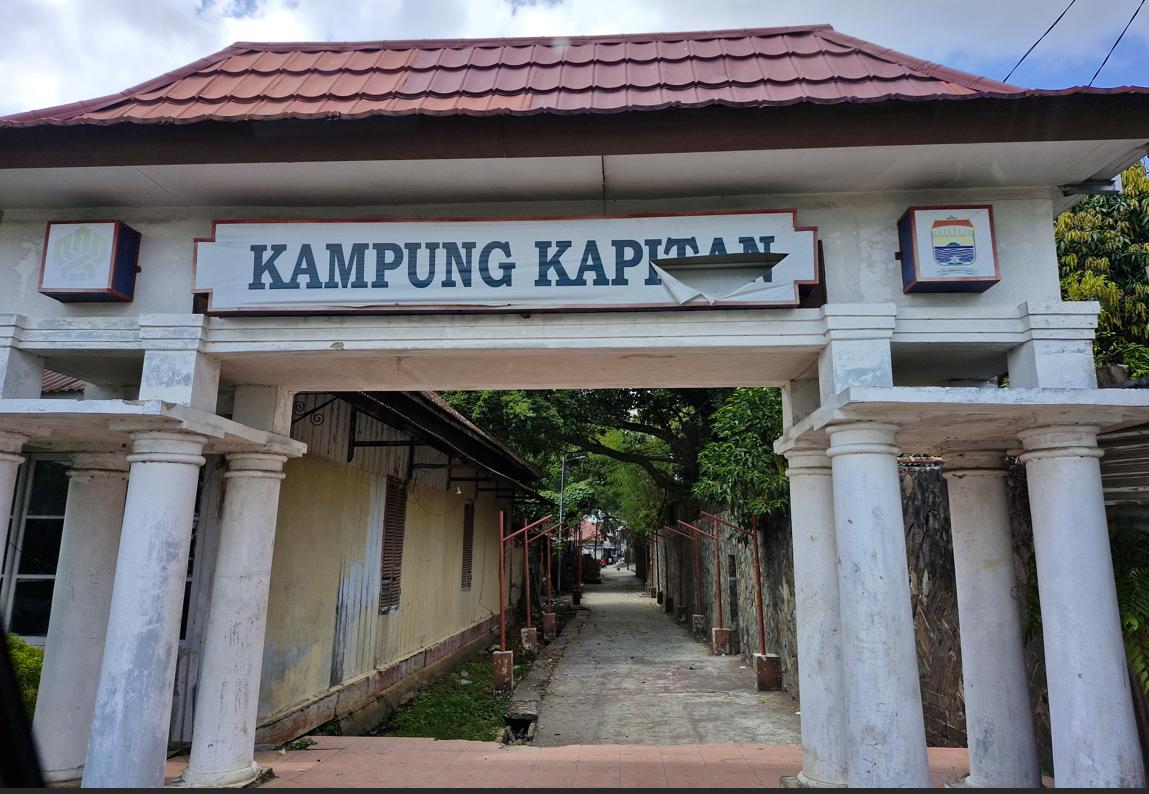
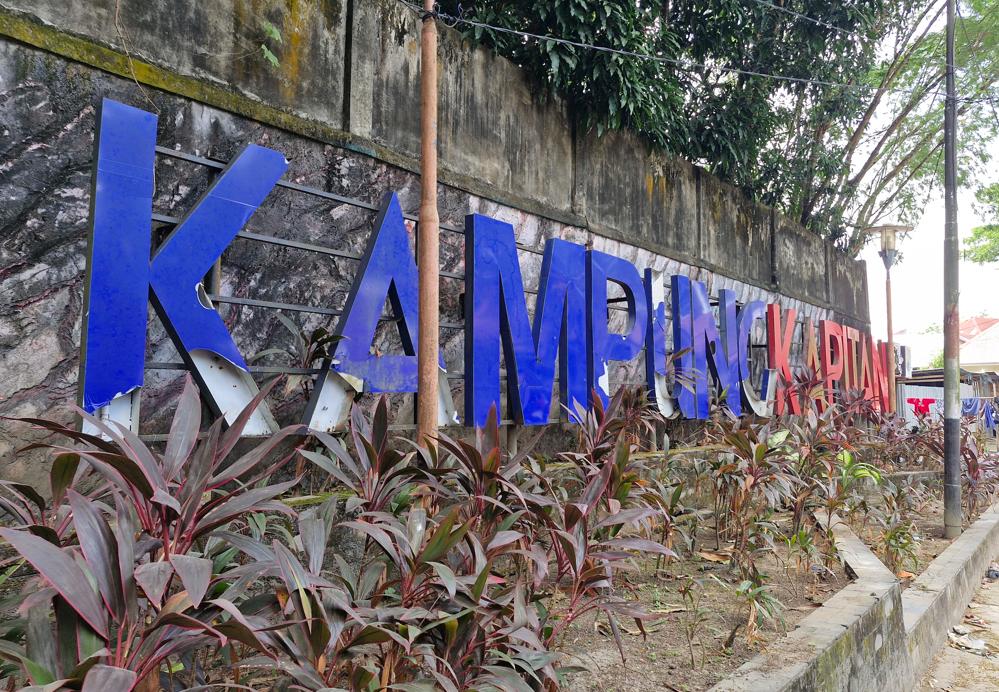
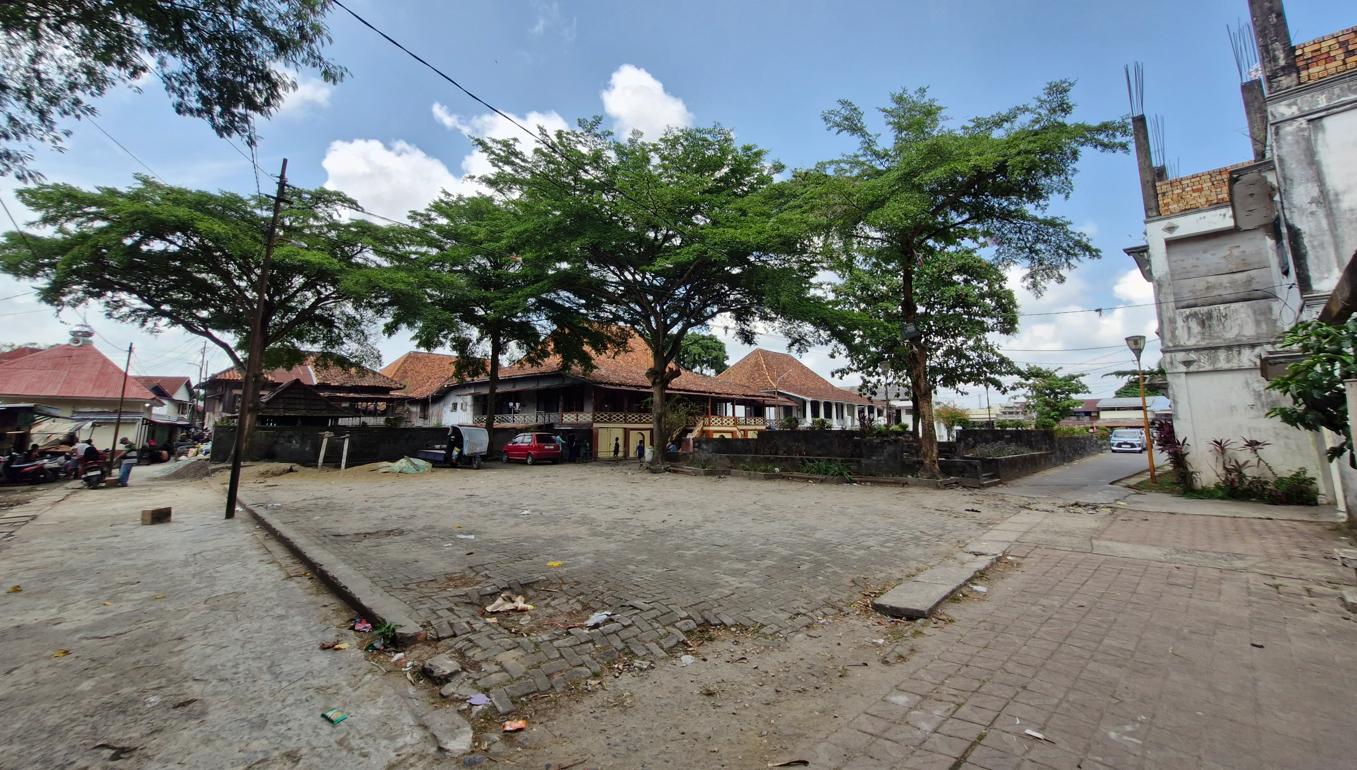
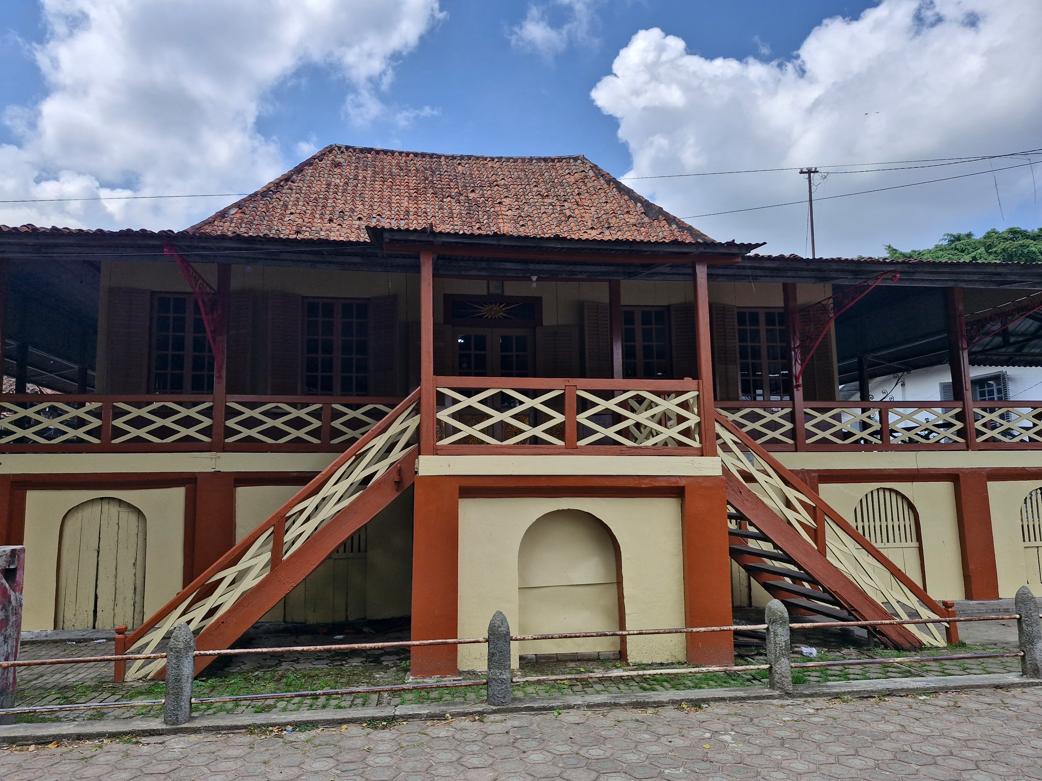
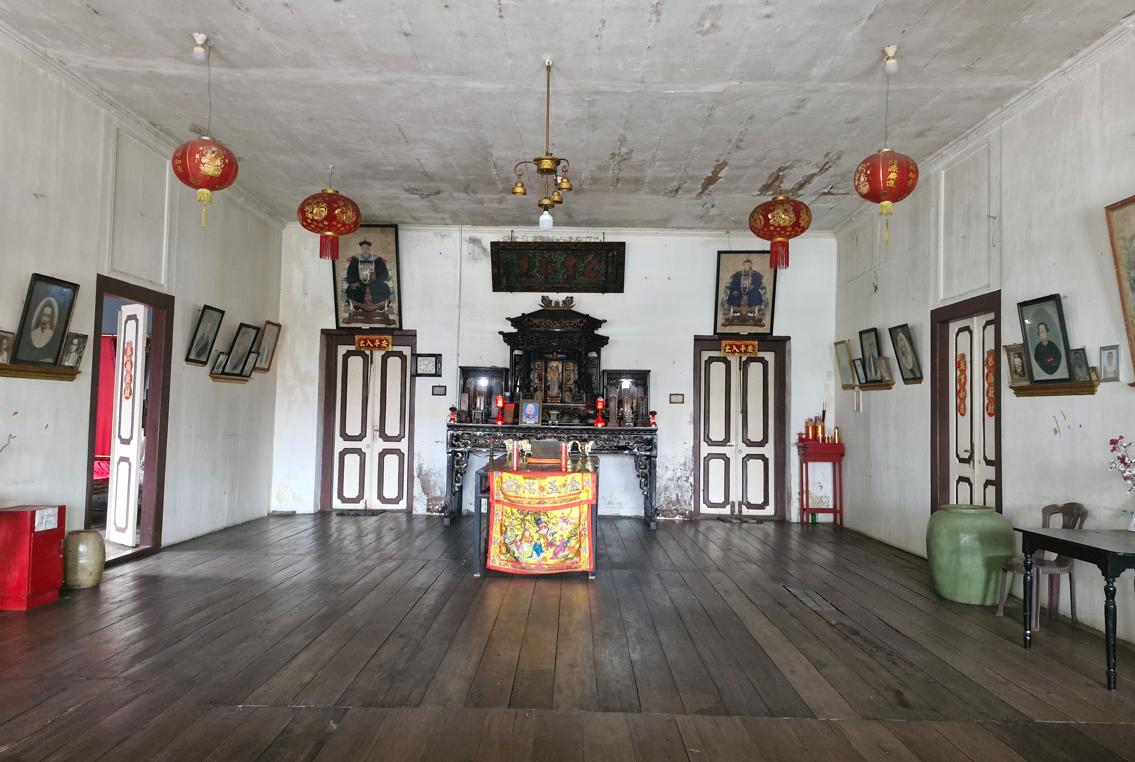
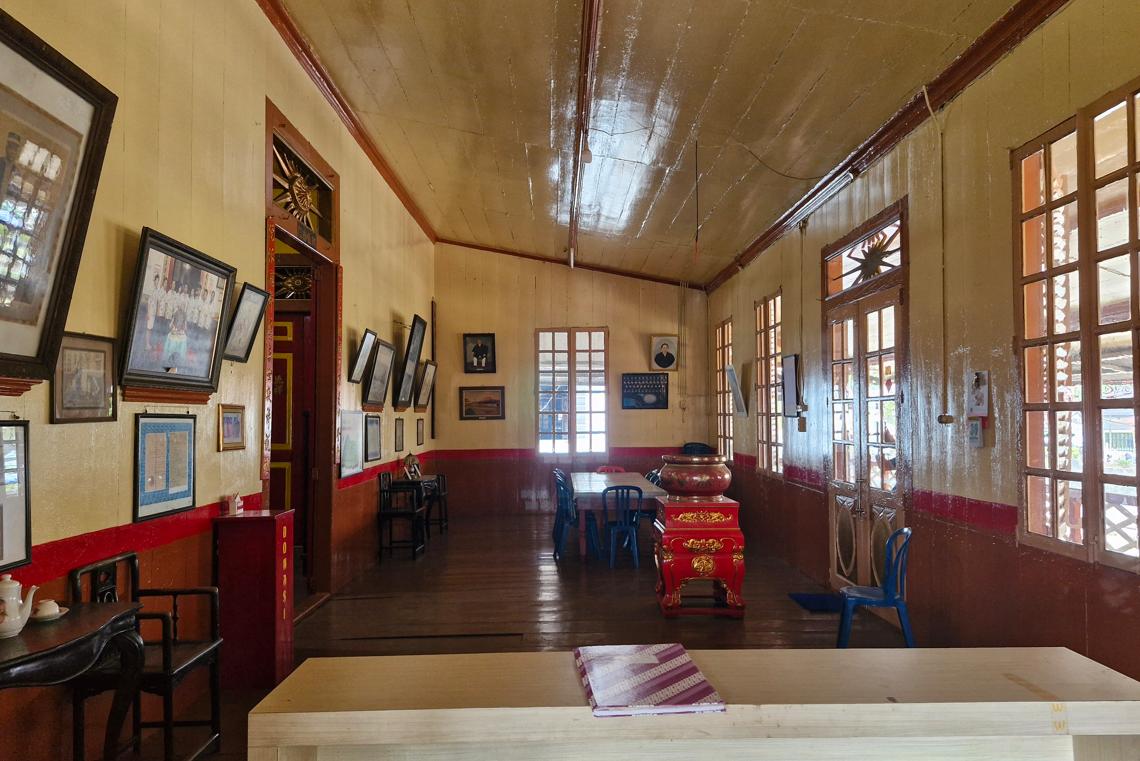
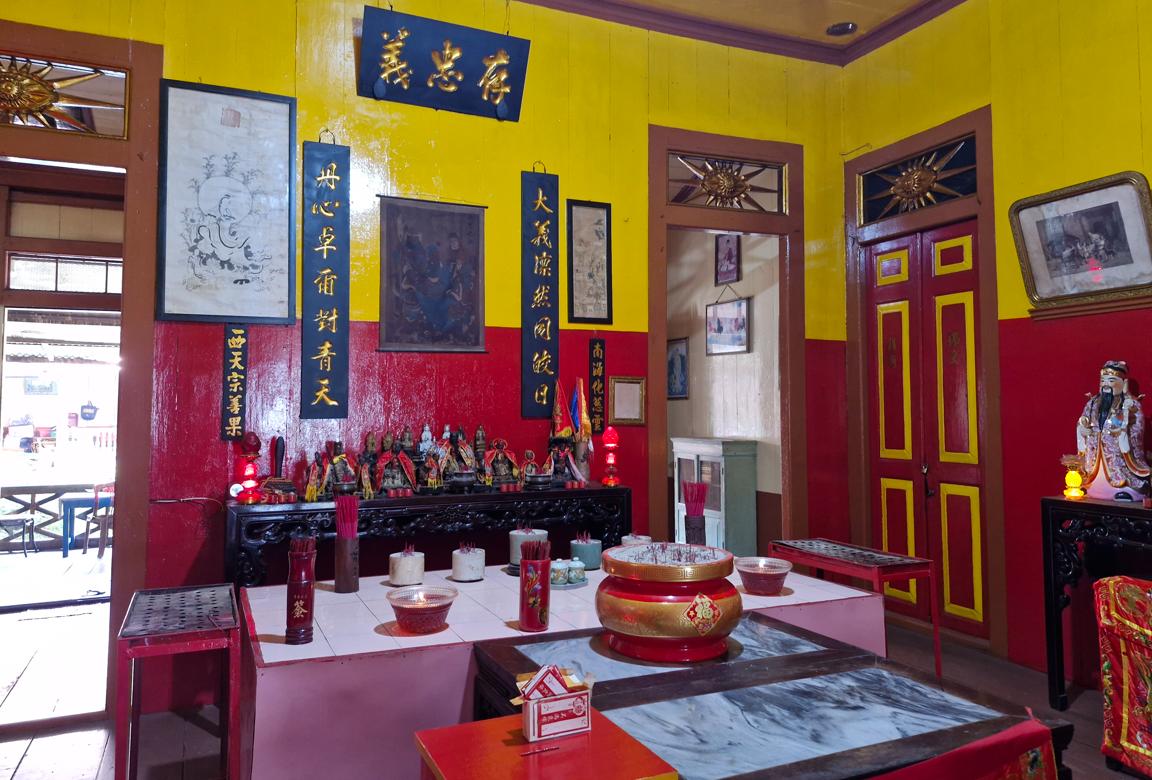
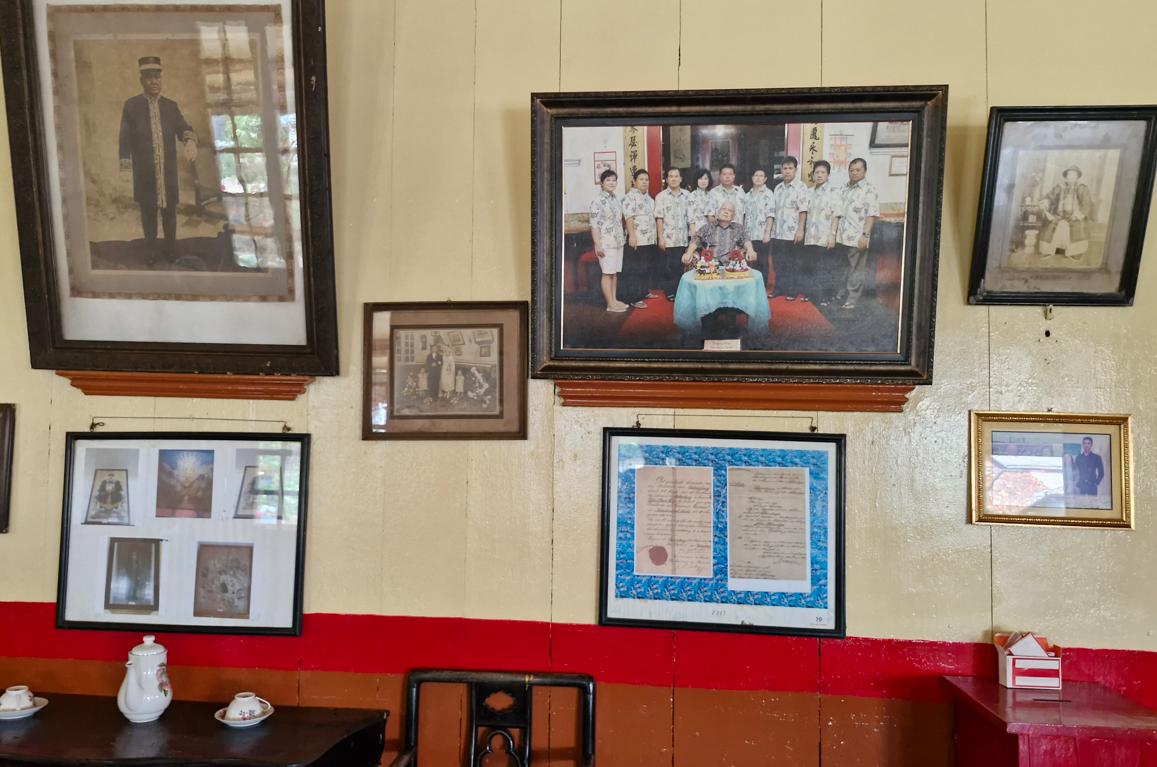
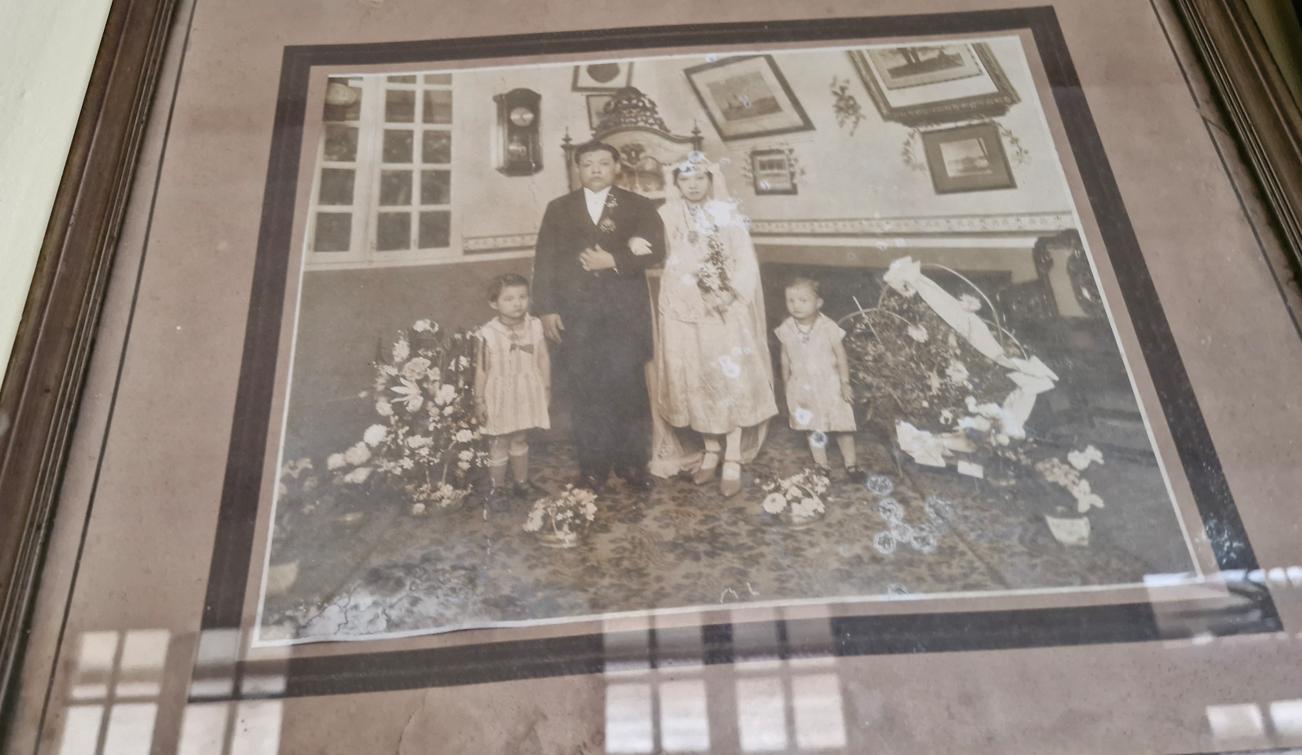
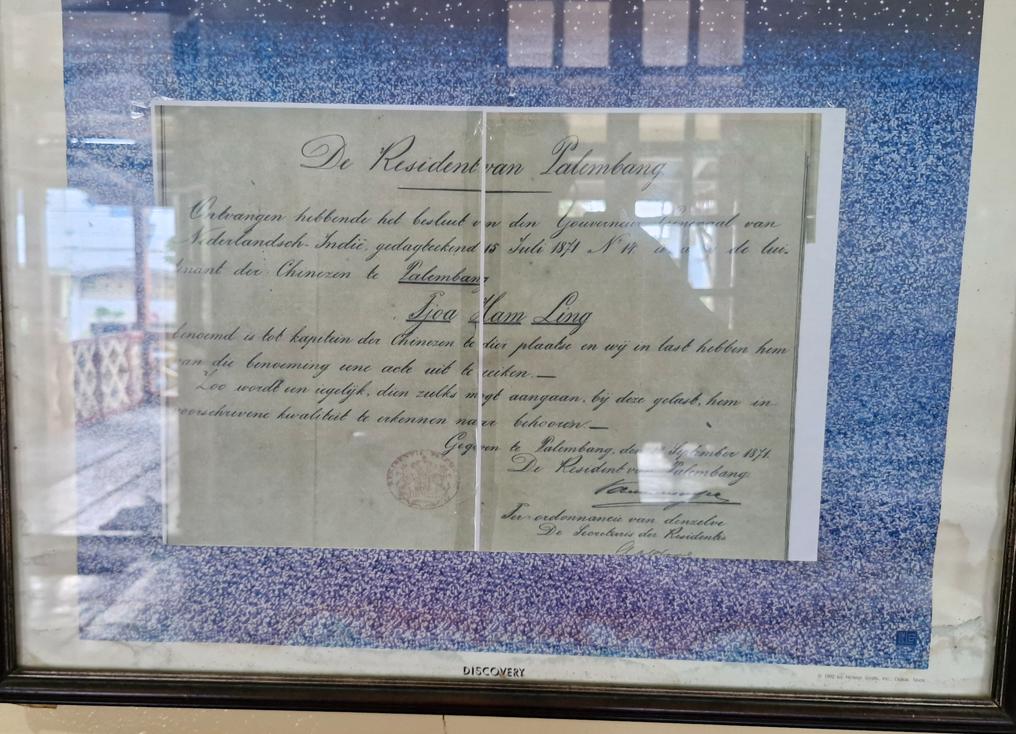
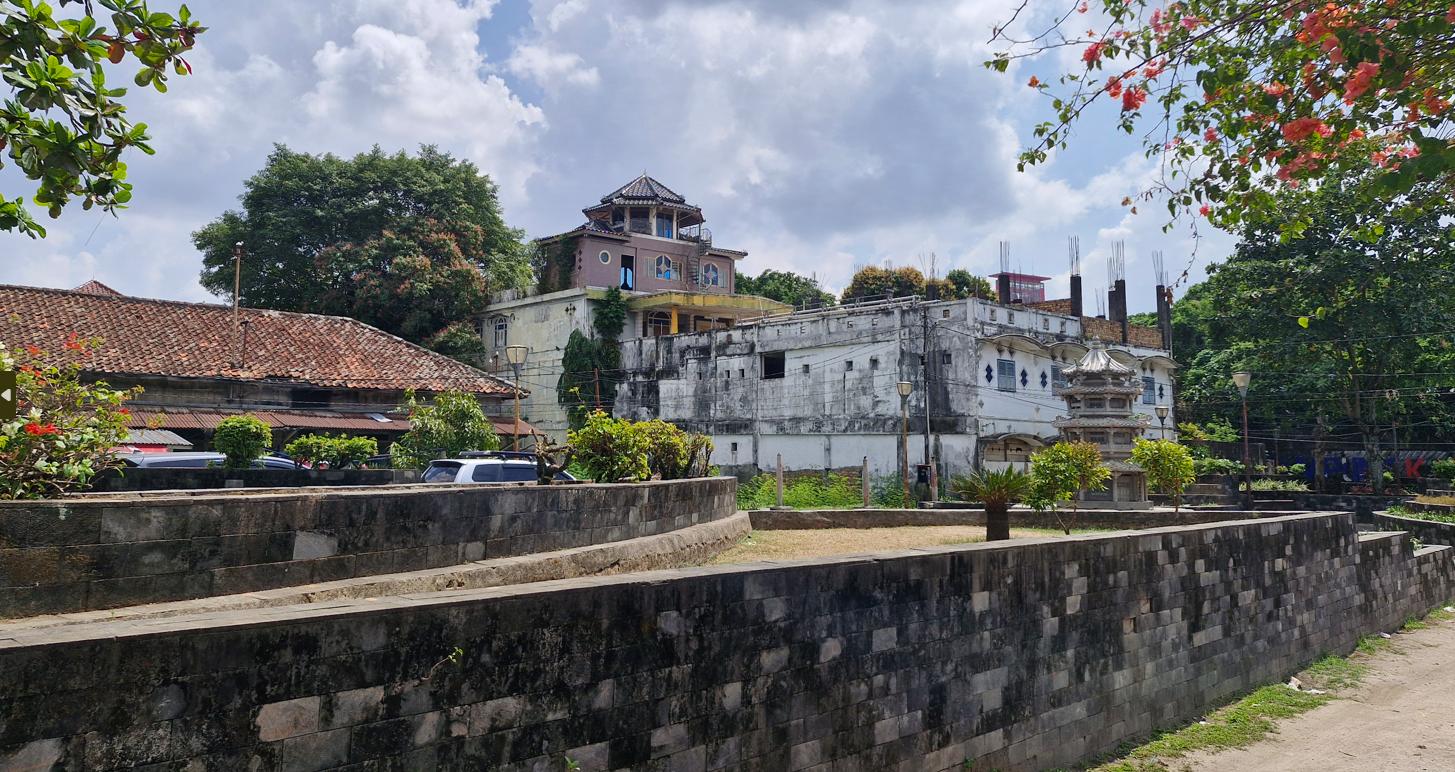
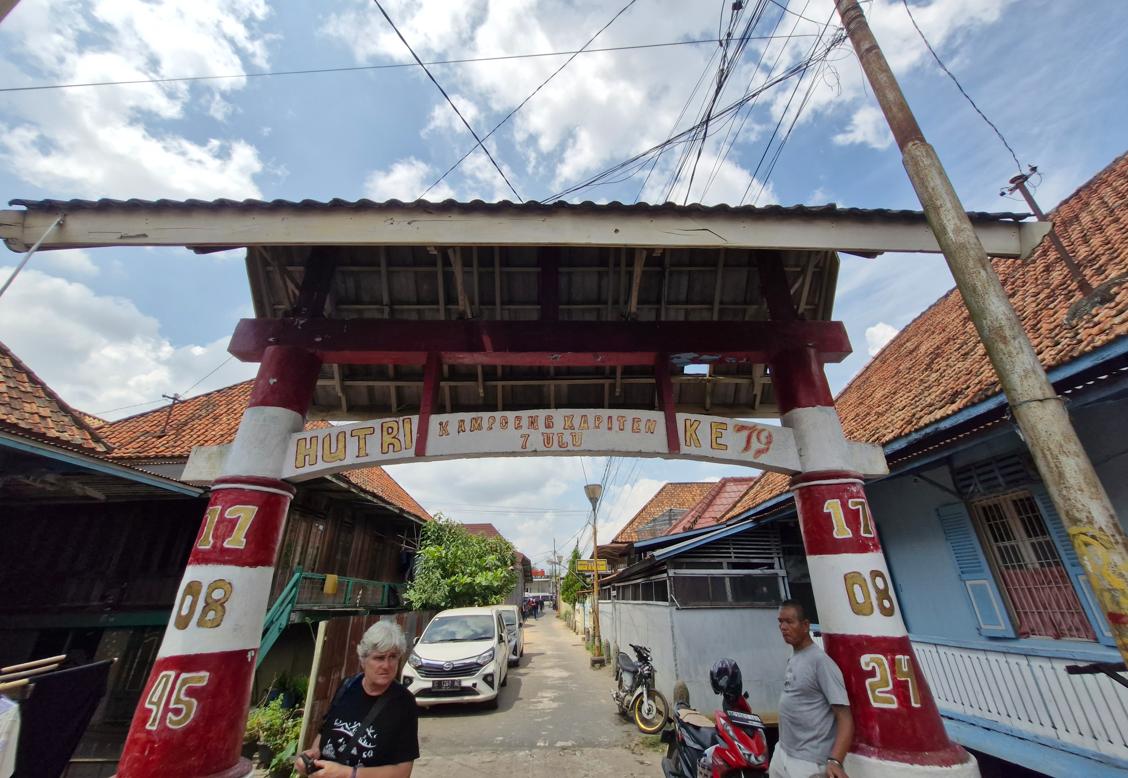
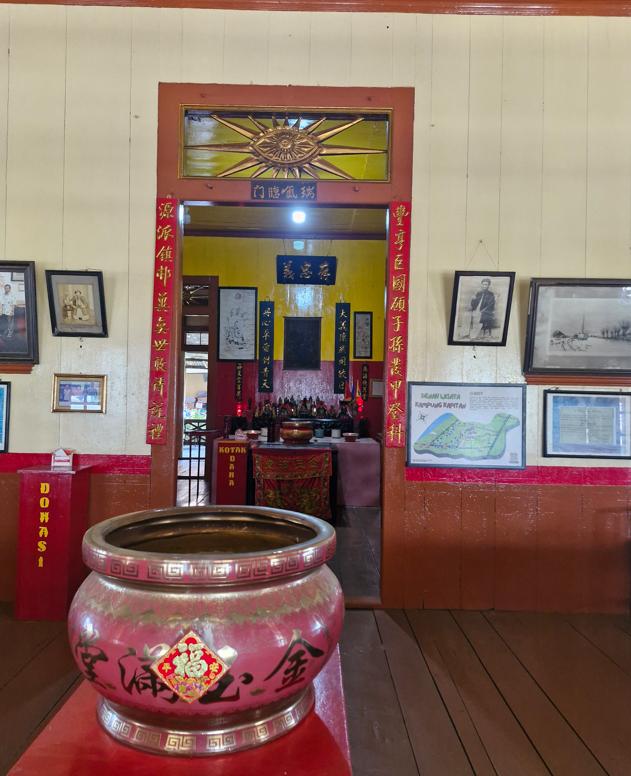
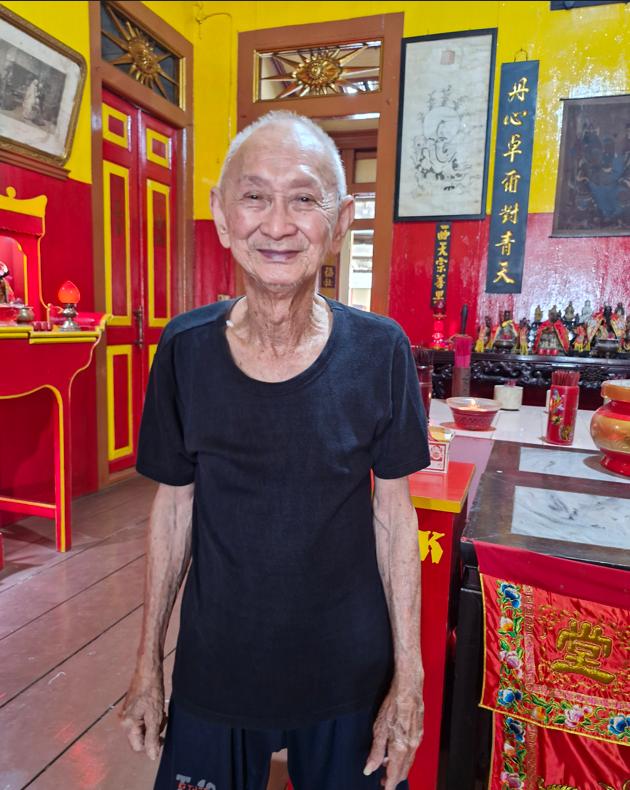
Nowhere did that layering feel more vivid than at Kampung Kapitan, a riverside enclave in Palembang's 7 Ulu district that has been, since the eighteenth century, the historic seat of the city's Chinese community. I stepped into a four-hundred-year-old house, “Oud Palembang, Roemah Kapitein Tjina 'Tjoa Ham Ling',” as a fading sign still identified it, its walls lined with Taoist altars and facsimile Dutch-era documents, and there met an elderly man, well into his seventies, who told me, in Mandarin, that he was descended in the thirteenth generation from a family that had arrived here possibly as far back as the Ming dynasty. His ancestor Tjoa Ham Ling, eleven generations back, had been appointed Kapitan, community headman, by the Dutch colonial administration itself, and the surname Tjoa, he noted, corresponds to Cai or Chua as it survives elsewhere across the Chinese diaspora, in Singapore not least.

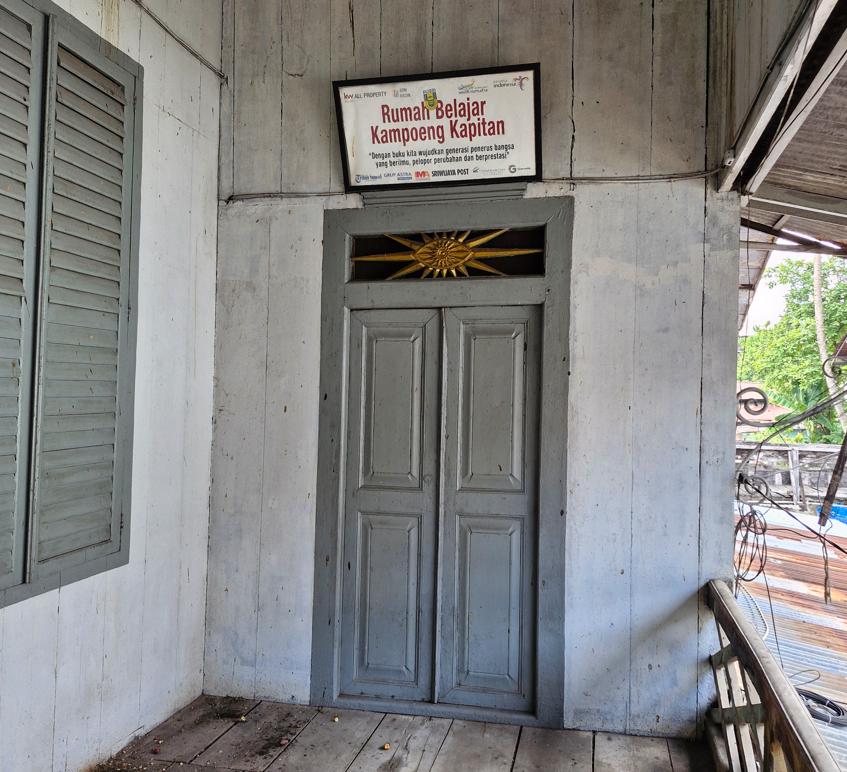
The appointment survives today as a framed certificate on the house's own wall: a Dutch document dated 14 September 1871, signed by the Resident of Palembang, formally naming him ‘Kapitein der Chinezen,’ a title descended from an earlier Dutch-appointed Chinese officer ranked Major over the whole of 7 Ulu district, passed down informally as ‘Tumenggungan Mayor Putih’ before settling into the Kapitan title the family still carries today in name alone. Outside, the site's own explanatory signboard, sun-bleached and propped crookedly against a fence, made an oddly fitting contrast: an archive kept immaculately for four centuries indoors, standing beside a public plaque the tropical damp had been left, quietly, to erase.

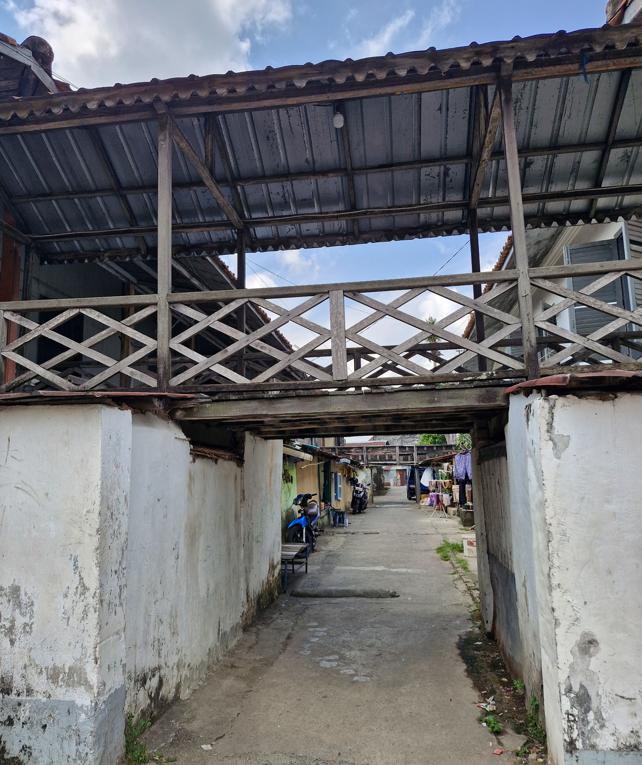
“This whole quarter was once entirely Chinese,” he told me, gesturing at the narrow lane outside, where antique shops now cluster around the surviving Rumah Limas houses. “Now only six or seven families remain. The rest went to Jakarta, to Medan. To Singapore.” He seemed genuinely pleased, in a quiet, unhurried way, to be talking with a fellow Chinese, a Singaporean this time, rather than a Jakartan or a Medan cousin. It struck me, walking back out into the afternoon heat, that this conversation, two men speaking Mandarin across thirteen generations of family memory, in a house built under a Malay sultan's patronage, in a Muslim-majority province of a country that once, under Suharto, banned public expressions of Chinese identity outright, was itself a small, living rebuttal to any simple story about what has and has not survived here.

Musi Riverside
Cheng Ho Mosque Architecture
Pulau Kemaro Pagoda
Pulau Kemaro Temple Grounds
Hok Tjing Rio Temple
Musi River Boats and Crossing

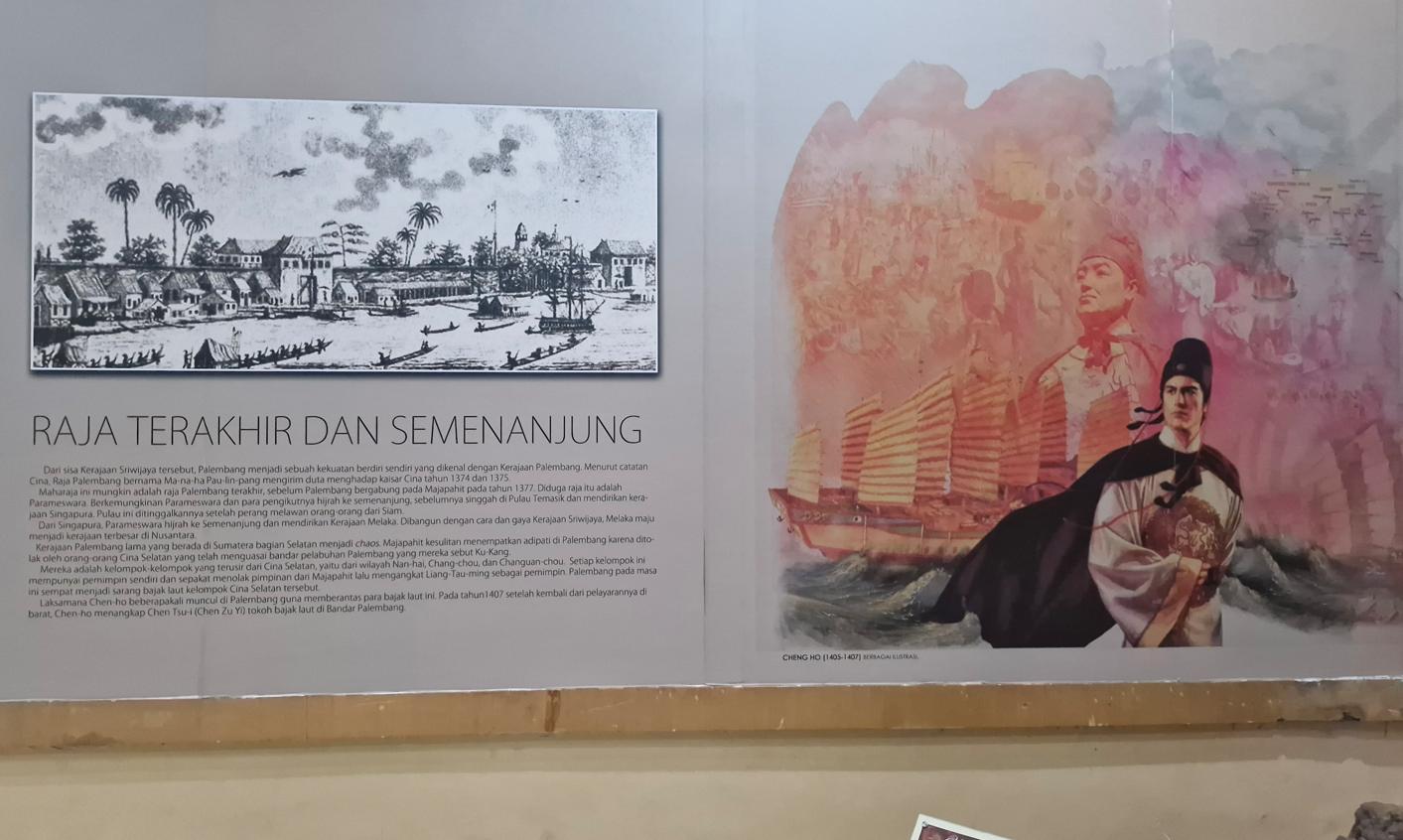
Palembang's Chinese heritage runs older and stranger even than the Kapitan's family line. In 1407, Admiral Zheng He's treasure fleet, on an ostensibly diplomatic mission through these waters, found Palembang under the control of a pirate king, Chen Zuyi, who, tipped off by a rival local leader, Shi Jinqing, that Chen intended to ambush the Ming fleet, was met instead with overwhelming force: five thousand of his men killed, ten ships destroyed, seven captured, Chen himself taken prisoner to Nanjing and executed. In the battle's aftermath the Ming court established a formal “Pacification Superintendency” at Palembang under Shi Jinqing, a quasi-colonial Chinese client polity that would, after his death, pass with startling matter-of-factness into the hands of his daughter, Shi Er-jie, confirmed as ruler by 1431 according to the Ming navigator Ma Huan's own eyewitness account, before the whole arrangement quietly lapsed around 1440 once Beijing's attention turned inward and Majapahit reabsorbed the territory.
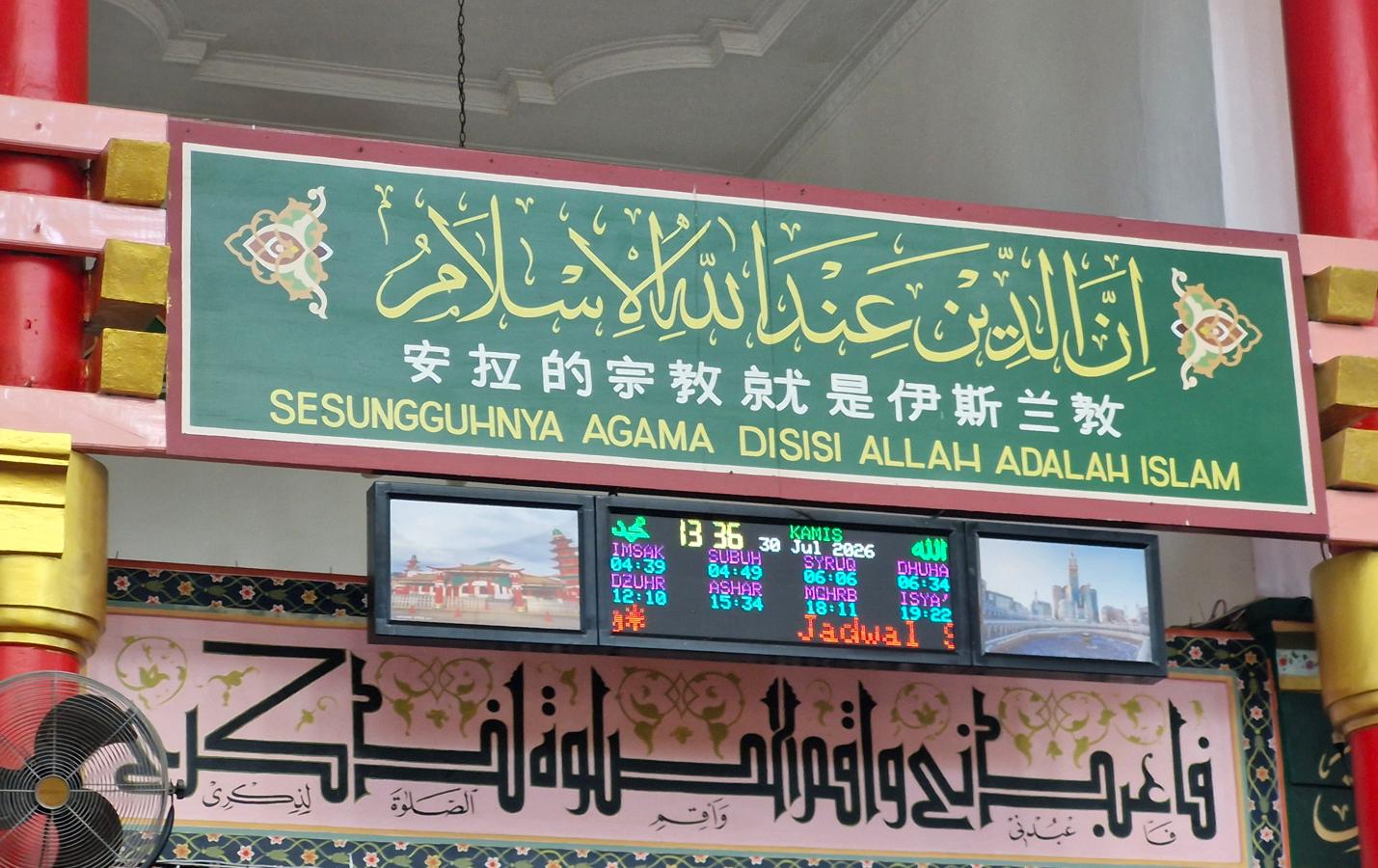
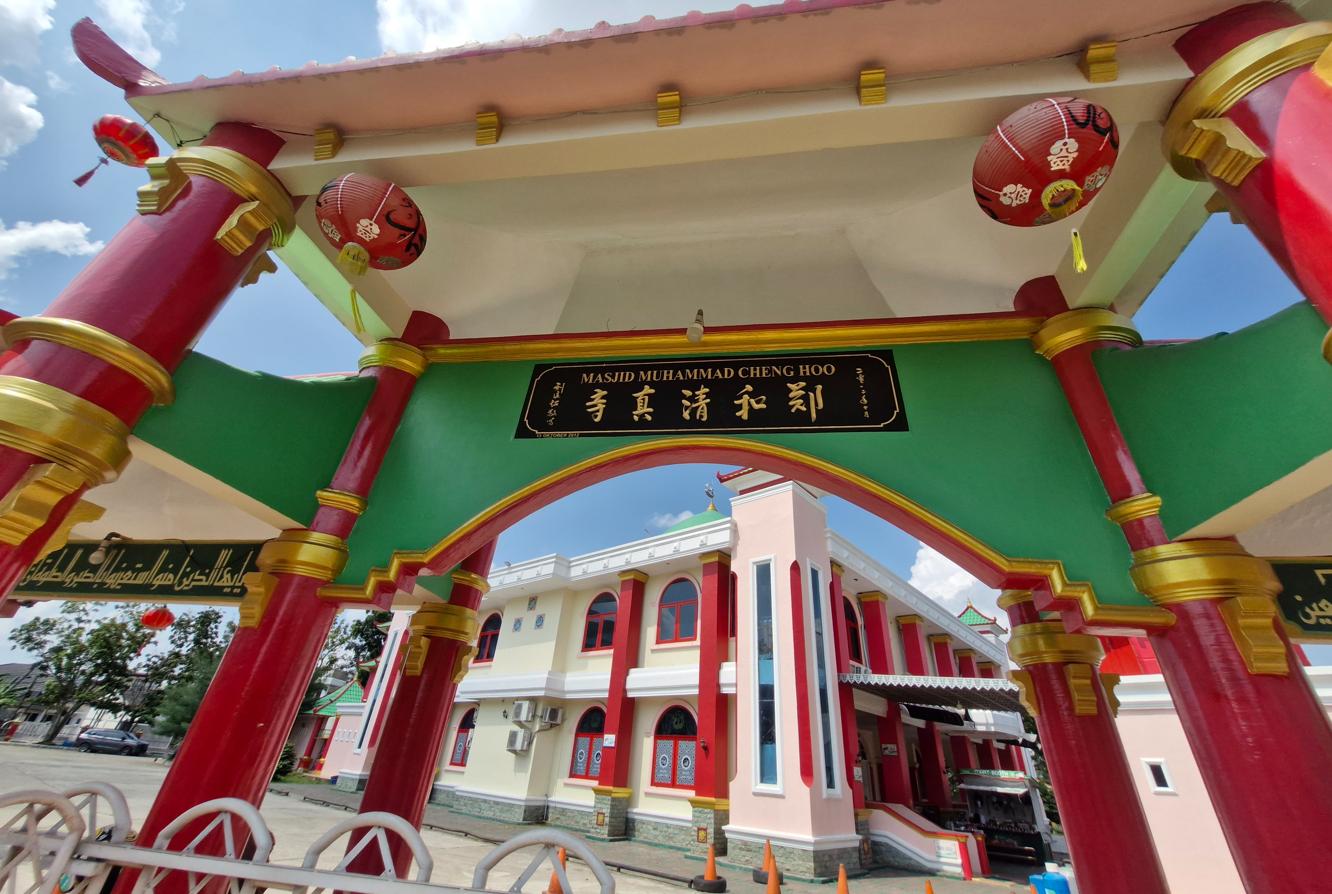
I found myself composing, one warm evening over kerupuk dipped in green sambal, a small classical Chinese quatrain to mark the memory, 巨港夜, “Night in Jugang [Palembang],” its final couplet reaching back across six centuries to that same battle: 遥思三宝平蛮日,祖义授首镇南洋, “my thoughts drift to the day San Bao pacified the unruly seas, Chen Zuyi's head surrendered, and the Southern Ocean was calmed.” San Bao, the “Three-Jewel Eunuch,” remains, six hundred years on, a genuinely popular figure across maritime Southeast Asia, honoured today at the Cheng Ho Mosque in Jakabaring, built by the Chinese Islamic Association of Indonesia and local Chinese community leaders on land the provincial government granted expressly for the purpose, its very existence a quiet, deliberate statement that Chinese and Muslim identity in Indonesia are not, and have never needed to be, in tension.

That statement matters more today than it might have a generation ago. China remains Indonesia's largest trading partner by a wide margin, bilateral trade running past $150 billion and fresh investment pledges arriving by the billions each year, yet the sentiment beneath those figures is markedly less settled than the headline numbers suggest. Surveys in recent years have found many Indonesians suspicious that Belt and Road-style financing amounts to a debt trap rather than genuine development partnership, and flashpoints like the forced relocation of villagers for a Chinese-backed “eco-city” project on Rempang Island have drawn sustained local protest and national attention. Beijing's investment, in other words, is welcomed by the state and regarded with real wariness by a good many ordinary Indonesians, a tension that sits, unspoken but not invisible, alongside the warmth of an afternoon conversation in Mandarin inside a four-hundred-year-old house on the Musi.

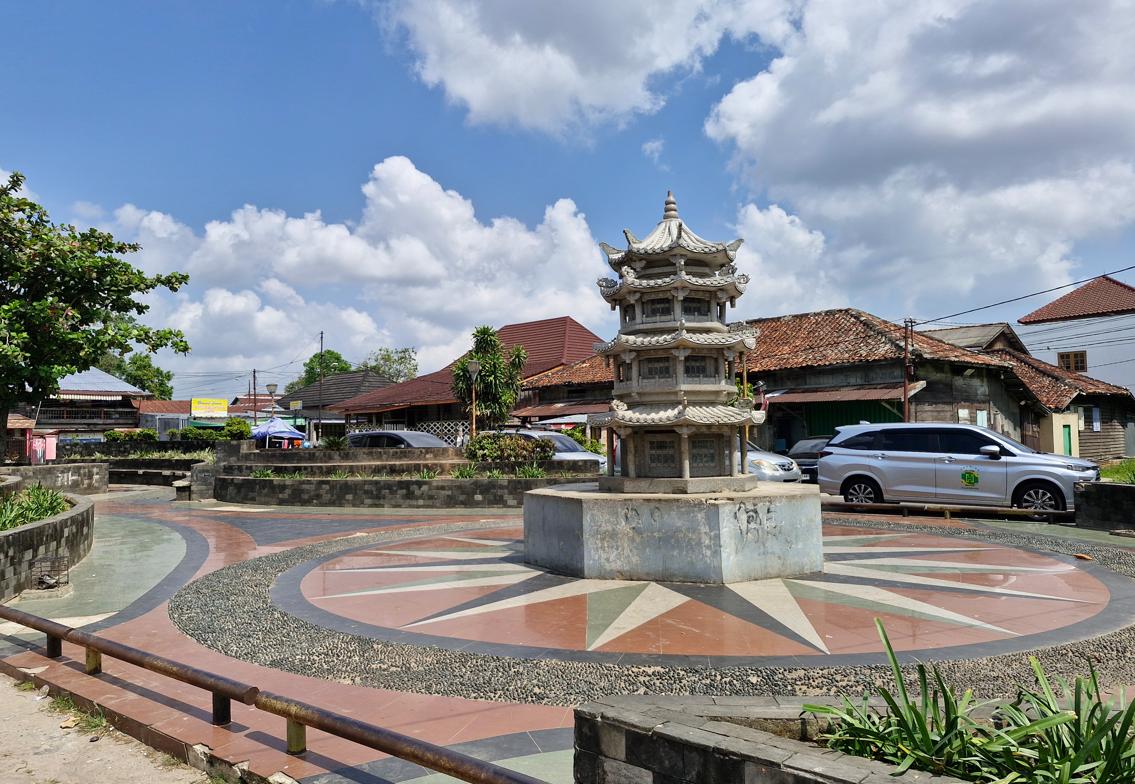
Six kilometres further downstream from the Ampera Bridge, at the point where the Musi widens into a shallow delta, sits Pulau Kemaro, Kemaro Island, a small alluvial islet that has become, almost entirely on the strength of one love story, one of Palembang's more visited river shrines. A nine-storey Chinese pagoda, built only in 2006, and the older Hok Tjing Rio temple beside it rise over the brown water, busiest each Cap Go Meh, when the island fills with lanterns and pilgrims climbing for the view. The legend that put it on our list concerns Princess Siti Fatimah, daughter of a Palembang sultan, and Tan Bun An, a wealthy Chinese trader who won her heart; her father consented to the match only on condition Tan produce a dowry worth a mountain of gold and silver, which Tan duly loaded onto a fleet of ships and sent upriver. A storm broke as the ships approached, and the treasure sank with them; Siti Fatimah, believing her betrothed lost, threw herself into the same waters, and the two are said to lie together on the island still, beneath a “Tree of Love” that locals credit with reading the fortunes of the couples who come to visit it. It is exactly the kind of doomed, extravagant romance that Chinese Indonesia tells about itself with real tenderness, and it was enough to send us, on our last morning in Palembang, down to the river to find a boat.

There is, it turns out, no ferry to Kemaro, and no shade at the jetty where the crossing has to be arranged instead: a stretch of open concrete on the Palembang side of the Musi, crowded with wooden boats in every stage of disrepair, under a midday sun that felt less like weather than a physical weight pressing down on us. A boatman quoted fifteen minutes each way, a figure I doubted the moment I looked out at the far bank and tried to square it against the width of river actually in between. What settled the matter, though, was not the heat or his optimistic arithmetic but the boats themselves: not one of the half-dozen tied up at the jetty carried a visible life jacket, and the Musi at that point runs wide, brown and fast, with the kind of current that does not forgive a capsized crossing.

Twenty years earlier, travelling as a considerably more adventurous backpacker answerable to nobody, I suspect I would simply have climbed aboard and worked out the risk afterwards. I am more careful now, more risk-averse, and I would like to think wiser, and two young children waiting at home have a way of sharpening that particular calculation. Marianne, watching the same boats rock against the jetty, arrived independently at the same conclusion I had, and neither of us needed to say very much to agree we would give it a miss. Standing there a moment longer before we turned back, I found myself thinking of a starker Musi story that Singaporeans of a certain generation carry without needing reminding: on 19 December 1997, SilkAir Flight MI 185 came down in this same river not far from where it meets the sea, killing all 104 people aboard, 46 of them Singaporean, among them the writer Bonny Hicks. It felt, at the time, like a reasonable enough thought to have standing on a jetty full of rickety, lifejacket-less boats; the legend of Kemaro, we decided, could stay a story told from the riverbank.

Kampung Arab Al-Munawar Lane
Al-Munawar Historic Enclave
Schoolchildren in Kampung Arab
Hadhrami Architecture

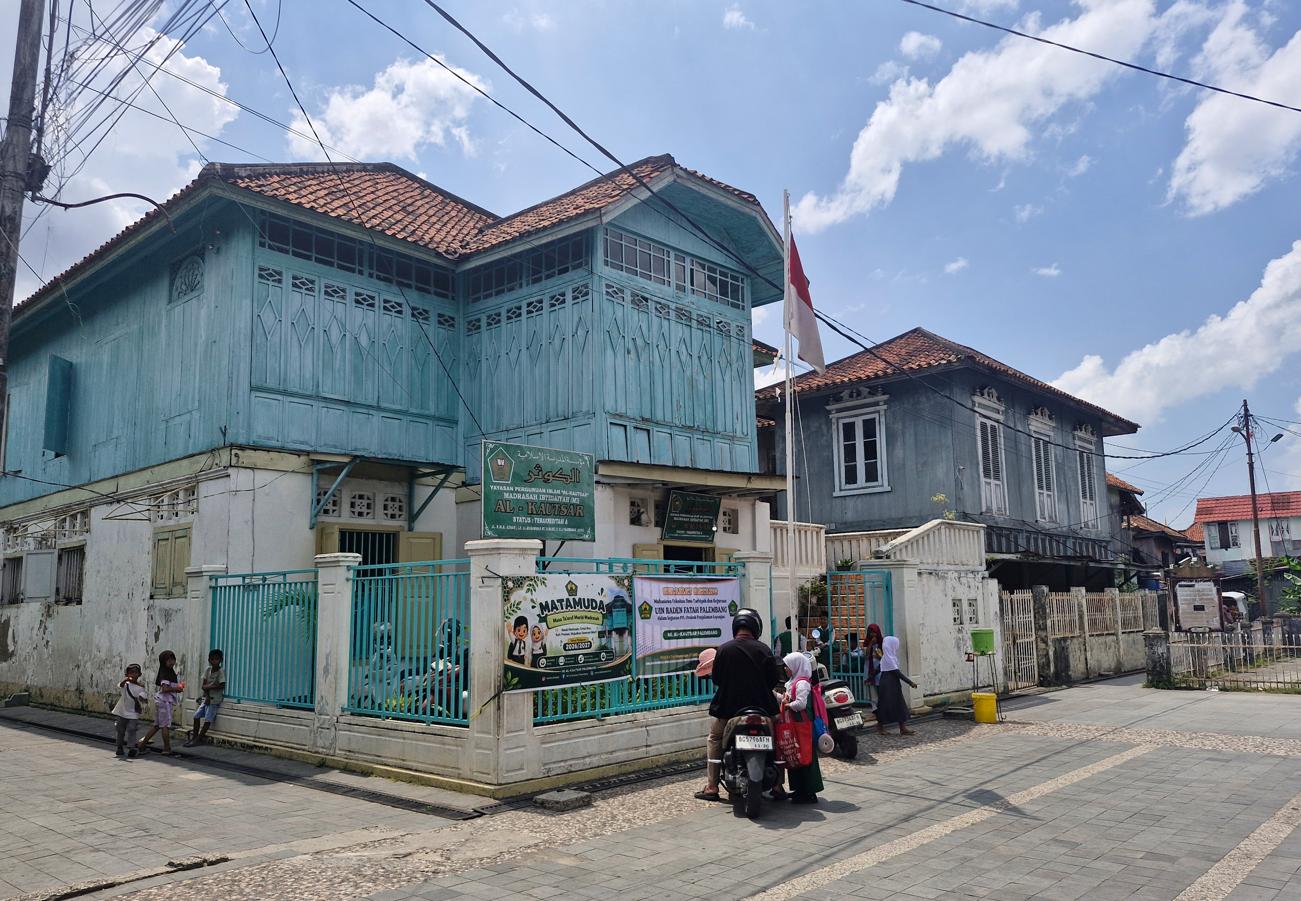
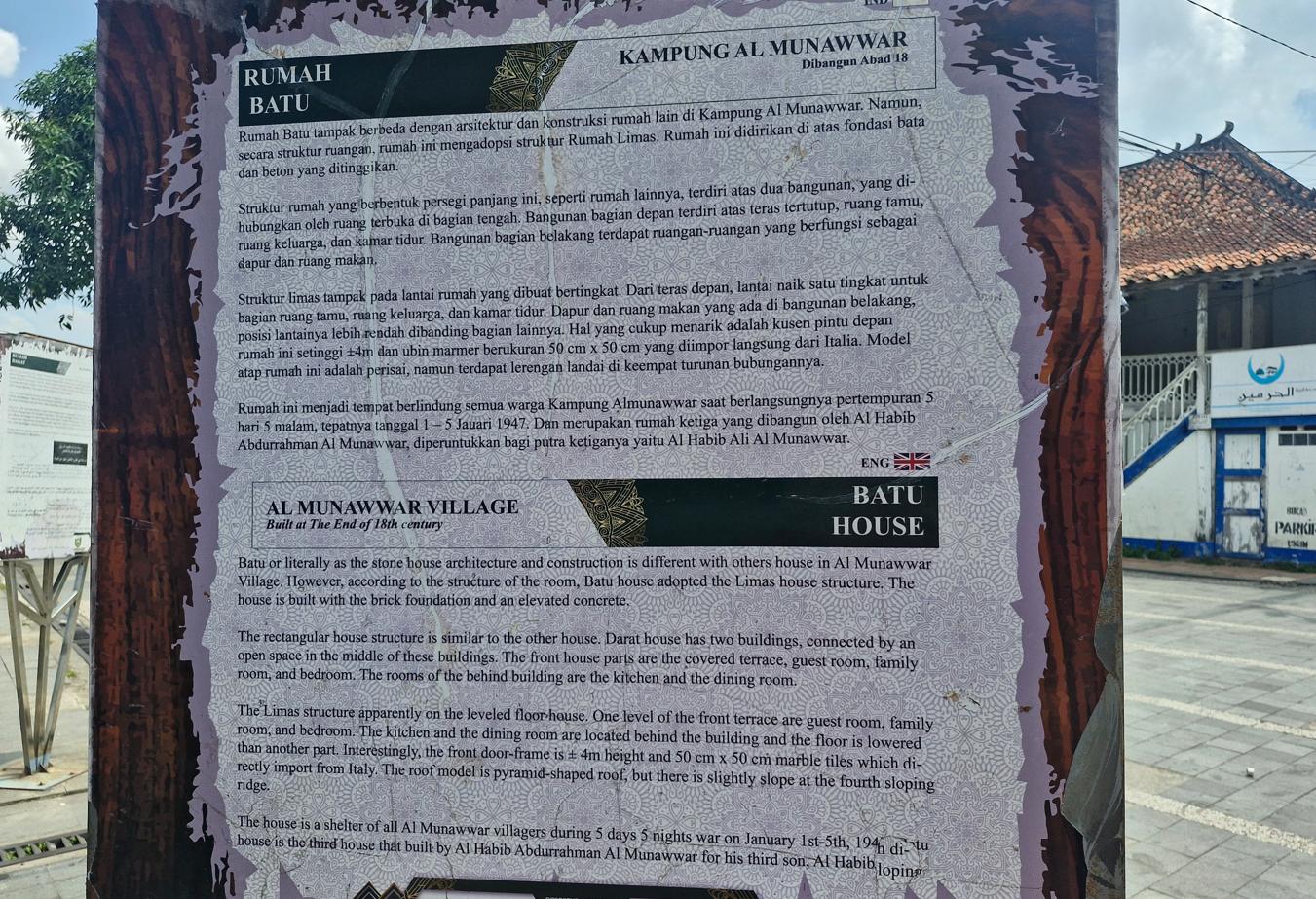
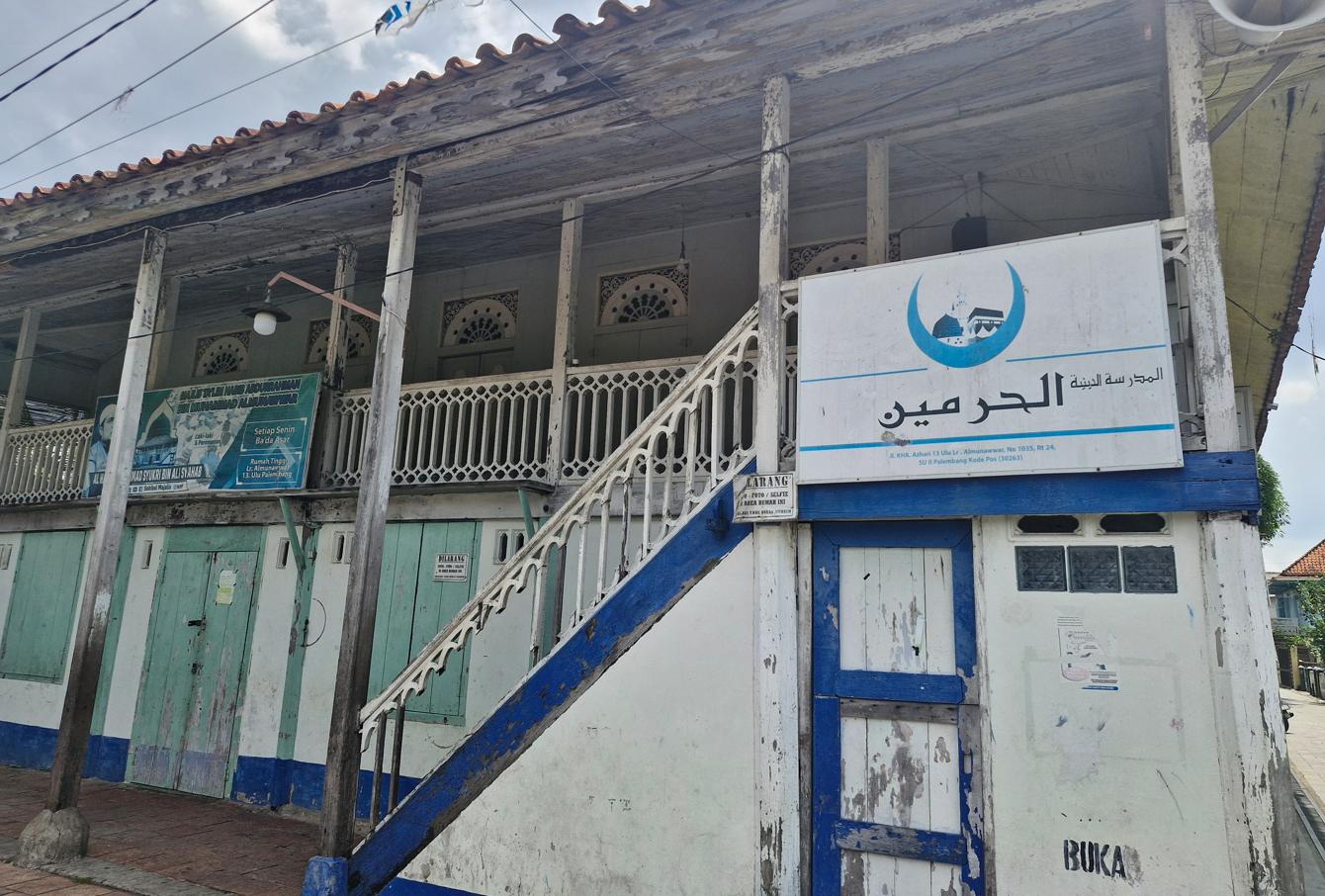
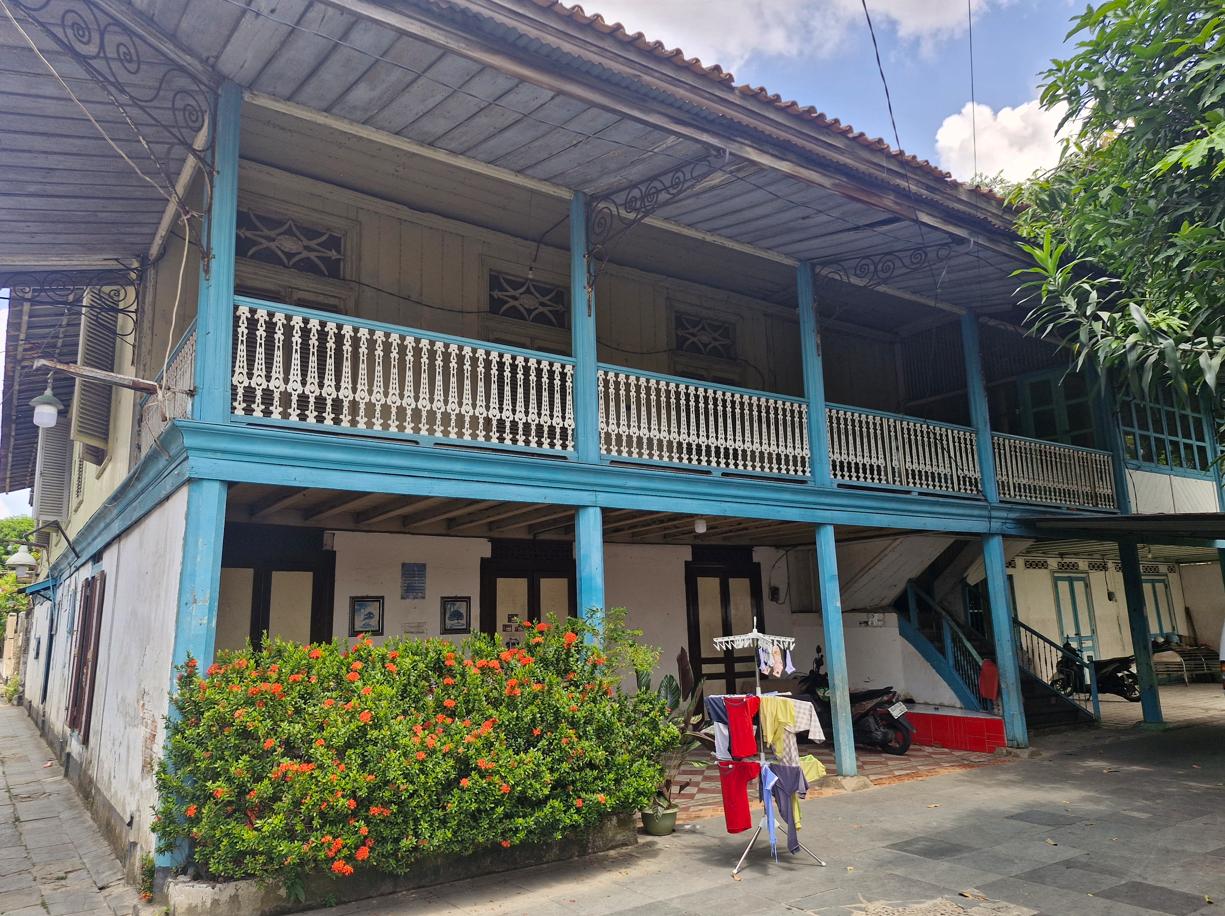
At Kampung Arab Al-Munawar, a short distance further along the same riverbank, we found a different diaspora keeping an equally long thread alive. Founded around 1728 by a Hadhrami sayyid, Habib Abdurrahman bin Muhammad Al-Munawar, the village still houses descendants of Yemeni merchants whose forebears served for generations as advisors and religious tutors to the Palembang sultans, close enough to the court that their graves stand today alongside the sultans' own in the royal burial complex.

As we arrived, a stream of schoolchildren came pouring out of the neighbourhood madrasah in Ottoman-style songkok, waving and calling out fragments of freshly learned English, “how are you,” “where are you from,” “welcome,” fired off in overlapping bursts without waiting for any reply, exactly the unselfconscious enthusiasm of children anywhere road-testing a new language on the first foreigner who happens past. It brought back, unexpectedly, my own memories of walking through Hadhramaut nearly two decades earlier, and of quieter Sunday mornings in Kampong Glam back home, a small triangular thread, Yemen to Palembang to Singapore, that felt, standing in that lane, considerably less like three separate histories than like one continuous conversation conducted over several centuries and several seas.

Al-Qur'an Al-Akbar Giant Wood Carving
Al-Qur'an Al-Akbar 5-storey Display
Engraved Tembesu Wood Board
Gilded Surah Detail

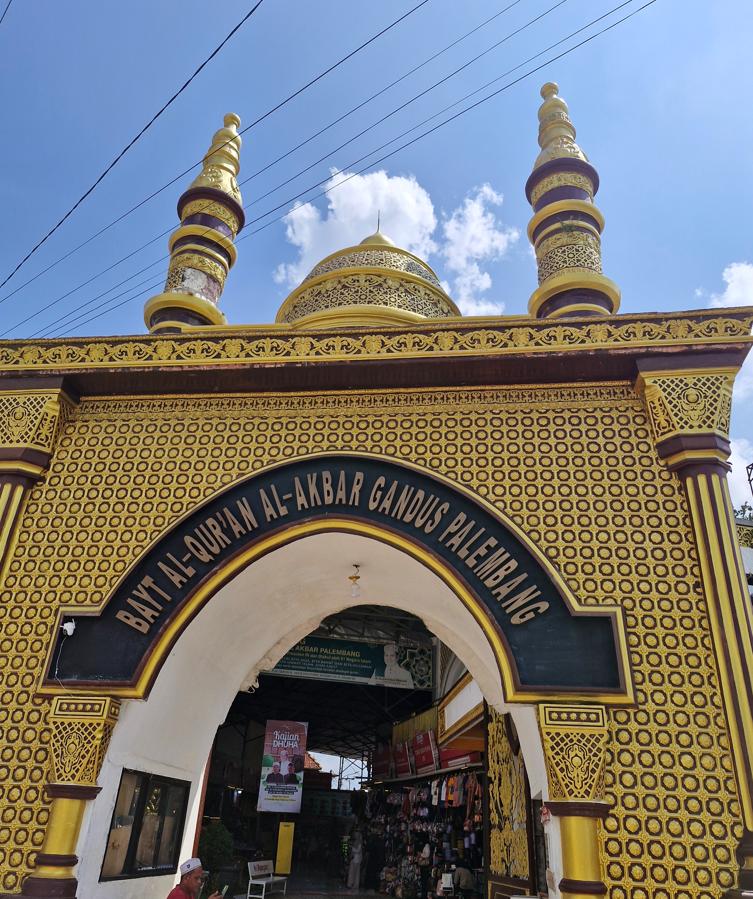
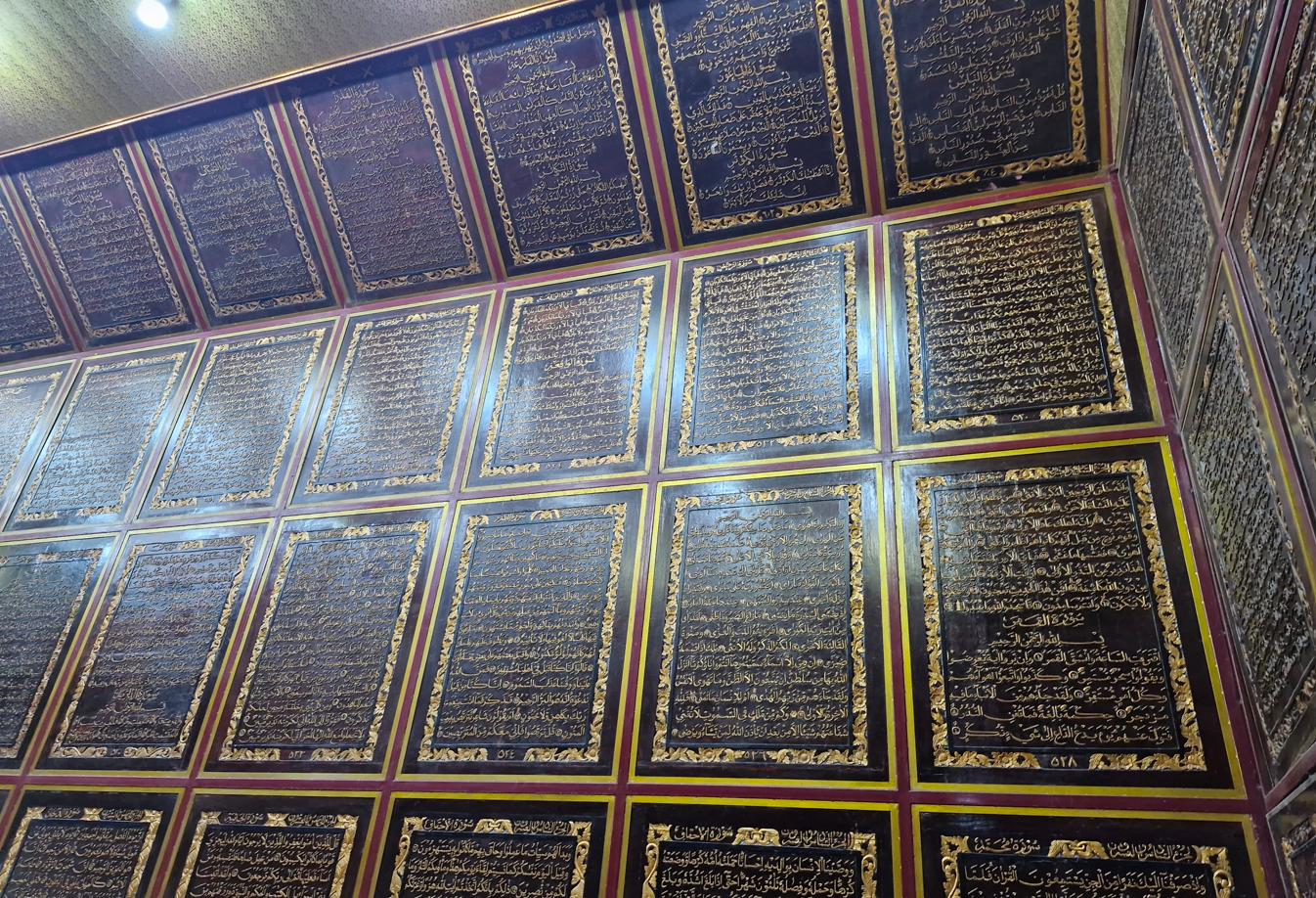
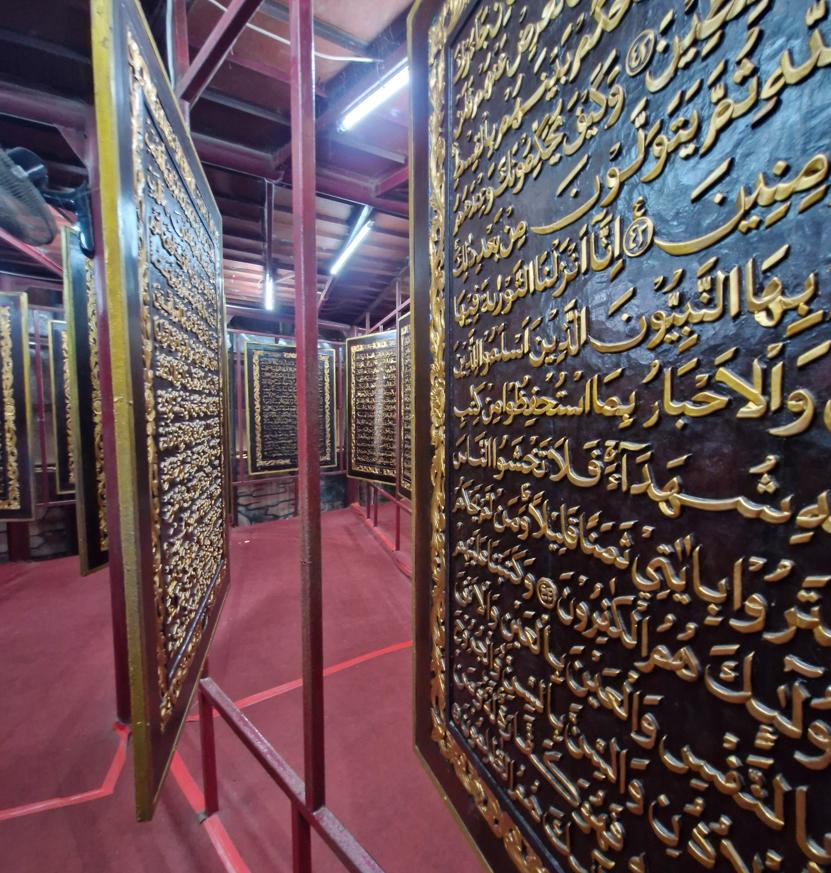
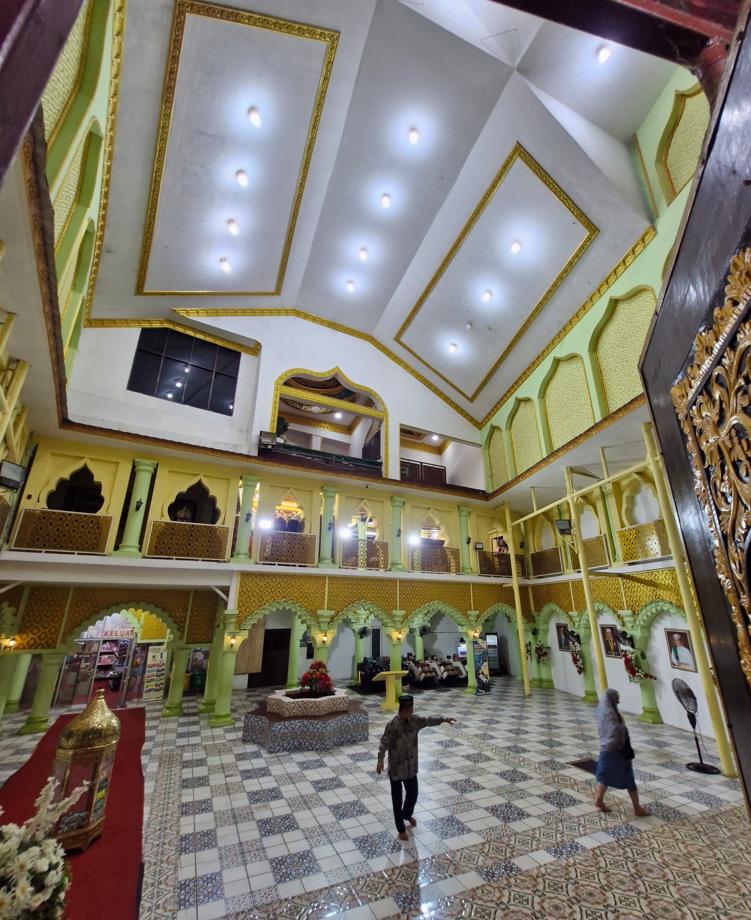
One last stop, out at Gandus on the city's western edge, supplied the most purely physical expression of devotion I saw anywhere on the trip: the Al-Qur'an Al-Akbar, a giant hand-carved wooden Quran housed in its own five-storey building at the Al-Ihsaniyah pesantren. All thirty juz, all 114 surah, more than six thousand ayat, are engraved by hand across 316 thick tembesu-wood boards, each one gilded and each one weighing close to fifty kilograms; the Indonesian Record Museum, MURI, certified it as the largest and heaviest Quran on earth, and it was formally inaugurated in January 2012 before a visiting delegation from the Organisation of Islamic Cooperation. Getting to it, oddly, was the more memorable part of the visit: the approach runs through a honeycomb of tiny stalls selling children's toys, bedsheets, batik tablecloths and trinkets of every description, narrow enough and repetitive enough that we genuinely lost our bearings twice trying to find the exit, a small commercial maze wrapped, with no apparent sense of incongruity, around one of Southeast Asia's most monumental single acts of religious devotion.

Palembang Pempek Feast
Traditional Pempek and Cuko
Fried Pempek Selection
Palembang Local Food Stall
Palembang Culinary Experience
Palembang Market Dish
Fish Cake Preparation
Dining by the River
Evening riverside eatery
Palembang City Lights

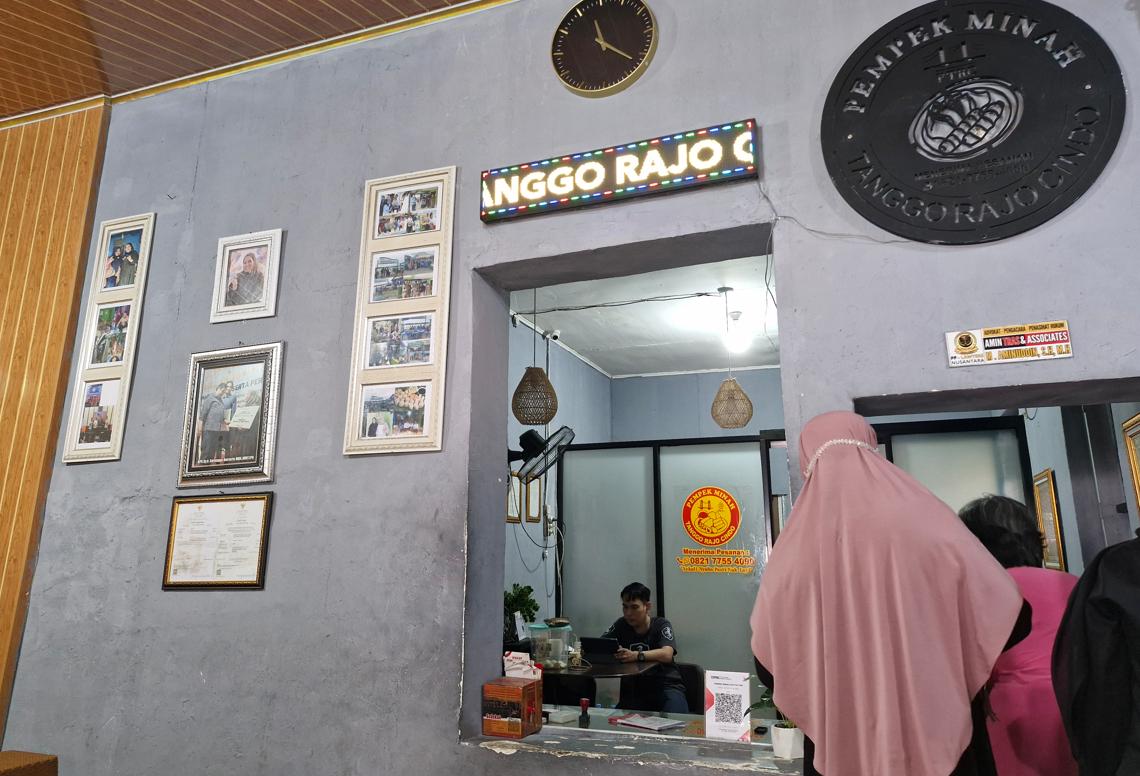
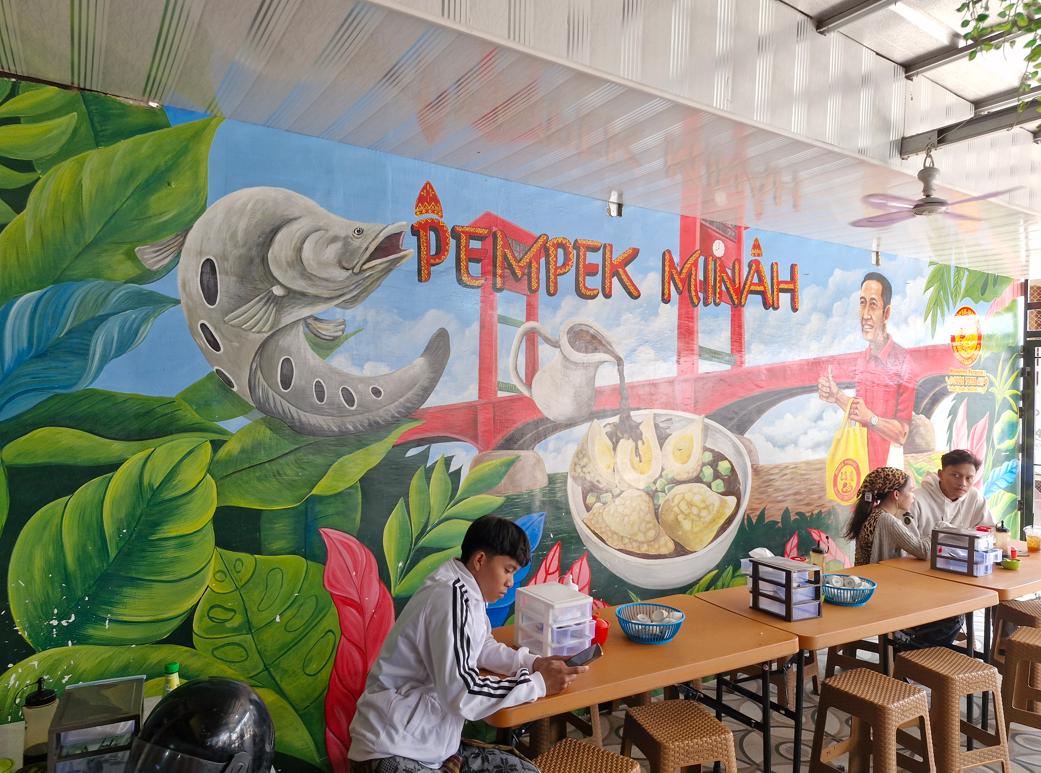
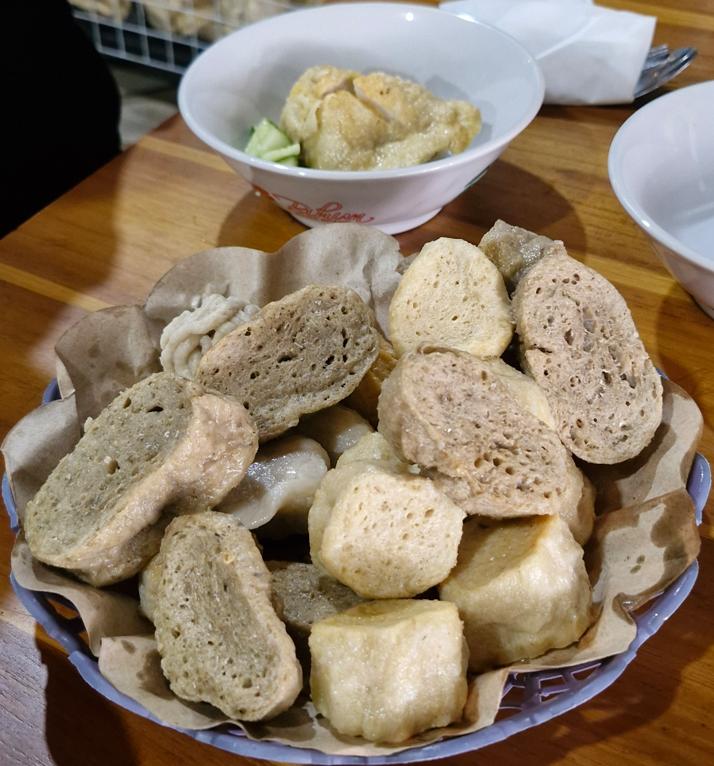
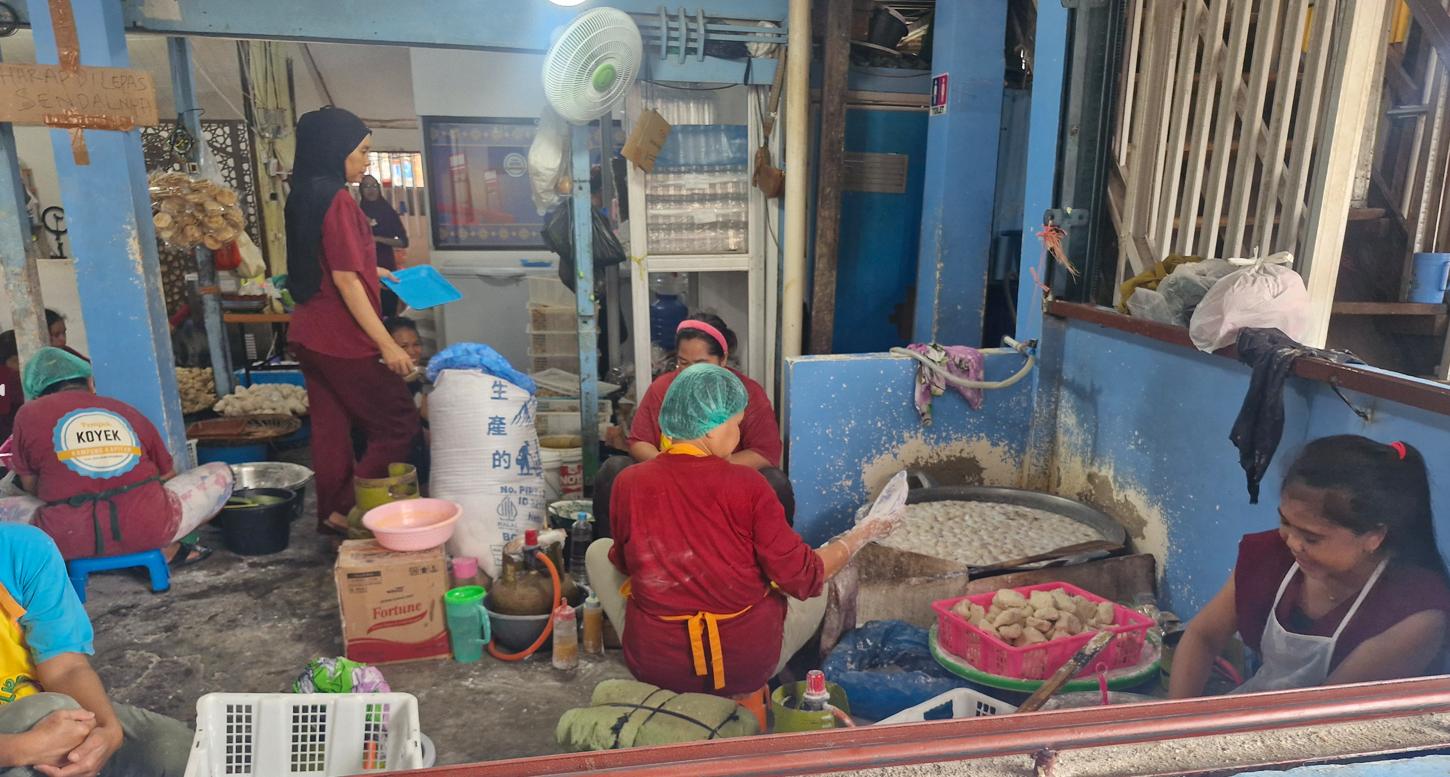
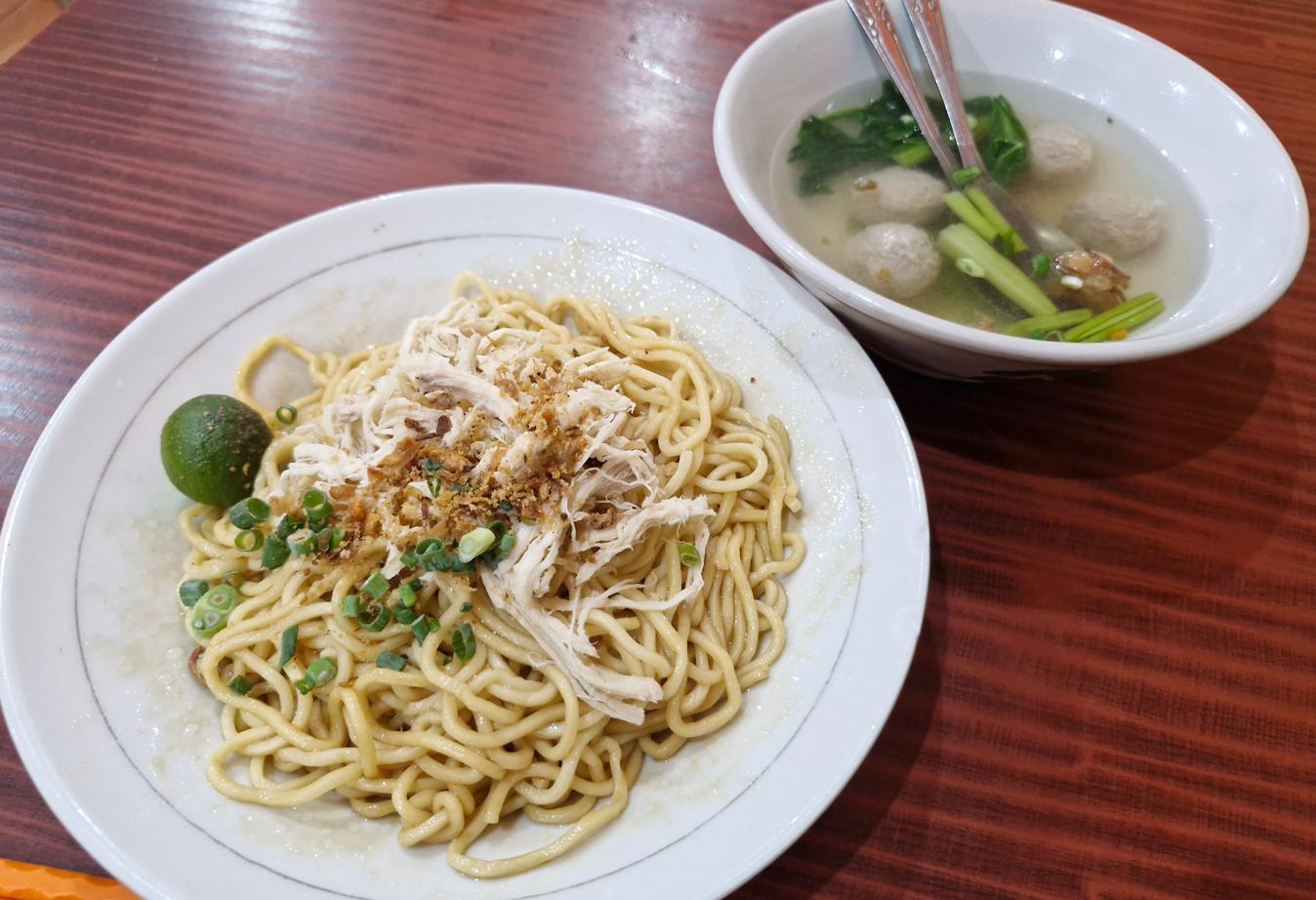
We finished the last full day in Palembang the way one really ought to finish any day in this city: with pempek, the dense, tapioca-bound fish cake said locally to have been invented by an old Chinese peddler nicknamed Apek, whose name, in one of those etymological just-so stories cities tell about their own food, survives in the dish's own. Pempek belongs to Palembang and the Musi's fish-rich waters as completely as rendang belongs to the Minangkabau highlands, and it is worth saying plainly, at the end of a trip that had by now taken me through four distinct culinary traditions, that Indonesia's regional cuisines rarely get this kind of individual recognition abroad. Padang food travels; pempek, the tempoyak and pindang I'd had back in Jambi, and Riau's own river cooking mostly stay home, however much better some of them arguably are. Cut into thick ovals and dropped into a tangy, dark cuko sauce sharp with tamarind and chilli, pempek is sold on what feels like every second street corner in the city. I confess I still prefer the smoother, more fish-forward texture of a proper Chinese fish ball, but I ate it anyway, twice, because a travel writer's job, in the end, is to eat what the city hands him and be honest about the verdict afterwards.

08
Up Next

EPILOGUE: THE CORRIDOR, RECONSIDERED

Synthesizing the voyage across Sumatra's empires, river valleys, and enduring maritime bridges.

If You Like This Website...