Reflections across the Melaka Strait, the Minangkabau Highlands, and the living corridor of Sumatra.
By Tan Wee Cheng
Flying home, I returned to the thought that had started this trip: the Strait of Malacca is a corridor, not a border. Ten days walking the homeland of the Minangkabau and the Melayu hadn’t dislodged that conviction. If anything, it had handed me more evidence than I knew how to carry.
Ten days, though, had covered barely a third of the island in any way that counted. Sumatra runs to somewhere between 473,000 and 482,000 square kilometres, depending on how generously one counts its offshore scatter. Count Nias, the Mentawais and Bangka-Belitung, and it becomes the sixth-largest island on Earth — larger than the whole of Sweden, close in size to Spain, not far short of Germany and the United Kingdom combined.
I visited North Sumatra in 2012. This trip added West Sumatra, Riau, Jambi and South Sumatra — four more provinces, a real but modest slice of that total. Everything else sat waiting exactly where it always had. Aceh, at the island’s northern tip, whose deliberate turn away from Malayness I’d only read about in Andaya’s work, never seen. Nias and the Mentawai Islands offshore, with megalithic and surfing cultures that belong to entirely different conversations. The highland megaliths around Pagaralam, older by some estimates than anything at Muara Takus or Muaro Jambi. Bengkulu, where Raffles governed and Marsden wrote, and where I’d followed both men only at second hand. Lampung, the island’s southern gateway to Java. Bangka-Belitung, ceded by one sultan’s misfortune and Raffles’ opportunism in 1812, never quite folded back into the mainland story. And the Natuna Islands, closer on the map to Malaysia and Vietnam than to Sumatra, yet still part of the same long archipelagic argument about where one place ends and another begins. Ten days had been enough to learn how much of a corridor this island really is. Nowhere near enough to walk the whole of it.
On the flight home I finally sat down to reread Leonard Andaya properly, and his phrase for the region fit the ten days better than the plane’s stale coffee deserved: leaves of the same tree. Malay, Minangkabau, Acehnese, Batak, Orang Laut — up close, the Straits’ many peoples look as separate as any two leaves. Underneath, though, they share one root system: trade, marriage, migration, myth. It’s old enough that no single branch can honestly claim to have grown independently of the rest.
The Acehnese, on the far side of the highlands I never reached this trip, built their own distinctiveness the same way the Minangkabau built theirs — not by isolation, but by a deliberate, strategic turn away. They had once actively courted a Malay identity; once Johor reclaimed the region’s premier court, they hardened instead around a stricter Islam and an inland rice economy. The Batak did much the same in reverse. They adopted Malay dress, titles and Islam wherever the coast made it profitable, while keeping the ancestral highlands stubbornly, deliberately un-Malay — a boundary maintained not by ignorance of the alternative but by clear-eyed calculation of what it protected. None of these, in other words, were ancient tribes discovered fully formed by history. They were, and in some sense still are, ongoing arguments about advantage, kinship and belonging, conducted in trade goods, marriage alliances and origin myths, over far more centuries than any modern border has existed to interrupt them.
Consider the genealogy alone. The Malay Annals trace the royal line of Melaka — and through Melaka, the sultanates of Johor, Perak, Pahang and Terengganu — back to Sang Sapurba. He is said to have descended at Bukit Seguntang, the very hill I had climbed in Palembang to pray, if that is the word, alongside businesspeople and job-seekers at a cluster of legendary tombs, before marrying into the Minangkabau court and being crowned in the highlands I had walked a week earlier. Sang Nila Utama, founder of Singapura in 1299 and by most tellings Sang Sapurba’s own son or brother, carries that same Palembang bloodline straight into my own country’s foundation myth.
That genealogy still lives in Negeri Sembilan — the one state in Malaysia, arguably in the entire Islamic world, that still officially practises adat perpatih. Its Minangkabau settlers carried this matrilineal system across the Strait in the twelfth century, and it survives there largely intact, inside a state as thoroughly wired into hyper-modern Malaysian industry as any of its neighbours. Rendang and lemang, Minangkabau dishes both, sit on Malaysian and Singaporean tables as unremarkably as they sit in Padang. Nasi Padang restaurants line ordinary Singaporean streets in numbers that outstrip, by any honest count, the attention most of us pay to where the tradition actually began.
It runs the other way too, quieter but just as real. Zubir Said, composer of Singapore’s national anthem, Majulah Singapura, was born in 1907 in Fort de Kock, Bukittinggi’s old colonial name. His father, a village chief, distrusted music so deeply that the boy taught himself on a bamboo flute he had carved in secret. Zubir arrived in Singapore at twenty-one with nothing but the clothes he travelled in. He did not reconcile with his father until 1959, when the old man finally heard Majulah Singapura performed, embraced his son in tears, and admitted, three decades late, that he had been wrong. It is a very Minangkabau story in the end: a young man sent out by circumstance and custom alike to seek his fortune in the rantau, who returns not with conventional wealth but with something that outlasts it, and is folded, eventually and completely, back into the honour of the place he came from.
None of this erases the harder currents running beneath the warmth, and I want to be clear about that. The Dutch King’s 2020 apology for “excessive violence” during the colonial period, and the compensation later paid to victims’ families in West Java and South Sulawesi, addressed specific, documented atrocities from the 1940s revolution. It said nothing about the uncounted dead of Sawahlunto’s coal seams a century earlier, worked to death under an administration that logged tonnage with scrupulous care and never bothered to log the men. Japan’s occupation survives here in a stranger, more ambivalent register than the one Singapore remembers, which is mostly the unrelieved horror of the Sook Ching. Genuine wartime brutality and forced labour sit here uneasily beside memory of an occupier who at least arrived promising liberation from a longer colonial yoke — one who, in Yamashita’s own words, claimed to have “come to break the chains of Dutch imperialism.”
The Chinese community itself has shrunk to six or seven families, where once an entire riverside quarter in Palembang was Chinese. Mandarin was spoken across thirteen generations in a single surviving house. A mosque was built expressly to prove that Zheng He's faith and his ancestry were never in contradiction. Today that community occupies an in-between position in Indonesia. It is neither fully assimilated nor fully apart. It is no longer persecuted the way it was under the worst years of Suharto's New Order, but it isn't entirely free of suspicion either — a low, persistent wariness still colours how some Indonesians read Chinese wealth and Chinese state investment alike. Like the Minangkabau themselves, this is a community defined above all by movement. It moves outward through merantau and outward again through diaspora. It is marked by a willingness to leave, and by a stubborn, generations-deep habit of somehow, eventually, being found again by someone from home.
I keep coming back, in the end, to Tsuyoshi Kato’s line about the paradox at the centre of everything I had spent ten days walking through: “The Minangkabau present a striking paradox: they possess the largest matrilineal society in the world, yet they are among the most devout Muslims in Southeast Asia and among the most highly mobile and cosmopolitan people in Indonesia.” Paradox, though, is maybe the wrong word for it — or at least too tidy a one.
What I had actually seen — from a Taj-Mahal-styled mosque built on reclaimed land against an earthquake not yet arrived, to a four-hundred-year-old house where a stranger from Singapore was welcomed in Mandarin as something closer to family than tourist — was not a paradox. It was a permanent, working equilibrium: adat and Islam, matriliny and merantau, ancient river-borne trade and twenty-first-century palm oil revenue, all held, however uneasily, in the same frame at once.
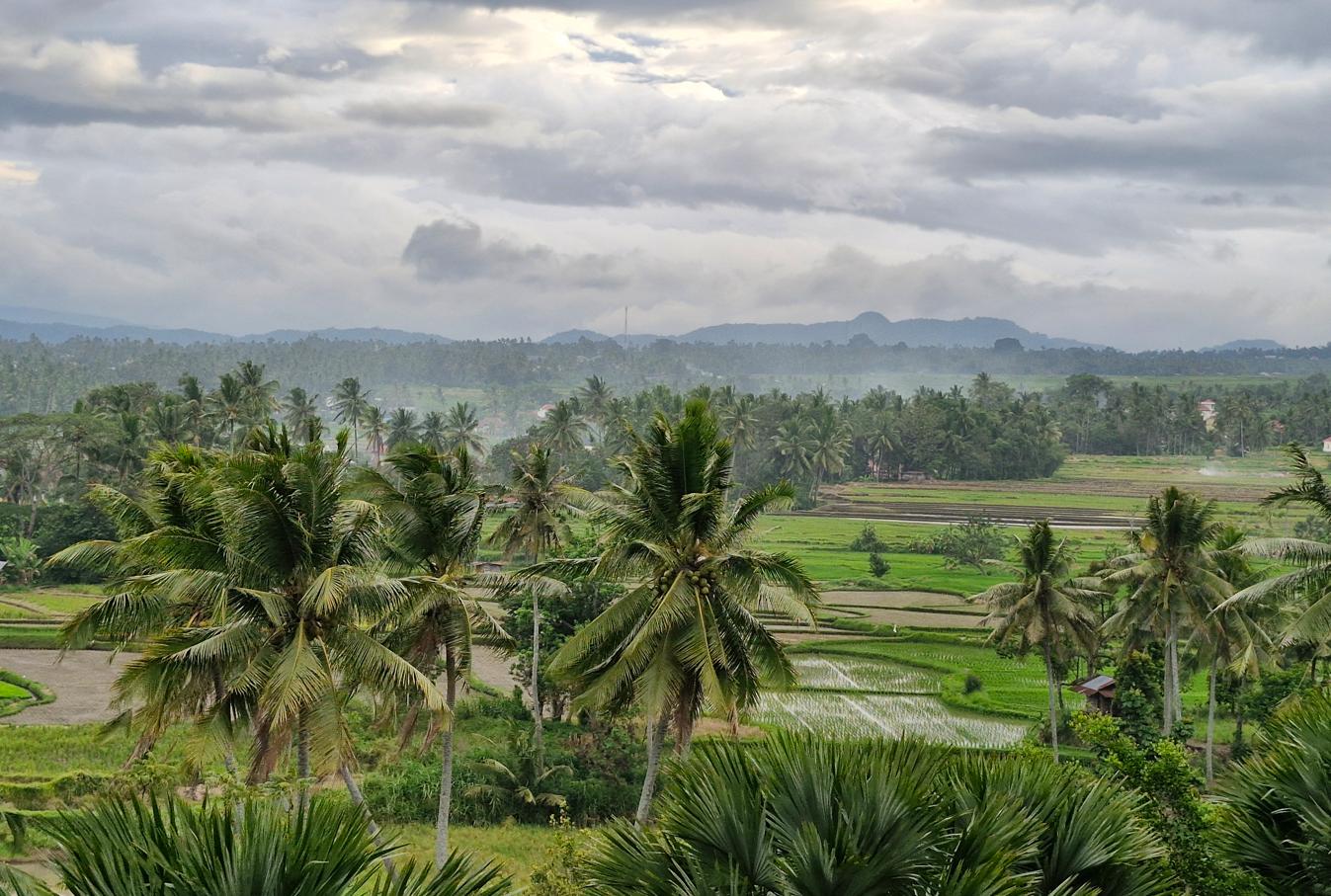
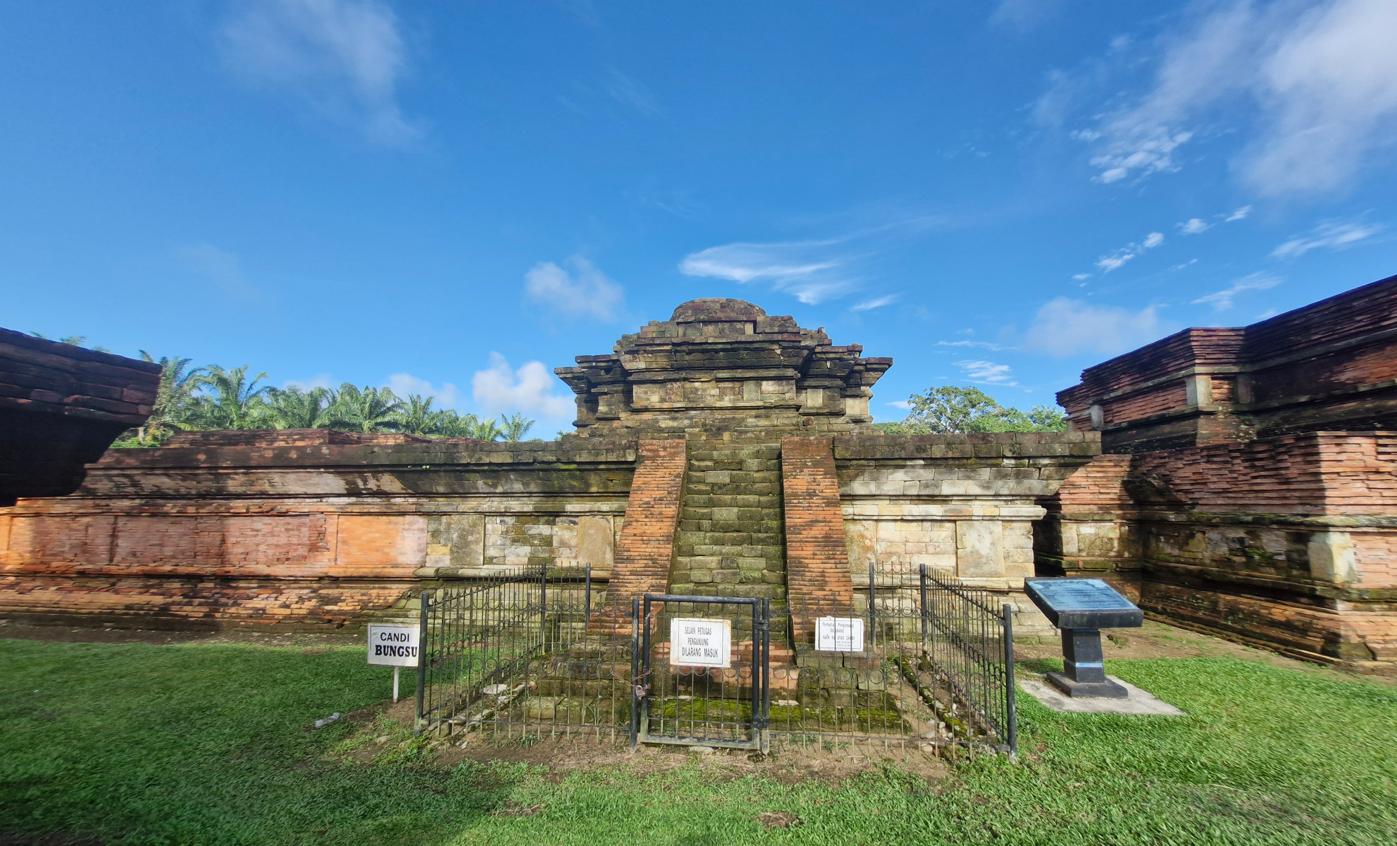
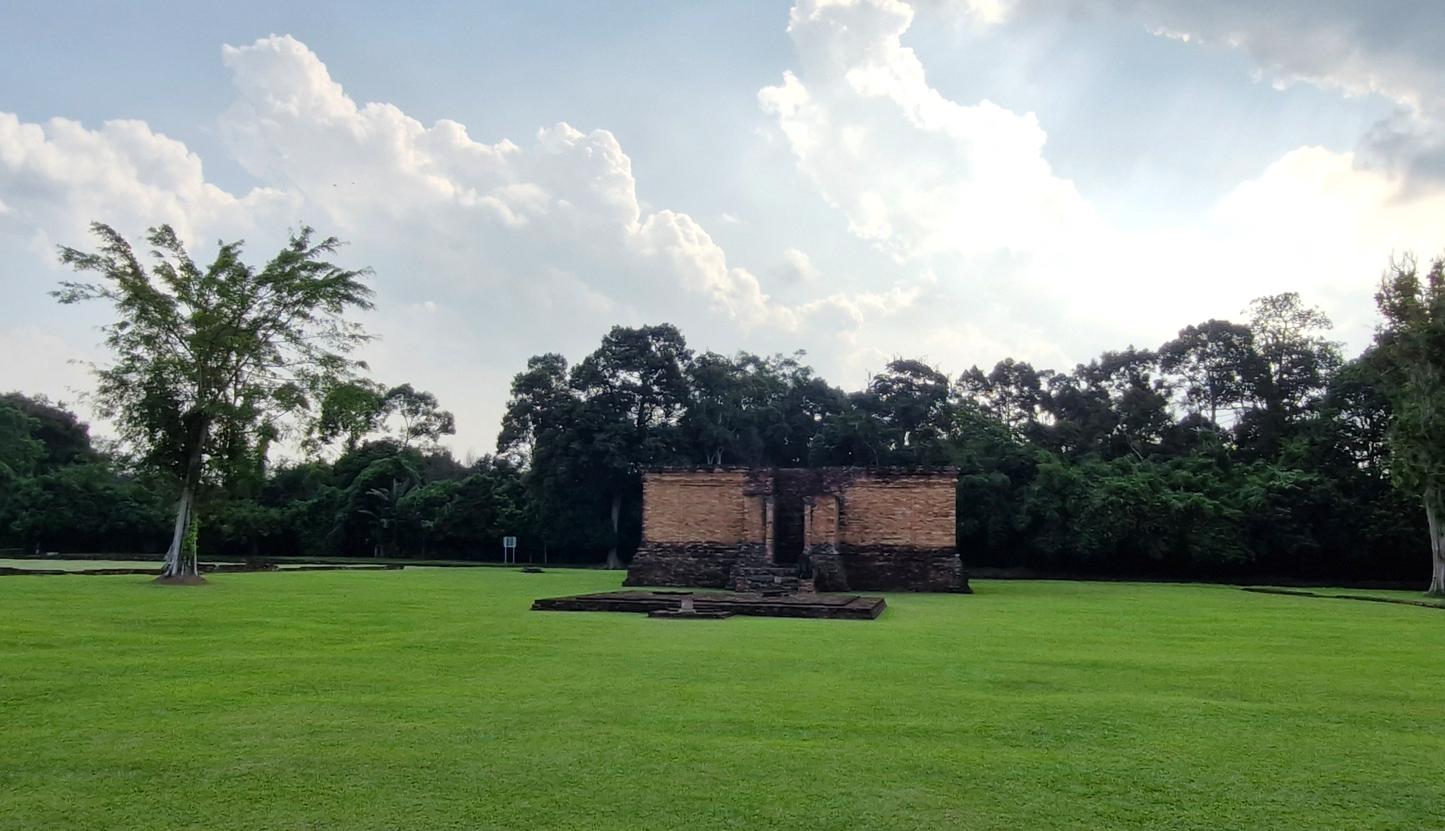
Pramoedya Ananta Toer once wrote of the Minangkabau intellectuals who gave Indonesia’s own revolution its voice — Hatta, Sjahrir, Tan Malaka — that “raised in a tradition of public discourse and egalitarian custom, they knew how to turn words into weapons of liberation.” Travelling their homeland, and the wider Melayu world that radiates outward from it along the Strait, I came away thinking the weapon was never really words alone. It was the corridor itself: the water, the rice terraces, the coal seams and temple mounds and royal graves and durian stalls and mosque volunteer guides, all strung along one continuous, unbroken line of contact. The Minangkabau and their Melayu cousins have spent fourteen centuries learning to walk it, back and forth, without ever quite calling it a border.
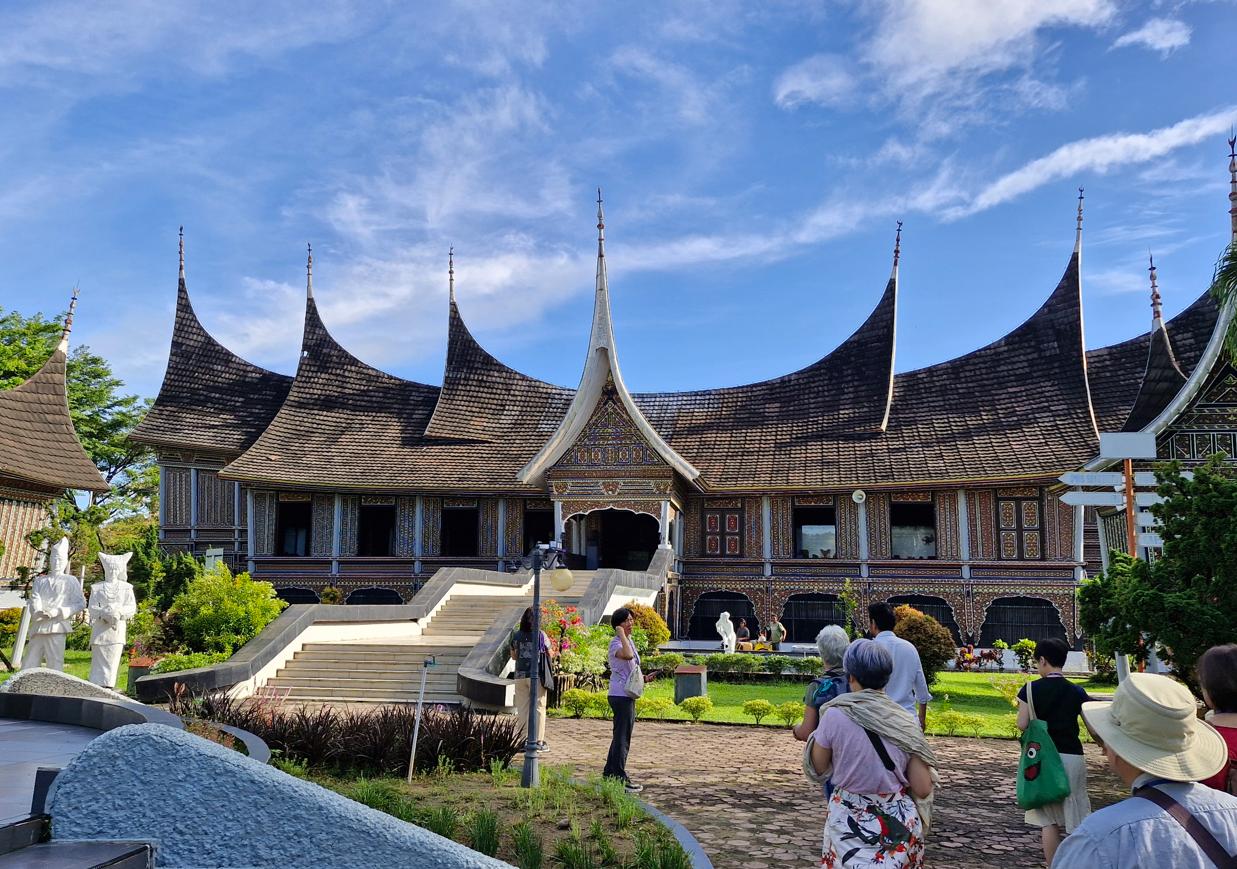
Every rumah gadang I passed on this trip still wore that same upswept roofline: horns raised against the sky, in memory of a calf too small to win the fight it was never meant to survive. Manang kabau — the buffalo has won — not through strength, but through knowing the ground it stood on better than the invader did. Andaya calls this whole world leaves of the same tree. I would put it more plainly. It is a corridor that has always known exactly where its own advantage lay, and a people who, fourteen centuries on, are still walking it under the buffalo’s horns.
Return to the series overview to explore all chapters, maps, and photo essays across Sumatra.